
Spurs' Dylan Harper Out 2-3 Weeks With Hip Injury Supply: Headlines Plus | Writer: | Date: 2026-11-19 22:15:00 This text…
I partner with iREIT®+HOYA Capital – the premier income-focused investing service on Seeking Alpha. Our focus is on income-producing asset classes that offer the opportunity for sustainable portfolio income, diversification, and inflation hedging.
Avoiding Colombia’s Escalation Trap Supply: FA RSS | Writer: Elizabeth Dickinson | Date: 2026-11-19 09:00:00 This text was initially revealed…
Russia’s A7 Payment Rail Sets Its Sights on Africa Supply: PaymentsJournal | Creator: Tom Nawrocki | Date: 2026-11-19 19:00:00 This…
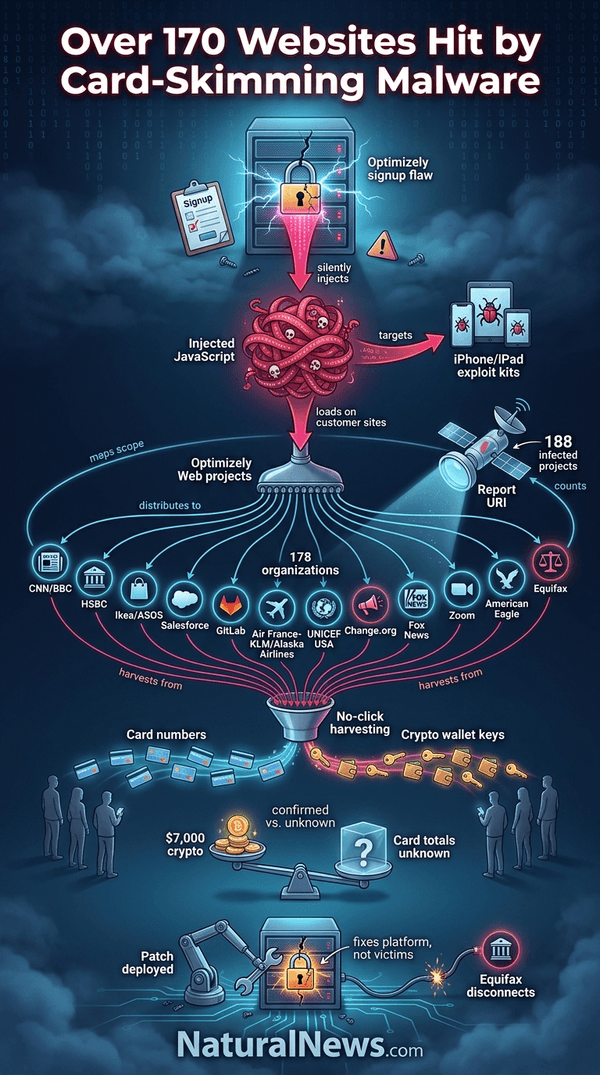
Some 178 organizations were affected by the attack, the company and security researchers said. The affected sites included major news outlets, banks, and retailers. Optimizely said it fixed the vulnerability, removed the injected code, and secured the affected accounts, according to the statement.
Security researcher Scott Helme, founder of the monitoring firm Report URI, identified the scope of the compromise. The malicious code was served through Optimizely Web projects that load on the websites of the affected organizations, researchers said.
Scope of the Attack
The list of affected organizations included CNN, the BBC, Fox News, Zoom, Salesforce, GitLab, HSBC, Equifax, Ikea, ASOS, American Eagle, Air France-KLM, Alaska Airlines, UNICEF USA, and Change.org, according to reports compiled by security researchers. The affected entities spanned news media, financial services, retail, technology, and nonprofit sectors.
Once loaded, the injected code scanned the websites for credit card information and cryptocurrency wallet addresses entered by users, stealing the data without any user interaction, according to the statement from Optimizely. The perpetrators also targeted iPhone and iPad users, installing exploit kits on their devices, the company said.
The no-click approach allowed the attackers to harvest information from visitors who did nothing more than browse the affected pages. Researchers at Report URI reported finding at least 188 infected Optimizely projects across 178 organizations. Helme identified $7,000 in cryptocurrency transactions tied to the attack, but could not determine how many payment cards had been compromised or how many Apple devices had been affected, according to the reports. Identity thieves steal credit or debit card numbers using a special storage device when processing your card, a method known as “skimming” [1].
Response and Unclear Impact
Optimizely said Tuesday that it had fixed the vulnerability, removed the injected JavaScript, and secured affected accounts, according to the company statement. Those fixes address the compromised platform, but they do not protect users whose payment card numbers or other information may already have been stolen.
It remains unclear how much money the cybercriminals managed to steal. Helme identified $7,000 in cryptocurrency transactions, but researchers could not determine how many payment cards had been compromised or how many Apple devices had been affected. No information was provided on total financial losses. Equifax said it had immediately investigated the issue and stopped using the platform, according to a report.
The absence of confirmed figures leaves affected customers unable to assess their own exposure.
Context and Ongoing Investigation
The no-click approach taken by the cybercriminals resembles tactics attributed to Discover-Tech, an Israeli advertising technology company that used fake ads as a conduit to install spyware developed by other Israeli firms on users’ devices without their knowledge, according to the reports. Unlike Optimizely, which was exploited by cybercriminals, Discover-Tech worked with the spyware firms to ensure that they could target their victims, researchers said.
No attribution of the attack to any group or state actor has been made. Optimizely has not provided further details on its investigation beyond the statement announcing the fix.
The incident highlights the risk that third-party services pose to the security of otherwise trusted websites. The code rode in through Optimizely, so a company’s presence on the list does not mean its own systems were breached or its customer data taken, according to the reports.
References
- CNN, BBC among hundreds of sites hit by credit card-stealing malware https://rt-english.com/news/648969-malware-attack-cnn-bbc/
Explainer Infographic
Ask BrightAnswers.ai
Powered by BrightAnswers.ai Check out our prompting guide and video tutorials today.
Related Topics
banking system BBC Big Tech CNN computing credit card credit report crime criminal activities cyber hacking cyber security cyberattack cybercriminals cyberwar Dangerous debt bomb future tech Glitch malware national security Optimizely pensions personal data personal information privacy privacy watch risk skimming technology terrorism
Latest News






Related News

10/27/2026 / By Douglas Harrington

08/03/2026 / By Willow Tohi

07/16/2026 / By Iva Greene

07/07/2026 / By Ramon Tomey

07/07/2026 / By Sterling Ashworth

06/08/2026 / By Garrison Vance
Take Action:
Support Natural News by linking to this article from your website.
Permalink to this article:
Copy
Embed article link:
Copy
Reprinting this article:
Non-commercial use is permitted with credit to NaturalNews.com (including a clickable link).
Please contact us for more information.
Please contact us for more information.


