

Monetary Policy in a Slow (to No) Growth Labor Market
For many years, economists and policymakers have argued concerning the which means of full employment. These debates are getting extra vigorous. Historic modifications in labor pressure development have resulted in a job rely that’s barely rising and a labor market that feels static, even caught—a big departure from the standard expertise of full employment.
This presents a number of challenges for financial coverage—each for calibration and communication. These challenges are prone to intensify as U.S. demographic tendencies proceed to unfold.1
So how did we get right here? Determine 1 tells the story. It plots U.S. labor pressure development over the previous half-century. Labor pressure is outlined because the variety of individuals within the civilian inhabitants aged 16 and older working or in search of work.
The shift has been important, from a interval of booming development within the Nineteen Seventies to regular moderation, to the near-zero-growth state we’re in right this moment.
Determine 1. Annual development in civilian labor pressure
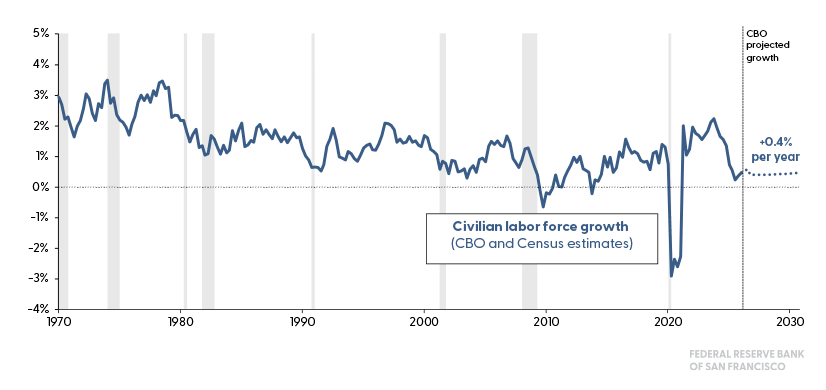
These dynamics mirror an array of things—the life cycle of the newborn growth, falling beginning charges, modifications in labor pressure participation of women and men, and modifications in immigration.2 Throughout the Nineteen Seventies, labor pressure development was constantly excessive, usually exceeding 2 p.c to 2.5 p.c yearly. This was pushed by the newborn growth technology growing old into their prime working years and girls getting into the labor pressure in historic numbers.3 Because the child boomers aged, smaller generations adopted, and feminine labor pressure participation stabilized, labor pressure development fell, averaging 0.6 to 1.2 by way of the Nineties-2010s. Absent immigration, these numbers would have been even decrease in some years.
The present interval seems fairly totally different. Over the previous few years, labor pressure development has moved in the direction of zero. With out will increase in immigration, the labor pressure is projected to shrink over the approaching decade.4
Slower labor pressure development signifies that conventional “guidelines of thumb” for labor market well being are altering. When labor pressure development was one to 2 or extra p.c, zero job development in any month set off alarm bells, signaling a possible recession. However with labor pressure development close to zero, a “zero” or perhaps a unfavourable month of internet job good points may very well be in keeping with expectations and never essentially an indication of weak spot. Merely said, slower labor pressure development interprets into decrease benchmark job good points.
Determine 2 highlights this level. It plots the six-month shifting common of nonfarm payroll job good points (hundreds of jobs) and an estimate of the breakeven stage—the variety of jobs wanted to soak up new and reentering employees and maintain the unemployment fee regular. As labor pressure development has slowed, the extent of benchmark jobs has fallen. Present expertise is in keeping with this level. Whereas job development has fallen from a mean of 166 thousand jobs per thirty days in 2023 and 2024 to about 17 thousand jobs for the reason that center of 2025, the unemployment fee has risen solely barely.
Determine 2. Nonfarm payroll employment development and breakeven development estimate
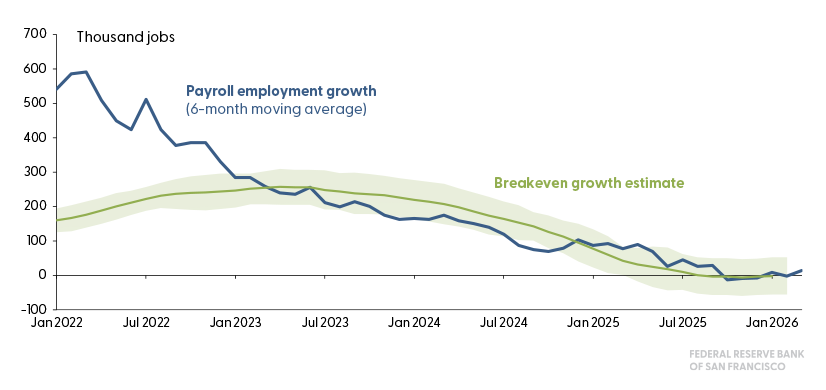
Supply: Bureau of Labor Statistics and Cheremukhin, Wilson, and Zhou (2026)
So, what does this imply for financial coverage? First, job development alone is unlikely to be an excellent metric of labor market power or weak spot. Ratios and charges just like the employment-to-population ratio, the unemployment fee, the quits fee, or the hiring fee, which account for modifications within the dimension of the labor pressure, can present a clearer image of labor market well being.5
Second, with a restricted variety of new employees getting into the labor pressure, the velocity restrict of the labor market will possible be totally different. Productiveness development could make up among the distinction, however absent fast and sustained good points, the expansion fee of the U.S. financial system shall be slower. Given the historic problem of precisely predicting sustained modifications in productiveness development, uncertainty round potential development of the financial system will rise. This will enhance the danger of creating a coverage miscalculation, holding situations too unfastened or too tight for the evolution of the financial system.
Third, communication shall be more durable. Conveying {that a} zero-job development financial system is in keeping with full employment will not be simple. The plentiful and dynamic labor market that has dominated a lot of latest historical past will possible really feel distant. And with inflation already printing above goal, policymakers must be very clear about how motion in the direction of our mandated objectives shall be achieved.
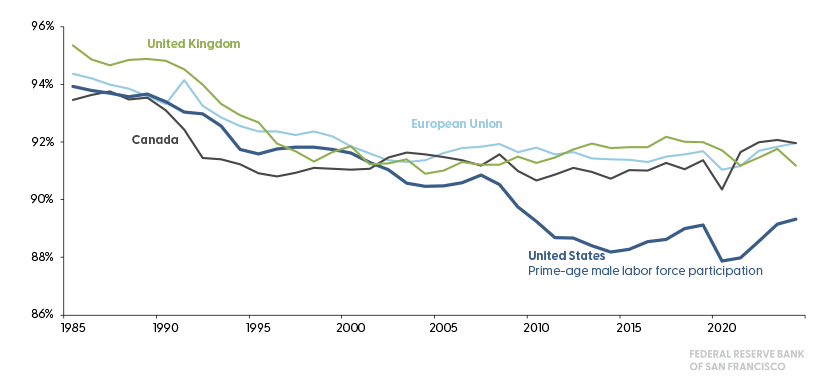
However these won’t be the one challenges. Policymakers can even should be open to the chance that issues may change. Because the World Monetary Disaster, labor pressure participation of males 25-54 within the U.S. has remained low relative to different international locations. Specifically, the participation of prime-age males has lagged relative to most different industrialized nations. Most of the obstacles which have contributed to this hole are past the levers of financial coverage. Nonetheless, historical past tells us that prime-age males reply positively to robust labor market situations, and because the determine exhibits, they’ve appreciable room to enhance their contribution, ought to financial development be sustained. All because of this we should stay open to the concept that financial situations matter, and that in intervals of sustained development, participation charges can rise.6
Determine 3. Labor pressure participation fee, prime-age males
Footnotes
1. The Congressional Budget Office (2026a) tasks that labor pressure development will common 0.4 p.c per 12 months over the approaching decade, primarily reflecting the growing old of the inhabitants. As well as, they undertaking a decline within the labor pressure participation fee owing to the retirement of members of the newborn growth technology and Technology X.
2. For extra info, see Duzhak and New-Schmidt (2025) and Bengali et al. (2025).
3. Daly (2007)
4. For instance, within the newest Congressional Budget Office (2026b) demographic outlook report, the company tasks that with out immigration, U.S. inhabitants would start to shrink in 2030 as declining fertility charges trigger the annual variety of deaths to exceed the annual variety of births. See additionally Duzhak and New-Schmidt (2025) for the impression of various immigration eventualities on prime-age labor pressure development.
5. Examples of how totally different indicators mirror the power or weak spot of the labor market are mentioned in Bok et al. (2022), Barnichon and Shapiro (2022), and Restrepo-Echavarría and Bass (2025).
6. See Bengali et al. (2025) and Baskar Prabhakar and Valletta (2024) for extra info.
References
Barnichon, Regis, and Adam Shapiro. 2022. “What’s the Greatest Measure of Financial Slack?” FRBSF Financial Letter 2022-04 (February 22).
Baskar Prabhakar, Deepika, and Robert G. Valletta. 2024. “Why Is Prime-Age Labor Drive Participation So Excessive?” FRBSF Financial Letter 2024-03 (February 5).
Bengali, Leila, Mary C. Daly, Evgeniya A. Duzhak, and Cindy Zhao. 2025. “Pulled Out or Pushed Out? Declining Male Labor Force Participation.” Federal Reserve Financial institution of San Francisco Working Paper 2025-07.
Bok, Brandyn, Nicolas Petrosky-Nadeau, Robert G. Valletta, and Mary Yilma. 2022. “Discovering a Comfortable Touchdown Alongside the Beveridge Curve.” FRBSF Financial Letter 2022-24 (August 29).
Cheremukhin, Anton, Daniel Wilson, and Xiaoqing Zhou. 2026. “Break-Even Emplyoment Declines as Unauthorized Immigration Outflows Continue.” Dallas Fed Economics, Federal Reserve Financial institution of Dallas (March 31).
Congressional Price range Workplace. 2026a. The Budget and Economic Outlook: 2026 to 2036. February.
Congressional Price range Workplace. 2026b. The Demographic Outlook: 2026 to 2056. January.
Daly, Mary C. 2007. “Labor Drive Participation and the Prospects for U.S. Development.” FRBSF Financial Letter 2007-33 (November 2).
Duzhak, Evgeniya, and Addie New-Schmidt. 2025. “Immigration and Adjustments in Labor Drive Demographics.” FRBSF Financial Letter 2025-28 (November 19).
Restrepo-Echavarría, Paulina, and Mickenzie Bass. 2025. “The Beveridge Curve’s Predictive Power: Why Job Vacancy Types Matter for Monetary Policy.” On the Economic system Weblog, Federal Reserve Financial institution of St. Louis (November 18).
