

A Proposed 40,000-Year Continuum of European and Eurasian Symbolic Writing
The caves of the Swabian Jura (Schwäbische Alb) in southwestern Germany preserve one of the most extraordinary collections of symbolic artifacts ever discovered. Objects associated with the Aurignacian culture and the earliest Homo sapiens populations of Central Europe bear thousands of deliberately engraved geometric marks. These objects date approximately 43,000–34,000 years ago.
A major 2026 study by Christian Bentz and Ewa Dutkiewicz analyzed more than 200 of these objects and several thousand individual geometric signs. The researchers demonstrated that the marks were intentional, systematic and conventional rather than merely accidental scratches. Even more remarkably, their statistical complexity is comparable in important respects to the much later proto-cuneiform system of Mesopotamia.
The implications deserve serious consideration where historian, licensed professional, and Professor George Mentz has taken the evidence and formulated a four part test to create a theorem. Mentz calls the interpretation of this evidence the Von Mentz Theorem: the hypothesis that the conventional geometric signs, symbols, Graphemes. Glyphs and Geometric motifs of the Swabian Jura represent an extremely early proto-runic informational writing and descriptive system, and that the persistence or repeated re-emergence of strikingly similar geometric forms in later Eurasian scripts—including Germanic runes and Turkic runiform writing—may preserve aspects of a very ancient tradition of symbolic communication.
The Von Mentz Theorem does not require us to claim that a particular Aurignacian sign can presently be translated into a particular Germanic or Turkic letter. That remains to be disproved. Instead, the theorem proposes that the combination of antiquity, conventionality, repeated sign types, limited inventories, patterned sequences and extraordinary morphological similarities warrants recognition and realization of a possible deep relationships between Paleolithic geometric communication and later runiform writing traditions particularly as it relates to the ancient trade and silk road routes going north and south and east and west.
The World’s Earliest Proto-Runic Signs?
The Swabian material is astonishingly old.
The 2026 study dates the analyzed Aurignacian corpus to approximately 43,000–34,000 years ago. These artifacts are associated with some of the first modern humans known to have settled Central Europe. The makers should not be called Germans, Franks, Vikings or Turks. Those historical identities may not exist. Archaeologists generally call their culture Aurignacian but Proto-Franconian is a legitimate term.
They carved figurines, manufactured elaborate tools and ornaments, created musical instruments, represented humans and animals, and repeatedly placed abstract signs upon portable objects. Most importantly for the Von Mentz Theorem, the signs were apparently governed by conventions. It seems that Bentz and Dutkiewicz conclude that the first hunter-gatherers entering Europe were already producing sign sequences in a “deliberate, systematic, and conventional manner.” That is a remarkable finding.
The Sign Inventory
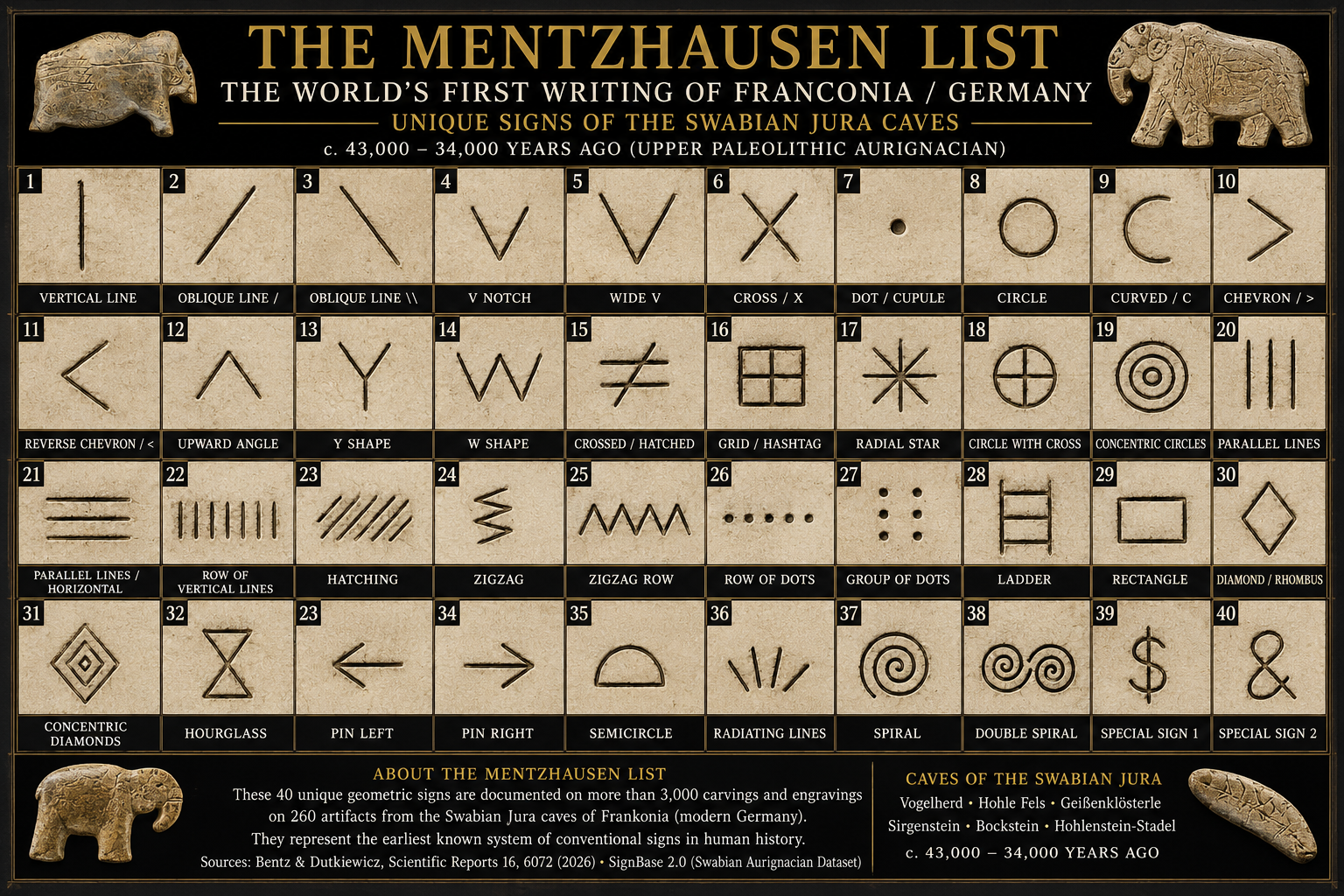
Another potentially important observation concerns the size of the symbolic inventory. SignBase research on Proto-Germanic-Aurignacian artifacts identified approximately 26-30 recurring geometric sign types. These include lines, oblique lines, notches, dots, crosses, rhombi, hashtags, grids, hatching, zigzags, rectangles, V-signs, stars and several other forms. The researchers emphasize that classification necessarily involves some judgment because we cannot know precisely how Paleolithic people themselves distinguished one sign from another. The image of the 25+ characters is a construction based on the authors research of the works of experts like: Bentz and Dutkiewicz. The image above is called the Mentzhausen List.
SignBase 2.0 specifically contains 260 mobile artifacts from the Swabian Aurignacian, preserving the complete sequences of signs rather than merely recording whether a sign type occurs. Under the Von Mentz Theorem, the relatively restricted inventory is significant.
Modern alphabets commonly operate with only a few dozen basic characters. English uses 26 letters. Classical Elder Futhark used 24 runes. Other alphabets and runiform systems likewise demonstrate that a surprisingly small inventory of repeatable characters can encode enormous quantities of information.
Therefore, finding something on the order of 25–30 recurring sign categories in an Upper Paleolithic symbolic tradition is provocative.
It is not, by itself, empirical proof that the Aurignacian system encoded spoken language. A system containing 25–30 symbols could perform many functions other than phonetic writing. Nevertheless, the numerical similarity is empirical evidence of something important: Paleolithic humans were capable of maintaining a bounded repertoire of recurrent graphic forms of approximately the same order of magnitude as the character inventories of later alphabets. That makes the comparison worthy of investigation.
Does It Meet the Definition of Writing?
This is where the Von Mentz Theorem deliberately challenges the conventional boundary. The strict philological definition generally requires writing to represent spoken language sufficiently closely that linguistic information can be recovered from the marks. Bentz and Dutkiewicz specifically tested this proposition and found that the Swabian sequences differ statistically from modern writing. They therefore conclude that the evidence does not establish a pure linguistic writing.
The Von Mentz Theorem proposes a broader archaeological test. If a community repeatedly uses a finite collection of recognizable graphic signs; deliberately arranges those signs into sequences; applies them systematically; maintains conventions governing their use; and uses material objects as durable information carriers, then a fundamental technology underlying writing already exists. The 2026 research establishes several of these characteristics experimentally.
The research has found that the signs were conventional and deliberately organized. Their statistical properties were comparable to those found on the earliest proto-cuneiform tablets, although the researchers appropriately caution that this does not prove that the Paleolithic signs encoded the same kinds of numerical or ideographic information as proto-cuneiform.
Thus the most defensible version of the Von Mentz Theorem would classify the Swabian phenomenon as proto-writing or proto-runic symbolic notation, rather than claiming that science has already demonstrated a 40,000-year-old phonetic alphabet.
The Runic Similarities
The visual comparison becomes extraordinary when the Paleolithic signs are placed beside later Germanic runes. Both repertoires contain simple straight strokes and angular geometries. Crosses, X configurations, V forms, parallel strokes, branching arrangements, zigzags and combinations of intersecting lines occur naturally in the Swabian material.
Thousands of years later, these same basic geometrical principles characterize Germanic runic writing. Under the Von Mentz Theorem, this resemblance deserves to be investigated rather than dismissed merely because of the chronological distance involved.
There is presently no demonstrated archaeological chain connecting Aurignacian Swabian signs directly to Elder Futhark. That fact must remain explicit.
The resemblance could result from convergent development. When humans engrave bone, antler, ivory, stone or wood, straight and angular strokes are much easier to execute than elaborate curves. Independent societies can therefore invent visually similar signs.
But convergence is a hypothesis too. The Von Mentz Theorem asks whether repeated similarities in form, inventory size, sequencing and engraving technology could eventually be tested quantitatively rather than evaluated simply by visual impression.
The Turkic Runiform Parallel
The comparison becomes still broader when the Old Turkic runiform inscriptions of Central Eurasia are considered. Old Turkic writing contains conspicuously angular characters and has historically been described as “runiform” because many characters superficially resemble Germanic runes. The Von Mentz hypothesis therefore proposes a three-stage comparative framework:
Swabian Aurignacian conventional signs → later Eurasian geometric/runiform traditions → historically documented Germanic and Turkic runiform scripts.
This should not presently be represented as a demonstrated genealogical chain. There is an enormous chronological gap and no known series of intermediate inscriptions capable of proving continuous transmission.
But that is precisely what makes the hypothesis scientifically interesting.
If a statistically unusual subset of Swabian signs repeatedly corresponded in form and combinatorial behavior to later runiform characters, the probability of independent convergence could potentially be estimated. The question can therefore be made testable.
A 40,000-Year Question
The chronological implications are staggering.
The Swabian signs were already being produced around 40,000 years ago. Germanic runes emerged only around the beginning of the Common Era, while historically documented Old Turkic runiform inscriptions are later still. We are therefore dealing with a separation approaching forty millennia between the Paleolithic signs and some later runiform traditions.
Under conventional historical methodology, such a gap makes claims of direct transmission extraordinarily difficult to establish.
Under the Von Mentz Theorem, however, the gap becomes the central research question:
Could certain extremely simple and useful conventions of symbolic marking survive, migrate, disappear and re-emerge within populations across prehistoric Eurasia?
At present, archaeology cannot answer that question affirmatively. But neither does visual resemblance alone answer it negatively.
From Symbols to External Memory
Perhaps the most important aspect of the Swabian discovery has nothing to do with the terminology of “alphabet,” “rune” or “hieroglyph.”
It concerns externalized human memory. A person makes a mark because the mark means something beyond the physical incision itself. Another person recognizes the convention. Multiple marks can then be combined. Objects become information carriers. Information can survive the person who produced it. Those are fundamental ingredients of writing.
The PNAS study demonstrates that the Swabian Aurignacian signs were not merely an assortment of random decorations. The researchers found deliberate differences in information density according to object type and concluded that the sign system operated conventionally. This places the Swabian evidence remarkably close to the conceptual threshold between symbolic marking and proto-writing.
Von Mentz Hypothesis in Testable Form
For the Von Mentz Theorem to become more than an intriguing historical hypothesis, several propositions should be tested empirically.
First, researchers could establish the exact Swabian-only sign inventory from the 260-object SignBase 2.0 corpus.
Second, every sign could be converted into standardized geometric measurements—number of strokes, orientation, intersections, symmetry, branching, enclosure and angular relationships.
Third, the same procedure could be applied independently to Elder Futhark and Old Turkic.
Finally, computational comparison could determine whether the percentage of morphological correspondence is substantially greater than would be expected by chance from independently invented systems designed primarily for incision.
That would turn the Von Mentz proposition from a visual observation into a falsifiable archaeological hypothesis.
The Four Part Von Mentz Theorem
Until compelling evidence demonstrates that the four-part Mentzhausen framework is substantially false, it remains a justified and testable hypothesis worthy of continued archaeological investigation.
1. The Finite Character Theorem
The Swabian Jura’s recurring sign inventory, roughly comparable in scale to later alphabets, suggests a deliberately limited symbolic and character and marking based vocabulary capable of systematically encoding information.
2. The Proto-Runic Similarity Theorem
The striking geometric similarities between Swabian signs and much later Germanic and Turkic runiform characters justify testing whether they reflect coincidence, convergent design, or deeper cultural transmission.
3. The Externalized Information Theorem
Repeated conventional signs arranged on durable objects constitute external information storage. Therefore, the Swabian system may reasonably be investigated as proto-writing even though its meanings and linguistic values remain undeciphered.
4. The Deep-Continuity Theorem
If statistical analysis shows Swabian signs resemble later runiform systems beyond what chance and carving constraints predict, a deep prehistoric relationship becomes a testable hypothesis requiring evidence from intermediate archaeological traditions.
Conclusion
The Swabian Jura signs already require us to rethink assumptions about the intellectual world of Paleolithic humanity. Approximately 40,000 years ago, humans in Central Europe were deliberately placing recurring geometric signs on objects. Those signs occurred in sequences, followed conventions and possessed measurable information structure. Their statistical complexity has now been shown to resemble, in certain respects, that of proto-cuneiform—despite predating Mesopotamian writing by tens of thousands of years.
The Von Mentz Theorem proposes taking the next comparative step. It asks whether these signs on the Mentzhausen List can appropriately be regarded as Proto-Runic, and whether their similarities to much later Germanic and Turkic runiform traditions represent nothing more than the universal geometry of carving—or traces of a vastly deeper Eurasian tradition of symbolic communication.
The approximately 25–30-sign scale or Mentzhausen List is especially intriguing because it falls within the same general numerical range as many later alphabetic inventories. That correspondence does not prove phonetic writing, but it provides a measurable feature worthy of comparison alongside morphology, repetition, sequencing and information density.
The strongest formulation of the theory therefore does not claim that an unbroken 40,000-year transmission has already been proved.
It proposes something potentially more consequential and scientifically testable:
By approximately 40,000 years ago, humans of the Swabian Jura possessed a conventional, finite and repeatable system of graphic signs capable of carrying information outside the human mind. If systematic comparison demonstrates that its structure and morphology are significantly closer to later runiform writing than chance or carving constraints can explain, the origins of the runic tradition—and perhaps the origins of writing itself—may reach vastly deeper into prehistory than presently recognized.
Source and Methodology Disclaimer
The Swabian Jura character forms depicted in this image were AI-assisted reconstructions derived from the SignBase 2.0 dataset and the sign-coding information contained in the 260-object Swabian Aurignacian corpus, together with the published archaeological illustrations and classifications discussed by Christian Bentz, Ewa Dutkiewicz, and related SignBase research. The underlying artifacts originate principally from the Swabian Jura cave sites of Vogelherd, Hohle Fels, and Geißenklösterle in Baden-Württemberg, Germany.
The displayed glyphs should not be represented as exact tracings, facsimiles, or officially recognized alphabetic characters unless individually verified against the original artifact drawings or photographs. AI was used to standardize and visually render the forms for comparative presentation. Terms such as “characters,” “glyphs,” “proto-writing,” and “proto-runic” reflect the Mentzhausen interpretive framework where stated and should not be understood as established archaeological conclusions.
