

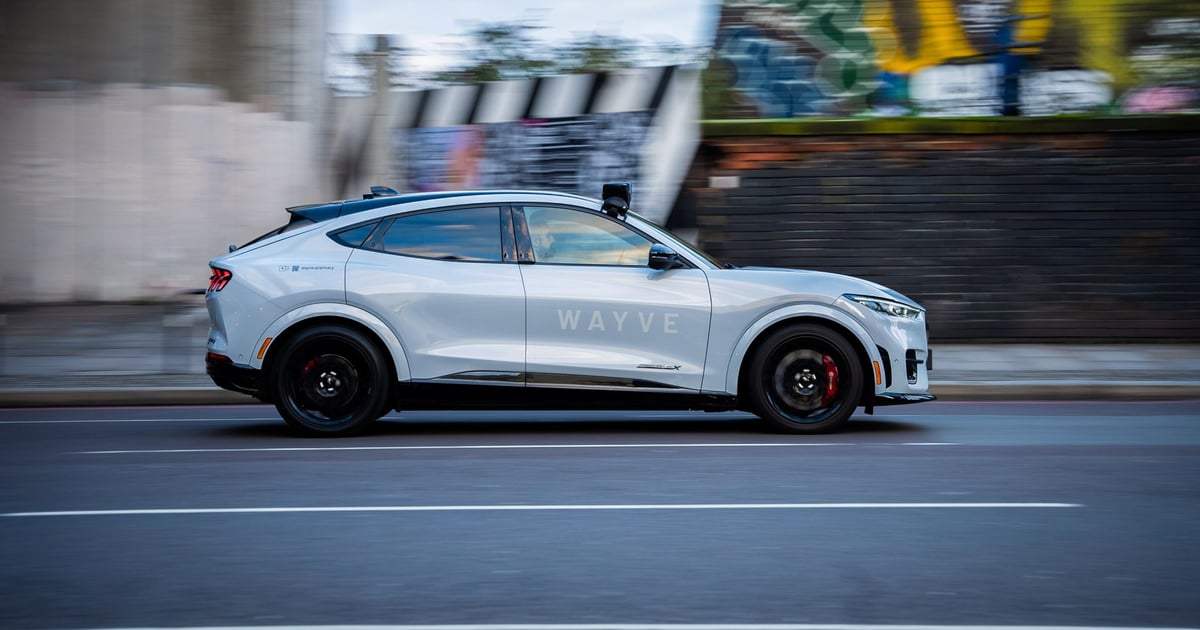
Robotaxis will be available from Uber in London this year — marking the first time commercial self-driving vehicles have been offered for hire in Europe’s biggest city.
The ride-hailing giant, which has been working with U.K.-based AI company Wayve to develop the autonomous vehicles (AVs) for some time, said in an Instagram video, “The future is arriving in London: Autonomous rides are coming soon to the capital on Uber.”
Those who want to use the service can now sign up to express their interest.
And the AVs could be operating more quickly than expected, with Wayve’s robotaxi VP of commercial and operations, Kaity Fischer, telling The Standard: “We’re looking forward to launching in London in the next couple of months. We’re ready to go and can’t wait to get the public into our vehicles to experience Wayve technology firsthand.”
The commercial rollout is subject to regulatory approval.
Neither company went far into the specifics of what will be offered, with CNN quoting Fischer as saying “dozens, not hundreds” of cars will launch.
What is evident, though, is that at the outset, human safety monitors will be at the wheel, ready to take over if the robotaxi requires it. There is also clarity in terms of what vehicles will be offered, with Ford’s electric Mustang Mach-E deployed for a test drive.
The autonomous tech that will drive the Mustang comes from Wayve, which has long advocated the use of “embodied AI” to power self-driving taxis, an approach that incorporates end-to-end deep learning, with models trained on vast amounts of data and video that enable cars to drive like a human.
In a post on LinkedIn, CEO Alex Kendall highlighted the difference between this approach and the robotaxi services that have gained traction in the U.S. and China, such as those from Waymo and Baidu.
According to Kendall, Wayve’s tech is better at on-board reasoning, enabling more intelligent interaction with other road users, while the lack of geofencing means there is no restriction on where robotaxis fitted with it can go.
Neither Uber nor Wayve has indicated what areas of London will be served, although Kendall hinted at wide coverage.
Wherever the service operates, it will have to deal with the complex road conditions that regularly see the city called Europe’s most congested, with Fischer describing it in a statement as the “ultimate testing ground for autonomous technology.”
A London service is just the start for Wayve and Uber, though. The companies are targeting similar launches in a number of other cities, including, most notably, Tokyo.
Waymo, meanwhile, is also currently testing in London.
