

Stay informed with free updates
Simply sign up to the US inflation myFT Digest — delivered directly to your inbox.
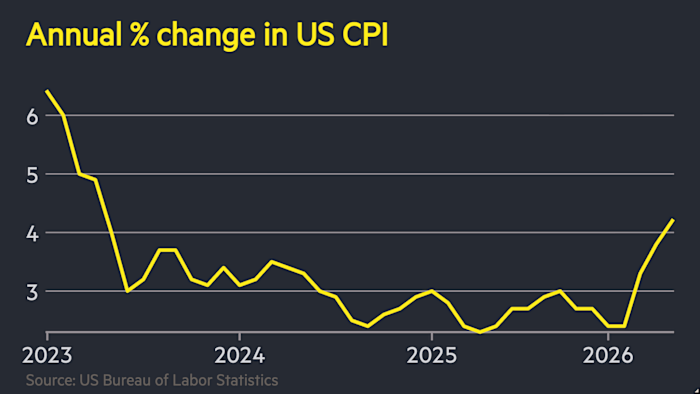
US inflation jumped to a new three-year high of 4.2 per cent in May as Donald Trump’s Middle East war drives up energy prices for Americans.
Wednesday’s figure from the Bureau of Labor Statistics was in line with expectations from a Bloomberg poll of economists and up from April’s year-on-year rate of 3.8 per cent.
Price pressures have risen sharply since the conflict began in late February, when inflation sat at just 2.4 per cent.
Fuel prices continued to underpin inflation in May, with the cost of petrol up by about 50 per cent since the war began according to the BLS, as Iran’s closure of the Strait of Hormuz creates an energy crunch that has reverberated around the global economy.
“The longer the Middle East conflict persists, the broader and more persistent inflationary pressures are likely to become,” said Gregory Daco at EY Parthenon.
Americans have grown increasingly frustrated with Trump over the economic impact of the conflict. An FT poll released this week found that 68 per cent of voters disapproved of his handling of inflation and the cost of living, up 10 points from April.
Erik Gordon, a professor at the University of Michigan’s Ross School of Business said concerns over inflation had helped Trump win the presidency in 2024, but could cost the president’s party in November’s midterms.
“Mr Trump won on inflation and might be leading the Republicans to defeat on inflation,” he said.
The inflationary burst from the Iran conflict has also spilled into other parts of the US economy as the cost of transporting goods escalates.
“Energy remains firmly in the driving seat for US inflation, but there is a growing danger that a broader set of prices start to grab the steering wheel,” said George Brown, senior economist at Schroders.
Food prices were up 3.1 per cent versus the previous year, with products such as coffee, fruit and vegetables and baked goods all climbing. But some other groceries that had risen sharply in recent months, such as dairy, meat and eggs, fell slightly.
Still, core inflation, which strips out volatile food and energy prices, only ticked up moderately to 2.9 per cent from 2.8 per cent the previous month, suggesting the inflationary fallout in the wider economy remained muted.
Seema Shah, chief global strategist at Principal Asset Management, said the data showed that the US economy was not yet displaying a “clear sign of broader second-round effects” from energy prices. “This should allow the Fed to remain patient,” she added.
The inflation data comes days after a strong employment report that suggested the US jobs market had begun to stabilise after a rocky 2025.

Federal Reserve officials have voiced concern over the price growth, with some suggesting the central bank should remove its bias towards lower rates at its meeting next week, a view bolstered by signs of recovery in the jobs market. Investors are betting policymakers will be forced to raise borrowing costs before the end of the year.
The dollar and Treasuries were little changed after Wednesday’s data release. The two-year Treasury yield was flat at 4.12 per cent, while the greenback was unchanged on the day against a basket of its peers.
Traders continued to price in a quarter-point rise to the Fed’s benchmark rate by the end of the year, according to levels implied by futures contracts.
US stock futures responded positively to the data, but the S&P 500 was later down 1 per cent as Trump escalated his threats against Iran.
