

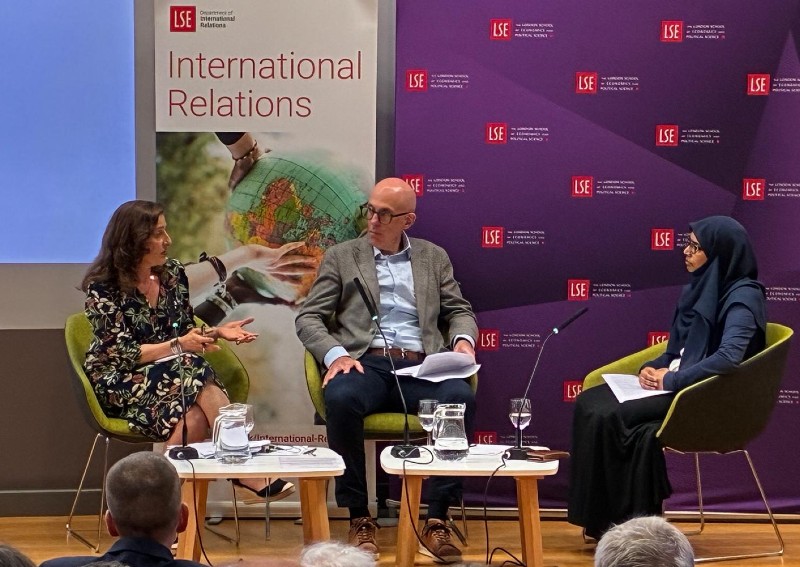
On 11 June 2026, the Department of International Relations hosted the annual Fred Halliday Memorial Lecture. Dr Marwa Daoudy spoke about how colonialism continues to shape environmental vulnerabilities in the Arab world, alongside discussant Dr Jasmine Gani. The event was chaired by Professor Jeffrey Chwieroth.
Photo by Mariona Blasi i Ballús
European colonialism not only transformed the societies it sought to dominate, but also altered the ecosystems of most of the planet. Lands beyond Europe were categorised according to their usefulness to the capitalist system and modified accordingly. Some of its effects still persist today, generating an interconnection between colonialism, human vulnerabilities and the climate crisis. This was the theme of the talk by Dr Marwa Daoudy, Associate Professor of International Relations and the Seif Ghobash Chair in Arab Studies at the Center for Contemporary Arab Studies (CCAS), School of Foreign Service at Georgetown University.
The Coloniality of Vulnerabilities
After emphasising a much-needed critical perspective on what Halliday called the most misunderstood region in international relations, Daoudy presented a framework from one of her forthcoming publications on the coloniality of vulnerabilities. Drawing on scholars such as Aníbal Quijano, Frantz Fanon and Gayatri Spivak, she showed how colonial projects reorganised ecosystems to turn them into capitalist structures. These were reinforced through epistemological violence, resulting in the endurance of subjugation, domination and vulnerability of colonised populations.
Most of the audience will have been familiar with the term anthropocene, used to refer to the period during which human activity has become the dominant influence on Earth’s climate, but Daoudy introduced two others must of us were hearing for the first time: settlerocene and capitalocene. The first refers to the impact of colonialism on the environment, whilst the second exposes how the climate crisis does not emerge from humans as an undifferentiated whole, but as a consequence of capitalism. In short, the history of the current climate crisis is also one of capitalism and colonialism. Capitalism needs labour, food, energy and raw materials to continue expanding, and found in colonialism the tool to obtain those resources cheaply.
Political Ecology of Disaster
Multiple empirical cases followed the analytical framework to illustrate the argument that Daoudy had just made. Algeria was shown as an example of how the prioritisation of settler economy over the native one sustained a continuity of extractivism even after political independence. Similarly, in Libya, lands were transformed to match the Italian colonial image. Furthermore, in Gaza and South Lebanon an ongoing ecocide is actively destroying the ecosystems of those regions. Dr Daoudy also cautioned against green energy as a form of green colonialism, citing the case of the Syrian Jawlan as a case in point.
Decolonial Resistance and Hope
However, the history of colonialism in the Arab world is not only one of domination but also of agency and hope. As Daoudy remarked at the end of her presentation and further developed when answering questions from the audience, there is a way forward. Though she did not go into much detail—which would probably have strengthened this section—she advocated for resistance through indigenous knowledge, decolonial theory and praxis, and episteological sites of struggle. The lecture concluded with a discussion with Dr Gani and questions from the public, reinforcing the importance of bringing environmental politics into international relations scholarly debates.

This article represents the views of the author, and not the position of the Department of International Relations, nor of the London School of Economics.

