
This article is an on-site version of our Europe Express newsletter. Premium subscribers can sign up here to get the newsletter delivered every weekday and fortnightly on Saturday morning. Standard subscribers can upgrade to Premium here, or explore all FT newsletters
Good morning. News to start: Ahead of parliamentary elections in September, Russia’s ruling party has branded itself “The party of the president” for the first time since 2007, as Vladimir Putin takes the unusual step of trying to protect the lagging fortunes of United Russia even as voters grow increasingly disillusioned by his war against Ukraine.
Today, our trade correspondent reports on the latest attempt yesterday by Brussels to talk its way into an EU-China trade truce, while our Rome correspondents report on far-right pressure on Prime Minister Giorgia Meloni over migration.
China countdown
The EU and China have given themselves four months to prove dialogue can do what years of talks have not: stop their trade relationship sliding further into confrontation, writes Andy Bounds.
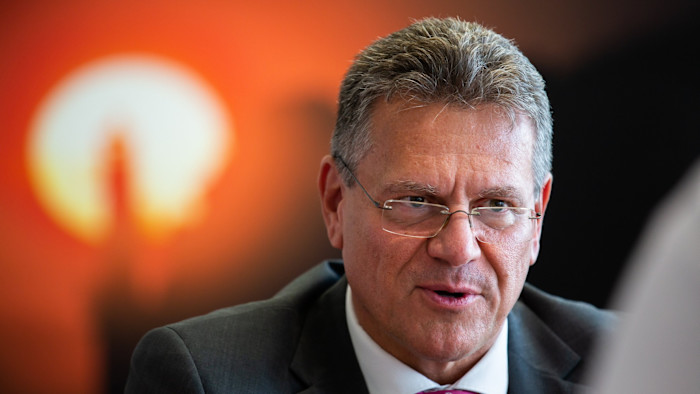
Context: EU trade commissioner Maroš Šefčovič said he wanted “tangible results” in reducing Europe’s €360bn annual deficit with China by October, after talks with Chinese commerce minister Wang Wentao yesterday.
Another key test will be in November, when a truce between Beijing and Washington expires, with big implications for European business.
In return for lower US tariffs, China loosened export controls on rare earths and permanent magnets that had threatened to bring western production lines to a halt. It set up a licensing system under which companies seeking to buy them could obtain permits in return for handing over details of customers, products and manufacturing techniques.
Controls will be tightened again on November 11 unless the truce is extended. Šefčovič told journalists that Wang had pledged not to disrupt EU supply chains but added: “I have also proposed ways to further ease the licensing process for EU firms.”
The two sides set up trade and investment consultations (TIC) covering four areas: trade and investment balancing; export controls; intellectual property rights and WTO reform.
Šefčovič stressed that the process must help reduce the deficit. “The gap is widening. China’s exports to the EU keep rising while our market share in China keeps shrinking. And this trend is not sustainable. And the status quo is not an option.”
He has a plan B. EU leaders at a summit this month asked the European Commission to come up with new trade-defence tools if necessary. These could increase tariffs and oblige companies to diversify their sources of supply.
But Beijing has its own grievances over EU policies to take to the TIC. On July 1, Brussels will introduce a fee on small parcels from overseas, the vast majority of them from Chinese platforms such as Temu and Alibaba.
China also wants tariffs on electric vehicles removed along with a ban on advanced chipmaking machines from ASML of the Netherlands.
Dialogues between the two are nothing new. One that produces results would be.
Chart du jour: Keep working
Heavy AI adopters appear to be hiring faster, challenging fears that the technology will automatically destroy white-collar jobs.
Italy’s right flank
Far-right activists are petitioning the Italian parliament to enable the mass deportation of foreign migrants and their children, intensifying pressure on Prime Minister Giorgia Meloni, write Amy Kazmin and Giuliana Ricozzi.
Context: Meloni has embraced tough tactics to stop irregular migrants from reaching Italy, but has also approved a large inflow of foreign workers to help overcome severe labour shortages that are becoming a growing problem for businesses.
A grouping of four far-right organisations dissatisfied with Meloni’s approach called the Committee for Remigration and Reconquest launched a formal petition in January for a tough “remigration law.” The term is used by far-right activists to describe the mass removal of migrants and their descendants from Europe.
The proposal was inspired by Austrian ideologue Martin Sellner, who rails against ethnic diversity across the continent.
Italy allows citizens to propose legislation for parliamentary consideration through petitions, which must be signed by 50,000 people within six months to be taken up as a “popular initiative”. The remigration petition gathered 150,000 signatories.
The petition will be formally deposited in parliament today, after which sympathetic lawmakers will seek to push it on to the legislative agenda.
Lawmakers from Futuro Nazionale, a fledgling hard-right party founded by former army general Roberto Vannacci, openly support remigration. But debate on the plan would severely embarrass members of Meloni’s coalition, whose business supporters rely on foreign workers.
“This is a way to push for action; the time for conferences and discussions is over,” said Salvatore Ferrara, of the Network of Patriots, part of the remigration coalition.
“This bill is radical but feasible. It is up to parliament to decide; if anyone backs down, it will expose the empty rhetoric of their slogans and reveal that no one is willing to tackle the problem.”
What to watch today
-
EU foreign policy chief Kaja Kallas, enlargement commissioner Marta Kos and migration commissioner Magnus Brunner visit Turkey.
Now read these
Are you enjoying Europe Express? Sign up here to have it delivered straight to your inbox every workday at 7am CET and on Saturdays at noon CET. Do tell us what you think, we love to hear from you: [email protected]. Keep up with the latest European stories @FT Europe
