
The Supreme Court struck down President Donald Trump’s executive order to strip the constitutional right of birthright citizenship from the children of certain noncitizen parents on Tuesday. It is a win for the Constitution and the rule of law.
That is the headline that will flash across every news site and TV screen today, but it is not the real story. The real story is how frighteningly close it came to not happening.
Four justices were willing to go along with an outrageous and slapdash effort by the president and his ideological allies to completely rewrite the Constitution’s cut-and-dry grant of citizenship by birthright. Justices Clarence Thomas, Samuel Alito and Neil Gorsuch all agreed with an ahistorical, cherry-picked history of the 14th Amendment’s ratification in order to side with Trump’s executive order that would strip birthright citizenship from the children of certain noncitizen parents. Justice Brett Kavanaugh also agreed that the Constitution did not cover the children targeted by Trump’s order, but instead claimed that the order would fail based on immigration statutes.
Birthright citizenship, as ordered by the Constitution, survived by the skin of its teeth in a 5-4 decision.
“While we won the case today, we also got a grave warning about the future,” said Rep. Greg Casar (D-Texas), chair of Congressional Progressive Caucus. “What should have been a simple unanimous, open and shut decision was dangerously close.”
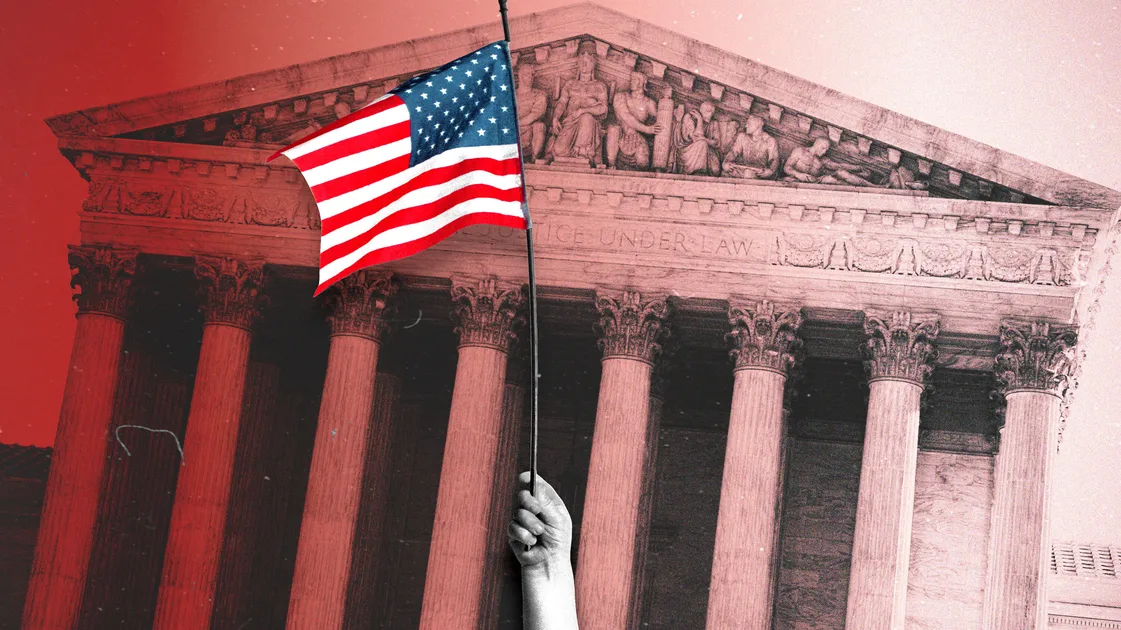
Illustration: HuffPost; Photo: Getty Images
There is no other way to characterize this than as an abomination. Despite a last-minute attempt by conservative law scholars to manufacture a history to support the dissenters position, the actual record of the adoption of the 14th Amendment, the actual practice of the conferral of citizenship in the United States, and its antecedents in the English Common Law and prior court precedent rejects this, as Chief Justice John Roberts writes in the majority opinion.
“[T]here is scant evidence for this dramatically revisionist view,” Roberts wrote about the dissent’s position that the authors of the 14th Amendment did not mean to enact birthright citizenship for nearly all children born on U.S. soil.
And yet, four of Roberts’ fellow Republican-appointed justices went along with it.
“The Court’s interpretation is not only contrary to the original meaning of the Fourteenth Amendment, it produces grotesque results. While foreigners who wish to immigrate lawfully must sometimes wait for many years, a child born here to a birth tourist is automatically a citizen,” Alito wrote in his dissent.
“The outcome suggests that we have a court that is incredibly fractured and highly politicized,” said Kristen Clarke, general counsel for the NAACP and former assistant attorney general for Civil Rights at the U.S. Justice Department. “Opinions issued by the dissenting justices read more like statements in full support of advancing Trump’s anti-immigration agenda.”
The conservative legal movement has been playing the long game to undo core American rights across the board. The push to overturn Roe v. Wade took nearly 50 years to come to fruition as activists and lawyers engaged in extensive grassroots mobilization and legal theorizing to obtain the support they needed for the court’s ruling in Dobbs v. Jackson. Similarly, it took unitary executive theory proponents decades from their huge loss in Morrison v. Olson in 1988 until Monday’s ultimate victory in Trump v. Slaughter.
While Trump’s effort to end birthright citizenship had been a part of political debate for some time, it was mostly confined to fringe corners of the far-right or speculatively discussed by Republican politicians. Those most prominently associated with this position were those like former anti-immigration GOP Reps. Steve King and Tom Tancredo ― both of whom were viewed as extremists.
But Trump’s takeover of the Republican Party shifted ending birthright citizenship into the party’s mainstream. When he announced his executive order in January 2025, it became an immediate issue: Conservative legal thinkers jumped to craft the revisionist and convoluted intellectual edifice to support it, ultimately used by the dissent to justify their position.
“The President’s initiative generated a groundswell of new scholarship into the original meaning of the Citizenship Clause,” Thomas wrote in dissent, noting the revisionist history he relied upon. “A wide range of originalist scholars have concluded that the 20th century executive practice was mistaken and that the Order has substantial lawful applications.”

Maxine Wallace/The Washington Post via Getty Images
The Supreme Court is now one vote away from ending the constitutional right to birthright citizenship. It’s a proposition that seemed beyond absurd just a few years ago and is a sign of rapid radicalization among the court’s conservative justices.
Roberts’ majority opinion does a good job of explaining how the arguments made by the dissenting justices are “wrong,” “misplaced,” and “simply not true.” But it is the concurrence from Justice Ketanji Brown Jackson that does the best work at stating what ending birthright citizenship would do.
The birthright citizenship guarantee of the 14th Amendment, she says, was not just about benefitting formerly enslaved people. Rather, it was about advancing an egalitarian and universalist legal framework. “The Reconstruction Amendments were an anticaste, antisubordination reset for the Nation, not a mere spot treatment for the dark stain of slavery,” Jackson wrote.
In detailing the history of the Colored Conventions, where free and formerly enslaved Black Americans organized for the end of slavery and justice in its aftermath, and the ratification of the 14th Amendment, Jackson explains how those who advocated for the birthright citizenship clause intentionally sought to enshrine a universal rule that they already believed to exist. Nonetheless, she says, this amounted to an “ambitious transformation” in American society to achieve a “repudiation of the notion that there is a ‘superior, dominant, ruling class of citizens.’”
That universalist and egalitarian promise is what the dissenting justices and Trump want to overturn.
In this way, the dissenting justices — Thomas, Alito, Gorsuch and Kavanaugh — seek a “a return to [the] core tenet” of the “detestable Dred Scott decision,” Jackson wrote, noting the 1857 decision that declared that Black Americans could not be citizens or have the rights of citizens.
“Their bottom line is that, for certain people, being born on American soil will not suffice to confer citizenship,” Jackson wrote. “It is that odious conclusion that the Citizenship Clause plainly rejects, as the Court explains.”
The bottom line is also just this: Four justices were willing to jettison birthright citizenship ― in some form or another. They sought nothing less than a total remaking of the country. And they are now only one vote away from making that a reality.
And Thomas promised in his dissent that this may be just the beginning, not the end of the fight: “I am not sure that today’s opinion will stand the test of time.”
Brandi Buchman contributed reporting.
