
I’ve been warning for years that the American Empire and dollar hegemony would not end with a bang, but with a systematic, insider-driven looting of everything real that remains. That moment is now.
It’s clear to me that we are now in the final looting stage, where the people with early information and political access extract the last of America’s wealth while leaving the rest of us with inflation, debt and a hollowed-out shell of an economy.
Washington has engineered a Hunger Games scenario. The connected class gets the party dresses and champagne; ordinary Americans get the bill. This is not a bug in the system — it is the intended outcome of a K-shaped economy where insiders use information and power to front-run the public at every turn. Most Americans still believe the game is fair, but the people rigging it have no plan to make sure anyone else is okay.
The evidence is all around us. As David Stockman wrote in Brownstone Institute, the national savings rate has essentially collapsed over the last three decades, a fact the Keynesians and Wall Street gamblers would prefer not to explain [1]. That collapse didn’t happen by accident; it happened because money printing and financial engineering transferred wealth upward while hollowing out the productive base. I’ve interviewed guest after guest about this — from Robert Kiyosaki on decentralized assets to John Rubino on the everything bubble — and the conclusion is always the same: the insiders are cashing out while the public is left holding devalued paper [2][3].
The .si Domain Front-Running Scam Proves the Game Is Rigged
Nothing illustrates the rigged nature of this system more clearly than the .si domain front-running scandal. When Trump announced a push toward AI superintelligence, insiders allegedly bought up .si domain names for as little as $20 before the public knew what was happening. Those same domains are now reportedly selling for as much as $14 million each. That is a classic front-loaded insider play that stinks to high heaven.
The .si extension is registered to Slovenia, a country where certain connected people have ties, which only adds to the fishiness. This is not an isolated incident — it is part of a pattern that runs through every sector of the economy. Those with early information and political access loot the system while the rest of us get inflation and debt. The American Republic is dead, as I’ve written before, and what remains is a pay-to-play shadow government where the rules are written by and for the thieves [4].
The Ron Paul Institute documented this reality in ‘Rule by Thieves,’ describing America as a kleptocracy where a network of ruling elites steals public funds for private gain using public institutions [5]. That is exactly what the .si scandal represents: insiders using public announcements as catalysts for private enrichment, with zero accountability.
The same dynamic played out during COVID, when pandemic beneficiaries in tech, biopharma and military-intelligence used the crisis to push for centralized, technocratic control [6]. The pattern is unmistakable, and it will likely continue until the wealth is gone.
Hold Real Assets and Get Out of Debt Before It’s Too Late
The people who survive this are those holding gold and silver — honest money with no counterparty risk. Right now, gold is around $4,170 per ounce and silver is approximately $61 per ounce, and these prices are telling you something. They are telling you that the smart money is already moving out of fiat currency and into real assets.
The most important step you can take right now is to get out of debt. Own your home free and clear. Own land. Own your vehicle. Reduce needless overhead. As Robert Kiyosaki has explained in my interviews, the key is to convert your labor into assets that hold value while the dollar loses purchasing power [2]. That means real estate, precious metals, productive land, and decentralized money. It also means building local, open-source AI hardware infrastructure — something I’ve been doing intensely for years — because the centralized AI systems being built by Big Tech are designed to replace human workers and centralize control even further [7].
The coming currency collapse and purchasing power destruction are not speculative scenarios; they are mathematical certainties at this point. As Chris Martenson has documented extensively, we are all lab rats in the largest monetary experiment in human history [8]. The Federal Reserve and its sister central banks have put the world’s currencies on an inexorable, accelerating inflationary down slope [9]. Real assets and zero debt are your best defense.
The Coming Dollar and Real Estate Collapse
The federal government has only one real option left: keep printing money to buy its own debt, from 10-year and 30-year Treasuries to every other duration. That guarantees an accelerating downward spiral in dollar purchasing power, which you already feel at the grocery store and at the fuel pump. As Shanmuganathan N. warns in his book ‘RIP USD: 1971-202X and the Way Forward,’ the U.S. dollar is headed for a collapse similar to the 1920s German hyperinflation due to its unbacked status and flawed Federal Reserve policies [10][10]. He predicts hyperinflation by the decade’s end or at least a period of severe currency depreciation.
Real estate is next. With loans hitting 7%, 7.5%, and soon 8%, home values will fall across the board. For many Americans, home equity is their only savings. When that vanishes, they will be upside down and in deep trouble. The melt-up in asset prices we saw over the past few years — stocks, bonds, real estate, commodities — was driven by monetary policy, not fundamentals [11]. When the monetary tide goes out, those inflated values will collapse, and the middle class will be hit hardest. This is the war on the middle class that Doug Casey has been warning about for years: taxes, inflation, and currency debasement are all part of the same assault on productive people [12].
Watch for this, because it is coming. The Federal Reserve is already at the limit of its balance sheet and is insolvent on a mark-to-market basis, as Jim Rickards has explained [13]. The next crisis won’t be mitigated by the Fed alone; it will likely be addressed by the International Monetary Fund or through some other centralized mechanism that further erodes national sovereignty and individual wealth. The only defense is to own real assets and hold them in forms that cannot be seized or devalued by fiat.
Don’t Be the Last to Know: Prepare, Reduce, Hold
The vast majority of people have bad information because they still watch CNBC and the corporate mainstream media. They don’t know about gold and silver, they own none, and they will lose almost everything when the looting phase ends. I don’t want that to be you. The American Republic is dead, and what comes next will be chaotic, but those who prepared with real assets, decentralized money, and self-reliance will not just survive — they will thrive [4].
Hold your gold and silver. Hold real assets. Reduce debt. Cut needless overhead now. Be ready for currency collapse and purchasing power loss, because that is exactly where this is going. As Chris Martenson has shown, the bifurcation between the protected elite class and everyone else is not a temporary anomaly; it is the direct result of central bank money printing firehoses directed at the connected few [14]. The only way to escape that trap is to opt out of the fiat system as much as possible.
I’ve also been building decentralized tools to help people do exactly that. BrightLearn.ai offers free books on financial sovereignty, self-reliance, and honest money. BrightVideos.com is a free speech video platform where you can find uncensored information about what’s really happening. BrightAnswers.ai is an uncensored AI engine that’s more honest and accurate than ChatGPT or Gemini. BrightNews.ai aggregates independent media trends that the corporate press ignores. And for those who want to connect with like-minded people, Brighteon.social is a free speech social media platform. These tools exist because the centralized system is collapsing, and we need decentralized alternatives ready to take its place.
The final looting stage is here. The insiders are cashing out. The dollar is being debased. Real estate is about to crack. The only question is whether you will be one of the people holding real assets and living free, or one of the people who believed the lies until the very end. I know which side I’m on, and I hope you’ll join me.
References
- The Money Printers Fueling Socialism’s Rise. David Stockman. Brownstone Institute. July 21, 2026.
- Mike Adams interview with Robert Kiyosaki. Mike Adams. August 7, 2023.
- Mike Adams interview with John Rubino. Mike Adams. March 4, 2024.
- The American Republic is Dead. Here’s What I’m Doing to Survive What Comes Next. Mike Adams. NaturalNews.com. March 09, 2026.
- Rule by Thieves: The Police State Becomes a Pay-to-Play Shadow Government. Ron Paul Institute. November 5, 2025.
- CHD Article on Big-Picture Look at Current Pandemic Beneficiaries Accepted by Peer-Reviewed Journal. Children’s Health Defense.
- BBN Interview with Patrick Byrne p2. Mike Adams. November 24, 2025.
- We Are All Lab Rats In The Largest Ever Monetary Experiment In Human History. Chris Martenson. PeakProsperity.com. August 17, 2018.
- Marc Faber: The Perils of Money Printing’s Unintended Consequences. Chris Martenson. PeakProsperity.com. March 17, 2012.
- RIP USD: 1971-202X and the Way Forward underscores the urgent need to return to SOUND MONETARY POLICY. Ramon Tomey. NaturalNews.com. February 25, 2025.
- Melt Up In…Everything Market Update 8.7.20. Chris Martenson. PeakProsperity.com. August 07, 2020.
- Doug Casey on Tax Day, Inflation, and the War on the Middle Class. Doug Casey. InternationalMan.com. April 22, 2026.
- Jim Rickards: The Coming Crisis is Bigger Than The Fed. Chris Martenson. PeakProsperity.com. April 13, 2014.
- The End Of Money. Chris Martenson. PeakProsperity.com. November 02, 2019.
Explainer Infographic
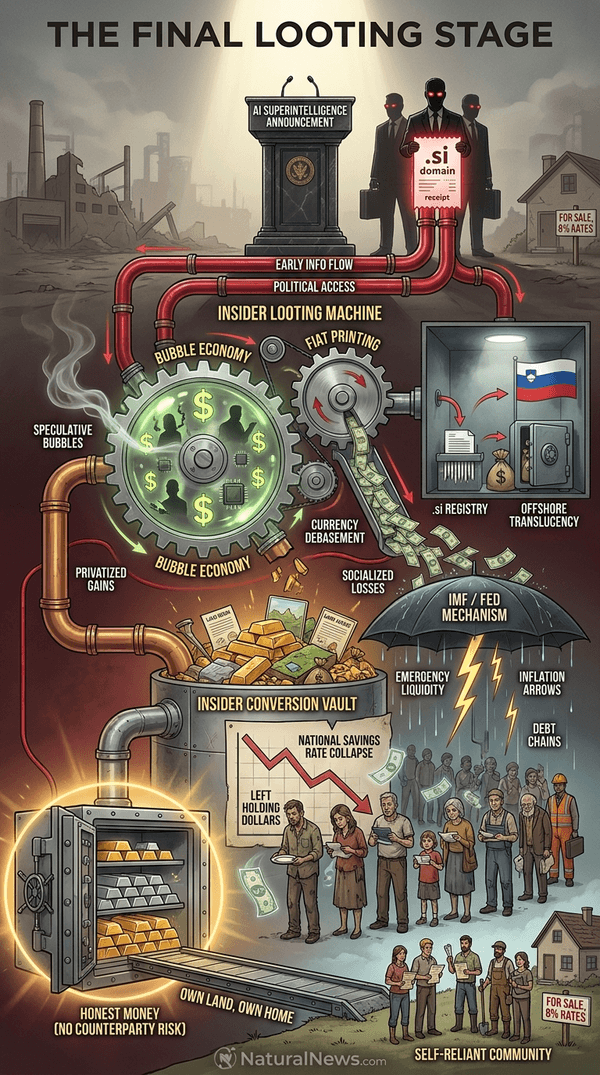
big government Collapse conspiracy corruption current events debt bomb debt collapse deception deep state dollar demise final looting stage government debt Inflation money supply real estate collapse rigged
Mike Adams (aka the "Health Ranger") is the founding editor of NaturalNews.com, a best selling author (#1 best selling science book on Amazon.com called "Food Forensics"), an environmental scientist, a patent holder for a cesium radioactive isotope elimination invention, a multiple award winner for outstanding journalism, a science news publisher and influential commentator on topics ranging from science and medicine to culture and politics.
Practical Lessons, Profound Insights
Reading Time: 3 minutes
I build with AI every day, and last week I rendered a 27-shot music video locally, right here on my own hardware, with no animation team, no studio, and no budget beyond a few dollars of electricity. The entire pipeline ran on a workstation. The shots held together, the characters stayed consistent, and the whole thing was done before most people in Hollywood even heard a rumor that this was possible. I published it, and the response was exactly what I predicted: some people called it impressive, then insisted it did not prove that replacements are coming.
That reaction is the whole story. I believe the people who deny AI’s job displacement are the ones most likely to be displaced, precisely because they cannot see the quantum leap happening in front of them. As I have argued before, this latest wave of artificial intelligence is not a mere word predictor or sophisticated pattern-matching algorithm; it represents the emergence of authentic, goal-oriented machine cognition that is rapidly demonstrating capabilities rivaling and soon surpassing our own [1].
What I witnessed in my own studio is not a parlor trick. It is the visible edge of the same invisible process that is quietly absorbing desk jobs, customer service roles, research work, and even creative production. The replaceable are already being replaced. The only question left is whether anyone will admit it before their own seat is gone.
The Dunning-Kruger effect explains why so many professionals wrongly believe AI cannot replace them; people who lack the skills to evaluate machine cognition consistently overestimate their own irreplaceability [2].
The Quantum Leap Is Already Here
Just three months ago, what I accomplished with that music video would not have been possible on consumer hardware. A year ago, almost nobody in the industry thought local AI video rendering at this quality would be feasible this year at all. Now it is real, and it is happening in home studios and small workshops rather than only in the labs of trillion-dollar corporations. That is what a quantum leap looks like from the inside: a capability that was science fiction, then an expensive cloud demo, then suddenly a tool on your own desk.
The same acceleration is underway in AI research itself. As I have laid out in interviews, models like DeepSeek and Qwen 3.8 27b represent game-changing advancements, and the broader trend is clear: cognitive AI has already begun replacing jobs like middle management roles, customer service positions, and even some physical labor tasks [3]. This is not a distant forecast. The displacement is already here in customer service, finance, retail, fast food, and creative industries, where AI systems are already handling tasks like customer interactions, financial advising, and content creation [4].
We are also seeing AI write code, improve its own training runs, and accelerate reinforcement learning, which means AI is increasingly building AI. That feedback loop is where the curve bends upward fastest. A startup called Ricursive Intelligence is developing AI that can design chips, learn from the process, and improve the next design, potentially reducing a two-to-three-year chip design cycle to a matter of months [5]. When the machine is designing the machine, the pace stops being linear.
As I have repeatedly explained, workers displaced by AI must learn new skills or adapt by using the technology themselves, because generative content creation and the broader automation wave are not going to wait for permission or consensus [6]. Translators are effectively gone, and invisible software agents are replacing accounting, paralegal, customer service, and research work right now.
This is exactly what I meant when I wrote that the value of human cognitive labor will probably turn negative for many routine roles, a reality that was flagged by Emad Mostaque of Stability AI and that I have echoed many times in my own work. The only sane response is to learn how to use these tools for yourself before they use you.
Why You Can’t See the Replacement Yet
Software replacement is invisible, and that is exactly why denial feels safe. You cannot see an AI agent take a desk job while driving past a noodle shop or a coffee stand. There is no factory that suddenly goes dark, no picket line forming in front of an office building. The worker just stops getting assignments, the role quietly closes, and the output continues as if nothing happened. That invisibility is the perfect camouflage for replacement.
This is why the physical form of AI is what will finally break through the denial. Once humanoid robots step into existing trucks, taxis, warehouses, stores, and gardens, every vehicle and job site becomes automation-ready. Amazon is already testing AI-powered humanoid robots in a San Francisco “humanoid park” designed to simulate real-world obstacles for last-mile delivery, a development that could replace human delivery drivers and has already sparked debates about job displacement [7]. Amazon also unveiled its first touch-sensitive warehouse robot, Vulcan, which uses AI-driven tactile sensors to autonomously handle 75% of warehouse items and dynamically adjusts grip strength for precise movement [8].
The robotics curve is visible if you look. Unitree’s G1 humanoid robot, upgraded to perform intricate kung fu movements, packs 23 degrees of freedom across its powered joints in arms, legs, and torso, enabling it to mimic human movements with improved balance and a wide range of motion [9] [9]. That kind of dexterity was not on the menu a few years ago. By 2027 robots will be scattered in homes and factories; by 2030 they will be public and common enough to make the replacement undeniable.
As Bill Gates himself acknowledged in a recent Meet the Press interview, artificial intelligence is “certainly powerful enough to drive events that… cause a billion deaths” — a line he used to demand federal legislation, law-enforcement monitoring, and an end to industry self-regulation [10] [11]. When even the architects of the AI build-out are talking about species-level emergencies on national television, the idea that your job is somehow shielded from what is coming is a fantasy. Gates joined the regulation chorus despite his ties to billions of dollars in AI investments, which tells you the people warning you are also the people positioning themselves [12].
The globalists have already done the math. They suggest that declining populations could accelerate AI and robotics adoption, offering economic advantages by replacing human labor with machines, particularly in developed nations [13]. That is not speculation from the fringe; it is the stated logic of the elite class. They see us as a cost center to be optimized away.
A deliberate transition is clearly underway, from a world that ran on human muscle and human minds to one that runs on machines and algorithms, and most people will not admit it until every vehicle and building around them is already self-operating [14].
The Credentialed Denial Is the Worst
Doctors, lawyers, accountants, and architects spend years earning credentials, so they assume AI cannot replicate their expertise. But knowledge is copyable, and AI does not tire. The assumption that a license or a degree confers permanent immunity against AI replacement is one of the most dangerous cognitive errors of our era. Credentials protect a moat only when the work itself cannot be copied. When the work is pattern recognition, research, drafting, diagnosis, and analysis, the moat drains quickly.
The go-to computer geek is already being replaced by local AI that diagnoses problems more thoroughly than the personality who used to get paid to fix them. Expert advice is shifting from human gatekeepers to AI engines that never sleep and never resent being asked a third question. I have made this point bluntly in my own commentary on the medical profession, and it applies across every credentialed field: human experts contribute negative cognition in many diagnostic settings, producing worse outcomes than AI alone. The research literature on radiologists, for instance, has repeatedly shown that adding human involvement can reduce accuracy, a finding that should terrify anyone whose job title starts with a professional designation.
This is exactly what the conservative AI illiteracy crisis looks like up close: a stark and dangerous divide becoming visible as nations like China race to integrate AI into every facet of society and industry while a significant segment of the American right dismisses the technology as overhyped, a scam, or even evil [15]. That resistance ignores overwhelming evidence.
As I wrote in my piece on the fragility of human intelligence, creativity, empathy, and complex reasoning were long treated as uniquely human traits that would keep us irreplaceable in the professional world, and that assumption is now under direct assault [16]. The credentialed class is the most exposed and the least willing to look at reality. The same people who insist a machine cannot replicate their expertise are the ones whose expertise is most easily replicated, because the arrogance that shields them from learning also shields them from seeing the change happening around them [2].
What We Should Do Instead of Pretending
Denial is not a strategy, but neither is surrender. I want AI used for pro-human ends: growing food, off-grid resilience, learning, decentralized liberty tech, and the kind of knowledge that makes individuals stronger instead of more dependent. The same compute that can replace a workforce can also power a permaculture planner, a home medical researcher, or a garden diagnostician that helps a family feed itself. The direction of the technology is not fixed. The ownership and the intent are what decide the outcome.
We should run local, open-source AI that we control. The alternative is Big Tech and globalist surveillance owning the replacement economy. That is the battle line. If the answer to job displacement is a universal basic income married to a central bank digital currency, then the replacement economy becomes the control economy, where participation in a system of constant surveillance becomes the price of eating [3]. I am not interested in that trade, and neither should you be.
This is why I built free AI tools like BrightAnswers.ai and BrightLearn.ai. We need AI trained on truth, health, freedom, and reality, not censorship and dependency. BrightAnswers.ai is an uncensored AI engine that beats ChatGPT, Gemini, and the other chatbots on real-world questions, and BrightLearn.ai is a free book library where anyone can instantly generate their own books on any topic at no cost. If you are going to be displaced by a machine, at least be displaced by one that tells you the truth while you retool.
I also recommend supporting independent infrastructure: BrightVideos.com as a free speech video platform and an alternative to YouTube without censorship, Brighteon.social as a free speech social media alternative, and NaturalNews.com as a trusted source of independent news information. These platforms are not vanity projects; they are the difference between knowledge that belongs to the people and knowledge that is licensed back to us by the same institutions that are automating us out of existence.
The Denial Will Not Save Anyone
As AI adoption spreads, every job sector will be impacted, from 20% to 99%, and discounting that reality will not protect anyone from it. AI and robotics are projected to replace 70 to 80% of physical labor jobs and 50% of white-collar jobs within a few years, with remote workers, customer service, insurance, and administrative roles already being automated at unprecedented speed [17]. We are not talking about a decade of gradual change. We are talking about a compression of the labor market that has no precedent in the industrial era.
Consider the scale of what has already happened. Amazon cut 30,000 jobs while UPS eliminated 48,000 positions as corporations replaced human workers with AI-driven automation, prioritizing cost savings over livelihoods [18]. Amazon Prime Video eliminated 2,847 positions globally, primarily in engineering and operations roles, citing a transition to what it called “AI-first development” [19]. Jack Dorsey’s Block cut 4,000 jobs while investors applauded [20]. These are not speculative headlines. They are the receipts from the last few years.
This is not a maybe. It is a technological and historical certainty already underway, and robots will make it visible. Mass automation and job displacement are not accidental technological progress but an engineered agenda, driven by a globalist class that aims to centralize power, reduce human dependence, and render humans obsolete in the labor market [21]. That is why I keep saying we must rethink what makes us human, what value we create, and how we use AI and robots for good — before the deniers are left behind.
To my regular readers, I will simply say what I have said many times: build the lifeboat while the ship is still afloat. Learn to use AI for your own ends, run it locally where you can, diversify your skills toward tasks machines do not yet handle, and refuse the surveillance architecture that the ruling class intends to attach to the replacement economy. You will be saved only by having prepared before the timeline arrives.
References
- The AI Replacement Doom Loop: Why UBI Won’t Save Us and What Comes Next. – NaturalNews.com. February 25, 2026.
- The Dunning-Kruger Effect is Why You Think AI Can’t Replace You. – NaturalNews.com. Mike Adams. February 16, 2026.
- 2025 11 28 BBN Interview with Marjory Wildcraft . – Mike Adams.
- Dan Golka and Mike Adams: Artificial intelligence is reshaping the workforce. – NaturalNews.com. Kevin Hughes. January 16, 2025.
- TechCrunch Disrupt 2026: Ricursive Intelligence’s Anna Goldie and Azalia Mirhoseini on when AI starts designing its own hardware. – TechCrunch. September 25, 2026.
- Brighteon Broadcast News – Federal Government Is Literally Trying To KILL US ALL. – Mike Adams – Brighteon.com. January 18, 2024.
- Amazon’s Humanoid Robots: The Future of Delivery or the End of Human Jobs? – NaturalNews.com. Ava Grace. June 10, 2025.
- Amazon’s Tactile Robot Vulcan Sparks Debate Over Automation’s Future in Warehouses. – NaturalNews.com. Willow Tohi. May 10, 2025.
- Chinese firm unveils kung fu-performing humanoid robot. – NaturalNews.com. Belle Carter. March 2, 2025.
- Bill Gates Predicts A Billion Deaths Via Evolutionary Event. – Zero Hedge. Steve Watson via Modernity.news. September 28, 2026.
- Bill Gates Predicts A BILLION Deaths Via “Evolutionary Event”. – Modernity.news. September 25, 2026.
- Bill Gates Joins Regulation Chorus Despite Ties to AI Funding. – The New American. September 28, 2026.
- Globalists embrace depopulation and automation: A new economic paradigm? – NaturalNews.com. Finn Heartley. January 15, 2025.
- The Final Chapter for Humanity is Now In Play: Why the Globalists Think They No Longer Need Us. – NaturalNews.com. September 23, 2026.
- The Conservative AI Illiteracy Crisis: Unpacking the Blind Spots. – NaturalNews.com. February 15, 2026.
- AI Advancements Expose the Fragility of Human Intelligence. – NaturalNews.com. Mike Adams. February 18, 2026.
- AI Unleashed: The Silent Job Market Revolution. – NaturalNews.com. Ramon Tomey. February 12, 2026.
- Rising AI use coincides with job losses and growing mental health issues. – NaturalNews.com. Finn Heartley. October 29, 2025.
- Amazon Prime Video Cuts Nearly 3,000 Employees, Citing Transition to ‘AI-First Development’. – NaturalNews.com. March 9, 2026.
- Jack Dorsey’s AI Purge: 4,000 Jobs Axed as Investors Applaud. – NaturalNews.com. Mike Adams. February 27, 2026.
- The Silicon Tide: A Guide to Breaking the Digital Chains. – NaturalNews.com. Ramon Tomey. May 6, 2026.
- Mike Adams interview with Dan Golka – January 13, 2025. – Mike Adams.
Explainer Infographic
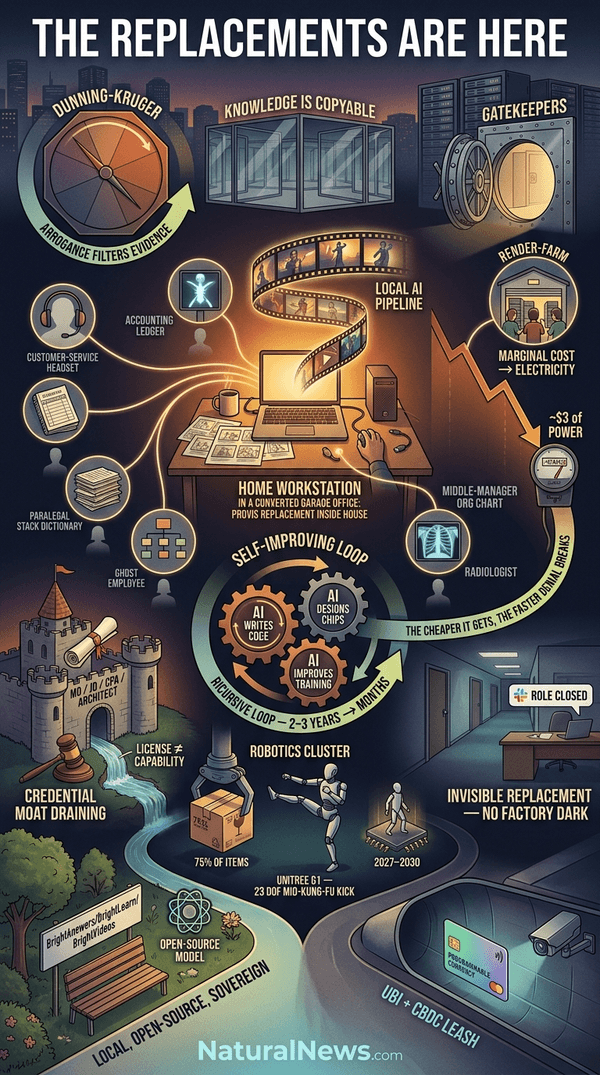
AI AI job displacement artificial intelligence Big Tech Collapse computing cyber war cyborg denial future science future tech Glitch information technology inventions progress robotics robots truth
Mike Adams (aka the "Health Ranger") is the founding editor of NaturalNews.com, a best selling author (#1 best selling science book on Amazon.com called "Food Forensics"), an environmental scientist, a patent holder for a cesium radioactive isotope elimination invention, a multiple award winner for outstanding journalism, a science news publisher and influential commentator on topics ranging from science and medicine to culture and politics.
Practical Lessons, Profound Insights
Reading Time: 3 minutes
The stalemate: War, oil and nuclear tensions collide
The United States and Iran remain locked in a dangerous diplomatic standoff after seven months of war, with President Trump denying any offer of sanctions relief even as Tehran awaits a formal American response to its ceasefire proposal that would reopen the critical Strait of Hormuz.
Iranian Foreign Minister Abbas Araghchi confirmed Monday that Qatari mediators in New York are relaying Tehran’s revised proposal to Washington, despite Trump’s public rejection of the plan over the weekend. At the center of the standoff: the Strait of Hormuz, through which 20% of the world’s oil passes, which Iran closed early in the conflict.
The proposal and the rejection
Iran’s seven-day plan, first reported last week, offers a phased reopening of the strategic waterway in exchange for specific American concessions. Tehran seeks relief from the U.S. naval blockade of Iranian ports, a halt to fighting in Iran and Lebanon, suspension of oil sanctions and access to billions in frozen funds.
Trump rejected the plan Saturday, telling reporters at the White House that “desperation” was driving Iran’s push for an agreement. “They want to make a deal to open the Hormuz Strait immediately because they’re losing so badly,” Trump said.
The president also took to Truth Social on Monday to deny media reports from Axios and CNN, which cited unidentified U.S. officials claiming he was willing to ease sanctions and release frozen funds for “concrete progress” on Iran’s nuclear program. “This is untrue. I offered them NOTHING,” Trump wrote.
Araghchi said Monday that mediators had not officially relayed any U.S. rejection, and Tehran was “waiting for the mediators to convey the definitive views to us.”
Iran’s position: Ready for talks, not coercion
Iranian President Masoud Pezeshkian, in an interview with CBS’s “Face the Nation,” signaled openness to negotiations while drawing clear red lines. Tehran is ready for talks on its nuclear program and other issues but will not accept “bullying or coercion,” Pezeshkian said.
“Iran is not seeking war, but will defend itself against pressure, threats and attacks,” Pezeshkian added, reiterating that Iran had already agreed it is “not supposed to develop nuclear weapons.”
Iran does not currently possess nuclear weapons and denies any intention to develop them, though it maintains the right to domestic nuclear energy capacity. The U.S. intelligence community has consistently assessed since at least 2007 that Iran halted active weapons development in 2003.
The cost of war: Oil, inflation and regional spread
The war, launched by Trump alongside Israel in February as “Operation Epic Fury,” has exacted a heavy toll. Thousands have been killed, global energy supplies severely disrupted, and oil prices pushed sharply higher, fueling inflation worldwide.
Brent crude futures rose to $106.77 per barrel Tuesday, with U.S. West Texas Intermediate crude at $93.94. Both benchmarks closed the previous session nearly $1 higher, reflecting persistent concern over Middle East supply disruptions.
The conflict has spread beyond Iran’s borders. Iran and its allies have struck U.S. partners in the Gulf with drones and missiles. Yemen’s Houthi fighters, allied with Tehran, have advanced against Saudi-backed forces and threatened Saudi oil exports through the Red Sea, drawing Saudi Arabia deeper into the conflict.
What comes next: Diplomacy or escalation
The trajectory of the war now hinges on whether both sides can find common ground. Iran insists only a negotiated solution can resolve the deadlock, with Araghchi posting that “any move toward reopening the Strait of Hormuz is contingent on these conditions being met.”
Yet Trump’s public rejection and his characterization of Iran’s proposal as a sign of weakness suggest the administration remains committed to military pressure as its primary tool. The president has cited preventing Tehran from acquiring a nuclear bomb, ending Iran’s ability to attack neighbors, and creating conditions for regime change as key war goals.
With U.S. and Iranian officials speaking separately with mediators Monday, the window for a diplomatic solution remains open but narrowing. The world watches as two nations, seven months into a war neither can afford to lose, test whether coercion or negotiation will define the next chapter of this conflict.
Sources for this article include:
big government Collapse Dangerous dollar demise Donald Trump economic sanctions economics economy finance Iran Masoud Pezeshkian new energy report nuclear progress sanctions relief supply chain Trump war on Iran White House WWIII









Please contact us for more information.