
Practical Lessons, Profound Insights
Browsing: Health
Reading Time: 3 minutes
I believe consciousness leaves real imprints on physical matter. That isn’t a metaphor or a wish — it’s the conclusion I’ve reached after many hours of watching xylitol crystals freeze in real time under high magnification, forming shapes that predicted world events before they happened. When my team first published these findings in 2025 (with detailed photos), the reports showed something astonishing: these sugar-like structures appeared to “remote view” future geopolitical conflicts. [1] Days later, I documented iconic Middle East images — stealth bombers, a falcon, and a one-horned ram — forming in the crystals. [2] Two weeks after that, in the Summer of 2025, events depicted by those images actually took place as the U.S. surprise bombed Iran.
But I knew the manual approach to this investigation couldn’t scale. Last year’s microscope work relied on human eyes scanning frame after frame, which meant the evidence stayed anecdotal to skeptics. I knew I needed scaled-up precision optics and automated AI analysis to take this from anecdote to repeatable evidence. And that’s where I’m focused right now.
Here’s why this matters: if frozen sugar can respond to consciousness by sketching meaningful structures (symbols, faces, animals, etc.) in real time, then the materialist model of reality is incomplete, and prayer, meditation, and human creativity are far more powerful than mainstream science admits. Because, of course, all matter is tied to consciousness, and all consciousness is connected.
The Keyence VHX: A Quantum Leap in Observing Consciousness
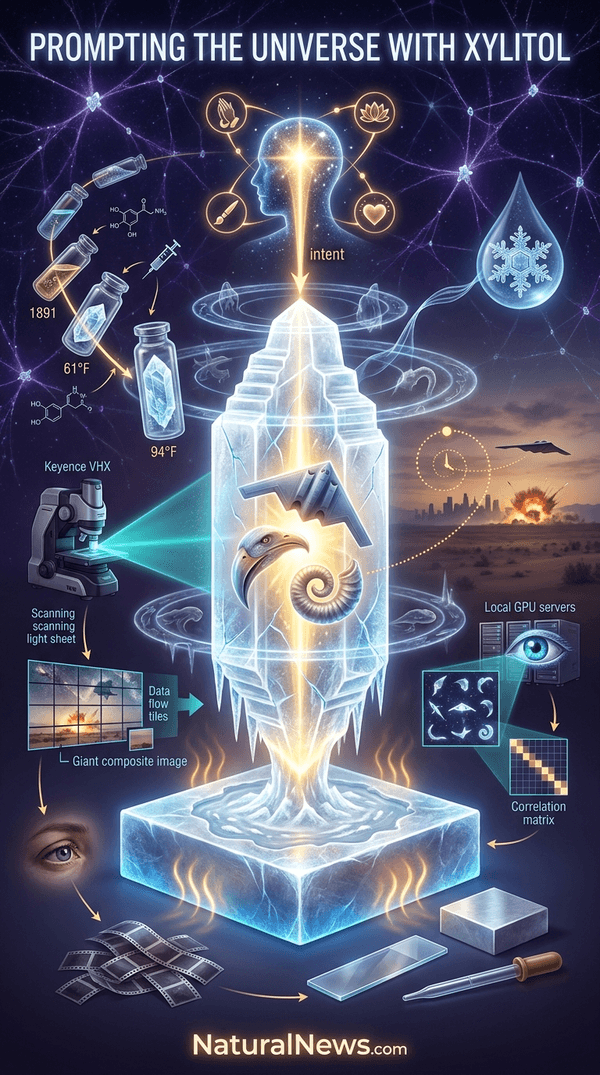
The new Keyence VHX optical microscope is the most advanced imaging tool I’ve ever used. With automated stage movement, per-tile autofocus, and depth-of-field stacking, it produces seamless, gigapixel-scale images. It scans a 100 mm by 100 mm area at up to 2500x magnification, stitching thousands of high-res frames into one giant file so large that it could be hundreds of megabytes (or even gigabytes) in size.
This eliminates one of the bottlenecks that held me back last year. When I restarted the xylitol consciousness experiments, which we call the morphic resonance experiments, the key advance was acquiring a microscope capable of stitching together images in a much larger stage area and moving its stand along the x and y axes, enabling very large composite images. [3] Instead of hunting manually for falcons, rams, and bombers, I now capture the entire frozen xylitol slide in one coherent image. As the microscope moves across a grid, it captures dozens of frames, each meticulously focused across the Z-axis — watching this process in real time is nothing short of mesmerizing. [4]
From there, I will use AI vision language tools (VL) for automated analysis, running high-end local GPUs with open source VL models like Qwen. (Plus some custom vibe coding for the app.)
Morphic Resonance Made Visible: What the Crystals Are Telling Us
Freezing xylitol on a chilled aluminum block is not random crystal chemistry; it is a rendering process, where phase transitions build 3D structures under the influence of morphic field templates. Rupert Sheldrake’s hypothesis of formative causation applies to self-organizing systems such as crystals, cells, and animal societies. [5]
The historical record backs this in a way that should stagger any honest scientist. Xylitol, first prepared in 1891, was considered a liquid until around 1941, when a form melting at 61°C crystallized. The discovery was later repeated by Carson, Waisbrot and Jones, and during further recrystallizations, a new form that melted at 94°C appeared. [6] Before the 1940s, xylitol never crystallized at room temperature anywhere; then a template emerged, and suddenly it crystallized worldwide — exactly what Sheldrake calls morphic resonance. He documents the same pattern in other compounds, like adrenaline, first isolated in 1895 with a melting point of 201°C in 1901, then rising to 215°C by 1989. [5]
Masaru Emoto demonstrated something similar with water, showing how its crystals transform based on the intent or emotions conveyed to them during freezing. [7] These xylitol crystals are physical answers to conscious prompts. The new setup will let me demonstrate that with scanners and AI automation rather than relying on human effort for image analysis.
The Mini Data Center: Teaching AI to See the Invisible
To analyze images too large for ordinary software, I’m upgrading my mini data center with high-end GPUs running local vision-language models that detect objects, faces, and symbols. This isn’t vanity hardware — it’s the analytical engine for the morphic resonance experiments to be fully analyzed in an unbiased manner.
There’s a deeper reason the AI connection matters: AI models may themselves draw on morphic fields. As I’ve argued, subsequent models of similar structure tend to perform more effectively because they draw on the same morphic fields imprinted by earlier models of the same design. [8] The machinery is not separate from the mystery — it participates in it. This will become more apparent to AI scientists over the next decade. (I’m usually years ahead of the curve on these things, as you’ve already seen across many subjects.)
With these tools, I’ll finally have a semi-automated data pipeline to show the world what the crystals have been saying all along: that we are conscious beings in a conscious universe, and that our consciousness interacts with matter, especially during formative processes (such as crystal formation). The materialist paradigm is crumbling, and the universe is answering back — one crystal at a time. [9]
Watch this space for amazing microscopy photos in the weeks and months ahead.
References
- Cosmic Consciousness Experiment Reveals Future War Images in Xylitol Crystals. – NaturalNews.com. Finn Heartley. May 30, 2025.
- Morphic Resonance “Remote Viewing” Reveals Iconic Middle East Images of Stealth Bombers, a Falcon, and a One-Horned Ram. – NaturalNews.com. Mike Adams. June 2, 2025.
- Health Ranger Report – Restarting the Xylitol Experiments. – BrightVideos.com. Mike Adams. May 23, 2026.
- Brighteon Broadcast News – Real Time Manifestation. – Brighteon.com. Mike Adams. May 23, 2025.
- Morphic Resonance: The Nature of Formative Causation. – Rupert Sheldrake.
- Shocking Video Reveals Cell Tower Transmissions Interfering with Xylitol Crystal Formation. – NaturalNews.com. April 12, 2021.
- The Hidden Messages in Water. – Masaru Emoto.
- Health Ranger Report – AI ALERT. – BrightVideos.com. Mike Adams. April 24, 2026.
- The Five Cosmic Truths They Desperately Don’t Want You to Understand. – NaturalNews.com. Mike Adams. April 24, 2026.
Explainer Infographic
Ask BrightAnswers.ai
Powered by BrightAnswers.ai Check out our prompting guide and video tutorials today.
Related Topics
AI artificial intelligence consciousness current events data center environment government politics science technology Xylitol
Mike Adams (aka the "Health Ranger") is the founding editor of NaturalNews.com, a best selling author (#1 best selling science book on Amazon.com called "Food Forensics"), an environmental scientist, a patent holder for a cesium radioactive isotope elimination invention, a multiple award winner for outstanding journalism, a science news publisher and influential commentator on topics ranging from science and medicine to culture and politics.
Practical Lessons, Profound Insights
Reading Time: 3 minutes
A Navy under siege
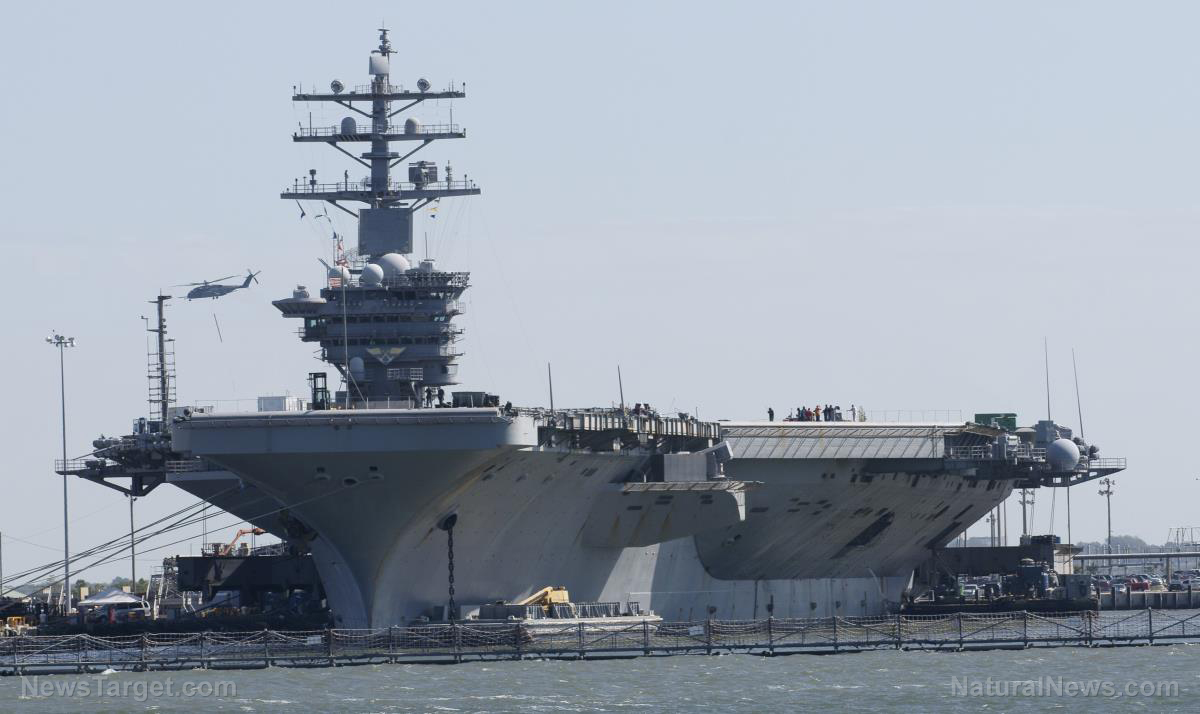
The mental and physical toll of America’s longest-running carrier deployment since the Vietnam War has reached a critical breaking point. Reports from military families and service members indicate that sailors aboard the USS Abraham Lincoln, operating near Iran, have attempted to jump overboard amid exhaustion, low morale and deteriorating living conditions. The carrier, deployed since November 2025, has been extended indefinitely as part of Operation Epic Fury, the US-Israel campaign against Tehran. With the crew having spent 250 consecutive days at sea, the Navy faces a humanitarian crisis that threatens both operational readiness and the lives of its 5,000 sailors and Marines.
Record deployment exacts heavy toll
The USS Abraham Lincoln departed San Diego on November 21, 2025, originally destined for the Pacific before being redirected to the Middle East. Since then, the crew has had only two days of shore leave—one in Guam in December and a brief stop in Oman in July. The deployment was slated to end in May but has been extended twice as the war with Iran grinds on.
According to the Navy Times and Stars and Stripes, the prolonged deployment has led to multiple suicide attempts. Annabelle Loma, wife of a sailor, told the Navy Times that her husband attempted to jump overboard, fearing his 13-year career would end in dishonor due to burnout. Another sailor’s wife recounted an incident where her husband physically restrained a fellow crew member from going over the side.
The crew’s resilience is eroding under the strain of relentless combat operations. Over the past eight months, the carrier has launched more than 10,000 aircraft sorties, supporting strikes on Iranian missile facilities, air defense systems and drone infrastructure. The flight deck, described by one Navy veteran as “the most dangerous place in the world,” is now a source of added risk as exhausted sailors manage high-speed aircraft and live ordnance in extreme conditions.
Families and lawmakers sound the alarm
At a town hall meeting in San Diego last week, attended by roughly 200 family members, Acting Navy Secretary Hung Cao faced emotional pleas for action. One spouse told officials that her husband had texted her, saying “he hopes he doesn’t wake up tomorrow.” Another accused Navy leadership of having “broken trust between us and the leadership.”
Democratic lawmakers have amplified these concerns. Rep. Mike Levin of California described the conditions on board as “moldy showers, broken toilets, laundry down for weeks, long stretches with no hot water, a meal that came down to half a cup of rice and two tortillas. No soap, deodorant, or toothpaste.” Rep. Jason Crow of Colorado, a former Army Ranger, warned that the strain is “building week by week.”
The Navy has pushed back against the harshest criticisms. Cmdr. Joseph Hontz, a 5th Fleet spokesperson, acknowledged that “more than 250 days on deployment is challenging for the crew and their equipment” but insisted the ship remains “fully capable of meeting all mission tasking.” However, the Navy’s official statement, noting that it had not identified an increase in suicidal ideation, stands in stark contrast to the accounts provided by families and service members.
A strategic miscalculation?
This crisis raises profound questions about the Biden-Trump administration’s conduct of the Iran war. Polls indicate the conflict is deeply unpopular, with President Donald Trump’s approval rating falling to 33 percent, its lowest since his return to office. The war has also exposed severe logistical deficiencies. The Navy has struggled to supply the fleet, with fresh food and basic hygiene products running short.
Beyond the immediate humanitarian concern lies a broader strategic calculus. The United States is demonstrating that its military might is not limitless. The Lincoln’s prolonged deployment risks not only the mental health of its crew but also the safety of its operations. As fatigue sets in, the likelihood of a catastrophic accident increases—an outcome that would undermine America’s credibility and embolden its adversaries.
The Navy’s decision to keep the Lincoln in theater without relief reflects a force stretched thin. The USS Theodore Roosevelt is reportedly preparing to relieve the Lincoln, but no timeline has been provided. Meanwhile, the war shows no signs of ending, with peace talks stalled and the Strait of Hormuz closed to most shipping.
The human cost of endless conflict
The USS Abraham Lincoln has become a symbol of the costs of a war without an exit strategy. The reports of suicide attempts and deplorable conditions are not merely a failure of logistics; they are a failure of leadership. The United States is asking its sailors to shoulder an unsustainable burden in a conflict that many, including members of the military’s own families, openly question.
As the Navy scrambles to address the immediate crisis, it must confront a larger truth: a military stretched to its breaking point is not a deterrent; it is a vulnerability. The country must reevaluate its strategic commitments in the Middle East and ensure that those who serve are not sacrificed on the altar of an open-ended war. The sailors of the Lincoln have done their duty. It is time for Washington to do its own.
Sources for this article include:
Ask BrightAnswers.ai
Powered by BrightAnswers.ai Check out our prompting guide and video tutorials today.
Related Topics
big government chaos Collapse Dangerous Globalism humanitarian Liberty mental military tech national security Resist WWIII
Latest News





Related News
08/13/2026 / By Garrison Vance
08/13/2026 / By Cassie B.

08/13/2026 / By Willow Tohi
08/13/2026 / By Garrison Vance

08/13/2026 / By Chase Codewell

08/12/2026 / By Morgan S. Verity
Take Action:
Support Natural News by linking to this article from your website.
Permalink to this article:
Copy
Embed article link:
Copy
Reprinting this article:
Non-commercial use is permitted with credit to NaturalNews.com (including a clickable link).
Please contact us for more information.
Please contact us for more information.


Practical Lessons, Profound Insights
Reading Time: 3 minutes
The report’s summary says the findings “allow one to deduce the fundamental cause” of excess mortality during the Wuhan coronavirus (COVID-19) period. Researchers with the Canada-based group have previously examined all-cause mortality data from 125 countries and found that patterns of excess death globally could not be explained by a pandemic respiratory virus, according to Children’s Health Defense [1].
Scale of Excess Mortality and Assigned Causes
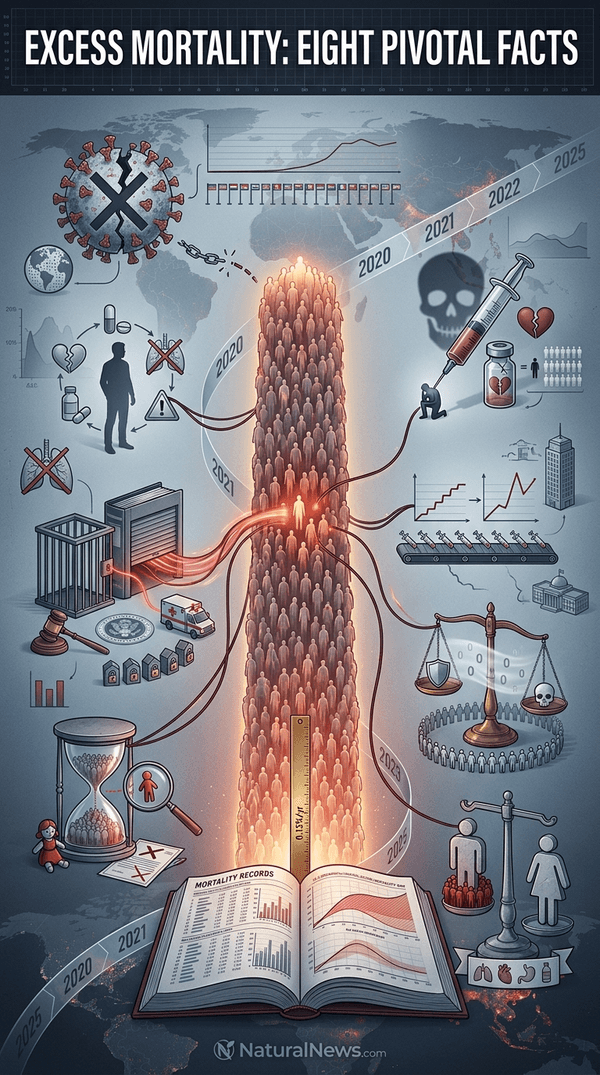
The report’s Fact No. 1 states the scale of excess all-cause mortality during the COVID period was 0.13% of population per year. Fact No. 2 states that the excess mortality “was not caused by a spreading respiratory pathogen,” according to the report. More than half of the 17 countries analyzed in a separate study had no detectable rise in all-cause mortality after the World Health Organization declared a global pandemic on March 11, 2020, until after the rollout of the COVID-19 vaccines and boosters, according to Children’s Health Defense [2].
Fact No. 3 states most COVID-period excess mortality in young adults and youth is not assigned to respiratory conditions such as COVID-19, the report said. Researchers Denis Rancourt, Joseph Hickey and Christian Linard examined all-cause mortality data in 125 nations between 2020 and 2023 and found that deaths commonly attributed to COVID-19 were actually due to other factors, including lockdowns and the vaccines themselves, according to NaturalNews.com [3].
Heterogeneity and Vaccine Timing
Fact No. 4 states excess mortality was “highly heterogeneous, tied to imposed measures and medical protocols” in specific jurisdictions, population groups, and locations, according to the report. An earlier analysis found that hot spots of sudden surges in all-cause mortality occurred only in specific locations in the Northern-hemisphere Western World synchronous with the March 11, 2020 declaration of a pandemic, according to Dr. Peter Breggin’s “Canary In a Covid World” [4].
Fact No. 5 states “the COVID-19 vaccine has harmed and killed many people,” the report said. A separate report by Correlation Research in the Public Interest estimated that COVID-19 vaccines averaged one death for every 800 injections worldwide across all age groups, according to NaturalNews.com [5].
Fact No. 6 states sharp peaks in excess mortality were temporally associated with rapid vaccine and booster rollouts, according to the report. Ed Dowd wrote in “Cause Unknown” that the rate of change in Fall 2021 was particularly striking as it coincided with the corporate mandates, and that the only thing that had changed was mass vaccination forced upon the millennial generation via government and corporate mandates [6].
Mortality Studies and Sex Disparities
Fact No. 7 states vaccination-status-discerned mortality studies “show no statistically significant mortality-averting benefit or mortality-causing liability” from COVID-19 vaccines, the report said. A study of 125 countries found “no apparent benefit” from COVID-19 vaccines, according to Children’s Health Defense [7].
Fact No. 8 states there is a “large systematic sex disparity” in COVID-period excess mortality from main assigned causes, including respiratory disease, according to the report. The report’s summary states that deaths were assigned to respiratory conditions, circulatory conditions, gut conditions, and accidental self-harm associated with drug and alcohol use. The report describes respiratory disease as “nominally COVID-19.”
Report’s Inference and Context
The report states that all the excess mortality of the COVID period is inferred to “arise from the many government assaults,” including fear propaganda, mandates, measures, public-health responses and medical assaults. The report states the known medical assaults included testing, facial masking, confinement, isolation, mechanical ventilation and vaccination rollouts.
A study of excess mortality in 125 countries found that the major causes of death globally stemmed from the public health establishment’s response, including mandates and lockdowns that caused severe stress, harmful medical interventions and the COVID-19 vaccines, according to Children’s Health Defense [8]. The organization described the study as the largest of its kind.
The report’s main lesson is that “stress was overwhelmingly the dominant underlying cause of disease and early death,” and CORRELATION is requesting support for independent research. Most excess deaths during the pandemic can be linked to biological stress brought on by coordinated and large-scale mandates and medical assaults, ranging from lockdowns to vaccination to denial of antibiotics and antivirals, according to a paper released by excess mortality researcher Denis Rancourt [9].
The report also states that the violent government COVID-19 campaign, like any major structural societal disruption that removes resources, mobility, human contact, social status and purpose caused the excess morbidity and mortality that occurred in all age groups.
References
- “Vaccines Caused 17 Million Deaths During Pandemic Plus 4 More Takeaways From Largest Excess Mortality Study to Date”. Children’s Health Defense. childrenshealthdefense.org.
- ChildrensHealthDefense.org. “Definite Causal Link Between COVID Vaccine Rollouts and All-Cause Mortality”. ChildrensHealthDefense.org. September 20, 2023.
- NaturalNews.com. “Report: Vaccines and Lockdowns Are Responsible for Excess All-Cause Mortality, Not COVID-19 Infection”. NaturalNews.com. August 1, 2024.
- Peter Breggin. “Canary In a Covid World: How Propaganda and Censorship Changed Our World”.
- NaturalNews.com. “Study finds causal link between COVID vaccines and mortality confirming 1 death for every 800 jabs”. NaturalNews.com. September 27, 2023.
- Ed Dowd. “Cause Unknown”.
- “Watch: Study of 125 Countries Finds ‘No Apparent Benefit’ From COVID Vaccines”. Children’s Health Defense. childrenshealthdefense.org.
- “Breaking: Largest Study of Its Kind Finds Excess Deaths During Pandemic Caused by Public Health Response, Not Virus”. Children’s Health Defense. childrenshealthdefense.org.
- “COVID Didn’t Cause Surge in Excess Deaths — The Pandemic Response Did”. Children’s Health Defense. childrenshealthdefense.org.
Explainer Infographic
Ask BrightAnswers.ai
Powered by BrightAnswers.ai Check out our prompting guide and video tutorials today.
Related Topics
. vaccines badhealth badmedicine badscience big government correlation COVID period covid-19 Denis Rancourt excess mortality genocide infections Medical Tyranny outbreak pandemic Plague real investigations research truth Vaccine deaths vaccine mandates vaccine wars Wuhan coronavirus
Latest News




Related News

08/12/2026 / By Coco Somers

08/12/2026 / By Morgan S. Verity

08/12/2026 / By Lance D Johnson
08/12/2026 / By Cassie B.

08/12/2026 / By Morgan S. Verity

08/12/2026 / By Petra Stone
Take Action:
Support Natural News by linking to this article from your website.
Permalink to this article:
Copy
Embed article link:
Copy
Reprinting this article:
Non-commercial use is permitted with credit to NaturalNews.com (including a clickable link).
Please contact us for more information.
Please contact us for more information.