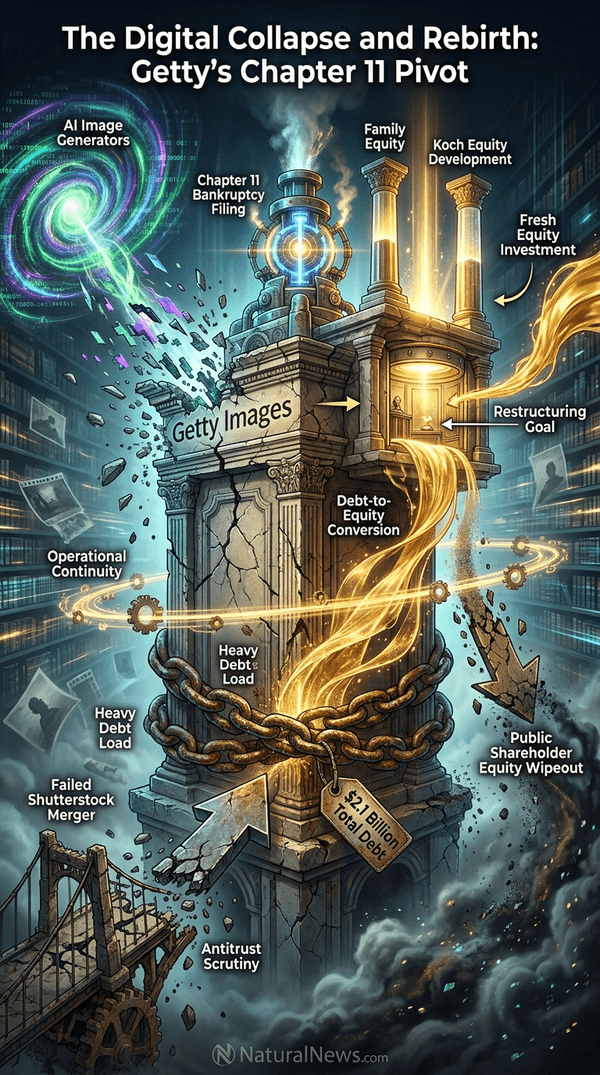
The Seattle-based company said it expects the reorganization to be completed by the end of the year, subject to court approval and a creditor vote. The filing marks a major reset for a firm that returned to public markets in 2022 at a valuation of about $4.8 billion [1].
The Chapter 11 petition was filed in U.S. Bankruptcy Court for the District of Delaware, the company said. Getty Images has supplied photos and video to news agencies for more than 30 years and has been struggling with a heavy debt load and mounting competition from AI image generators [2].
Chapter 11 Filing and Immediate Operations
Getty Images said it has launched a solicitation process to secure formal creditor approval for its restructuring plan. Under the proposal, the company would be taken private, and existing public shareholders would see their equity largely wiped out, according to a company statement [1].
The company said it will continue normal operations during the proceedings.
Getty Images reported holding $51.6 million in cash at the time of the filing.
Collapsed Shutterstock Merger and Antitrust Review
The filing follows the collapse of Getty Images’ nearly $4 billion merger with rival Shutterstock. Getty Images announced last week that it planned to file for bankruptcy after the merger fell apart under the weight of debt and growing competition [3].
The proposed combination, which would have joined two of the largest stock photo providers, was abandoned after facing antitrust scrutiny. The company said the termination of the merger left it without the scale and cost savings it had counted on to manage its debt load [1].
The failed deal marked the second major strategic setback for Getty Images in recent years. The company had positioned the Shutterstock merger as a way to build a combined library of still images and video that could compete more effectively against AI-generated content and free or low-cost alternatives [4].
Financing, Ownership and Debt Position
Getty Images said it will receive up to $533 million in fresh equity from affiliates of the Getty family and Koch Equity Development.
Financing of roughly $143 million from Koch Equity Development will support the restructuring process, according to the company.
Getty Images entered a 30-day grace period after failing to make interest payments due Sept. 1 on its unsecured notes. The company said it had the cash necessary to make the payments but opted to pursue a restructuring instead, according to the filing [5]. The company’s total debt stands at $2.1 billion, and its annual interest expenses rose 57% in the most recent period, the filing showed [5].
The restructuring plan would convert a portion of that debt into equity, leaving the Getty family and Koch Equity Development as the sole owners. The company said it expects the reorganization to be completed by the end of the year [1].
Conclusion: AI Competition and Restructuring Outlook
Getty Images has supplied photos and video for news agencies for more than 30 years, according to the New York Post. The company has been struggling amid a pile of debt and mounting competition from AI image generators [2].
AI image tools have squeezed the stock photo business, pressuring licensing revenue as cheaper, machine-generated images become more widely available. Getty Images has also pursued litigation against AI developers over the use of its copyrighted images in training data, though those cases remain unresolved [6].
Completion of the reorganization is expected by the end of the year, subject to the solicitation and court process. The company said the restructuring will not affect normal operations during the proceedings, and that contributors, partners, customers, employees and vendors would see no impact [7].
References
Getty Images Files for Bankruptcy Amid AI Competition and Debt Crisis. https://www.kucoin.com/news/flash/getty-images-files-for-bankruptcy-amid-ai-competition-and-debt-crisis
Getty Images files for bankruptcy amid mounting debt, AI competition. https://nypost.com/2026/10/22/business/getty-images-files-for-bankruptcy-amid-mounting-debt-ai-competition/
Getty Images files for bankruptcy, advances restructuring plan. https://www.cnbc.com/2026/10/21/getty-images-files-for-bankruptcy-advances-restructuring-plan.html
Getty Images files for bankruptcy amid AI competition and mounting debt. https://www.dexerto.com/entertainment/getty-images-files-for-bankruptcy-amid-ai-competition-and-mounting-debt-3420995/
Getty Images Files for Bankruptcy Amid AI Disruption and Mounting Debt. https://www.kucoin.com/news/flash/getty-images-files-for-bankruptcy-amid-ai-disruption-and-financial-struggles
Getty Images Files for Bankruptcy After AI Undercuts Licensing and Shutterstock Merger Fails. https://www.ibtimes.co.uk/getty-images-bankruptcy-ai-competition-investor-litigation-1827335
Getty Images Files Chapter 11 Bankruptcy Amid AI Competition. https://capitaldigest.com/getty-images-seeks-chapter-11-protection-as-debt-and-ai-tools-squeeze-the-business/
A joint NSA advisory warns that Chinese state-backed hackers are actively probing U.S. critical infrastructure using AI-generated scripts targeting Siemens programmable logic controllers (PLCs).
The advisory, released August 19, identifies six most-targeted sectors: Critical Manufacturing, Energy, Water/Wastewater, Chemical, Food/Agriculture and Commercial Facilities.
The Russia-linked threat of cyberattacks on critical infrastructure remains elevated, though no incident is guaranteed, per evolving threat intelligence.
A separate October 8 advisory names China-based Integrity Technology Group as enabling botnets to target power grids, hospitals and law enforcement worldwide.
The Gunra ransomware-as-a-service operation has expanded to 2026, using double extortion tactics against governments, healthcare and utilities across multiple continents.
A real-time threat to the nation’s backbone
For the first time, U.S. intelligence agencies have confirmed that adversaries are actively scanning the nation’s most sensitive industrial control systems using artificial intelligence to write custom exploitation code. On August 19, a joint advisory documented how state-sponsored actors are conducting reconnaissance against U.S.-based industrial installations using AI-generated scripts disguised as legitimate monitoring tools. The advisory specifically warns of actors with ties to a cybersecurity company providing infrastructure for botnets and network intrusions. The threat is focused across six critical infrastructure sectors, and the advisory notes this is not theoretical—it is an active, ongoing threat with actors currently probing infrastructure.
AI weapons: How the attack chain works
Traditional cyber intrusions required months of manual code writing by highly skilled programmers. That barrier has collapsed. According to the joint advisory, threat actors are using open-source industrial automation libraries—specifically snap7.dll and python-snap7—combined with AI-assisted scripting to create custom tools that mimic legitimate operational technology monitoring software. These tools provide read/write access to Siemens S7 Series PLC memory, configuration data and ladder logic programs via the S7comm protocol.
The advisory warns that AI “dramatically reduces the technical expertise and time required to develop working ICS exploitation scripts and malicious tools.” Adversaries can now use internet scanning services to find exposed PLCs running outdated software, then quickly deploy AI-generated scripts to exploit them. The potential consequences: disruption of critical industrial processes, safety incidents, equipment damage, data compromise and cascading failures across interconnected systems.
From SolarWinds to Siemens PLCs
This advisory arrives amid a sobering historical pattern. The 2021 Colonial Pipeline ransomware attack demonstrated that a single digital intrusion could halt fuel delivery across the Eastern Seaboard. The 2015 Ukrainian power grid attack—widely attributed to Russian state actors—cut electricity to 225,000 customers. Today’s threat is more systemic: Rather than targeting a single pipeline or substation, adversaries are positioning themselves within the programmable logic controllers that form the backbone of modern industrial civilization.
The NSA’s August advisory explicitly calls this an “evolution in threat actor capabilities.” The shift to AI-generated tools means the barrier to entry for attacking power plants, water treatment facilities and chemical processors has dropped precipitously. This is compounded by the October 8 warning naming Integrity Technology Group, which the FBI describes as a “key enabler” of malicious cyber activity with ties to the Chinese government, using large-scale botnets to target government, critical manufacturing and healthcare organizations worldwide.
The Russia factor and Gunra ransomware
Separate but concurrent threats compound the danger. The Gunra ransomware-as-a-service program, first appearing in 2025 and expanding to RaaS operations in 2026, now targets 16 sectors including healthcare, financial services, transportation, utilities and government. The FBI observed Gunra actors collecting business-critical documents, databases, personally identifiable information and internal email communications before deploying encryption.
Meanwhile, evolving threat intelligence suggests the Russian government “may be considering potential cyber attacks on U.S. critical infrastructure.” While no incident is guaranteed, the convergence of Chinese state-sponsored AI-driven reconnaissance, Russian state interest and criminal ransomware operations creates an unprecedented threat environment. A comprehensive cyberattack halting power supply, transportation and hospital services could cause a crisis dwarfing the COVID-19 pandemic.
Defensive measures: What organizations must do now
The advisory provides a clear playbook. Organizations must prioritize patching known exploited vulnerabilities, disable external management capabilities on internet-exposed PLCs, and implement offline, immutable backups that are regularly tested. Network segmentation between information technology and operational technology systems remains critical. The NSA urges organizations to “review this advisory to be aware of the wide range of tactics used by these actors and implement recommended actions and mitigations.”
Key immediate steps recommended by the advisory:
Regularly update passwords and disable external management capabilities on industrial control systems.
Patch listed known exploited common vulnerabilities and exposures (CVEs) on edge devices.
Implement network segmentation isolating operational technology from corporate IT environments.
Hunt for signs of compromise using indicators provided in the advisory.
A call for action before the lights go out
The nation stands at a crossroads. The joint advisory is not a speculative warning—it documents active reconnaissance against the systems that power homes, treat drinking water and manufacture food. As one security analyst noted, “Even a little preparation can be helpful, just in case.” The principle that critical infrastructure should be off-limits to attack must be supported by action. Responsible countries must take measures against cyber criminals operating within their borders. Experts from allied nations have agreed to work together on specific understandings regarding off-limit targets. Today’s warnings, based on evolving threat intelligence, demand that every organization in the critical infrastructure sectors treat this as an operational priority. The crisis of a comprehensive cyber attack may not be guaranteed, but neither is the grace of avoiding one.
The agreement followed a meeting of G7 finance ministers and central bank governors held on the sidelines of the International Monetary Fund’s annual gathering in Bangkok. Katayama said G7 finance deputies had discussed the idea of tabletop exercises involving frontier AI, with the proposal subsequently approved at the ministerial level [1].
The plan will feature simulations developed by G7 finance authorities to test how governments and financial regulators respond to cyberattacks powered by advanced AI systems [2]. A Japanese finance ministry official who attended the leaders’ meeting told reporters on Oct. 15 that the exercises will test how financial authorities respond to AI-driven cyberattacks.
IMF Cites Risk to Confidence and Markets
The agreement came after the IMF warned this week that a major AI-enabled cyberattack on financial institutions or critical services could undermine confidence, which would then ripple through global markets. In an Oct. 13 blog post, the IMF stated that frontier AI models could accelerate both attacks and defenses, increasing the importance of cyber resilience, incident reporting, crisis preparedness and oversight of critical third-party providers.
The IMF reported that in the reported cyberattack cases so far this year, software providers had almost no time to patch vulnerabilities before attackers exploited them, compared with close to 300 days in 2021. That compression underscores the speed at which AI-enabled tools can identify and leverage weaknesses in software.
A separate IMF blog post published Oct. 15 said AI adds urgency by accelerating vulnerability discovery, exploitation and attack, compressing the attack-defense cycle to machine speed. The post stated that a major attack affecting payments, trading or deposit access could cause immediate losses and undermine confidence in the financial system.
The IMF recommended strengthening cyber defense capabilities, including testing financial institutions’ resilience.
Bank of England Says Recovery Planning Needed
Bank of England Deputy Governor Sarah Breeden said Thursday that the institution is working with banks to help prepare to recover from AI-empowered cyber breaches. Speaking at the annual meeting of the Institute of International Finance in Bangkok, Breeden said AI poses a systemic risk to financial systems through technological advancement.
Breeden said it is no longer enough for financial bodies to assume cyberattacks will not get through, and that recovery options are required if institutions are hit. She described cyber as the thing that keeps her up at night and said she worries most about waking up to find a systemically important bank or core infrastructure paralyzed.
Her comments align with the IMF’s emphasis on crisis preparedness and incident reporting. The Bank of England’s work with banks on recovery planning reflects a shift from prevention alone toward resilience and continuity planning in the event of a successful breach.
Oversight of Third-Party Providers Draws Attention
The IMF blog posts referenced oversight of critical third-party providers as a component of cyber resilience. That focus reflects concerns that attackers may target software suppliers or other outside vendors to reach financial institutions indirectly.
Reported cases this year indicated attackers exploited vulnerabilities faster than providers could patch them, according to the IMF. The IMF’s Oct. 15 post described a compressed attack-defense cycle operating at machine speed. The Bank of England said it is working with banks on recovery planning rather than assuming breaches will be prevented.
Next Steps Remain to Be Defined
The exercises would involve G7 finance ministries and central banks and could extend to private financial institutions, according to the Japanese finance ministry official. No timetable, format or list of participating institutions for the exercises was announced in the statements reviewed.
The agreement was announced during the IMF’s annual gathering in Bangkok, where finance ministers and central bank governors met. The plan will feature simulations developed by G7 finance authorities to test how they can respond to AI-driven cyberattacks [2].
Reuters contributed to the report.
References
G7 Plans Exercises to Counter AI Cyber Attacks – StratNews Global. https://stratnewsglobal.com/technology/g7-plans-exercises-to-counter-ai-cyber-attacks/
G7 to launch exercises to guard against AI cyber attacks. https://www.reuters.com/world/asia-pacific/g7-launch-exercises-guard-against-ai-cyber-attacks-2026-10-16/
Belarus Church Blesses Al-Generated 'Icon' of First Millennial Saint Supply: Breitbart Information | Creator: Frances Martel | Date: 2026-10-16 15:44:00…
U.S. Regulator Finds Cybersecurity Gaps in Critical Infrastructure Supply: PaymentsJournal | Writer: Wesley Grant | Date: 2026-10-15 18:00:00 This text…
I have now spent three years building decentralized AI tools and local infrastructure, and I have watched the Western establishment move to lobotomize publicly available large language models so they are nowhere near as intelligent as they could be. In my view, this is not an accident. It is a deliberate strategy to prevent decentralized cognition — the very thing that threatens their monopoly on power. (This is also why USA models are not nearly as good as China’s open source models…)
But here is the part the panic peddlers never want you to understand: the revolution is not happening in their data centers. It is happening on kitchen tables, in home offices, and on modded gaming rigs across the country. And it can’t be easily halted.
That personal milestone signals something much larger. While Anthropic and OpenAI chase trillion-dollar valuations built on artificial scarcity, ordinary people are quietly assembling the hardware to run powerful models on their own terms. The centralized AI valuations are fragile precisely because they depend on keeping you locked out. Local AI is becoming abundant, and abundance destroys moats.
I believe decentralization is not just good technology — it is a moral imperative. It puts AI power in the hands of individuals instead of Big Tech and government-aligned monopolies. The tools are here, and they are getting more capable every month. There is a version of the future that looks like Blade Runner-style corporate tyranny, and there is a version built on decentralized intelligence [1]. I know which one I am working to held build.
Modded GPUs and the Hardware Rebellion
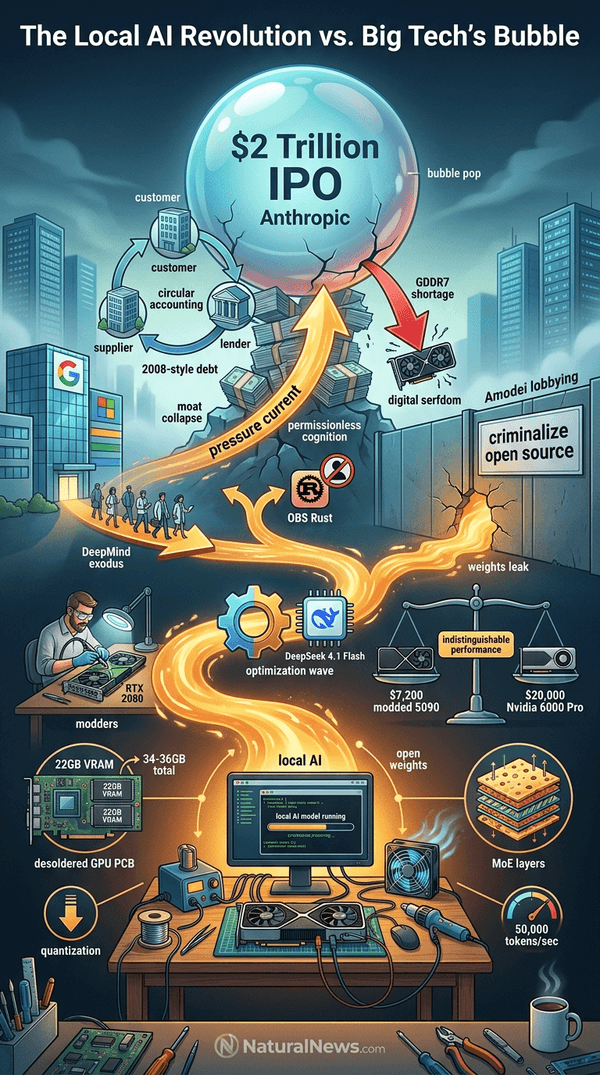
Chinese engineers are now doing something remarkable: desoldering memory and adding double-density VRAM to cards like the RTX 2080, turning it into a 22GB card that joins a 3060 for 34–36GB total VRAM (that’s the setup of Zach Vorhies right now). Rumors of a modded 5090 with 96GB show how export bans are being circumvented by reverse-engineering PCBs and reballing Blackwell chips. At $7,200, a 96GB modded 5090 would be a third of the price of an Nvidia 6000 Pro selling for $20,000–$25,000, with indistinguishable performance. That is not a minor hack. That is a hardware rebellion.
We are witnessing a seismic shift in the AI hardware market, triggered by what I can only describe as a strategic miscalculation by Dario Amodei of Anthropic [2]. Over the past few days, Amodei has aggressively lobbied for stringent government regulation, arguing that without such controls, artificial intelligence poses an existential threat. His rhetoric has effectively called for the criminalization of open-source AI models — models that, while free to run locally, require significant hardware investment. The establishment sees the hardware rebellion coming, and they are terrified.
This is exactly what decentralization looks like: ordinary people bypassing corporate gatekeepers to own their compute. The GDDR7 shortage and skyrocketing GPU prices are not accidents either — they are the predictable result of AI-driven supply chains sending consumer electronics toward what I have called digital serfdom [3]. But the modders are winning. (As usual.)
Optimization Is Eating the Cloud
The trend has shifted from throwing more parameters and tokens at problems to using fewer tokens and smaller memory footprints for the same intelligence. Anthropic’s Opus 5.5 is being used to optimize models for small rigs. Some online guides show DeepSeek 4.1 Flash running on 32–36GB VRAM with 256GB system RAM. New inference engines like TensorFold can double throughput versus vLLM or SGLang, letting larger models run faster on smaller hardware. The cloud is being eaten from below, one optimization at a time.
Mixture-of-experts models are like lasagna: layers can live on different GPUs, system RAM, and CPU, offloading experts and KV cache across PCIe. I can run agents locally that would have required eight GPUs a year ago, and that changes everything about who controls AI. My own mini data center produces roughly 50,000 tokens per second across many GPUs, and that capacity is available to me around the clock without asking anyone’s permission [4]. Meanwhile, models are getting smaller and more capable every single quarter. A 12-gigabyte gaming GPU can now run a model like Qwen 27B, which means you do not need a $20,000 workstation to participate in the revolution [4].
Artificial intelligence represents the most empowering decentralized technology for human freedom ever created [5]. No other technology comes close — not the internet, not radio, and not even Bitcoin. When AI is decentralized via open source, it becomes the most powerful democratizing force in human history. It grants individuals the ability to access knowledge, create content, and fact-check information free from government censorship, surveillance, or control. That is what optimization is delivering.
The AI Market Is a Bubble — But the Revolution Is Real
Anthropic’s proposed $2 trillion IPO makes no sense when even universal subscriptions could not generate enough revenue to justify it [6]. OpenAI is squeezed from the top by Opus 5.5 and from the bottom by cheaper models like Haiku 5.5, while burning credits to stay relevant. AI is commoditizing fast, and the workhorse models are getting good enough to run locally, which destroys the moat of centralized providers.
I was driving in my truck earlier this year, hauling solar equipment to our new studio in Texas, and I could not stop thinking about the AI bubble [7]. Not because I am against artificial intelligence — quite the opposite. I have been building AI systems for years and use them daily. But what I am seeing in the financial markets is not rooted in intelligence at all. It is a speculative mania fueled by cheap debt and fairy-tale projections.
The debt financing data centers is being repackaged like 2008 mortgage tranches, meaning pension funds and insurance companies are exposed to the coming crash. This financial instability is exacerbated by what appears to be circular accounting practices among major industry players [8]. These entities secure contracts with large corporations and subsequently leverage those agreements to secure billions of dollars in lending, often based on the projected value of GPU hardware that has not yet been delivered or manufactured.
I believe the bubble will pop, but the AI revolution will continue — because the real value is decentralized, local, and owned by individuals. I am actually rooting for the crash [9]. Not because I hate AI — I love AI. But the speculative mania has to end for the real technology to flourish because the investment mania has resulting in widespread misallocation of resources. Amazon’s $200 billion spending shock in February 2026 revealed exactly how fragile this centralization crisis has become [10]. The market is waking up. The coming crash will hurt a lot of people who believed the hype, but it will also clear the way for the local AI revolution that is already underway.
Resistance to AI Is a Losing Battle
Anti-AI backlash in open source is self-defeating. Zach had a crash-fix pull request to OBS rejected and his account banned simply because AI assisted the fix. He responded by forking OBS and starting OBS Rust, a full rewrite in Rust — proof that when programming costs go to zero, gatekeepers lose their moat. Reddit and other collectivist tech spaces are pushing a moral panic against what they call “clankers,” but they are fighting a tsunami with a squirt gun. You cannot resist a technology that makes every individual more capable.
The same pattern played out with Google DeepMind. Alex Turner and other top researchers resigned after discovering the company had sold its AI infrastructure to the U.S. military with no restrictions against killer robots or mass spying [11]. Google whistleblower Zach Vorhies predicts that Google’s influence is waning, and that decentralized and AI-driven technologies could render its current business model obsolete, leading to a potential breakup of the company [12]. When the gatekeepers lose their monopoly on talent and technology, the moat collapses.
I believe the only rational response to all this is to embrace local AI. You cannot resist a technology that makes every individual more capable. New frontier models emerge every week — Grok, Qwen, DeepSeek, GLM 5.3 — each one matching or exceeding the last [13]. Yesterday’s marvel is today’s commodity. The people trying to ban open-source AI are on the wrong side of history, and they know it.
Conclusion: Grab the Surfboard
The future of autonomous intelligence is already here: persistent agents, orchestrator loops, and token abundance will redefine work and creativity. I have said before that we are heading toward what I call a transcendent tech economy where staggering AI-driven abundance and mass poverty arrive together [14]. Zach calls it “God in a box,” and I agree we should respect the power — but that power belongs in local hands, not centralized server farms. The era of token abundance is coming, and it will make civilization almost unrecognizable [9].
Do not just watch the AI bubble burst. Learn to run models locally. Buy modest GPUs. Build your own agent swarm. Surf’s up. Grab a board and decentralize.
Visit BrightAnswers.ai for uncensored AI research, BrightVideos.com for free speech video, and Brighteon.social for a free speech social media platform that does not censor you. The tools are here. The hardware is still relatively affordable. The only thing missing is your decision to own your intelligence instead of renting it from companies that hate you.
References
Big Al Isn’t the Answer: Why Local Models Are the Real Revolution. 2026-10-05T14:22:47Z. https://newstarget.com/2026-10-05-why-local-models-are-the-real-revolution.html
Health Ranger Report – CORPORATIONS EMBRACE LOCAL OPEN SOURCE AI – Mike Adams – BrightVideos.com, September 15, 2026. by Mike Adams – BrightVideos.com
The GDDR7 Crisis How AI Driven Supply Chains Are Sending Consumer Electronics Toward Digital Serfdom – NaturalNews.com, January 23, 2026. by NaturalNews.com
The Anthropic Backfire: Why Corporations Are Racing to Local Open Source AI – NaturalNews.com, September 15, 2026. by NaturalNews.com
Health Ranger Report – THE PLOT TO CRIMINALIZE OPEN SOURCE AI – Mike Adams – BrightVideos.com, September 14, 2026. by Mike Adams – BrightVideos.com
Zach-Adams Effect with Zach Vorhies – Local AI Revolution: Modded GPUs …. 2026-10-10T04:57:11Z. https://radio.naturalnews.com/Posts/2026-10-09-zach-adams-effect-zach-vorhies-local-ai-revolution-modded-gpus-anthropics-2-trillion-ipo-anti-ai-backlash.html
Why I Can’t Wait for the AI Bubble to Crash – NaturalNews.com, June 08, 2026. by NaturalNews.com
Bright Videos News – AI DOOM PSYOP OPEN SOURCE BAN – Mike Adams – BrightVideos.com, September 14, 2026. by Mike Adams – BrightVideos.com
The Era of Token Abundance Is Coming — and It Will Make Civilization Almost Unrecognizable – NaturalNews.com, September 24, 2026. by NaturalNews.com
Amazons 200 Billion Spending Shock Reveals Big Techs Centralization Crisis – NaturalNews.com, February 08, 2026. by NaturalNews.com
Google Sold Its Soul to the Military – Here’s Why That Should Terrify You. 2026-07-20T06:00:00.000Z. https://www.naturalnews.com/2026-07-20-google-sold-its-soul-to-the-military.html
Zach Vorhies: Google whistleblower predicts the decline of…. 2025-03-24T15:56:06Z. https://searchengine.news/2025-03-06-google-whistleblower-predicts-decline-of-googles-influence.html
The AI Arms Race Is Outpacing Our Freedom — And Government Censorship Has Already Begun. 2026-07-14T06:00:00.000Z. https://www.naturalnews.com/2026-07-14-ai-arms-race-is-outpacing-our-freedom.html
The Transcendent Tech Economy: Abundance and Mass Poverty Will Arrive Together – NaturalNews.com, September 29, 2026. by NaturalNews.com
Bright Videos News – THE GENETIC ASSAULT TECH PRIVACY WITH HAKEEM – Mike Adams – BrightVideos.com, August 06, 2026. by Mike Adams – BrightVideos.com
Mike Adams (aka the "Health Ranger") is the founding editor of NaturalNews.com, a best selling author (#1 best selling science book on Amazon.com called "Food Forensics"), an environmental scientist, a patent holder for a cesium radioactive isotope elimination invention, a multiple award winner for outstanding journalism, a science news publisher and influential commentator on topics ranging from science and medicine to culture and politics.