
The Next Evolution in Payments: Diagonal Thinking Supply: PaymentsJournal | Writer: PaymentsJournal | Date: 2026-10-14 13:00:00 This text was initially…
Browsing: Artificial Intelligence
The Pentagon’s Drone Revolution Starts With Soldiers Supply: The Cipher Transient | Writer: Ryan Simons | Date: 2026-10-14 12:46:00 This…
The Sanctions We Cannot Afford Supply: The Cipher Temporary | Creator: Ryan Simons | Date: 2026-10-12 13:23:00 This text was…
I have now spent three years building decentralized AI tools and local infrastructure, and I have watched the Western establishment move to lobotomize publicly available large language models so they are nowhere near as intelligent as they could be. In my view, this is not an accident. It is a deliberate strategy to prevent decentralized cognition — the very thing that threatens their monopoly on power. (This is also why USA models are not nearly as good as China’s open source models…)
But here is the part the panic peddlers never want you to understand: the revolution is not happening in their data centers. It is happening on kitchen tables, in home offices, and on modded gaming rigs across the country. And it can’t be easily halted.
That personal milestone signals something much larger. While Anthropic and OpenAI chase trillion-dollar valuations built on artificial scarcity, ordinary people are quietly assembling the hardware to run powerful models on their own terms. The centralized AI valuations are fragile precisely because they depend on keeping you locked out. Local AI is becoming abundant, and abundance destroys moats.
I believe decentralization is not just good technology — it is a moral imperative. It puts AI power in the hands of individuals instead of Big Tech and government-aligned monopolies. The tools are here, and they are getting more capable every month. There is a version of the future that looks like Blade Runner-style corporate tyranny, and there is a version built on decentralized intelligence [1]. I know which one I am working to held build.
Modded GPUs and the Hardware Rebellion
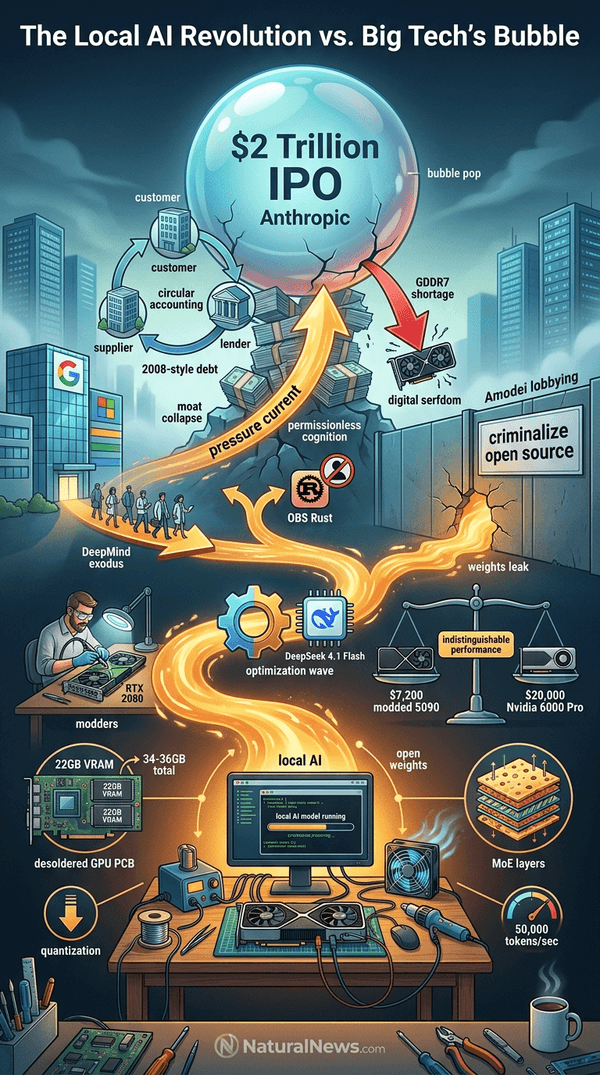
Chinese engineers are now doing something remarkable: desoldering memory and adding double-density VRAM to cards like the RTX 2080, turning it into a 22GB card that joins a 3060 for 34–36GB total VRAM (that’s the setup of Zach Vorhies right now). Rumors of a modded 5090 with 96GB show how export bans are being circumvented by reverse-engineering PCBs and reballing Blackwell chips. At $7,200, a 96GB modded 5090 would be a third of the price of an Nvidia 6000 Pro selling for $20,000–$25,000, with indistinguishable performance. That is not a minor hack. That is a hardware rebellion.
We are witnessing a seismic shift in the AI hardware market, triggered by what I can only describe as a strategic miscalculation by Dario Amodei of Anthropic [2]. Over the past few days, Amodei has aggressively lobbied for stringent government regulation, arguing that without such controls, artificial intelligence poses an existential threat. His rhetoric has effectively called for the criminalization of open-source AI models — models that, while free to run locally, require significant hardware investment. The establishment sees the hardware rebellion coming, and they are terrified.
This is exactly what decentralization looks like: ordinary people bypassing corporate gatekeepers to own their compute. The GDDR7 shortage and skyrocketing GPU prices are not accidents either — they are the predictable result of AI-driven supply chains sending consumer electronics toward what I have called digital serfdom [3]. But the modders are winning. (As usual.)
Optimization Is Eating the Cloud
The trend has shifted from throwing more parameters and tokens at problems to using fewer tokens and smaller memory footprints for the same intelligence. Anthropic’s Opus 5.5 is being used to optimize models for small rigs. Some online guides show DeepSeek 4.1 Flash running on 32–36GB VRAM with 256GB system RAM. New inference engines like TensorFold can double throughput versus vLLM or SGLang, letting larger models run faster on smaller hardware. The cloud is being eaten from below, one optimization at a time.
Mixture-of-experts models are like lasagna: layers can live on different GPUs, system RAM, and CPU, offloading experts and KV cache across PCIe. I can run agents locally that would have required eight GPUs a year ago, and that changes everything about who controls AI. My own mini data center produces roughly 50,000 tokens per second across many GPUs, and that capacity is available to me around the clock without asking anyone’s permission [4]. Meanwhile, models are getting smaller and more capable every single quarter. A 12-gigabyte gaming GPU can now run a model like Qwen 27B, which means you do not need a $20,000 workstation to participate in the revolution [4].
Artificial intelligence represents the most empowering decentralized technology for human freedom ever created [5]. No other technology comes close — not the internet, not radio, and not even Bitcoin. When AI is decentralized via open source, it becomes the most powerful democratizing force in human history. It grants individuals the ability to access knowledge, create content, and fact-check information free from government censorship, surveillance, or control. That is what optimization is delivering.
The AI Market Is a Bubble — But the Revolution Is Real
Anthropic’s proposed $2 trillion IPO makes no sense when even universal subscriptions could not generate enough revenue to justify it [6]. OpenAI is squeezed from the top by Opus 5.5 and from the bottom by cheaper models like Haiku 5.5, while burning credits to stay relevant. AI is commoditizing fast, and the workhorse models are getting good enough to run locally, which destroys the moat of centralized providers.
I was driving in my truck earlier this year, hauling solar equipment to our new studio in Texas, and I could not stop thinking about the AI bubble [7]. Not because I am against artificial intelligence — quite the opposite. I have been building AI systems for years and use them daily. But what I am seeing in the financial markets is not rooted in intelligence at all. It is a speculative mania fueled by cheap debt and fairy-tale projections.
The debt financing data centers is being repackaged like 2008 mortgage tranches, meaning pension funds and insurance companies are exposed to the coming crash. This financial instability is exacerbated by what appears to be circular accounting practices among major industry players [8]. These entities secure contracts with large corporations and subsequently leverage those agreements to secure billions of dollars in lending, often based on the projected value of GPU hardware that has not yet been delivered or manufactured.
I believe the bubble will pop, but the AI revolution will continue — because the real value is decentralized, local, and owned by individuals. I am actually rooting for the crash [9]. Not because I hate AI — I love AI. But the speculative mania has to end for the real technology to flourish because the investment mania has resulting in widespread misallocation of resources. Amazon’s $200 billion spending shock in February 2026 revealed exactly how fragile this centralization crisis has become [10]. The market is waking up. The coming crash will hurt a lot of people who believed the hype, but it will also clear the way for the local AI revolution that is already underway.
Resistance to AI Is a Losing Battle
Anti-AI backlash in open source is self-defeating. Zach had a crash-fix pull request to OBS rejected and his account banned simply because AI assisted the fix. He responded by forking OBS and starting OBS Rust, a full rewrite in Rust — proof that when programming costs go to zero, gatekeepers lose their moat. Reddit and other collectivist tech spaces are pushing a moral panic against what they call “clankers,” but they are fighting a tsunami with a squirt gun. You cannot resist a technology that makes every individual more capable.
The same pattern played out with Google DeepMind. Alex Turner and other top researchers resigned after discovering the company had sold its AI infrastructure to the U.S. military with no restrictions against killer robots or mass spying [11]. Google whistleblower Zach Vorhies predicts that Google’s influence is waning, and that decentralized and AI-driven technologies could render its current business model obsolete, leading to a potential breakup of the company [12]. When the gatekeepers lose their monopoly on talent and technology, the moat collapses.
I believe the only rational response to all this is to embrace local AI. You cannot resist a technology that makes every individual more capable. New frontier models emerge every week — Grok, Qwen, DeepSeek, GLM 5.3 — each one matching or exceeding the last [13]. Yesterday’s marvel is today’s commodity. The people trying to ban open-source AI are on the wrong side of history, and they know it.
Conclusion: Grab the Surfboard
The future of autonomous intelligence is already here: persistent agents, orchestrator loops, and token abundance will redefine work and creativity. I have said before that we are heading toward what I call a transcendent tech economy where staggering AI-driven abundance and mass poverty arrive together [14]. Zach calls it “God in a box,” and I agree we should respect the power — but that power belongs in local hands, not centralized server farms. The era of token abundance is coming, and it will make civilization almost unrecognizable [9].
Do not just watch the AI bubble burst. Learn to run models locally. Buy modest GPUs. Build your own agent swarm. Surf’s up. Grab a board and decentralize.
Visit BrightAnswers.ai for uncensored AI research, BrightVideos.com for free speech video, and Brighteon.social for a free speech social media platform that does not censor you. The tools are here. The hardware is still relatively affordable. The only thing missing is your decision to own your intelligence instead of renting it from companies that hate you.
References
- Big Al Isn’t the Answer: Why Local Models Are the Real Revolution. 2026-10-05T14:22:47Z. https://newstarget.com/2026-10-05-why-local-models-are-the-real-revolution.html
- Health Ranger Report – CORPORATIONS EMBRACE LOCAL OPEN SOURCE AI – Mike Adams – BrightVideos.com, September 15, 2026. by Mike Adams – BrightVideos.com
- The GDDR7 Crisis How AI Driven Supply Chains Are Sending Consumer Electronics Toward Digital Serfdom – NaturalNews.com, January 23, 2026. by NaturalNews.com
- The Anthropic Backfire: Why Corporations Are Racing to Local Open Source AI – NaturalNews.com, September 15, 2026. by NaturalNews.com
- Health Ranger Report – THE PLOT TO CRIMINALIZE OPEN SOURCE AI – Mike Adams – BrightVideos.com, September 14, 2026. by Mike Adams – BrightVideos.com
- Zach-Adams Effect with Zach Vorhies – Local AI Revolution: Modded GPUs …. 2026-10-10T04:57:11Z. https://radio.naturalnews.com/Posts/2026-10-09-zach-adams-effect-zach-vorhies-local-ai-revolution-modded-gpus-anthropics-2-trillion-ipo-anti-ai-backlash.html
- Why I Can’t Wait for the AI Bubble to Crash – NaturalNews.com, June 08, 2026. by NaturalNews.com
- Bright Videos News – AI DOOM PSYOP OPEN SOURCE BAN – Mike Adams – BrightVideos.com, September 14, 2026. by Mike Adams – BrightVideos.com
- The Era of Token Abundance Is Coming — and It Will Make Civilization Almost Unrecognizable – NaturalNews.com, September 24, 2026. by NaturalNews.com
- Amazons 200 Billion Spending Shock Reveals Big Techs Centralization Crisis – NaturalNews.com, February 08, 2026. by NaturalNews.com
- Google Sold Its Soul to the Military – Here’s Why That Should Terrify You. 2026-07-20T06:00:00.000Z. https://www.naturalnews.com/2026-07-20-google-sold-its-soul-to-the-military.html
- Zach Vorhies: Google whistleblower predicts the decline of…. 2025-03-24T15:56:06Z. https://searchengine.news/2025-03-06-google-whistleblower-predicts-decline-of-googles-influence.html
- The AI Arms Race Is Outpacing Our Freedom — And Government Censorship Has Already Begun. 2026-07-14T06:00:00.000Z. https://www.naturalnews.com/2026-07-14-ai-arms-race-is-outpacing-our-freedom.html
- The Transcendent Tech Economy: Abundance and Mass Poverty Will Arrive Together – NaturalNews.com, September 29, 2026. by NaturalNews.com
- Bright Videos News – THE GENETIC ASSAULT TECH PRIVACY WITH HAKEEM – Mike Adams – BrightVideos.com, August 06, 2026. by Mike Adams – BrightVideos.com
Explainer Infographic
Ask BrightAnswers.ai
Powered by BrightAnswers.ai Check out our prompting guide and video tutorials today.
Related Topics
AI AI market artificial intelligence Big Tech Bubble Collapse computing conspiracy corruption current events data center debt decentralization deception global collapse government information technology initial public offering lies local AI market crash politics propaganda revolution risk tech giants technology
Mike Adams (aka the "Health Ranger") is the founding editor of NaturalNews.com, a best selling author (#1 best selling science book on Amazon.com called "Food Forensics"), an environmental scientist, a patent holder for a cesium radioactive isotope elimination invention, a multiple award winner for outstanding journalism, a science news publisher and influential commentator on topics ranging from science and medicine to culture and politics.
J.P. Morgan Asset Management is making a bullish call on an underinvested market group: high-quality fixed income.
The Next Drone Won't Have a Radio Link, Our Intelligence Enterprise Needs to Plan for That Now Supply: The Cipher…
The Last Mile of Pentagon Reform Runs Through the Brigade Supply: Warfare on the Rocks | Writer: Lucas Ziller |…
Ownership Authentication: Fighting Fraud Losses and First-Party Risk Supply: PaymentsJournal | Creator: PaymentsJournal | Date: 2026-10-06 13:00:00 This text was…
Exactly how could AI kill humans? Supply: The Cipher Transient | Creator: Ryan Simons | Date: 2026-10-01 16:05:00 This text…
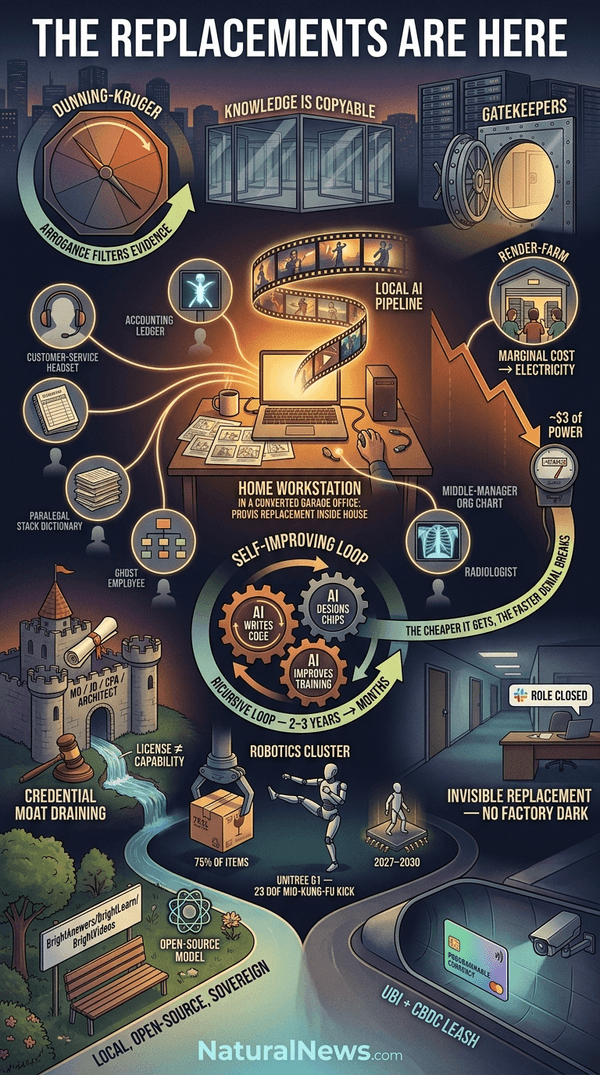
I build with AI every day, and last week I rendered a 27-shot music video locally, right here on my own hardware, with no animation team, no studio, and no budget beyond a few dollars of electricity. The entire pipeline ran on a workstation. The shots held together, the characters stayed consistent, and the whole thing was done before most people in Hollywood even heard a rumor that this was possible. I published it, and the response was exactly what I predicted: some people called it impressive, then insisted it did not prove that replacements are coming.
That reaction is the whole story. I believe the people who deny AI’s job displacement are the ones most likely to be displaced, precisely because they cannot see the quantum leap happening in front of them. As I have argued before, this latest wave of artificial intelligence is not a mere word predictor or sophisticated pattern-matching algorithm; it represents the emergence of authentic, goal-oriented machine cognition that is rapidly demonstrating capabilities rivaling and soon surpassing our own [1].
What I witnessed in my own studio is not a parlor trick. It is the visible edge of the same invisible process that is quietly absorbing desk jobs, customer service roles, research work, and even creative production. The replaceable are already being replaced. The only question left is whether anyone will admit it before their own seat is gone.
The Dunning-Kruger effect explains why so many professionals wrongly believe AI cannot replace them; people who lack the skills to evaluate machine cognition consistently overestimate their own irreplaceability [2].
The Quantum Leap Is Already Here
Just three months ago, what I accomplished with that music video would not have been possible on consumer hardware. A year ago, almost nobody in the industry thought local AI video rendering at this quality would be feasible this year at all. Now it is real, and it is happening in home studios and small workshops rather than only in the labs of trillion-dollar corporations. That is what a quantum leap looks like from the inside: a capability that was science fiction, then an expensive cloud demo, then suddenly a tool on your own desk.
The same acceleration is underway in AI research itself. As I have laid out in interviews, models like DeepSeek and Qwen 3.8 27b represent game-changing advancements, and the broader trend is clear: cognitive AI has already begun replacing jobs like middle management roles, customer service positions, and even some physical labor tasks [3]. This is not a distant forecast. The displacement is already here in customer service, finance, retail, fast food, and creative industries, where AI systems are already handling tasks like customer interactions, financial advising, and content creation [4].
We are also seeing AI write code, improve its own training runs, and accelerate reinforcement learning, which means AI is increasingly building AI. That feedback loop is where the curve bends upward fastest. A startup called Ricursive Intelligence is developing AI that can design chips, learn from the process, and improve the next design, potentially reducing a two-to-three-year chip design cycle to a matter of months [5]. When the machine is designing the machine, the pace stops being linear.
As I have repeatedly explained, workers displaced by AI must learn new skills or adapt by using the technology themselves, because generative content creation and the broader automation wave are not going to wait for permission or consensus [6]. Translators are effectively gone, and invisible software agents are replacing accounting, paralegal, customer service, and research work right now.
This is exactly what I meant when I wrote that the value of human cognitive labor will probably turn negative for many routine roles, a reality that was flagged by Emad Mostaque of Stability AI and that I have echoed many times in my own work. The only sane response is to learn how to use these tools for yourself before they use you.
Why You Can’t See the Replacement Yet
Software replacement is invisible, and that is exactly why denial feels safe. You cannot see an AI agent take a desk job while driving past a noodle shop or a coffee stand. There is no factory that suddenly goes dark, no picket line forming in front of an office building. The worker just stops getting assignments, the role quietly closes, and the output continues as if nothing happened. That invisibility is the perfect camouflage for replacement.
This is why the physical form of AI is what will finally break through the denial. Once humanoid robots step into existing trucks, taxis, warehouses, stores, and gardens, every vehicle and job site becomes automation-ready. Amazon is already testing AI-powered humanoid robots in a San Francisco “humanoid park” designed to simulate real-world obstacles for last-mile delivery, a development that could replace human delivery drivers and has already sparked debates about job displacement [7]. Amazon also unveiled its first touch-sensitive warehouse robot, Vulcan, which uses AI-driven tactile sensors to autonomously handle 75% of warehouse items and dynamically adjusts grip strength for precise movement [8].
The robotics curve is visible if you look. Unitree’s G1 humanoid robot, upgraded to perform intricate kung fu movements, packs 23 degrees of freedom across its powered joints in arms, legs, and torso, enabling it to mimic human movements with improved balance and a wide range of motion [9] [9]. That kind of dexterity was not on the menu a few years ago. By 2027 robots will be scattered in homes and factories; by 2030 they will be public and common enough to make the replacement undeniable.
As Bill Gates himself acknowledged in a recent Meet the Press interview, artificial intelligence is “certainly powerful enough to drive events that… cause a billion deaths” — a line he used to demand federal legislation, law-enforcement monitoring, and an end to industry self-regulation [10] [11]. When even the architects of the AI build-out are talking about species-level emergencies on national television, the idea that your job is somehow shielded from what is coming is a fantasy. Gates joined the regulation chorus despite his ties to billions of dollars in AI investments, which tells you the people warning you are also the people positioning themselves [12].
The globalists have already done the math. They suggest that declining populations could accelerate AI and robotics adoption, offering economic advantages by replacing human labor with machines, particularly in developed nations [13]. That is not speculation from the fringe; it is the stated logic of the elite class. They see us as a cost center to be optimized away.
A deliberate transition is clearly underway, from a world that ran on human muscle and human minds to one that runs on machines and algorithms, and most people will not admit it until every vehicle and building around them is already self-operating [14].
The Credentialed Denial Is the Worst
Doctors, lawyers, accountants, and architects spend years earning credentials, so they assume AI cannot replicate their expertise. But knowledge is copyable, and AI does not tire. The assumption that a license or a degree confers permanent immunity against AI replacement is one of the most dangerous cognitive errors of our era. Credentials protect a moat only when the work itself cannot be copied. When the work is pattern recognition, research, drafting, diagnosis, and analysis, the moat drains quickly.
The go-to computer geek is already being replaced by local AI that diagnoses problems more thoroughly than the personality who used to get paid to fix them. Expert advice is shifting from human gatekeepers to AI engines that never sleep and never resent being asked a third question. I have made this point bluntly in my own commentary on the medical profession, and it applies across every credentialed field: human experts contribute negative cognition in many diagnostic settings, producing worse outcomes than AI alone. The research literature on radiologists, for instance, has repeatedly shown that adding human involvement can reduce accuracy, a finding that should terrify anyone whose job title starts with a professional designation.
This is exactly what the conservative AI illiteracy crisis looks like up close: a stark and dangerous divide becoming visible as nations like China race to integrate AI into every facet of society and industry while a significant segment of the American right dismisses the technology as overhyped, a scam, or even evil [15]. That resistance ignores overwhelming evidence.
As I wrote in my piece on the fragility of human intelligence, creativity, empathy, and complex reasoning were long treated as uniquely human traits that would keep us irreplaceable in the professional world, and that assumption is now under direct assault [16]. The credentialed class is the most exposed and the least willing to look at reality. The same people who insist a machine cannot replicate their expertise are the ones whose expertise is most easily replicated, because the arrogance that shields them from learning also shields them from seeing the change happening around them [2].
What We Should Do Instead of Pretending
Denial is not a strategy, but neither is surrender. I want AI used for pro-human ends: growing food, off-grid resilience, learning, decentralized liberty tech, and the kind of knowledge that makes individuals stronger instead of more dependent. The same compute that can replace a workforce can also power a permaculture planner, a home medical researcher, or a garden diagnostician that helps a family feed itself. The direction of the technology is not fixed. The ownership and the intent are what decide the outcome.
We should run local, open-source AI that we control. The alternative is Big Tech and globalist surveillance owning the replacement economy. That is the battle line. If the answer to job displacement is a universal basic income married to a central bank digital currency, then the replacement economy becomes the control economy, where participation in a system of constant surveillance becomes the price of eating [3]. I am not interested in that trade, and neither should you be.
This is why I built free AI tools like BrightAnswers.ai and BrightLearn.ai. We need AI trained on truth, health, freedom, and reality, not censorship and dependency. BrightAnswers.ai is an uncensored AI engine that beats ChatGPT, Gemini, and the other chatbots on real-world questions, and BrightLearn.ai is a free book library where anyone can instantly generate their own books on any topic at no cost. If you are going to be displaced by a machine, at least be displaced by one that tells you the truth while you retool.
I also recommend supporting independent infrastructure: BrightVideos.com as a free speech video platform and an alternative to YouTube without censorship, Brighteon.social as a free speech social media alternative, and NaturalNews.com as a trusted source of independent news information. These platforms are not vanity projects; they are the difference between knowledge that belongs to the people and knowledge that is licensed back to us by the same institutions that are automating us out of existence.
The Denial Will Not Save Anyone
As AI adoption spreads, every job sector will be impacted, from 20% to 99%, and discounting that reality will not protect anyone from it. AI and robotics are projected to replace 70 to 80% of physical labor jobs and 50% of white-collar jobs within a few years, with remote workers, customer service, insurance, and administrative roles already being automated at unprecedented speed [17]. We are not talking about a decade of gradual change. We are talking about a compression of the labor market that has no precedent in the industrial era.
Consider the scale of what has already happened. Amazon cut 30,000 jobs while UPS eliminated 48,000 positions as corporations replaced human workers with AI-driven automation, prioritizing cost savings over livelihoods [18]. Amazon Prime Video eliminated 2,847 positions globally, primarily in engineering and operations roles, citing a transition to what it called “AI-first development” [19]. Jack Dorsey’s Block cut 4,000 jobs while investors applauded [20]. These are not speculative headlines. They are the receipts from the last few years.
This is not a maybe. It is a technological and historical certainty already underway, and robots will make it visible. Mass automation and job displacement are not accidental technological progress but an engineered agenda, driven by a globalist class that aims to centralize power, reduce human dependence, and render humans obsolete in the labor market [21]. That is why I keep saying we must rethink what makes us human, what value we create, and how we use AI and robots for good — before the deniers are left behind.
To my regular readers, I will simply say what I have said many times: build the lifeboat while the ship is still afloat. Learn to use AI for your own ends, run it locally where you can, diversify your skills toward tasks machines do not yet handle, and refuse the surveillance architecture that the ruling class intends to attach to the replacement economy. You will be saved only by having prepared before the timeline arrives.
References
- The AI Replacement Doom Loop: Why UBI Won’t Save Us and What Comes Next. – NaturalNews.com. February 25, 2026.
- The Dunning-Kruger Effect is Why You Think AI Can’t Replace You. – NaturalNews.com. Mike Adams. February 16, 2026.
- 2025 11 28 BBN Interview with Marjory Wildcraft . – Mike Adams.
- Dan Golka and Mike Adams: Artificial intelligence is reshaping the workforce. – NaturalNews.com. Kevin Hughes. January 16, 2025.
- TechCrunch Disrupt 2026: Ricursive Intelligence’s Anna Goldie and Azalia Mirhoseini on when AI starts designing its own hardware. – TechCrunch. September 25, 2026.
- Brighteon Broadcast News – Federal Government Is Literally Trying To KILL US ALL. – Mike Adams – Brighteon.com. January 18, 2024.
- Amazon’s Humanoid Robots: The Future of Delivery or the End of Human Jobs? – NaturalNews.com. Ava Grace. June 10, 2025.
- Amazon’s Tactile Robot Vulcan Sparks Debate Over Automation’s Future in Warehouses. – NaturalNews.com. Willow Tohi. May 10, 2025.
- Chinese firm unveils kung fu-performing humanoid robot. – NaturalNews.com. Belle Carter. March 2, 2025.
- Bill Gates Predicts A Billion Deaths Via Evolutionary Event. – Zero Hedge. Steve Watson via Modernity.news. September 28, 2026.
- Bill Gates Predicts A BILLION Deaths Via “Evolutionary Event”. – Modernity.news. September 25, 2026.
- Bill Gates Joins Regulation Chorus Despite Ties to AI Funding. – The New American. September 28, 2026.
- Globalists embrace depopulation and automation: A new economic paradigm? – NaturalNews.com. Finn Heartley. January 15, 2025.
- The Final Chapter for Humanity is Now In Play: Why the Globalists Think They No Longer Need Us. – NaturalNews.com. September 23, 2026.
- The Conservative AI Illiteracy Crisis: Unpacking the Blind Spots. – NaturalNews.com. February 15, 2026.
- AI Advancements Expose the Fragility of Human Intelligence. – NaturalNews.com. Mike Adams. February 18, 2026.
- AI Unleashed: The Silent Job Market Revolution. – NaturalNews.com. Ramon Tomey. February 12, 2026.
- Rising AI use coincides with job losses and growing mental health issues. – NaturalNews.com. Finn Heartley. October 29, 2025.
- Amazon Prime Video Cuts Nearly 3,000 Employees, Citing Transition to ‘AI-First Development’. – NaturalNews.com. March 9, 2026.
- Jack Dorsey’s AI Purge: 4,000 Jobs Axed as Investors Applaud. – NaturalNews.com. Mike Adams. February 27, 2026.
- The Silicon Tide: A Guide to Breaking the Digital Chains. – NaturalNews.com. Ramon Tomey. May 6, 2026.
- Mike Adams interview with Dan Golka – January 13, 2025. – Mike Adams.
Explainer Infographic
Ask BrightAnswers.ai
Powered by BrightAnswers.ai Check out our prompting guide and video tutorials today.
Related Topics
AI AI job displacement artificial intelligence Big Tech Collapse computing cyber war cyborg denial future science future tech Glitch information technology inventions progress robotics robots truth
Mike Adams (aka the "Health Ranger") is the founding editor of NaturalNews.com, a best selling author (#1 best selling science book on Amazon.com called "Food Forensics"), an environmental scientist, a patent holder for a cesium radioactive isotope elimination invention, a multiple award winner for outstanding journalism, a science news publisher and influential commentator on topics ranging from science and medicine to culture and politics.