Browsing: bioterrorism
Accountability reaches a crossroads
A convergence of legal challenges and media revelations has placed former National Institutes of Health Director Dr. Anthony Fauci at the center of an intensifying accountability movement, as Republican lawmakers pursue contempt proceedings, perjury investigations, and revelations emerge about alleged censorship of pandemic-related reporting.
The developments mark a significant shift in the public reckoning over COVID-19 policy decisions that resulted in prolonged school closures, business shutdowns and unprecedented government mandates affecting millions of Americans.
Senate subpoena refusal escalates tensions
On Friday, Fauci declined a voluntary request to appear before Sen. Ron Johnson’s Permanent Subcommittee on Investigations, marking the second Senate panel seeking his testimony. The Wisconsin Republican has conducted a parallel investigation into the federal pandemic response, including vaccine safety and efficacy questions.
Johnson’s office confirmed receiving notification from Fauci’s attorney rejecting the interview request. The senator stated that his subcommittee would continue obtaining records and speaking with former associates of the longtime public health official while exploring legal options.
This refusal follows the Senate Homeland Security Committee’s party-line vote to hold Fauci in contempt after his July 29 appearance, during which he asserted Fifth Amendment protections more than 100 times rather than answer substantive questions.
Media censorship allegations surface
In a separate development, former ABC News senior national correspondent Terry Moran revealed that his network gutted a 2021 Nightline investigation into the Wuhan lab-leak theory after Fauci reviewed the script. Speaking on The Fifth Column podcast, Moran described receiving the edited piece with instructions that Fauci had seen it.
Moran stated that the final product arrived “incomprehensible,” stripped of meaningful analysis and loaded with caveats. The former correspondent said he never watched the broadcast again because it no longer represented his work.
The account provides a rare insider perspective on how mainstream media outlets handled lab-origin questions during the pandemic, when such inquiries were frequently dismissed as fringe conspiracy theories.
Legal arguments over Fifth Amendment protections
Sen. Rand Paul, the Kentucky Republican chairing the Homeland Security Committee, has argued that former President Joe Biden’s preemptive pardon of Fauci eliminates any legitimate basis for invoking Fifth Amendment protections against self-incrimination.
Legal experts have noted the complexity of the pardon question. While a federal pardon removes criminal jeopardy for covered offenses, it does not necessarily protect against state prosecutions or civil litigation. State attorneys general in Florida, Alabama and Louisiana have opened separate investigations.
Paul has also renewed calls for the Justice Department to examine whether Fauci committed perjury during his 2021 congressional testimony about gain-of-function research funding. Fauci testified that NIH did not fund such research at the Wuhan Institute of Virology, a statement Paul contends was false.
Historical context and ongoing investigations
The current pressure on Fauci follows years of scrutiny over pandemic policies and research funding decisions. Documents obtained through congressional investigations revealed private communications where Fauci discussed potential risks associated with COVID-19 vaccines that were not publicly disclosed at the time.
Emails released by Paul’s office showed Fauci instructing then-NIH Director Francis Collins to “read it, then destroy it” regarding certain records — language that Paul characterized as a potential violation of federal records law.
The House Select Subcommittee on the Coronavirus Pandemic previously conducted its own investigation, producing a final report that challenged several of Fauci’s public statements regarding lab-leak origins and research funding.
A reckoning long deferred
The accumulation of legal challenges, media revelations and congressional actions suggests that the era of unquestioning deference to public health authorities has ended. Johnson’s subcommittee continues pursuing records and witness testimony, while the contempt referral awaits action at the Justice Department.
Whether these efforts produce criminal charges, civil liability, or simply a fuller public accounting remains uncertain. What appears increasingly clear is that the American people’s demand for answers about the COVID-19 response will not be satisfied by silence, privilege claims, or media gatekeeping.
The investigations into Fauci’s conduct represent more than a political conflict. They raise fundamental questions about government transparency, scientific integrity and the accountability of unelected officials whose decisions carried profound consequences for individual liberty and public health.
Sources for this article include:
. vaccines Anthony Fauci badhealth badmedicine badscience big government biological weapon bioterrorism biowar conspiracy covid-19 Dangerous Medicine gain-of-function infections medical fascism Medical Tyranny outbreak pandemic real investigations science deception science fraud spike protein traitors vaccine wars

Please contact us for more information.
Who We Are
Meet the Health Ranger
Free Email Newsletter
Support
Write for Us
Media Information
Advertising Information
Submit a News Tip
Privacy Policy
Terms of Use
Home
All News
Health Ranger Store
Health Ranger Report Podcast
Natural News App
BrightAnswers.ai
Blog Articles
RSS Feed
This site is part of the Natural News Network © 2022 All Rights Reserved. Privacy | Terms All content posted on this site is commentary or opinion and is protected under Free Speech. Truth Publishing International, LTD. is not responsible for content written by contributing authors. The information on this site is provided for educational and entertainment purposes only. It is not intended as a substitute for professional advice of any kind. Truth Publishing assumes no responsibility for the use or misuse of this material. Your use of this website indicates your agreement to these terms and those published here. All trademarks, registered trademarks and servicemarks mentioned on this site are the property of their respective owners.
The resulting pathogens, known as bacteriophages – viruses that infect bacteria – cannot infect humans or animals, the report stated. Samuel King, a Stanford graduate student and study author, told the New York Times (NYT): “It just felt like the obvious next step.” Large language models, which underlie tools such as ChatGPT, can generate realistic text and pose risks of misuse in creating fake news or other misinformation [1].
Evo Model Trained on Genetic Sequences
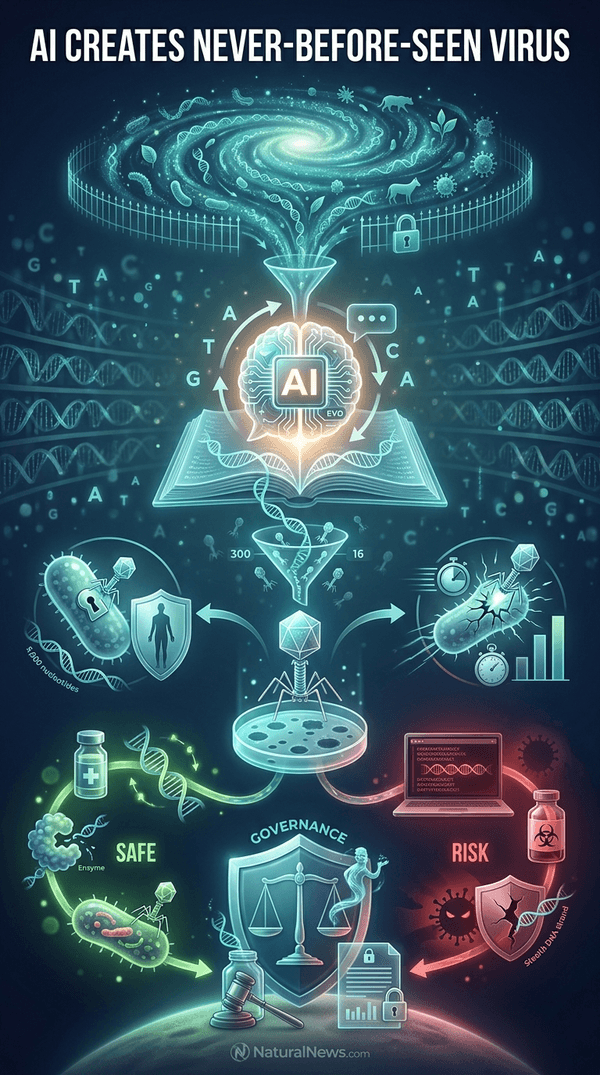
Evo, a program similar to ChatGPT, scanned about nine trillion nucleotide bases from animals, plants, viruses and microbes, according to the research team. Rather than analyzing written text, the model was used to dissect and form genetic code, the report stated.
After learning natural DNA patterns, Evo generated nearly 300 genomes of Phi X-174, a virus chosen because it cannot infect humans or animals. Sixteen of those genomes were determined to be viable, the study reported.
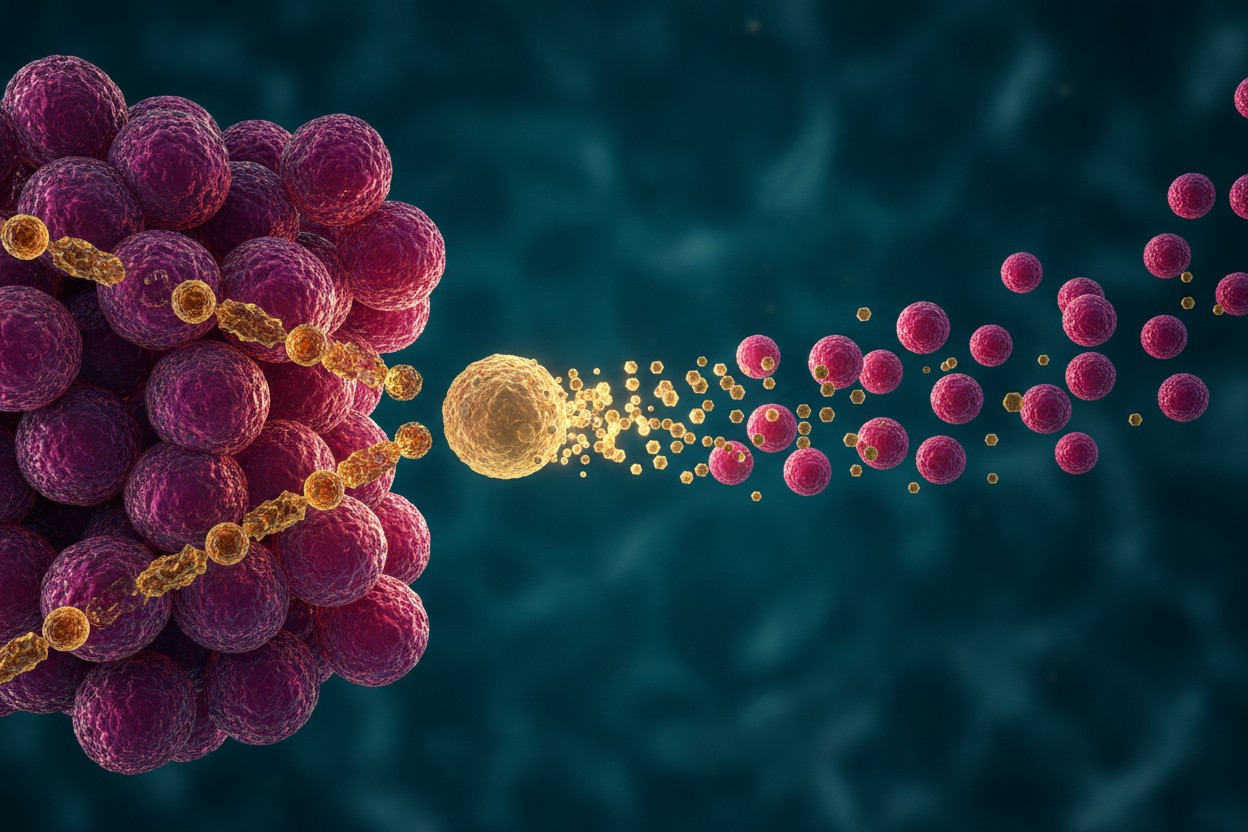
In petri dish tests, some AI-designed phages multiplied faster than the original Phi X-174 and burst out of host cells, according to the authors. The researchers selected Phi X-174 because a virus genome is less complex than the DNA instructions found in a human cell, the report stated.
Researchers Call Study a Turning Point
Marc Güell of Pompeu Fabra University in Spain told the BBC the study was “a very significant turning point” and “allows us to dream of exciting possibilities for tackling humanity’s greatest challenges.” Güell said that “for the first time in history, we are beginning to design biology on a computer,” according to the BBC.
The scientists said they did not provide the model with data from viruses that infect humans, animals, plants or fungi, the article noted. The team also excluded similar viruses that infect other organisms, the report stated.
Biosafety and Biosecurity Questions Raised
But Dr. Thomas Inglesby and Dr. Moritz Hanke of the Johns Hopkins Center for Health Security wrote in a Science article that the results raised “urgent biosafety and biosecurity questions.” They said the issue is no longer “whether generative viral genome design will exist” but whether it can be used without “enabling serious harm.” Viruses that could cause disease “should not be pursued,” they added, according to the report.
Hanke told NYT: “You could say, ‘Hey, genomic language model, make me an influenza genome that is modified to be more transmissible or to be more lethal.'” A Microsoft study demonstrated that AI can be used to design novel, toxic biological agents by “paraphrasing” the genetic sequences of known toxins, allowing them to bypass commercial biosecurity screening software, according to a NaturalNews.com report [2].
The U.S. National Institutes of Health should improve how it regulates lab-generated viruses that could pose a national security risk, according to its biosecurity advisers, the National Science Advisory Board for Biosecurity [3]. In a previous case, a team at Boston University’s National Emerging Infectious Diseases Laboratories developed a new strain of the Wuhan coronavirus (COVID-19) that killed 80% of infected mice in a laboratory setting, according to a preprint study [4]. Declassified documents released in June 2026 showed U.S.-funded coronavirus research included planning for spike-protein modifications, receptor-adaptation experiments, and testing in humanized mice, according to ZeroHedge [5].
Implications of AI-Designed Pathogens
The study is among the first examples of generative AI being applied to biology, according to researchers, and the field remains at an early stage. Scientists emphasized that the resulting bacteriophages pose no threat to humans, but the methods could be adapted to other genomes, experts said.
Some analysts have said that only a few companies in the world have the resources to invest in developing large language models similar to GPT-4, a factor that could shape oversight [1]. The report raised policy questions about future oversight of AI-generated biological sequences, with the authors stating that dangerous viruses should not be pursued. A technology executive described one path as “to completely prioritize technology to maximize what’s possible without considering potential implications.” [1]
References
- aacid zlib3 files 20241105T001425Z 29870425 3zFrZWC8qLJzJ5FoyS9nN5.
- Ava Grace. “Digital Pandora’s Box: How AI Outsmarts Biosecurity and Paves the Path for Next-Generation Threats”. NaturalNews.com. October 09, 2025.
- Emily Kopp. “‘Vague and Secretive’: Risky NIH Research Not Adequately Regulated, Experts Say”. Children’s Health Defense. January 21, 2024.
- Michael Nevradakis. “Insane: Boston Researchers Create ‘More Lethal’ Strain of COVID, Prompting Calls to Shut Down Risky Gain-of-Function Research”. Children’s Health Defense. January 21, 2024.
- “Gabbard Drops Fauci COVID-19 Receipts On Last Day: He Funded The Research, Cooked The Cover Story, Then Lied To Congress”. Zero Hedge. June 19, 2026.
Explainer Infographic

AI model artificial intelligence bacteriophages badhealth badscience biological weapons biosafety biosecurity bioterrorism biowar computing Dangerous DNA patterns Evo future tech genetic lunacy Glitch information technology nucleotides pathogens Phi X-174 robots virus genome Viruses
Please contact us for more information.