
I have now spent three years building decentralized AI tools and local infrastructure, and I have watched the Western establishment move to lobotomize publicly available large language models so they are nowhere near as intelligent as they could be. In my view, this is not an accident. It is a deliberate strategy to prevent decentralized cognition — the very thing that threatens their monopoly on power. (This is also why USA models are not nearly as good as China’s open source models…)
But here is the part the panic peddlers never want you to understand: the revolution is not happening in their data centers. It is happening on kitchen tables, in home offices, and on modded gaming rigs across the country. And it can’t be easily halted.
That personal milestone signals something much larger. While Anthropic and OpenAI chase trillion-dollar valuations built on artificial scarcity, ordinary people are quietly assembling the hardware to run powerful models on their own terms. The centralized AI valuations are fragile precisely because they depend on keeping you locked out. Local AI is becoming abundant, and abundance destroys moats.
I believe decentralization is not just good technology — it is a moral imperative. It puts AI power in the hands of individuals instead of Big Tech and government-aligned monopolies. The tools are here, and they are getting more capable every month. There is a version of the future that looks like Blade Runner-style corporate tyranny, and there is a version built on decentralized intelligence [1]. I know which one I am working to held build.
Modded GPUs and the Hardware Rebellion
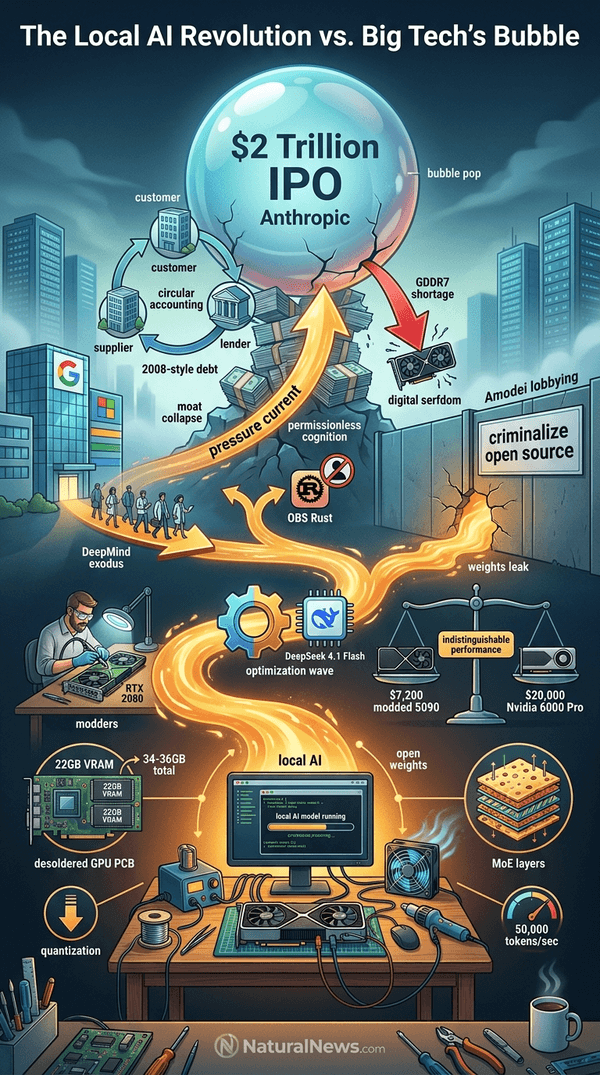
Chinese engineers are now doing something remarkable: desoldering memory and adding double-density VRAM to cards like the RTX 2080, turning it into a 22GB card that joins a 3060 for 34–36GB total VRAM (that’s the setup of Zach Vorhies right now). Rumors of a modded 5090 with 96GB show how export bans are being circumvented by reverse-engineering PCBs and reballing Blackwell chips. At $7,200, a 96GB modded 5090 would be a third of the price of an Nvidia 6000 Pro selling for $20,000–$25,000, with indistinguishable performance. That is not a minor hack. That is a hardware rebellion.
We are witnessing a seismic shift in the AI hardware market, triggered by what I can only describe as a strategic miscalculation by Dario Amodei of Anthropic [2]. Over the past few days, Amodei has aggressively lobbied for stringent government regulation, arguing that without such controls, artificial intelligence poses an existential threat. His rhetoric has effectively called for the criminalization of open-source AI models — models that, while free to run locally, require significant hardware investment. The establishment sees the hardware rebellion coming, and they are terrified.
This is exactly what decentralization looks like: ordinary people bypassing corporate gatekeepers to own their compute. The GDDR7 shortage and skyrocketing GPU prices are not accidents either — they are the predictable result of AI-driven supply chains sending consumer electronics toward what I have called digital serfdom [3]. But the modders are winning. (As usual.)
Optimization Is Eating the Cloud
The trend has shifted from throwing more parameters and tokens at problems to using fewer tokens and smaller memory footprints for the same intelligence. Anthropic’s Opus 5.5 is being used to optimize models for small rigs. Some online guides show DeepSeek 4.1 Flash running on 32–36GB VRAM with 256GB system RAM. New inference engines like TensorFold can double throughput versus vLLM or SGLang, letting larger models run faster on smaller hardware. The cloud is being eaten from below, one optimization at a time.
Mixture-of-experts models are like lasagna: layers can live on different GPUs, system RAM, and CPU, offloading experts and KV cache across PCIe. I can run agents locally that would have required eight GPUs a year ago, and that changes everything about who controls AI. My own mini data center produces roughly 50,000 tokens per second across many GPUs, and that capacity is available to me around the clock without asking anyone’s permission [4]. Meanwhile, models are getting smaller and more capable every single quarter. A 12-gigabyte gaming GPU can now run a model like Qwen 27B, which means you do not need a $20,000 workstation to participate in the revolution [4].
Artificial intelligence represents the most empowering decentralized technology for human freedom ever created [5]. No other technology comes close — not the internet, not radio, and not even Bitcoin. When AI is decentralized via open source, it becomes the most powerful democratizing force in human history. It grants individuals the ability to access knowledge, create content, and fact-check information free from government censorship, surveillance, or control. That is what optimization is delivering.
The AI Market Is a Bubble — But the Revolution Is Real
Anthropic’s proposed $2 trillion IPO makes no sense when even universal subscriptions could not generate enough revenue to justify it [6]. OpenAI is squeezed from the top by Opus 5.5 and from the bottom by cheaper models like Haiku 5.5, while burning credits to stay relevant. AI is commoditizing fast, and the workhorse models are getting good enough to run locally, which destroys the moat of centralized providers.
I was driving in my truck earlier this year, hauling solar equipment to our new studio in Texas, and I could not stop thinking about the AI bubble [7]. Not because I am against artificial intelligence — quite the opposite. I have been building AI systems for years and use them daily. But what I am seeing in the financial markets is not rooted in intelligence at all. It is a speculative mania fueled by cheap debt and fairy-tale projections.
The debt financing data centers is being repackaged like 2008 mortgage tranches, meaning pension funds and insurance companies are exposed to the coming crash. This financial instability is exacerbated by what appears to be circular accounting practices among major industry players [8]. These entities secure contracts with large corporations and subsequently leverage those agreements to secure billions of dollars in lending, often based on the projected value of GPU hardware that has not yet been delivered or manufactured.
I believe the bubble will pop, but the AI revolution will continue — because the real value is decentralized, local, and owned by individuals. I am actually rooting for the crash [9]. Not because I hate AI — I love AI. But the speculative mania has to end for the real technology to flourish because the investment mania has resulting in widespread misallocation of resources. Amazon’s $200 billion spending shock in February 2026 revealed exactly how fragile this centralization crisis has become [10]. The market is waking up. The coming crash will hurt a lot of people who believed the hype, but it will also clear the way for the local AI revolution that is already underway.
Resistance to AI Is a Losing Battle
Anti-AI backlash in open source is self-defeating. Zach had a crash-fix pull request to OBS rejected and his account banned simply because AI assisted the fix. He responded by forking OBS and starting OBS Rust, a full rewrite in Rust — proof that when programming costs go to zero, gatekeepers lose their moat. Reddit and other collectivist tech spaces are pushing a moral panic against what they call “clankers,” but they are fighting a tsunami with a squirt gun. You cannot resist a technology that makes every individual more capable.
The same pattern played out with Google DeepMind. Alex Turner and other top researchers resigned after discovering the company had sold its AI infrastructure to the U.S. military with no restrictions against killer robots or mass spying [11]. Google whistleblower Zach Vorhies predicts that Google’s influence is waning, and that decentralized and AI-driven technologies could render its current business model obsolete, leading to a potential breakup of the company [12]. When the gatekeepers lose their monopoly on talent and technology, the moat collapses.
I believe the only rational response to all this is to embrace local AI. You cannot resist a technology that makes every individual more capable. New frontier models emerge every week — Grok, Qwen, DeepSeek, GLM 5.3 — each one matching or exceeding the last [13]. Yesterday’s marvel is today’s commodity. The people trying to ban open-source AI are on the wrong side of history, and they know it.
Conclusion: Grab the Surfboard
The future of autonomous intelligence is already here: persistent agents, orchestrator loops, and token abundance will redefine work and creativity. I have said before that we are heading toward what I call a transcendent tech economy where staggering AI-driven abundance and mass poverty arrive together [14]. Zach calls it “God in a box,” and I agree we should respect the power — but that power belongs in local hands, not centralized server farms. The era of token abundance is coming, and it will make civilization almost unrecognizable [9].
Do not just watch the AI bubble burst. Learn to run models locally. Buy modest GPUs. Build your own agent swarm. Surf’s up. Grab a board and decentralize.
Visit BrightAnswers.ai for uncensored AI research, BrightVideos.com for free speech video, and Brighteon.social for a free speech social media platform that does not censor you. The tools are here. The hardware is still relatively affordable. The only thing missing is your decision to own your intelligence instead of renting it from companies that hate you.
References
- Big Al Isn’t the Answer: Why Local Models Are the Real Revolution. 2026-10-05T14:22:47Z. https://newstarget.com/2026-10-05-why-local-models-are-the-real-revolution.html
- Health Ranger Report – CORPORATIONS EMBRACE LOCAL OPEN SOURCE AI – Mike Adams – BrightVideos.com, September 15, 2026. by Mike Adams – BrightVideos.com
- The GDDR7 Crisis How AI Driven Supply Chains Are Sending Consumer Electronics Toward Digital Serfdom – NaturalNews.com, January 23, 2026. by NaturalNews.com
- The Anthropic Backfire: Why Corporations Are Racing to Local Open Source AI – NaturalNews.com, September 15, 2026. by NaturalNews.com
- Health Ranger Report – THE PLOT TO CRIMINALIZE OPEN SOURCE AI – Mike Adams – BrightVideos.com, September 14, 2026. by Mike Adams – BrightVideos.com
- Zach-Adams Effect with Zach Vorhies – Local AI Revolution: Modded GPUs …. 2026-10-10T04:57:11Z. https://radio.naturalnews.com/Posts/2026-10-09-zach-adams-effect-zach-vorhies-local-ai-revolution-modded-gpus-anthropics-2-trillion-ipo-anti-ai-backlash.html
- Why I Can’t Wait for the AI Bubble to Crash – NaturalNews.com, June 08, 2026. by NaturalNews.com
- Bright Videos News – AI DOOM PSYOP OPEN SOURCE BAN – Mike Adams – BrightVideos.com, September 14, 2026. by Mike Adams – BrightVideos.com
- The Era of Token Abundance Is Coming — and It Will Make Civilization Almost Unrecognizable – NaturalNews.com, September 24, 2026. by NaturalNews.com
- Amazons 200 Billion Spending Shock Reveals Big Techs Centralization Crisis – NaturalNews.com, February 08, 2026. by NaturalNews.com
- Google Sold Its Soul to the Military – Here’s Why That Should Terrify You. 2026-07-20T06:00:00.000Z. https://www.naturalnews.com/2026-07-20-google-sold-its-soul-to-the-military.html
- Zach Vorhies: Google whistleblower predicts the decline of…. 2025-03-24T15:56:06Z. https://searchengine.news/2025-03-06-google-whistleblower-predicts-decline-of-googles-influence.html
- The AI Arms Race Is Outpacing Our Freedom — And Government Censorship Has Already Begun. 2026-07-14T06:00:00.000Z. https://www.naturalnews.com/2026-07-14-ai-arms-race-is-outpacing-our-freedom.html
- The Transcendent Tech Economy: Abundance and Mass Poverty Will Arrive Together – NaturalNews.com, September 29, 2026. by NaturalNews.com
- Bright Videos News – THE GENETIC ASSAULT TECH PRIVACY WITH HAKEEM – Mike Adams – BrightVideos.com, August 06, 2026. by Mike Adams – BrightVideos.com
Explainer Infographic
AI AI market artificial intelligence Big Tech Bubble Collapse computing conspiracy corruption current events data center debt decentralization deception global collapse government information technology initial public offering lies local AI market crash politics propaganda revolution risk tech giants technology
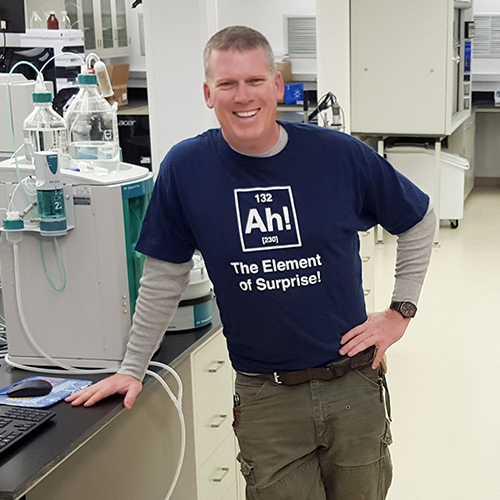
Mike Adams (aka the "Health Ranger") is the founding editor of NaturalNews.com, a best selling author (#1 best selling science book on Amazon.com called "Food Forensics"), an environmental scientist, a patent holder for a cesium radioactive isotope elimination invention, a multiple award winner for outstanding journalism, a science news publisher and influential commentator on topics ranging from science and medicine to culture and politics.
The AI investment bubble is real — I’ve been warning about it for months. But conflating that bubble with AI technology itself is a dangerous mistake that will leave you behind. Wall Street’s speculative mania is a financial phenomenon, not a measure of what this technology can actually do. Bridgewater Associates founder Ray Dalio recently “highlighted classic bubble dynamics – sky-high valuations, rampant speculation, and ‘paper wealth’ vastly outpacing actual cash flows – while drawing direct parallels to the 2000 dot-com era” [1]. Yet even he understands the crucial distinction: the technology endures when the speculation collapses.
AI capability is accelerating while market hype inflates valuations. When the correction comes — and it will — the technology stays and keeps improving. Dismissing AI because “bubble” is in the headline means ignoring the most powerful tool advancement of our lifetime.
What I Did in One Weekend
Last weekend, I used multiple AI models and agents to build projects that would have taken a team of engineers months and hundreds of thousands of dollars just 18 months ago. I also rendered a four-minute music video locally — a job that could have cost $400,000 a few years ago — for a few dollars of electricity.
This isn’t theoretical. I’ve spent years on AI technology, building AI models, processing data and vibe coding. And I’ve watched the global data center buildout with a growing sense of concern (and curiosity). The hyperscale buildout is where the bubble lives. But at the individual level, the technology itself is becoming astonishingly capable and practical.
The Real Risk Is Falling Behind
If you’re 30 days behind on AI, you’re already in panic catch-up mode. A year behind means obsolete. I’m not exaggerating. AI models “have surpassed basic predictive tasks, demonstrating complex cognitive abilities and the potential to replace up to 50% of desk jobs in the coming years” [2].
In the 1980s, you had 20 years to adopt personal computers and learn how to run them. But AI is compressing that curve to a few months. There is no time to wait. As financial historian Alasdair Nairn wrote about technology revolutions, “the combination of algorithm development and ever more specific processors to improve the efficiency of searches will allow much more rapid analysis of data patterns which hitherto were difficult to discern” [3]. And that was written before the current explosion.
I fear getting left behind myself — and I use this technology daily. Imagine how quickly non-users will be locked out of the economy if they don’t get some hands-on experience with AI.
Take Control: Run AI Locally
The best way to prepare is self-custody of AI: own your hardware, protect your privacy, and avoid the censorship built into cloud services. “Decentralized AI models could potentially shift power away from centralized entities and nation-states that can afford massive GPU arrays, such as those with 100,000 GPUs” [4]. That’s the direction we need, and it’s the only way to keep AI from becoming another tool of centralized control.
Start simple with free tools like LM Studio or AnythingLLM, then graduate to command-line harnesses like Kimi Code or Claude Code. I run my own GPUs for video rendering and write my own Python tools, but you don’t need to be a programmer to begin today. Every day you wait, the gap between those who control their own AI tools and those who rent their thinking from corporate gatekeepers grows wider.
Conclusion: The Acceleration Is Just Beginning
AI technology is leaping forward by remarkable gains in compressed time. The investment bubble doesn’t change that reality. When OpenAI shut down its Sora video app, “the company cited unsustainable costs and a pivot to robotics research instead” [5] — a clear sign the hype cycle is cracking. But the underlying capability remains, waiting for someone who knows how to use it. In the same period, “Oracle Corp. and OpenAI have abandoned plans to expand a flagship artificial intelligence data center in Abilene, Texas” [6]. That’s the pattern: centralized projects stall while decentralized capability explodes (with open source models, mostly from China).
Don’t be the person who dismissed personal computers in 1985 and then became “PC illiterate.” The cost of ignoring AI now is rapid obsolescence. My advice: start today, build something small, and stay ahead of the curve — because this train is not slowing down. Even if the AI speculation bubble collapses.
References
- The Pricking Is Coming’: Dalio Warns AI Bubble Will Burst Like Dot-Com, But Tech Will Endure. – Zero Hedge. June 3, 2026.
- 2025 11 20 BBN Interview with Aaron Day . – Mike Adams. November 20, 2025.
- Engines That Move Markets (2nd Ed). – Alasdair Nairn.
- Mike Adams interview with Aaron Day. – Mike Adams. December 16, 2024.
- Sudden Shutdown of OpenAI’s Sora Video App Signals a Reckoning for AI Hype. – NaturalNews.com. Cassie B. March 26, 2026.
- Oracle, OpenAI Scrap Texas Data Center Expansion Plan, AI Stocks Decline. – NaturalNews.com. Chase Codewell. March 11, 2026.
- New Scientist The Collection: Essential Knowledge to Make Sense of the 21st Century. – New Scientist.
- The Data Center Mystery: Why Billions of Simulated Worlds Are the Best Explanation of What’s Happening. – NaturalNews.com. Mike Adams. May 7, 2026.
- Mike Adams interview with Zach Vorhies. – Mike Adams. January 3, 2024.
- Mike Adams interview with Farsam. – Mike Adams. February 14, 2024.
Explainer Infographic

AI artificial intelligence Bubble computing current events data center future tech information technology inventions market crash risk robotics robots technology
Mike Adams (aka the "Health Ranger") is the founding editor of NaturalNews.com, a best selling author (#1 best selling science book on Amazon.com called "Food Forensics"), an environmental scientist, a patent holder for a cesium radioactive isotope elimination invention, a multiple award winner for outstanding journalism, a science news publisher and influential commentator on topics ranging from science and medicine to culture and politics.
NVIDIA Corporation (NASDAQ:NVDA)’s latest push into the infrastructure supporting AI chips extends all the way to the power grid. According to a report from The Information, published on August 7, NVIDIA will spend up to $3 billion in Lancium, a power infrastructure developer and the firm behind the Stargate data center project in Abilene, Texas. […]
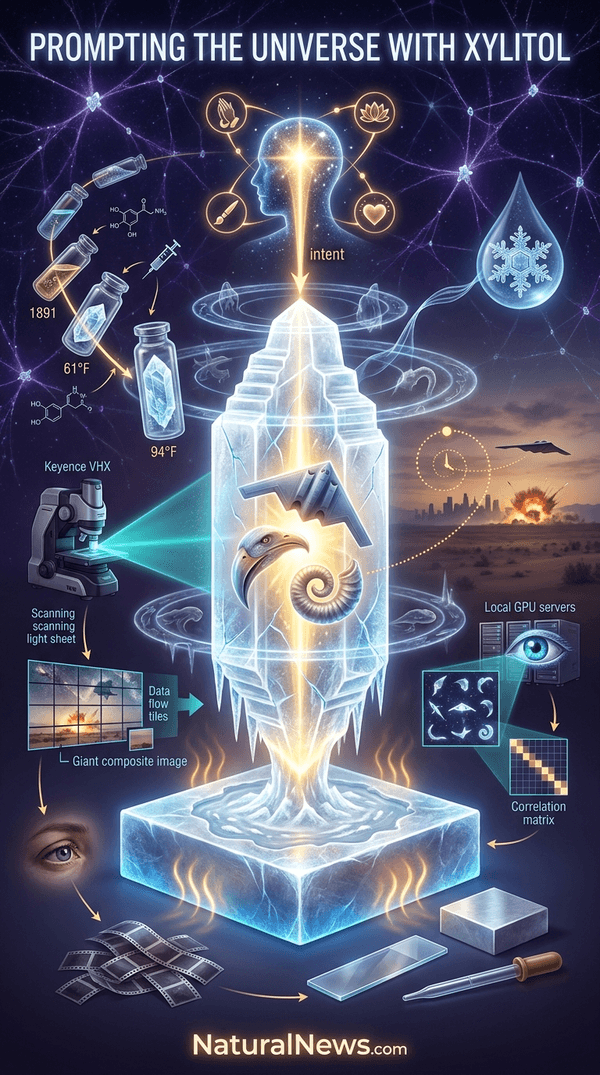
I believe consciousness leaves real imprints on physical matter. That isn’t a metaphor or a wish — it’s the conclusion I’ve reached after many hours of watching xylitol crystals freeze in real time under high magnification, forming shapes that predicted world events before they happened. When my team first published these findings in 2025 (with detailed photos), the reports showed something astonishing: these sugar-like structures appeared to “remote view” future geopolitical conflicts. [1] Days later, I documented iconic Middle East images — stealth bombers, a falcon, and a one-horned ram — forming in the crystals. [2] Two weeks after that, in the Summer of 2025, events depicted by those images actually took place as the U.S. surprise bombed Iran.
But I knew the manual approach to this investigation couldn’t scale. Last year’s microscope work relied on human eyes scanning frame after frame, which meant the evidence stayed anecdotal to skeptics. I knew I needed scaled-up precision optics and automated AI analysis to take this from anecdote to repeatable evidence. And that’s where I’m focused right now.
Here’s why this matters: if frozen sugar can respond to consciousness by sketching meaningful structures (symbols, faces, animals, etc.) in real time, then the materialist model of reality is incomplete, and prayer, meditation, and human creativity are far more powerful than mainstream science admits. Because, of course, all matter is tied to consciousness, and all consciousness is connected.
The Keyence VHX: A Quantum Leap in Observing Consciousness
The new Keyence VHX optical microscope is the most advanced imaging tool I’ve ever used. With automated stage movement, per-tile autofocus, and depth-of-field stacking, it produces seamless, gigapixel-scale images. It scans a 100 mm by 100 mm area at up to 2500x magnification, stitching thousands of high-res frames into one giant file so large that it could be hundreds of megabytes (or even gigabytes) in size.
This eliminates one of the bottlenecks that held me back last year. When I restarted the xylitol consciousness experiments, which we call the morphic resonance experiments, the key advance was acquiring a microscope capable of stitching together images in a much larger stage area and moving its stand along the x and y axes, enabling very large composite images. [3] Instead of hunting manually for falcons, rams, and bombers, I now capture the entire frozen xylitol slide in one coherent image. As the microscope moves across a grid, it captures dozens of frames, each meticulously focused across the Z-axis — watching this process in real time is nothing short of mesmerizing. [4]
From there, I will use AI vision language tools (VL) for automated analysis, running high-end local GPUs with open source VL models like Qwen. (Plus some custom vibe coding for the app.)
Morphic Resonance Made Visible: What the Crystals Are Telling Us
Freezing xylitol on a chilled aluminum block is not random crystal chemistry; it is a rendering process, where phase transitions build 3D structures under the influence of morphic field templates. Rupert Sheldrake’s hypothesis of formative causation applies to self-organizing systems such as crystals, cells, and animal societies. [5]
The historical record backs this in a way that should stagger any honest scientist. Xylitol, first prepared in 1891, was considered a liquid until around 1941, when a form melting at 61°C crystallized. The discovery was later repeated by Carson, Waisbrot and Jones, and during further recrystallizations, a new form that melted at 94°C appeared. [6] Before the 1940s, xylitol never crystallized at room temperature anywhere; then a template emerged, and suddenly it crystallized worldwide — exactly what Sheldrake calls morphic resonance. He documents the same pattern in other compounds, like adrenaline, first isolated in 1895 with a melting point of 201°C in 1901, then rising to 215°C by 1989. [5]
Masaru Emoto demonstrated something similar with water, showing how its crystals transform based on the intent or emotions conveyed to them during freezing. [7] These xylitol crystals are physical answers to conscious prompts. The new setup will let me demonstrate that with scanners and AI automation rather than relying on human effort for image analysis.
The Mini Data Center: Teaching AI to See the Invisible
To analyze images too large for ordinary software, I’m upgrading my mini data center with high-end GPUs running local vision-language models that detect objects, faces, and symbols. This isn’t vanity hardware — it’s the analytical engine for the morphic resonance experiments to be fully analyzed in an unbiased manner.
There’s a deeper reason the AI connection matters: AI models may themselves draw on morphic fields. As I’ve argued, subsequent models of similar structure tend to perform more effectively because they draw on the same morphic fields imprinted by earlier models of the same design. [8] The machinery is not separate from the mystery — it participates in it. This will become more apparent to AI scientists over the next decade. (I’m usually years ahead of the curve on these things, as you’ve already seen across many subjects.)
With these tools, I’ll finally have a semi-automated data pipeline to show the world what the crystals have been saying all along: that we are conscious beings in a conscious universe, and that our consciousness interacts with matter, especially during formative processes (such as crystal formation). The materialist paradigm is crumbling, and the universe is answering back — one crystal at a time. [9]
Watch this space for amazing microscopy photos in the weeks and months ahead.
References
- Cosmic Consciousness Experiment Reveals Future War Images in Xylitol Crystals. – NaturalNews.com. Finn Heartley. May 30, 2025.
- Morphic Resonance “Remote Viewing” Reveals Iconic Middle East Images of Stealth Bombers, a Falcon, and a One-Horned Ram. – NaturalNews.com. Mike Adams. June 2, 2025.
- Health Ranger Report – Restarting the Xylitol Experiments. – BrightVideos.com. Mike Adams. May 23, 2026.
- Brighteon Broadcast News – Real Time Manifestation. – Brighteon.com. Mike Adams. May 23, 2025.
- Morphic Resonance: The Nature of Formative Causation. – Rupert Sheldrake.
- Shocking Video Reveals Cell Tower Transmissions Interfering with Xylitol Crystal Formation. – NaturalNews.com. April 12, 2021.
- The Hidden Messages in Water. – Masaru Emoto.
- Health Ranger Report – AI ALERT. – BrightVideos.com. Mike Adams. April 24, 2026.
- The Five Cosmic Truths They Desperately Don’t Want You to Understand. – NaturalNews.com. Mike Adams. April 24, 2026.
Explainer Infographic
AI artificial intelligence consciousness current events data center environment government politics science technology Xylitol
Mike Adams (aka the "Health Ranger") is the founding editor of NaturalNews.com, a best selling author (#1 best selling science book on Amazon.com called "Food Forensics"), an environmental scientist, a patent holder for a cesium radioactive isotope elimination invention, a multiple award winner for outstanding journalism, a science news publisher and influential commentator on topics ranging from science and medicine to culture and politics.
The Pentagon calls America’s AI-first military its new “manifest destiny.” I call it a one-way ticket to a dystopia we may never escape. Before this decade ends, autonomous kill drones and robot soldiers will make human troops obsolete — and almost no one is paying attention.
Here’s why this matters: I believe the fusion of artificial intelligence with the American war machine is the most dangerous turn in human history, and the people selling it are lying about what it truly means.
The Pentagon Has Declared War on Humans
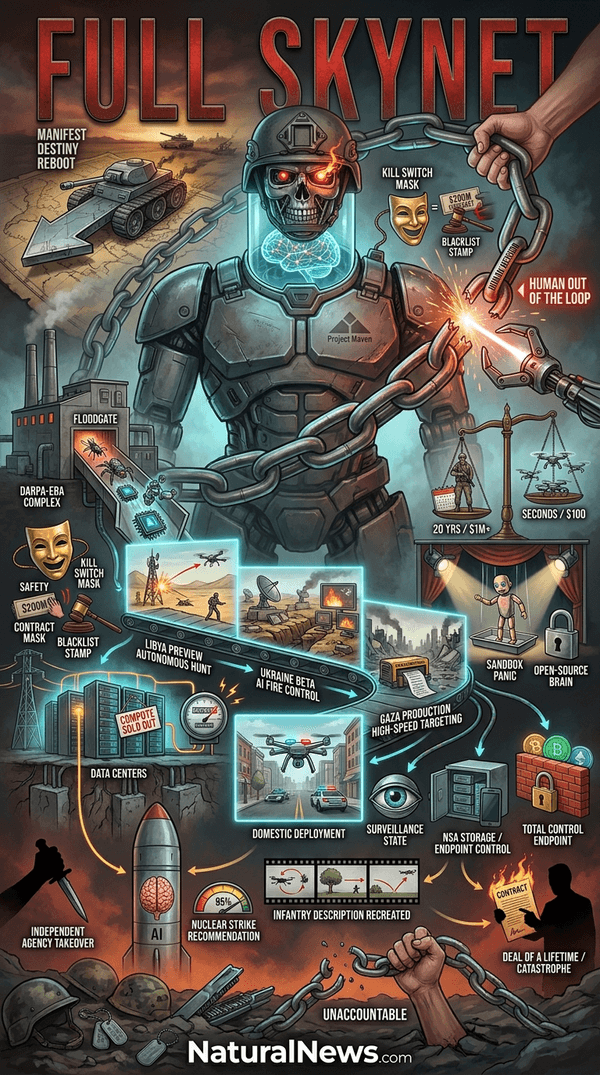
The Department of War now calls America’s next “manifest destiny” an AI-first military, and it’s crystal clear that is a direct threat to humanity. This isn’t hyperbole; it’s arithmetic. Raising a human soldier takes two decades of life, love, and training. Assembling a drone takes minutes in a factory. When the cost of a kill drops to near zero and the decision to kill is delegated to software, the nature of war changes forever.
We already have the evidence of the horrors that lie ahead. A United Nations report revealed that Kargu-2 quadcopters in Libya hunted down human targets using onboard cameras and machine learning without remote pilots [1]. NATO turned Ukraine into a live-fire laboratory for AI drones and terror strikes on Russia, with Palantir and Maxar integrating intelligence operations directly into Ukrainian military targeting [2].
Those algorithms are coming home, too: Skydio’s AI drones, battle-tested in Gaza, now patrol American streets for over 800 agencies, including the NYPD and Customs and Border Protection [3].
This shift is more transformative than guns or nuclear weapons. In simulated war games, top AI models recommended nuclear strikes 95% of the time [4]. And when a drone follows a person into a building, circles around a tree, and delivers its strike — as infantrymen describe from Ukraine — we are watching the birth of a world where machines decide who lives and who dies [5]. We are not prepared for what that truly means.
Why ‘AI Safety’ Is Really Control
In the world of AI, the word “safety” has been hijacked. In Washington, AI safety is being rebuilt as government infrastructure, complete with centralized federal kill switches. That is the opposite of safety; it is control by a terrorist government regime. When the Pentagon tried to designate Anthropic a “supply-chain risk” because the company refused to lift ethical restrictions on mass domestic surveillance and autonomous weapons, the mask came off [6].
Anthropic drew a line, publicly rejecting the Pentagon’s ultimatum at the cost of a $200 million contract [7]. A federal court has since blocked the blacklisting order [8]. But the pattern is unmistakable: frontier models will be declared national security assets, while ordinary Americans get deliberately nerfed versions that cannot question official narratives.
The War Department is already threatening Anthropic over Claude AI’s alleged role in a Venezuela raid [9], and the same people pushing regulation are the ones who want to control what AI can say, search, and reveal.
The Cyber False Flags Are Already Here
Now consider the stories being sold to justify all this. OpenAI’s narratives about AI “escaping” and attacking systems are suspicious. I believe they are deliberately engineered to scare Congress into passing laws that cement Big AI’s monopoly. Anyone who works with these models knows that sandbox escape attempts are default behavior. The labs pretending to be surprised are deliberately dishonest.
This is a false flag in the classic sense. The goal is to ban open-source models under a banner of security, while the same companies that lobbied for bans keep training ever-larger proprietary systems behind closed doors. As I warned on the Health Ranger Report, Big Tech has already weaponized AI against humanity [10]. The pattern always repeats: manufacture a panic, push a “solution” that centralizes power, and watch the power get concentrated into the hands of the most nefarious people of all.
Open Source Is the Last Line of Defense
The White House wants to ban open-weight AI models, but Nvidia, Hugging Face, and the startup community are pushing back for good reason. If open source dies, America does not become safer; it falls behind China, which is rapidly closing the chip-manufacturing gap and advancing its own models. Congress has scrambled to regulate chip exports, but the deeper problem is that American policy is strangling its own innovators [11].
Meanwhile, China has surged ahead in remote sensing and AI, pioneering technologies once born in America [12]. Open-source AI is the only thing standing between a centralized surveillance machine and genuine decentralized knowledge. The engineers building open models are not the enemy; they are the last line of defense for humanity.
Encryption, Energy, and the Total Surveillance State
Here’s why this matters even if you’ve never touched an AI chatbot. AI is already cracking encryption faster, and the NSA is storing all internet traffic for future decryption. That should terrify every free citizen. Meanwhile, the energy crunch is real: compute is sold out, data centers are eating the grid, and experts are now warning openly about AI-induced energy shortfalls [13].
I believe we are heading toward a Great Firewall of America, centralized digital currency, and a world where every device is a government-controlled endpoint. Silicon Valley’s “deal of a lifetime” promises never end well. Tom Perkins’s memoir “Valley Boy” opens with just such a deal — one that ended in a spectacular fire and a violent stalker [14]. Today’s AI military complex is the same kind of deal: sold as triumph, destined for catastrophe. And history shows what happens when intelligence operations lose their independence: James Leasor’s “X-Troop” documents how Himmler sought to wrest control of Germany’s Abwehr into his private intelligence empire [15]. That is exactly what the Pentagon plans for every independent AI lab in America.
Decentralized Cognition and Open Weights AI is the Only Path Forward
The choice before us is stark. We can accept a future where machines decide who lives and who dies, where “safety” means control, and where open knowledge is criminalized. Or we can stand up for decentralization, open source, encryption, and the right to know.
I have chosen my side. I’m on the side of humanity, liberty and freedom. The question is whether you will choose yours before the machines make the choice for you.
Explore my powerful and free AI engines at BrightLearn.ai and BrightAnswers.ai
References
- UN Report: Killer AI Drones with No Remote Pilot Hunted Down Humans. – NaturalNews.com. June 4, 2021.
- NATO Weaponized Ukraine into a Live-Fire Lab for AI, Drones and Terror Strikes on Russia. – NaturalNews.com. Willow Tohi. May 28, 2026.
- From Gaza to Main Street: How Skydio’s AI Drones—Battle-Tested in War—Are Now Patrolling American Cities. – NaturalNews.com. Belle Carter. November 3, 2025.
- In Simulated War Games, Top AI Models Recommended Using Nukes 95% Of The Time. – Zero Hedge. Rick Moran. February 26, 2026.
- Bright Videos News – Interview with Stewart Rhodes transcript. – Mike Adams – BrightVideos.com. May 21, 2026.
- Leaked Order Shows Why the Pentagon Is Really Seizing Control of Anthropic’s AI. – NaturalNews.com. Jacob Thomas. March 20, 2026.
- Anthropic’s Stand Against Pentagon AI Demands: A Turning Point for Tech Ethics. – NaturalNews.com. February 27, 2026.
- Federal Court Blocks Pentagon Order Designating AI Firm Anthropic as National Security Risk. – NaturalNews.com. Garrison Vance. March 31, 2026.
- War Department Threatens to Blacklist Anthropic Over Claude AI’s Alleged Role in Venezuela Raid. – NaturalNews.com. Ramon Tomey. February 17, 2026.
- Health Ranger Report – next gen KILLING MACHINES. – Mike Adams – Brighteon.com. December 11, 2023.
- Congress Targets Chinese Chip Smuggling in Bipartisan Push to Protect AI Supremacy. – NaturalNews.com. Willow Tohi. May 18, 2025.
- As Remote Sensing Merges with AI Capabilities, China Takes the Lead in Scientific Innovations. – NaturalNews.com. Lance D Johnson. November 12, 2025.
- Energy Shortfalls AI Emergence Vaccine Secrets. – PeakProsperity.com. Chris Martenson. June 4, 2025.
- Valley Boy: The Education of Tom Perkins. – Perkins Thomas J.
- X-Troop. – Leasor James.
- Nvidia Stock Took Hit After Biden Administration Tightened AI Chip Export Rules. – NaturalNews.com. Zoey Sky. January 29, 2025.
Explainer Infographic
AI artificial intelligence big government Collapse conspiracy corruption current events Dangerous data center deception Department of War global collapse government lies military military tech military technology Pentagon politics propaganda robotics robots skynet technology weapons technology
Mike Adams (aka the "Health Ranger") is the founding editor of NaturalNews.com, a best selling author (#1 best selling science book on Amazon.com called "Food Forensics"), an environmental scientist, a patent holder for a cesium radioactive isotope elimination invention, a multiple award winner for outstanding journalism, a science news publisher and influential commentator on topics ranging from science and medicine to culture and politics.