A fire at Savannah River National Laboratory in South Carolina triggered a Site Area Emergency on Wednesday evening.
Local media, citing the site, reported an unfiltered ground-level radiological release.
Department of Energy officials said surveys found no detectable contamination and ended the emergency at 9:45 p.m.
One worker was hospitalized with minor injuries, and officials have not said what burned.
The fire came less than two weeks after approval of a $23.5 billion plutonium-core plant at the site.
A fire at the Savannah River National Laboratory near Aiken, South Carolina, prompted officials at the Energy Department’s Savannah River Site to declare a Site Area Emergency at 5:39 p.m. Wednesday. Officials said the fire occurred in a single room, and site entrances were temporarily closed to incoming traffic while rail, river and air traffic near the site were restricted.
A DOE spokesperson said one employee was hospitalized with minor injuries. The emergency was terminated at 9:45 p.m. after radiological surveys found no detectable contamination. Employees not involved in emergency response or shutdown operations were instructed to shelter in place, officials said, and protective actions were later lifted as the site was cleared to resume normal operations Thursday.
Officials report no detectable contamination as local media cite unfiltered release
A DOE spokesperson said, “No radiological contamination has been reported,” while an SRS statement said radiological surveys indicated no detectable levels of contamination. Local media, citing the Savannah River Site, reported that the fire involved an unfiltered ground-level radiological release. Officials did not provide details on what burned or how much material may have been released.
A Federal Aviation Administration temporary flight restriction alert reportedly cited a “US Govt Nuclear Incident” as the reason for the shutdown, according to a social media post. SRS officials said they notified appropriate state and local government agencies and advised nearby residents to monitor local radio and television stations for updates and instructions.
A warhead supplier with a $23.5 billion plutonium plant on the way
The Savannah River Site was built in the early 1950s during the Cold War to produce plutonium and tritium for U.S. nuclear weapons, according to the Department of Energy and the site website. The site continues to process and replenish tritium, a radioactive isotope of hydrogen used to boost the explosive yield of nuclear warheads, and it manages nuclear materials and radioactive waste.
The National Nuclear Security Administration set a $23.5 billion performance baseline for the Savannah River Plutonium Processing Facility’s main processing building, with completion estimated for December 2038, the agency told ExchangeMonitor. NNSA approved Critical Decisions 2 and 3 for the plutonium processing facility on Oct. 15, clearing construction and procurement activities, while watchdog groups criticized the project’s cost and schedule.
Questions remain over fire’s cause and release details
Highway 125 remained open, site barricades were reopened, and shift workers were instructed to report as usual while other employees were told to return to work Thursday, according to SRS. The incident occurred less than two weeks after NNSA announced approvals for the plutonium-core plant at the site, a project intended to support modernization of the U.S. nuclear weapons stockpile.
The pattern here is familiar to anyone who has tracked institutional responses to nuclear incidents: the emergency declaration comes quickly, the “all clear” comes quickly, and the details that would allow independent verification — what material was present, what monitoring was conducted, where sensors were located — remain vague. That is not necessarily evidence of a cover-up. It is, however, evidence that the public is being asked to trust a conclusion without being given the underlying data.
The Savannah River Site website states that ensuring national security and protecting workers, the public and the environment are its highest goals. Those goals are not in conflict, but they are only credible when the public can see the evidence behind the assurances. A fire in a single room at a nuclear laboratory is a small event in the grand scheme. Silence about what burned and what was released would be a larger one.
The DOE and SRS should release the radiological survey data, the fire investigation findings, and the monitoring records from the surrounding area. Until then, the official story rests on trust rather than transparency.
How are you handling the daily drumbeat of doom? The AI doomerism, the diesel shortages, the trucker strikes, the empty-shelf panic that flickers across your news feed every few weeks?
I believe most people are drowning in it. They oscillate between paralyzing fear and willful denial, and neither state does them any good. But you are different. If you have been listening — not to the corporate media, not to the government press conferences, but to the independent voices who warned you about the COVID injections, the engineered energy crisis, and the coming food riots — then you are already far better prepared than the average American.
My position is plain: you will survive the coming chaos. Not because you have a perfect bunker or a year’s supply of freeze-dried lasagna, but because survival was never about flawless stockpiles. It is about mindset, decisive action, and community. I have written many articles about the engineered collapse of energy infrastructure and the deliberate starvation of billions, and I have watched my audience respond not with panic but with preparation. That is why I am confident about your odds.
None of Us Is Fully Prepared — And That’s Not the Point
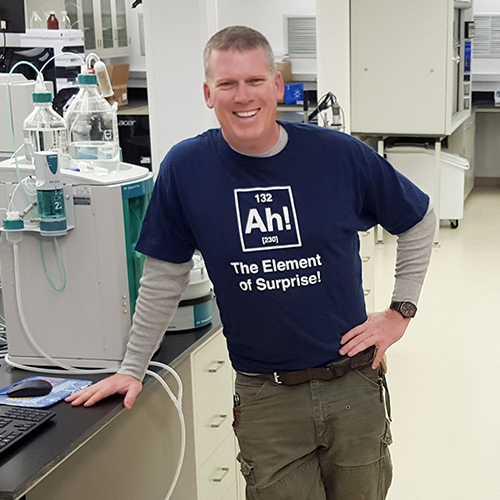
Let me be honest with you: I am not fully prepared either. I spend more hours working, recording interviews, and podcasting than I do prepping. I recently spent far too many hours learning to crimp wires for the off-grid solar system I am building, sweating over connectors and watching tutorial videos until my eyes crossed [1]. That experience reminded me that the gap between where I am and where I want to be is real. But here is the truth I want you to internalize: perfect preparedness is impossible. You cannot replicate Home Depot in your garage, and you cannot replicate a grocery store in your kitchen. No one can.
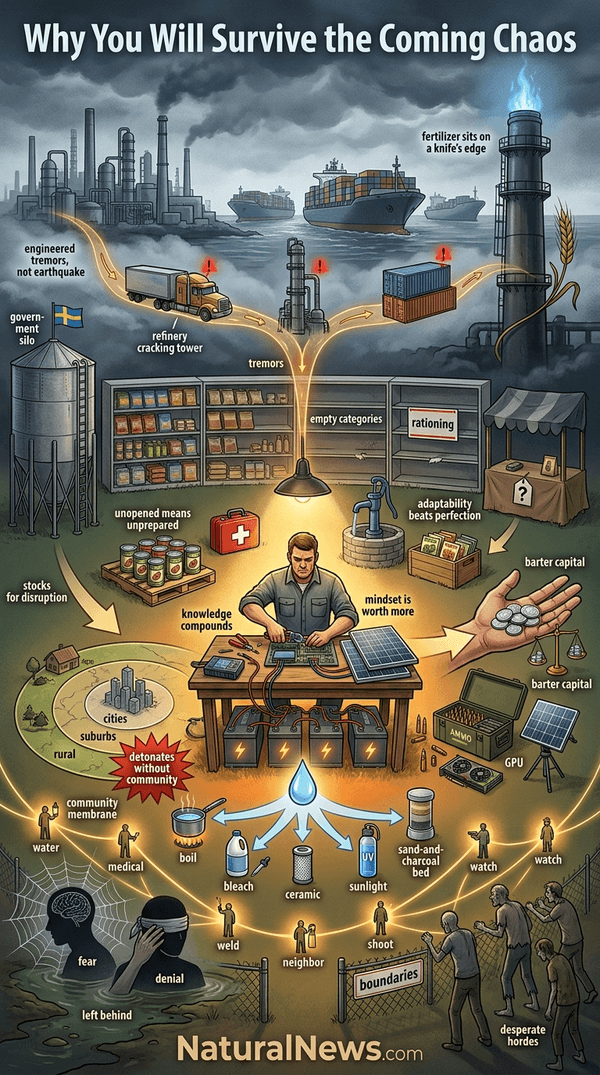
The sooner you accept that, the faster you can focus on what actually matters. Collapse is usually gradual, not a single all-at-once event. As I have said before, we are witnessing deliberate tremors, not a sudden earthquake [2]. There can be sharp lurches and spikes — a trucker strike here, a diesel shortage there — but the overall slide is slow enough that adaptability beats perfection every time.
That is why flexibility is your greatest asset. You may plan for scenario A, but you will get B, C, or D. The person who has a water filter and the knowledge to use it will outperform the person who bought a pallet of bottled water and never learned how to find a spring. The person who has seeds and basic gardening skills will eat when the person with a garage full of MREs runs out. Knowledge, as I have said many times, is more critical than equipment.
The Collapse Will Be Gradual, Local, and Personal
The real trend is not a Hollywood-style single event. It is the erosion of the rule of law, supply chains, and institutional functioning over many months and years. I have documented how the sabotage of global energy infrastructure is intended to starve billions, and how the Strait of Hormuz crisis is being leveraged to accelerate mass starvation, especially in vulnerable nations [2]. The systems that keep grocery stores stocked and pharmacies supplied are far more fragile than most people realize.
What replaces those systems? Barter networks, local community, and knowing a guy with diesel or spare parts. The person who can fix a tractor, purify water, or grow food becomes more valuable than the person with a cryptocurrency wallet. This is why I urge you to decentralize your dependence on central systems: water, food, medicine, money, and power. Backup water storage, a well, or rainwater catchment are no longer eccentric hobbies. Food storage, gold and silver, and practical trade goods like ammunition and even GPU compute power are the currencies of a decentralized future. Sweden, for its part, is stockpiling emergency grain for the first time since the Cold War, citing the risk of supply chain disruption from war or conflict [3]. If a government is doing that, you should consider doing the same.
The geography of survival matters too. Cities will see the worst violence and uncertainty. Suburbs will be caught in between, with desperate people spilling out of urban cores. Rural areas, where people already have armed self-reliance, will fare better — but only if they have built community and prepared for the gradual breakdown. As one activist analysis put it, the hinterlands will not merely empty; they will detonate, and distance alone will not save you [4]. The answer is not isolation. The answer is local networks, shared skills, and the kind of resilience that comes from knowing your neighbors and having something to trade.
Your Mindset Matters More Than Your Stockpile
The unprepared go from ignorance to panic in an instant. They mock you for storing food, for buying silver, for learning herbal medicine — until the shelves are empty and the banks are closed. Then they demand to know why you did not warn them. You have already been awake and thinking ahead, which means you are not starting from zero when the crisis becomes obvious. You have taken action. You have bought the seeds, stacked the silver, learned the skills. That puts you in a fundamentally different position.
Even a massive die-off scenario — as some analysts have predicted, with figures as low as 0.8 percent of humanity surviving a global collapse [5] — would still leave a surviving subset. Your mindset and preparation put you in that subset. I have said before that emotional preparedness is paramount, and that the best way to achieve it is to allow yourself time to sit with these changes before they arrive [6]. Early warning buys you the time to ask: All of this is coming. What do I need to do?
That is the question that separates survivors from victims.
The Hardest Part Will Be Other People
The hordes of starving, unprepared people will be a greater danger than running out of food. This is not a pleasant thing to say, but it is true. Many who dismissed you as a crazy prepper will later come asking for food, water, and help for their kids. They will not be evil people. They will be desperate people. And desperation makes people do things they never imagined.
The social dynamics of collapse are brutal but predictable. Be compassionate, but hold your ground. Help those you can and say no to those you cannot, even when it is emotionally difficult. The Survival Medicine Handbook warns that even modern medical facilities may be useless if they are understaffed, under-supplied, and overcrowded, and that most people are unwittingly unprepared for a world where help is not on the way [7]. You cannot save everyone, and trying to do so will get you killed.
That is why community — real community, built before the crisis — is so important. The Ultimate Survival Medicine Guide emphasizes that a society can only be rebuilt by a community, and that there is no time like the present to network with like-minded people [8]. Build your group now. Know who you can trust. Know who has skills you lack. And prepare yourself emotionally for the hard decisions that will come.
Conclusion: You Will Survive — Now Keep Going
If you have prepared at all — if you have stored some food, learned a skill, bought a few ounces of silver — you have already made significant progress. You are well equipped for what is coming. Survival is about mindset, action, and preparedness, not flawless stockpiles. The people who survive are not the ones with the most stuff. They are the ones who kept their heads, adapted to changing circumstances, and helped their communities.
I will keep working to keep you informed through my podcasts, videos, and articles. I have a new preparedness course coming in mid-November, and I will continue to share everything I learn about self-reliance, decentralization, and navigating the chaos ahead. My platforms at NaturalNews.com, BrightLearn.ai, BrightVideos.com, BrightAnswers.ai, Brighteon.social, and BrightNews.ai remain free and uncensored resources for anyone who wants to learn.
So stop doubting yourself. You will be okay. Keep building resilience. Keep learning. Keep preparing. The chaos is coming, but you are ready for it — and you will survive.
References
Hold Tight to a Real-World Anchor to Survive the Imminent Global Chaos. https://www.naturalnews.com/2026-06-16-hold-tight-to-a-real-world-anchor.html
The Sabotage of Global Energy Infrastructure is Intended to Starve Billions of Humans to Death – NaturalNews.com, April 21, 2026. by NaturalNews.com
Sweden revives Cold War food stockpiling amid rising conflict fears – NaturalNews.com, October 16, 2025. by NaturalNews.com
The Kill Zone: Why Your Bunker’s Distance From the City Might Get You Killed. 2026-10-04T22:00:00.000Z. https://activistpost.com/the-kill-zone-why-your-bunkers-distance-from-the-city-might-get-you-killed/
Dr Leonard Coldwell on Decentralize TV Only 08 of humanity will survive the coming GLOBAL COLLAPSE – NaturalNews.com, January 20, 2025. by NaturalNews.com
Decentralize TV – Episode 116 Chris Martenson on energy crisis – Mike Adams – Decentralize.TV, June 12, 2026. by Mike Adams – Decentralize.TV
The Survival Medicine Handbook A guide for when help is NOT on the way. by Alton Joseph Alton Amy
Ultimate Survival Medicine Guide, The. by Joseph Alton [Alton, Joseph]
Mike Adams (aka the "Health Ranger") is the founding editor of NaturalNews.com, a best selling author (#1 best selling science book on Amazon.com called "Food Forensics"), an environmental scientist, a patent holder for a cesium radioactive isotope elimination invention, a multiple award winner for outstanding journalism, a science news publisher and influential commentator on topics ranging from science and medicine to culture and politics.
A growing number of mainstream Americans are beginning to consider contingency planning, often only after experiencing a personal crisis like a power outage or natural disaster.
Financial precarity remains a major barrier: 60% of U.S. households live paycheck to paycheck, making it difficult to stockpile supplies or fund evacuations.
Research shows that evacuation decisions are hindered by cost, lack of transportation, health concerns, pet ownership, and risk perception.
Experts recommend pre-disaster strategies such as building more accessible shelters, accommodating pets, and improving public education on risk.
Preppers are divided on how to handle the unprepared during a crisis — options range from defense to sharing supplies to integrating newcomers into survival groups.
The wake-up call: Why more people are starting to prepare
Across the United States, a subtle but measurable shift is underway. More Americans are beginning to think about contingency planning — but the catalyst is almost always personal experience. A power outage during a Texas winter storm. Four days without electricity after a Category 1 hurricane in Florida. A week of rolling blackouts. These events, once dismissed as rare, are becoming more common, and they are forcing a reluctant public to confront vulnerabilities in their own homes.
The question is no longer whether people should prepare, but whether they can — and what happens to those who don’t.
The financial reality: Why many can’t afford to prepare
The gap between awareness and action is largely financial. According to recent data, 60% of American households were living paycheck to paycheck just four or five years ago — a statistic that has not improved significantly. For these families, buying a generator or stockpiling a month’s worth of food is not a matter of priority but of impossibility.
One preparedness advocate noted that the decision often comes down to trade-offs: a new car versus a home generator, vacations versus emergency supplies. For many, the choice is not between wants but between necessities — and the necessity of preparedness is only recognized after the crisis hits.
This financial reality also affects evacuation. Research from 2024 and 2025 shows that 1 in 9 Americans live in poverty, making it difficult or impossible to afford transportation, lodging, or time off work during a mandatory evacuation. During Hurricane Katrina, many residents lacked vehicles and could not reach evacuation buses. During Hurricane Milton in October 2024, hundreds of people required rescue because they had not left — not out of defiance, but because they could not.
Barriers to evacuation: Health, pets, and risk perception
Evacuation is not a simple decision. Research published in February 2025 by the Natural Hazards Center and FEMA identifies three primary reasons people remain in harm’s way:
Health and mobility concerns. Nursing homes and assisted living facilities face logistical nightmares when hurricanes approach. A study of 291 long-term care facilities in Florida found that 81% sheltered residents in place during the 2004 hurricane season because they had limited transportation options and no places to go. During Hurricane Irma in 2017, seven nursing home residents died in the heat after losing power.
Pets. Pet owners are significantly less likely to evacuate than others. Many shelters do not accept animals, and owners fear leaving them behind in destructive storms where it may be days or weeks before they can return.
Risk perception. Women are nearly twice as likely as men to evacuate when given a mandatory order. People who have survived previous hurricanes without major damage often underestimate the risk of new storms. Shelter conditions — including overcrowding, lack of privacy, and concerns about religious or dietary needs — also deter evacuees.
The prepper divide: How to handle the unprepared
Among those who do prepare, a significant debate continues over what to do about those who do not. The preparedness community is split into four broad camps:
Defense. Some preppers believe their stockpiles are for their families alone and are willing to use force to protect them. The main risk: sheer numbers. Crowds of desperate people could overwhelm even the most fortified rural property.
Sharing. Others plan to feed anyone who shows up and send them on their way. The concern: once you feed one person, word spreads. More will come, and they may keep returning.
Stockpiling for others. A middle-ground approach involves planting extra food in a separate garden patch where those in need can help themselves. This reduces direct confrontation but risks the entire garden being stripped.
Integration. Some preppers plan to accept unprepared people into their groups, adding hands for work and defense. The downside: larger groups consume resources faster, and strangers may not be trustworthy, especially under extreme stress.
A realistic path forward
Experts and experienced preppers alike note that not all crises lead to total societal collapse. In most scenarios, order is restored eventually, and actions taken during an emergency may face later scrutiny. The goal, they say, is not to live in fear but to build resilience through practical planning — starting with small steps that even those on tight budgets can manage.
Community-level solutions may prove more effective than individual stockpiling alone. Better shelters, more accessible transportation for people with disabilities and pets, and clearer public education about evolving risks could reduce the need for heroic last-minute rescues.
Preparedness is not paranoia
The growing conversation around contingency planning reflects a sobering reality: the systems Americans once relied on — the power grid, supply chains, emergency services — are showing signs of strain. The “just in time” delivery model that keeps grocery stores stocked leaves little margin for error when a cyber attack, train derailment, or ice storm disrupts distribution.
Preparedness, advocates argue, is not about hoarding or fear. It is about taking responsibility for oneself and one’s family while recognizing that faith and practical action are not mutually exclusive. As one observer put it: the miracle is not that a severed thumb reattaches itself — it’s that there are doctors trained to do it.