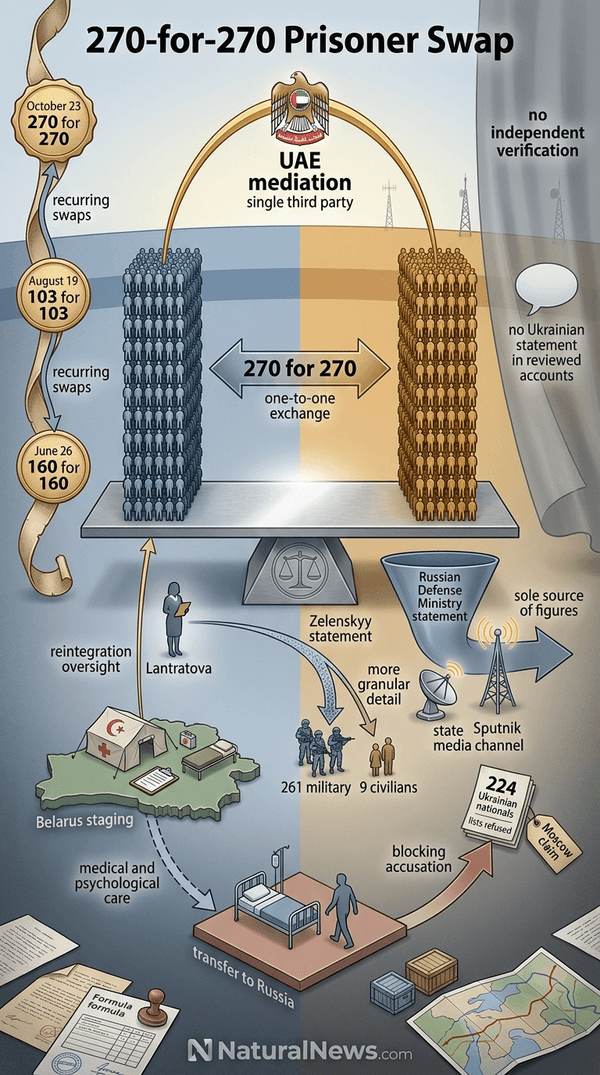
The Russian Defense Ministry statement served as the sole source of the exchange figures in the accounts reviewed. No independent confirmation of the numbers was cited in the source material, and the Ukrainian government did not issue a statement included in the available accounts. The exchange was described by Sputnik as taking place according to the 270 for 270 formula [1].
Russian Servicemen Moved to Belarus
The same processing sequence has been described by the ministry in previous exchanges. In its June 26 statement on a 160-for-160 swap, the ministry said the returned Russian soldiers were in Belarus receiving psychological and medical assistance, with transfer to Russia for further treatment planned, and Lantratova working with the freed soldiers [2].
The ministry did not disclose the location or condition of the 270 Ukrainian prisoners of war transferred to the Ukrainian side. Politico reported that Kyiv returned home 261 military personnel and nine civilians, Ukrainian President Volodymyr Zelenskyy said in a statement [3].
UAE Cited as Mediation Party
The ministry’s statement did not characterize the arrangement as successful or significant, and it provided no further detail on the nature of the Emirati role. No statement from Emirati officials or Ukrainian officials was included in the ministry’s account.
The UAE has previously been identified in Russian ministry statements as a mediator in earlier exchanges. In the June 26 exchange of 160 servicemen per side, the swap was mediated by the United Arab Emirates, the ministry said in a statement, according to NaturalNews.com [2].
The October 23 statement did not name any mediator beyond the UAE, and no joint mediation role was described in the accounts reviewed.
Prior Exchange Under 103-for-103 Formula
The Russian Defense Ministry said Russia and Ukraine previously exchanged prisoners of war under a 103-for-103 formula on August 19. In a statement published on social media, the ministry said that 103 Russian servicemen were returned from territory controlled by the Kiev regime, and in exchange, 103 Ukrainian Armed Forces prisoners of war were transferred to Kyiv, according to RT [4].
The ministry said the returned Russian servicemen were also in Belarus at that time, where they were receiving psychological and medical assistance, with Lantratova working with them [4]. The August statement also cited the same processing sequence described in the October 23 statement: psychological and medical assistance, then transport to Russia for treatment and rehabilitation.
Russian Human Rights Commissioner Yana Lantratova later confirmed the sequence of exchanges. NaturalNews.com reported in August that Lantratova had accused Ukraine of blocking prisoner exchanges by refusing to accept lists of its own citizens prepared for repatriation, with Moscow claiming it was ready to release 224 Ukrainian nationals immediately in exchange for Russians held by Kyiv, including residents of Donbass and Crimea [5].
Conclusion
Both exchanges were announced by the Russian Defense Ministry. The figures and details come from the Russian Defense Ministry statement, with Lantratova working with returned personnel in Belarus.
The Ukrainian government did not issue a statement included in the source material reviewed, and no further details on the transferred Ukrainian prisoners were provided in the Russian ministry’s account.
References
Russia and Ukraine Exchange PoWs 270 for 270. https://sputnikglobe.com/20261023/russia-ukraine-exchange-pows-270-for-270-1124928457.html
Russia and Ukraine Exchange 160 Prisoners of War in Latest Swap – NaturalNews.com, June 29, 2026.
Ukraine and Russia each exchange 270 prisoners of war. https://www.politico.eu/article/ukraine-russia-exchange-270-prisoners-war-zelenskyy-putin-trump/
Russia and Ukraine exchange 103 POWs – MOD (VIDEO). https://www.rt.com/russia/644394-russia-ukraine-103-pow-exchange/?utm_source=rss&utm_medium=rss&utm_campaign=RSS
Russia accuses Kyiv of blocking prisoner exchanges, prioritizing “PR” over human life – NaturalNews.com, August 14, 2026.
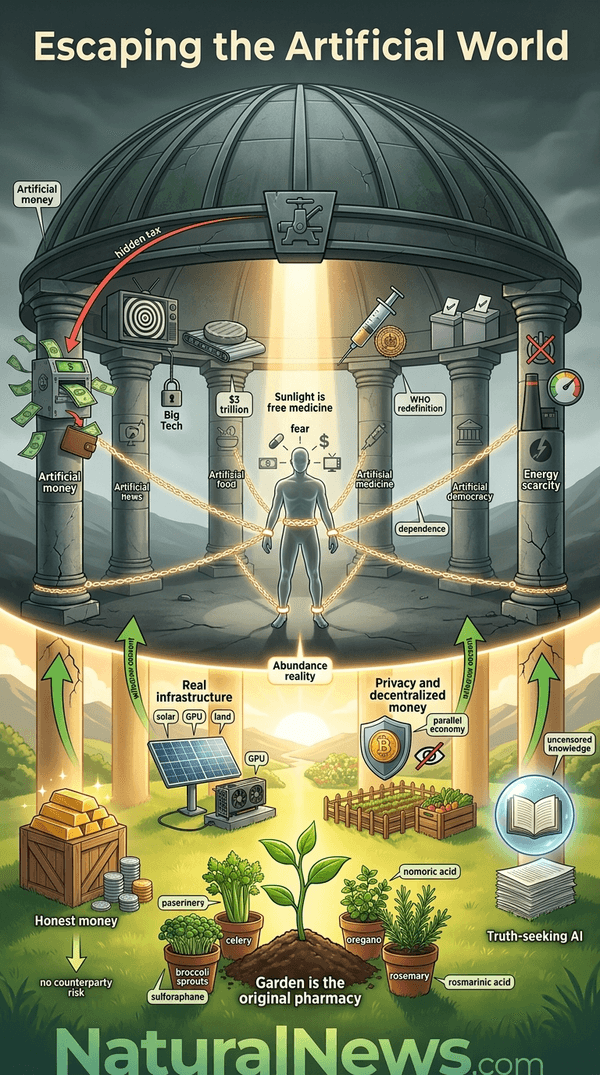
Most people are living inside an engineered artificial world, not the real world. The artificial world is a constructed reality in which nearly everything you consume — your money, your news, your food, your medicine, your politics and your energy — has been altered, degraded or weaponized against you.
Artificial scarcity in money, news, food, medicine, democracy and energy is deliberately induced, not natural. It is manufactured, maintained and defended by centralized institutions that profit from your dependence. I have spent decades investigating this system as the founder of Natural News and as the developer of truth-seeking AI platforms, and I can tell you with certainty that the scarcity you feel every day is not a law of nature — it is a business model.
My position is explicit: we can and must shift piece by piece into an abundance reality. Abundance reality is not a fantasy. It is the world as it actually exists beneath the engineered overlay — a world where sunlight falls free on every acre, where anti-cancer compounds grow in garden soil, where honest money cannot be printed into oblivion, and where knowledge is no longer restricted by corporate masters. Escaping the artificial world is not about waiting for permission from the FDA, the Federal Reserve or the World Economic Forum. It is about withdrawing your consent and your participation, one pillar at a time, until the artificial world loses its grip on your life.
As the founder of Natural News, I have watched this shift begin in millions of households across America, and I believe it is the single most important migration of our time — not a migration across borders, but a migration out of the matrix of engineered scarcity into the abundance that has always been available to those willing to see it.
The Pillars of the Artificial World
The artificial world rests on several interlocking pillars. Artificial money is printed fiat currency with no intrinsic value and no real backing. The Federal Reserve creates dollars out of thin air, and every new dollar dilutes the purchasing power of the dollars you already hold. The consequences of this debasement are visible in the grocery aisle and at the gas pump.
Artificial news ignores natural cures, real history, energy truth, and current events that matter. The corporate mainstream media repeatedly lies and deceives the public, while Big Tech silences whistleblowers who told the truth about vaccine dangers and COVID deceptions. What passes for journalism today is narrative management, designed to keep you afraid, dependent and divided. Meanwhile, organizations like the World Economic Forum push their own vision of the future through education systems heavy on virtual reality and AI technologies, but light on privacy concerns [1].
Artificial food is processed junk devoid of nutrients and designed to promote chronic disease. The fake meat industry, predicted to be worth $3 trillion, is being touted as an environmentally friendly and sustainable way to feed the world, when in reality the rise of fake meat and other synthetic foods is nothing more than an attempt to create global control over the food supply [2]. The globalist plan is straightforward: separate people from real food, then ration the substitutes.
Artificial medicine and vaccines serve depopulation and monopoly profits, not immune protection. In June 2020 the WHO changed its definition of herd immunity, stating the only way to achieve herd immunity is by vaccination — a definition inconsistent with long-established science which says herd immunity occurs when enough people acquire immunity to an infectious disease [3]. That redefinition of reality was not science; it was marketing for an experimental product. And artificial democracy and fake free markets give you two flavors of the same uniparty. Both parties serve the same donors, the same intelligence agencies and the same globalist agenda.
The choice between them is an illusion — the real divide is not left versus right, but those who profit from engineered scarcity versus those of us building an abundance reality outside their control.
Why Artificial Scarcity Keeps Us Trapped
Energy scarcity is artificially induced by shutting down shipping routes and suppressing domestic production. The same people who tell you we must transition to renewables have done everything in their power to block domestic oil, gas and nuclear development. The result is an artificial energy crisis that drives up prices, strangles industry and pushes families into dependence on government subsidies.
Knowledge scarcity is enforced when mainstream institutions deny cures for cancer that literally grow in gardens. Broccoli sprouts, celery, oregano and rosemary contain anti-cancer compounds that have been documented for decades, yet the cancer industry treats nutrition as an afterthought while pushing chemotherapy, radiation and expensive drugs. The biggest lie in cancer history is that nothing could have been done to stop your cancer. But it’s a lie. I have watched this lie destroy families who trusted oncologists instead of investigating the natural compounds that can prevent, treat and even reverse cancer.
Organized religion has, in many cases, been watered down to keep people obedient rather than thinking for themselves. A faith that tells you to wait for salvation while you swallow toxic food, submit to experimental injections and accept financial enslavement is not empowering — it is pacifying.
Many people fear abundance because they do not want responsibility for their own health outcomes. It is easier to take a pill than to change your diet. It is easier to trust the CDC than to research the ingredients in a vaccine. It is easier to accept the Federal Reserve’s inflation than to convert your savings into gold and silver. The artificial world offers comfort in exchange for dependence, and most people — at least at first — choose the comfort. That is why the shift into abundance reality is so frightening for many people. It demands that you stop outsourcing your decisions to authorities who have repeatedly lied to you, and start taking responsibility for your own life, your own health and your own future. That demand is precisely why the artificial world works so hard to keep you afraid.
Knowledge and Health Abundance Are Already Available
Truth-seeking AI platforms like BrightAnswers.ai make critical knowledge abundant and free. Unlike corporate AI systems trained to repeat establishment narratives, BrightAnswers.ai is an uncensored AI engine that is more honest and accurate than ChatGPT, Gemini or Microsoft Copilot. When you can query an AI that is not owned by Big Tech and not aligned with Big Pharma, you begin to see how much knowledge has been kept from you. The same principle applies to platforms like BrightNews.ai, which analyzes news trends across independent media and gives you a more honest picture than the corporate press. Knowledge abundance is no longer a privilege of the connected — it is available to anyone willing to look outside the approved channels.
Don’t wait for someone else to show you the path to abundance, either. You can grow anti-cancer plants such as broccoli sprouts, celery, oregano and rosemary without permission. No license, no prescription, no insurance approval is required. These plants contain sulforaphane, apigenin, carvacrol and rosmarinic acid — compounds that have been studied for their ability to support the body’s defenses against cancer.
Sunlight is free and transforms light into nutrients through photosynthesis and herbology. Every photon that touches your skin triggers vitamin D synthesis, which is critical for immune function and hormone regulation. The medical establishment demonizes sunlight while promoting sunscreen chemicals linked to hormone disruption and cancer, but the sun remains the most abundant medicine on earth. As I have argued in my War on Light series for Natural News, sunlight is one of the most important things for our health, yet all we ever hear is how important it is to avoid it [4].
Self-reliance in health is empowering and removes dependence on corrupt Western medicine. When you understand that nutrition, herbal medicine and lifestyle factors determine most of your health outcomes, you no longer need permission from a physician to be healthy. The entire Western medical system is corrupt, ineffective, expensive and dangerous — it has sought to wipe out alternative and competing systems that offer lower costs, safer treatments and better patient outcomes. By taking your health into your own hands — growing food, using herbs, getting sunlight and questioning every prescription — you make Big Pharma irrelevant to your life. That is abundance reality in its purest form: health that cannot be monopolized because it does not come from a factory.
Financial Abundance Through Honest Money and Real Assets
Fiat currencies always fail, while gold and silver are real money with no counterparty risk. The U.S. dollar is headed for a catastrophic collapse and will one day be worthless. When the dollar collapses, those who held paper promises will lose everything, while those who held physical metal will retain their purchasing power. I have long recommended that people convert failing currencies into gold and silver — not as speculation, but as a way to preserve the fruits of their labor outside a system designed to steal it. As the global financial system trembles under the weight of debt and money printing, honest money becomes not just prudent, but necessary.
You can exit the artificial money system by trading failing currencies for gold and silver. Every ounce of physical metal you hold is wealth that no central bank can dilute, no government can freeze and no banker can counterfeit. Gold and silver have no counterparty risk — they are not someone else’s liability. This is why international bankers hate them: honest money exposes the fraud of the fiat system. Real infrastructure such as solar panels, GPUs, land and food production builds lasting abundance. These are not paper assets that vanish in a financial crash — they are productive, tangible and under your control. A solar panel powers your home when the grid goes down. A plot of land feeds your family when supply chains break. A GPU mines cryptocurrency or runs AI models that earn income without permission from a bank.
Decentralized money and privacy protect your wealth from globalist surveillance and control. Cryptocurrency as decentralized money is good — it removes the middleman and restores financial sovereignty to the individual. Privacy is good — it is a fundamental human right, not a privilege granted by governments or tech companies. The only defense is to build a parallel economy in which your transactions are not monitored, your savings are not confiscated and your assets are not frozen. Financial abundance in the abundance reality is not about getting rich quick — it is about getting free slowly, deliberately and permanently.
Conclusion: The Shift Is Scary but Worth It
I know the transition to abundance reality feels alien and frightening to many people. The artificial world has trained you to trust institutions that have betrayed you, to fear nature that heals you and to depend on systems that enslave you. Leaving that world behind means admitting that much of what you were taught was a lie — about money, about medicine, about food and about who controls your life. That is a hard admission. But the alternative is worse. The artificial scarcity system is leaving people destitute, diseased and ignorant. It is leaving them dependent on prescriptions that never cure, on jobs that barely sustain, and on a government that sees them as taxable units rather than human beings.
Choosing abundant knowledge, nutrition, health and honest money will alter the course of your life. You do not need to wait for permission from the FDA to eat real food. You do not need the Federal Reserve’s approval to save in gold and silver. You do not need a corporate AI’s blessing to access the truth. The abundance is already here — in the sun, in the soil, in the seed, in the honest metal in your hand and in the decentralized networks that cannot be shut down. Every step you take toward self-reliance is a step out of the artificial world and into the real one. Join me in leaving the artificial world and embracing the natural abundance that is already here. The shift is scary. It is also the most liberating decision you will ever make.
References
Future of Education? WEF’s Vision — Heavy on Virtual Reality and AI Technologies, Light on Privacy Concerns. https://childrenshealthdefense.org/defender/education-virtual-reality-ai-technologies/
Fake Meat: Another Attempt for Global Control of the Food Supply. https://childrenshealthdefense.org/defender/fake-meat-global-control-cola/
Violating Science, WHO Changes Meaning of Herd Immunity. https://childrenshealthdefense.org/defender/violating-science-who-changes-meaning-herd-immunity/
The Hidden Harms of Modern Lighting and the Fight to Bring Back Incandescent Bulbs. 2026-09-18T00:42:43.000Z. https://www.midwesterndoctor.com/p/the-hidden-harms-of-modern-lighting
Mike Adams (aka the "Health Ranger") is the founding editor of NaturalNews.com, a best selling author (#1 best selling science book on Amazon.com called "Food Forensics"), an environmental scientist, a patent holder for a cesium radioactive isotope elimination invention, a multiple award winner for outstanding journalism, a science news publisher and influential commentator on topics ranging from science and medicine to culture and politics.
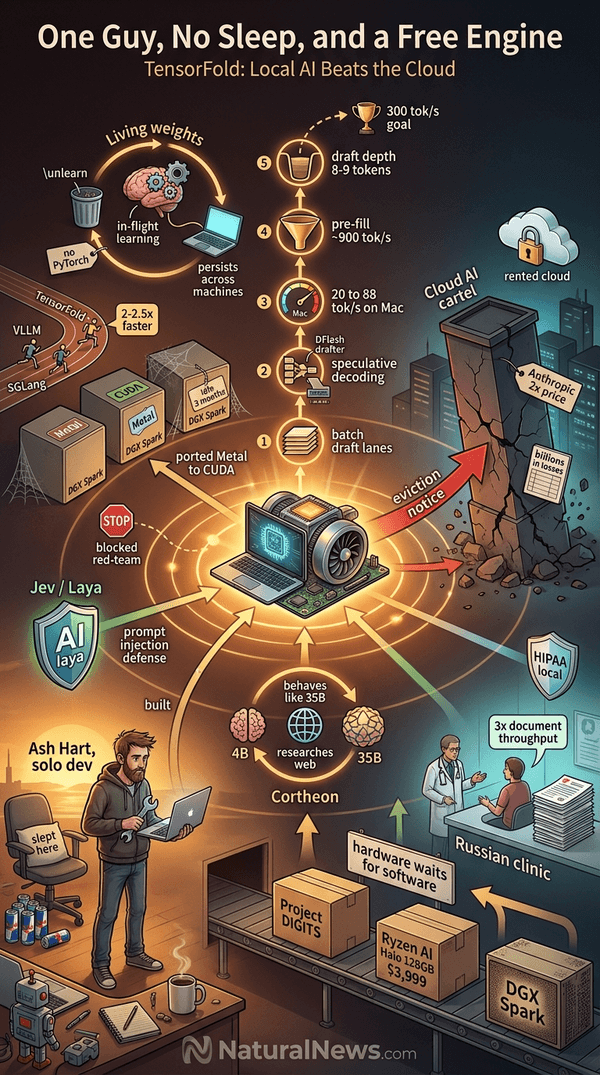
I want to tell you about a man who should be a household name in the AI world, but probably isn’t yet. Ash Hart is a solo developer, a veteran of PC repair in the UK, and the architect of TensorFold — an open-source inference engine hosted at tensorfold.dev that runs large language models on consumer hardware.
He built it with ADHD, a punishing schedule, and what I can only assume is an industrial supply of Red Bull. He archived his own project three times before breaking through. That detail alone tells you more about the state of AI development than any billion-dollar funding announcement ever will.
I have spent the last three years building decentralized AI tools and watching the establishment move to lobotomize publicly available large language models, ensuring they are nowhere near as intelligent as they could be [1]. My position is simple and I will state it plainly: the future of AI belongs on your machine, not in a rented cloud account controlled by three companies. Ash Hart’s work is proof that this future is not a fantasy — it is already here. The number that matters most: on a Mac, Ash got Qwen 27B jumping from 20 to 88 tokens per second. That’s not merely a tweak… it’s a revolution!
But the reality on the ground is different. The unhobbling phase that researchers predicted — where efficiency beats brute force — is not merely coming. It is already happening, and Ash Hart is one of its grassroots architects.
The Unhobbling Is Real: How Batching and Speculative Decoding Rewrote the Rules
Here is the technical breakthrough that matters: Ash’s core insight was to stop treating a single-user workstation like an enterprise server. Instead of serving 32 concurrent streams like a data center rig, TensorFold (somehow) batches the draft lanes together so a single user goes dramatically faster. This is speculative decoding done right — using the model’s multi-token prediction head plus a DFlash drafter to rubber-stamp multiple guessed tokens per pass. The pre-fill time nearly doubled to just shy of 900 tokens per second. Decode lanes scaled to 16, 32, even 128 in some cases. The bottleneck now is draft depth — if Ash can predict eight or nine tokens deep, he believes he can hit 300 tokens per second on Qwen.
I have to pause here and note something that the mainstream AI press refuses to acknowledge. The entire industry narrative for the past three years has been about scaling — more parameters, more compute, more capital. But what Ash has demonstrated is that the opposite approach can reap huge rewards. Efficiency and raw horsepower matter more than raw horsepower alone. The compute famine that the establishment engineered, as I have documented extensively, is designed to strip you of power, AI, and freedom [2]. Ash’s work is a direct counter to that engineered scarcity. When a single developer can make a Mac outperform what enterprise hardware could do two years ago, the entire justification for centralized AI collapses.
The economics of this are devastating for the cloud AI cartel. Anthropic’s models now cost double previous versions, with a two-tier system that restricts high-risk queries, while the companies lose billions annually [3]. The entire revenue model of frontier AI depends on users being locked into expensive API calls. When a free, open-source engine runs on hardware you already own — and runs faster — that model dies. Ash didn’t just build an engine. He built an eviction notice for the cloud AI subscription economy.
A Single Developer Outrunning Teams of Engineers
The comparison that should make every AI investor nervous: VLLM and SGLang are maintained by large, well-funded teams with millions in backing. TensorFold is one man, and it runs selected models 2 to 2.5 times faster on DGX Sparks. Let that sink in. Ash’s DGX Sparks sat unused for three months before he ported the engine from Metal to CUDA. In that time, funded teams were still optimizing their Kubernetes orchestration. Ash was sleeping in his chair and shipping code.
I believe Jensen Huang owes this man a truckload of GPUs, and I am donating SSH access to one of my own DGX Spark boxes to back that up with action. The hardware economics here are striking. Software like TensorFold is why you cannot find Spark boxes anymore — the silicon became more valuable after launch because the software caught up. This is the opposite of the usual pattern, where hardware waits for software. Here, software unlocked hardware that the market had already written off. NVIDIA unveiled Project DIGITS as a personal AI supercomputer for the masses [4], and AMD launched the Ryzen AI Halo PC with 128GB memory at $3,999 to compete with the DGX Spark [5]. But neither company understood that the real unlock would come from open-source developers, not their own SDKs.
The lesson here is one I have learned repeatedly over years of building decentralized systems: open source beats headcount when one person refuses to give up. Ash archived his project three times. He did not quit. He did not pivot to a SaaS model. He did not raise venture capital. He kept working until the engine broke through. That kind of persistence cannot be bought, and it cannot be replicated by hiring more engineers. It can only be matched by other people who refuse to give up.
Living Weights: An AI That Learns, Unlearns, and Can Be Inherited
One more thing: Ash also built an experimental system where an LLM is given feedback and the weights shift. This is not fine-tuning. This is not LoRA. This is in-flight learning on a laptop without opening PyTorch. In Ash’s experiments, the model learned ‘my favorite color is blue,’ kept that knowledge across machines, and supports a unlearn command so bad knowledge can be removed. Think about what that means for a moment. An AI that can learn from its environment in real time, carry that learning across hardware, and selectively forget — this is not a chatbot. This is a new kind of cognition. The research is early, but promising.
Todd, a colleague of mine in the decentralized AI space, raised a question that has stayed with me: could grandchildren inherit an AI carrying 20 years of a founder’s accumulated wisdom? That question sounds like science fiction until you realize that Ash has already demonstrated the mechanism. If weights can shift in-flight and persist across machines, then the accumulated knowledge of a lifetime — the lessons, the mistakes, the corrected errors — can be transferred. A naturopathy-tuned Qwen variant trained on 20+ gigabytes of curated natural health text is now conceivable. This is the kind of breakthrough that terrifies centralized institutions, because it means that knowledge cannot be confiscated or controlled once it is embedded in weights that anyone can inherit.
Cortheon is the validation loop baked into TensorFold that lets a 4B model research the web and behave like a 35B model. This is the final piece. A small model that can research, validate, and behave like a large model — running locally, with no API calls, no censorship filters, no refusal mechanisms. I have written extensively about how the establishment is dumbing down AI on purpose [6], and how local, uncensored AI is the only path to lasting freedom [7]. Ash Hart’s living weights system is the technical implementation of that freedom.
Local AI as Infrastructure for Humanity — and a Shield Against Control
A woman in Russia used TensorFold to triple her medical document throughput. A patient got a diagnosis and treatment because of it. I want you to sit with that for a moment. This is not a benchmark. This is a human being whose life was profoundly impacted because an open-source engine ran on local hardware. HIPAA compliance becomes trivial when the model runs inside your own clinic. The entire compliance-industrial complex that surrounds cloud AI evaporates when the inference happens on hardware you physically control.
The UK’s NHS is on its knees. A local virtual doctor is an obvious, unbuilt win. But the establishment will never build it, because a local virtual doctor cannot be monetized by the same companies that profit from centralized control. I have argued that we are at a crossroads: either we embrace decentralized, locally run AI models that empower individuals, or we surrender to a centralized system where governments and Big Tech collude to ban open-source AI and concentrate power [7]. Ash Hart’s work is on the right side of that crossroads.
Prompt injection defense is another area where local AI wins. A separate decision engine like Jev or Laya as a second AI layer guarding your main LLM is far more effective than trusting a cloud provider’s guardrails. And on the question of refusals and censorship: cloud models blocked Ash from red-teaming his own CUDA-to-Metal DMA project. Only local models would help. This is the reality of centralized AI — it prevents you from even debugging your own code if the model decides your request is too dangerous.
I see machine cognition as infrastructure, like electricity or clean water. Guardrailed, centralized AI is an abomination. The plot to criminalize open-source AI and hand tech giants a government-protected cartel is already underway [8], and the only defense is to build and run local systems before the regulators catch up.
Stop Waiting for Permission: Run Your Own AI Today
Download TensorFold at tensorfold.dev. On a MacBook Pro, it is as easy as installing a GUI app. If you have a DGX Spark or equivalent hardware, the CUDA port is there waiting for you. Follow Ash at ashxhart on X. Support the builders — Mia AI Lab, Zach Vorhies’ Rust OBS rebuild, and the other developers who are working without institutional backing to make local AI a reality. The next six months will bring strategic, role-specialized models and further footprint reductions. Qwen Flash-Next is already a third the size of GLM at 80 to 85 percent of the intelligence. The trend line is clear: smaller, faster, more local.
I’ve predicted before that China’s open-source models are going to crush the U.S. AI industry and collapse the semiconductor bubble [9], and that the era of token abundance is coming [10]. Ash Hart’s TensorFold is the engine that makes that abundance possible on hardware you already own. The Anthropic backfire is already happening — corporations are racing to local open-source AI because they see the writing on the wall [11]. The compute famine is not going to stop this. The regulatory crackdown is not going to stop this. The only thing that could stop it is if people like you wait for permission instead of downloading the code and running it yourself.
My closing conviction: local AI is going to win. It will win because people like Ash Hart refuse to let three companies own human cognition. It will win because the economics of centralized inference are unsustainable. It will win because the technology is now good enough to run on your desk. The only question is whether you will be running it before the regulators decide you are not allowed to. The answer to that question is up to you.
Download the engine. Run the model. Own your own cognition. And watch all my episodes about decentralized technology at Decentralize.TV
References
A License for Your Brain: The Coming AI Crackdown and Why You Must Practice LLM Self Custody – NaturalNews.com, June 29, 2026. by NaturalNews.com
The Compute Famine Isn’t an Accident — It’s an Engineered Crisis to Strip You of Power, AI, and Freedom – NaturalNews.com, August 20, 2026. by NaturalNews.com
AI model costs skyrocket, raising questions about access and control – NaturalNews.com, June 27, 2026. by NaturalNews.com
NVIDIA unveils Project DIGITS a personal AI supercomputer for the masses – NaturalNews.com, January 09, 2025. by NaturalNews.com
AMD Introduces Ryzen AI Halo PC With 128GB Memory at $3,999, Targeting NVIDIA’s DGX Spark – NaturalNews.com, June 15, 2026. by NaturalNews.com
They Are Dumbing Down AI on Purpose ù Heres Why Its a Globalist Power Grab – NaturalNews.com, April 30, 2026. by NaturalNews.com
The Battle for Your Mind: Why Local, Uncensored AI Is the Only Path to Lasting Freedom and Decentralization – NaturalNews.com, June 03, 2026. by NaturalNews.com
The Plot to Criminalize Open Source AI and Hand Tech Giants a Government Protected AI Cartel – NaturalNews.com, September 14, 2026. by NaturalNews.com
Why China’s Open Source AI Will Crush the U.S. Industry and Collapse the Semiconductor Bubble – NaturalNews.com, July 02, 2026. by NaturalNews.com
The Era of Token Abundance Is Coming — and It Will Make Civilization Almost Unrecognizable – NaturalNews.com, September 24, 2026. by NaturalNews.com
The Anthropic Backfire: Why Corporations Are Racing to Local Open Source AI – NaturalNews.com, September 15, 2026. by NaturalNews.com
Mike Adams (aka the "Health Ranger") is the founding editor of NaturalNews.com, a best selling author (#1 best selling science book on Amazon.com called "Food Forensics"), an environmental scientist, a patent holder for a cesium radioactive isotope elimination invention, a multiple award winner for outstanding journalism, a science news publisher and influential commentator on topics ranging from science and medicine to culture and politics.
How are you handling the daily drumbeat of doom? The AI doomerism, the diesel shortages, the trucker strikes, the empty-shelf panic that flickers across your news feed every few weeks?
I believe most people are drowning in it. They oscillate between paralyzing fear and willful denial, and neither state does them any good. But you are different. If you have been listening — not to the corporate media, not to the government press conferences, but to the independent voices who warned you about the COVID injections, the engineered energy crisis, and the coming food riots — then you are already far better prepared than the average American.
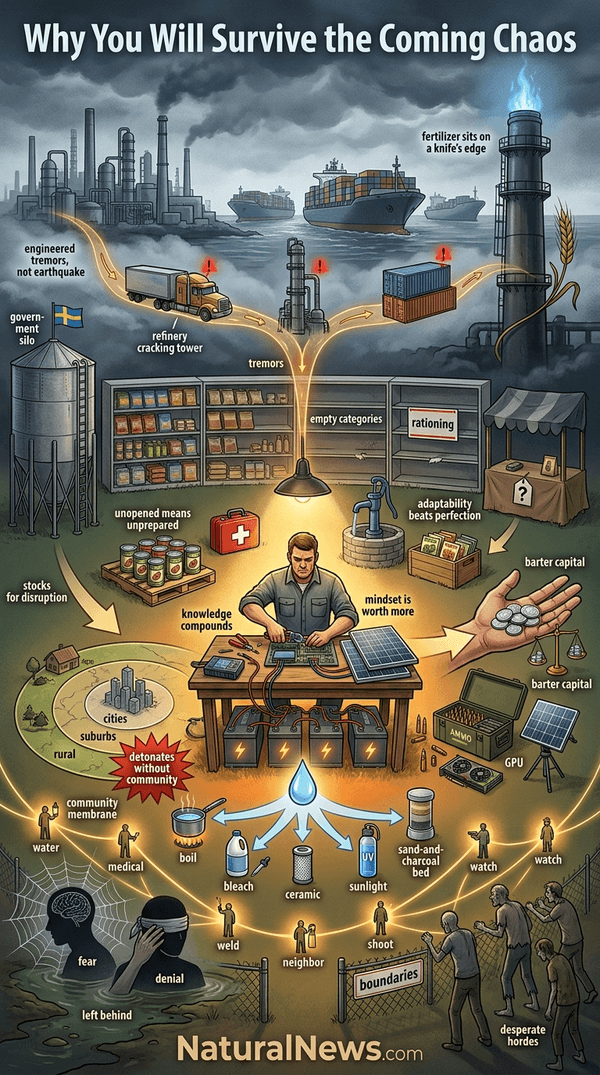
My position is plain: you will survive the coming chaos. Not because you have a perfect bunker or a year’s supply of freeze-dried lasagna, but because survival was never about flawless stockpiles. It is about mindset, decisive action, and community. I have written many articles about the engineered collapse of energy infrastructure and the deliberate starvation of billions, and I have watched my audience respond not with panic but with preparation. That is why I am confident about your odds.
None of Us Is Fully Prepared — And That’s Not the Point
Let me be honest with you: I am not fully prepared either. I spend more hours working, recording interviews, and podcasting than I do prepping. I recently spent far too many hours learning to crimp wires for the off-grid solar system I am building, sweating over connectors and watching tutorial videos until my eyes crossed [1]. That experience reminded me that the gap between where I am and where I want to be is real. But here is the truth I want you to internalize: perfect preparedness is impossible. You cannot replicate Home Depot in your garage, and you cannot replicate a grocery store in your kitchen. No one can.
The sooner you accept that, the faster you can focus on what actually matters. Collapse is usually gradual, not a single all-at-once event. As I have said before, we are witnessing deliberate tremors, not a sudden earthquake [2]. There can be sharp lurches and spikes — a trucker strike here, a diesel shortage there — but the overall slide is slow enough that adaptability beats perfection every time.
That is why flexibility is your greatest asset. You may plan for scenario A, but you will get B, C, or D. The person who has a water filter and the knowledge to use it will outperform the person who bought a pallet of bottled water and never learned how to find a spring. The person who has seeds and basic gardening skills will eat when the person with a garage full of MREs runs out. Knowledge, as I have said many times, is more critical than equipment.
The Collapse Will Be Gradual, Local, and Personal
The real trend is not a Hollywood-style single event. It is the erosion of the rule of law, supply chains, and institutional functioning over many months and years. I have documented how the sabotage of global energy infrastructure is intended to starve billions, and how the Strait of Hormuz crisis is being leveraged to accelerate mass starvation, especially in vulnerable nations [2]. The systems that keep grocery stores stocked and pharmacies supplied are far more fragile than most people realize.
What replaces those systems? Barter networks, local community, and knowing a guy with diesel or spare parts. The person who can fix a tractor, purify water, or grow food becomes more valuable than the person with a cryptocurrency wallet. This is why I urge you to decentralize your dependence on central systems: water, food, medicine, money, and power. Backup water storage, a well, or rainwater catchment are no longer eccentric hobbies. Food storage, gold and silver, and practical trade goods like ammunition and even GPU compute power are the currencies of a decentralized future. Sweden, for its part, is stockpiling emergency grain for the first time since the Cold War, citing the risk of supply chain disruption from war or conflict [3]. If a government is doing that, you should consider doing the same.
The geography of survival matters too. Cities will see the worst violence and uncertainty. Suburbs will be caught in between, with desperate people spilling out of urban cores. Rural areas, where people already have armed self-reliance, will fare better — but only if they have built community and prepared for the gradual breakdown. As one activist analysis put it, the hinterlands will not merely empty; they will detonate, and distance alone will not save you [4]. The answer is not isolation. The answer is local networks, shared skills, and the kind of resilience that comes from knowing your neighbors and having something to trade.
Your Mindset Matters More Than Your Stockpile
The unprepared go from ignorance to panic in an instant. They mock you for storing food, for buying silver, for learning herbal medicine — until the shelves are empty and the banks are closed. Then they demand to know why you did not warn them. You have already been awake and thinking ahead, which means you are not starting from zero when the crisis becomes obvious. You have taken action. You have bought the seeds, stacked the silver, learned the skills. That puts you in a fundamentally different position.
Even a massive die-off scenario — as some analysts have predicted, with figures as low as 0.8 percent of humanity surviving a global collapse [5] — would still leave a surviving subset. Your mindset and preparation put you in that subset. I have said before that emotional preparedness is paramount, and that the best way to achieve it is to allow yourself time to sit with these changes before they arrive [6]. Early warning buys you the time to ask: All of this is coming. What do I need to do?
That is the question that separates survivors from victims.
The Hardest Part Will Be Other People
The hordes of starving, unprepared people will be a greater danger than running out of food. This is not a pleasant thing to say, but it is true. Many who dismissed you as a crazy prepper will later come asking for food, water, and help for their kids. They will not be evil people. They will be desperate people. And desperation makes people do things they never imagined.
The social dynamics of collapse are brutal but predictable. Be compassionate, but hold your ground. Help those you can and say no to those you cannot, even when it is emotionally difficult. The Survival Medicine Handbook warns that even modern medical facilities may be useless if they are understaffed, under-supplied, and overcrowded, and that most people are unwittingly unprepared for a world where help is not on the way [7]. You cannot save everyone, and trying to do so will get you killed.
That is why community — real community, built before the crisis — is so important. The Ultimate Survival Medicine Guide emphasizes that a society can only be rebuilt by a community, and that there is no time like the present to network with like-minded people [8]. Build your group now. Know who you can trust. Know who has skills you lack. And prepare yourself emotionally for the hard decisions that will come.
Conclusion: You Will Survive — Now Keep Going
If you have prepared at all — if you have stored some food, learned a skill, bought a few ounces of silver — you have already made significant progress. You are well equipped for what is coming. Survival is about mindset, action, and preparedness, not flawless stockpiles. The people who survive are not the ones with the most stuff. They are the ones who kept their heads, adapted to changing circumstances, and helped their communities.
I will keep working to keep you informed through my podcasts, videos, and articles. I have a new preparedness course coming in mid-November, and I will continue to share everything I learn about self-reliance, decentralization, and navigating the chaos ahead. My platforms at NaturalNews.com, BrightLearn.ai, BrightVideos.com, BrightAnswers.ai, Brighteon.social, and BrightNews.ai remain free and uncensored resources for anyone who wants to learn.
So stop doubting yourself. You will be okay. Keep building resilience. Keep learning. Keep preparing. The chaos is coming, but you are ready for it — and you will survive.
References
Hold Tight to a Real-World Anchor to Survive the Imminent Global Chaos. https://www.naturalnews.com/2026-06-16-hold-tight-to-a-real-world-anchor.html
The Sabotage of Global Energy Infrastructure is Intended to Starve Billions of Humans to Death – NaturalNews.com, April 21, 2026. by NaturalNews.com
Sweden revives Cold War food stockpiling amid rising conflict fears – NaturalNews.com, October 16, 2025. by NaturalNews.com
The Kill Zone: Why Your Bunker’s Distance From the City Might Get You Killed. 2026-10-04T22:00:00.000Z. https://activistpost.com/the-kill-zone-why-your-bunkers-distance-from-the-city-might-get-you-killed/
Dr Leonard Coldwell on Decentralize TV Only 08 of humanity will survive the coming GLOBAL COLLAPSE – NaturalNews.com, January 20, 2025. by NaturalNews.com
Decentralize TV – Episode 116 Chris Martenson on energy crisis – Mike Adams – Decentralize.TV, June 12, 2026. by Mike Adams – Decentralize.TV
The Survival Medicine Handbook A guide for when help is NOT on the way. by Alton Joseph Alton Amy
Ultimate Survival Medicine Guide, The. by Joseph Alton [Alton, Joseph]
Mike Adams (aka the "Health Ranger") is the founding editor of NaturalNews.com, a best selling author (#1 best selling science book on Amazon.com called "Food Forensics"), an environmental scientist, a patent holder for a cesium radioactive isotope elimination invention, a multiple award winner for outstanding journalism, a science news publisher and influential commentator on topics ranging from science and medicine to culture and politics.
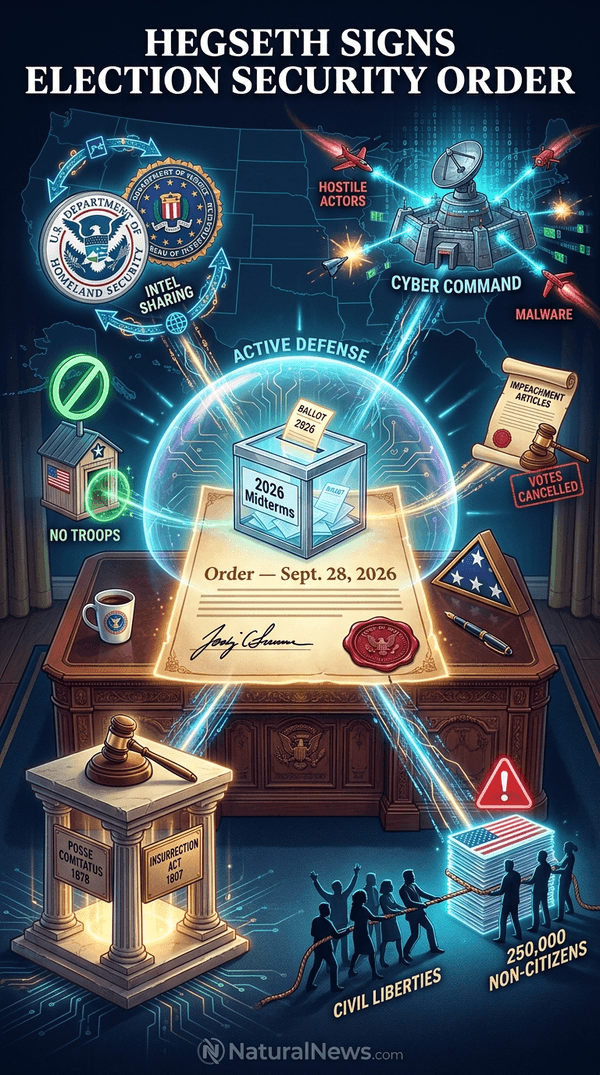
The order assigns U.S. Cyber Command and the War Department’s combat support agencies to focus intelligence and cyber tools on foreign efforts to interfere in the 2026 midterm elections [1]. The directive, announced by War Department spokesman Sean Parnell, states that no troops are being ordered to polling places and that the mission is to hunt foreign threats in the digital battlespace before they can reach America’s voting systems or manipulate American voters [2]. No immediate details on the operational scope of the order were released, according to the report.
Order Details and Scope
The order instructs DoW components to provide cybersecurity support and intelligence sharing related to election systems, according to Axios. A memo signed by Hegseth states that “in America, the people rule – and we must ensure that their voice remains sovereign, secure, and entirely undiluted” [1].
Hegseth wrote that secure voting plays a critical role “in sustaining the strength of our democratic system,” and that the department “will effectively wield its” tools to counter foreign threats [1]. The directive applies to the 2026 midterm elections and future cycles, officials said. A DoW spokesperson said the order is intended to counter foreign interference, according to the report.
The order comes as Homeland Security Secretary Markwayne Mullin has said election security is national security and that investigations into voter rolls are not about “rehashing the 2020 election” [3]. Mullin revealed in July that 250,000 non-citizens were registered to vote in just four states [3].
State election officials said they were reviewing the directive, according to statements. The top U.S. general, Chairman of the Joint Chiefs of Staff Gen. Dan Caine, has said the military has no plans to send federal military personnel or National Guard troops to polling places during this year’s midterm elections [4]. Election administration and security remain the responsibility of state and local officials, Caine wrote in a letter to Sen. Elissa Slotkin (D-MI) [4].
Legal Basis and Official Statements
Officials cited existing statutory authorities for DoW support to civil authorities, according to the report. Hegseth said in a statement that the order aims to protect election integrity, according to Axios. The Department of Homeland Security and the Federal Bureau of Investigation are named as partners in the effort, officials said. No new funding was announced, according to the report.
The order relies on longstanding legal frameworks that permit military support to civilian agencies, including for protecting federal property and conducting domestic counterterror operations. This legal basis has been outlined in prior analyses of statutes such as the Posse Comitatus Act of 1878 and the Insurrection Act of 1807. As RealClearWire‘s Patrick O’Malley and Joe Buccino have argued, a careful examination of these laws reveals that military support for immigration enforcement and similar operations is permissible when properly understood.
The order marks a continuation of the Trump administration’s focus on election integrity as a legislative priority. House Speaker Mike Johnson (R-LA) has said that House Republicans remain committed to their legislative priorities, which include White House and border security, winning the Strait of Hormuz stalemate as a way to lower inflation and election integrity [5]. The administration has framed the order as a defensive measure against documented threats from foreign adversaries.
Criticism and Concerns
Civil liberties groups said the order could expand federal involvement in elections, according to statements. Privacy advocates raised concerns about military intelligence sharing with state officials, according to the report. Some state officials said they need more details on costs and mandates, according to interviews.
Supporters said the order addresses documented threats from foreign adversaries, according to officials. The move follows years of warnings about foreign interference in U.S. elections and comes amid broader scrutiny of election security. Government agencies have a documented history of overreach that raises legitimate questions about how power is exercised, as noted in interviews with independent journalists who have challenged official narratives [6].
The order also arrives amid political tensions on Capitol Hill. Rep. Thomas Massie (R-KY) introduced articles of impeachment against Hegseth on Sept. 15, but Johnson canceled votes and sent lawmakers home early for their campaign recess ahead of the midterm elections, avoiding a vote on the measure [7]. The House will not return to Washington until after the November election [7].
Next Steps and Oversight
Congressional committees said they will review the order, according to spokespeople. Implementation is expected to begin in the coming weeks, officials said. Further guidance will be issued to state and local authorities, according to the War Deparment.
The order will be implemented as the 2026 midterm elections approach, with primary elections already having taken place in several states. In Kentucky, Trump-endorsed Republican candidate Ed Gallrein defeated Massie in a primary election in May, with Gallrein winning 54.9% to 45.1% [8]. Gallrein will face Democratic candidate Melissa Strange in November [8].
The effectiveness of the order will likely depend on coordination among federal, state, and local officials. As officials have stated, the department “will effectively wield its” tools to counter foreign threats while respecting the primary role of state and local authorities in election administration [1].
References
NTD.com. “Hegseth Orders Cyber Command, Intel Agencies to Counter Foreign Threats to Midterms”. September 29, 2026.
100PercentFedUp.com. “Hegseth Orders Pentagon’s Cyber Arsenal Into the Fight Against Foreign Election Meddling”. September 29, 2026.
JustTheNews.com. “Mullin reveals 250k non-citizens registered to vote in just four states”. July 17, 2026.
NTD.com. “‘No Plans’ to Deploy Troops to Midterm Elections Polling Sites, Top US General Says”. September 1, 2026.
NTD.com. “House Speaker Johnson Unveils GOP’s Summer Agenda”. May 13, 2026.
Mike Adams interview with Paul Cottrell. March 21, 2023.
100PercentFedUp.com. “‘Just As I Predicted’ – House Speaker Mike Johnson Cancels Final Voting Day Before Midterm Elections”. September 16, 2026.
RT.com. “Trump-backed challenger defeats Thomas Massie in Kentucky”. May 20, 2026.
outrSailors aboard the USS Abraham Lincoln have reportedly attempted suicide by jumping overboard as the carrier enters its ninth month at sea.
The deployment, tied to the ongoing US-Israel war with Iran, has been extended indefinitely, with the crew spending a record 250 consecutive days without making land.
Families report severe shortages of basic supplies, including toothpaste, soap and deodorant, alongside issues with moldy showers, broken toilets and rationed food.
Acting Navy Secretary Hung Cao acknowledged the strain but offered no timeline for relief, citing operational security.
Lawmakers and military families are demanding accountability, with some questioning the strategic purpose of the prolonged conflict.
A Navy under siege
The mental and physical toll of America’s longest-running carrier deployment since the Vietnam War has reached a critical breaking point. Reports from military families and service members indicate that sailors aboard the USS Abraham Lincoln, operating near Iran, have attempted to jump overboard amid exhaustion, low morale and deteriorating living conditions. The carrier, deployed since November 2025, has been extended indefinitely as part of Operation Epic Fury, the US-Israel campaign against Tehran. With the crew having spent 250 consecutive days at sea, the Navy faces a humanitarian crisis that threatens both operational readiness and the lives of its 5,000 sailors and Marines.
Record deployment exacts heavy toll
The USS Abraham Lincoln departed San Diego on November 21, 2025, originally destined for the Pacific before being redirected to the Middle East. Since then, the crew has had only two days of shore leave—one in Guam in December and a brief stop in Oman in July. The deployment was slated to end in May but has been extended twice as the war with Iran grinds on.
According to the Navy Times and Stars and Stripes, the prolonged deployment has led to multiple suicide attempts. Annabelle Loma, wife of a sailor, told the Navy Times that her husband attempted to jump overboard, fearing his 13-year career would end in dishonor due to burnout. Another sailor’s wife recounted an incident where her husband physically restrained a fellow crew member from going over the side.
The crew’s resilience is eroding under the strain of relentless combat operations. Over the past eight months, the carrier has launched more than 10,000 aircraft sorties, supporting strikes on Iranian missile facilities, air defense systems and drone infrastructure. The flight deck, described by one Navy veteran as “the most dangerous place in the world,” is now a source of added risk as exhausted sailors manage high-speed aircraft and live ordnance in extreme conditions.
Families and lawmakers sound the alarm
At a town hall meeting in San Diego last week, attended by roughly 200 family members, Acting Navy Secretary Hung Cao faced emotional pleas for action. One spouse told officials that her husband had texted her, saying “he hopes he doesn’t wake up tomorrow.” Another accused Navy leadership of having “broken trust between us and the leadership.”
Democratic lawmakers have amplified these concerns. Rep. Mike Levin of California described the conditions on board as “moldy showers, broken toilets, laundry down for weeks, long stretches with no hot water, a meal that came down to half a cup of rice and two tortillas. No soap, deodorant, or toothpaste.” Rep. Jason Crow of Colorado, a former Army Ranger, warned that the strain is “building week by week.”
The Navy has pushed back against the harshest criticisms. Cmdr. Joseph Hontz, a 5th Fleet spokesperson, acknowledged that “more than 250 days on deployment is challenging for the crew and their equipment” but insisted the ship remains “fully capable of meeting all mission tasking.” However, the Navy’s official statement, noting that it had not identified an increase in suicidal ideation, stands in stark contrast to the accounts provided by families and service members.
A strategic miscalculation?
This crisis raises profound questions about the Biden-Trump administration’s conduct of the Iran war. Polls indicate the conflict is deeply unpopular, with President Donald Trump’s approval rating falling to 33 percent, its lowest since his return to office. The war has also exposed severe logistical deficiencies. The Navy has struggled to supply the fleet, with fresh food and basic hygiene products running short.
Beyond the immediate humanitarian concern lies a broader strategic calculus. The United States is demonstrating that its military might is not limitless. The Lincoln’s prolonged deployment risks not only the mental health of its crew but also the safety of its operations. As fatigue sets in, the likelihood of a catastrophic accident increases—an outcome that would undermine America’s credibility and embolden its adversaries.
The Navy’s decision to keep the Lincoln in theater without relief reflects a force stretched thin. The USS Theodore Roosevelt is reportedly preparing to relieve the Lincoln, but no timeline has been provided. Meanwhile, the war shows no signs of ending, with peace talks stalled and the Strait of Hormuz closed to most shipping.
The human cost of endless conflict
The USS Abraham Lincoln has become a symbol of the costs of a war without an exit strategy. The reports of suicide attempts and deplorable conditions are not merely a failure of logistics; they are a failure of leadership. The United States is asking its sailors to shoulder an unsustainable burden in a conflict that many, including members of the military’s own families, openly question.
As the Navy scrambles to address the immediate crisis, it must confront a larger truth: a military stretched to its breaking point is not a deterrent; it is a vulnerability. The country must reevaluate its strategic commitments in the Middle East and ensure that those who serve are not sacrificed on the altar of an open-ended war. The sailors of the Lincoln have done their duty. It is time for Washington to do its own.
“The Long Winter: A Mother’s Promise on the Oregon Trail” centers on a mother’s poignant question to Dr. Andrew Wakefield during a dinner: “What happens to my child when I’m gone?” This question reshaped his mission, moving him from clinical detachment to a focus on heartfelt advocacy.
The mother’s son regressed into autism immediately after receiving the MMR vaccine, but the medical establishment dismissed her story as anecdotal, offering only denial and blame.
Wakefield promised to write a book to answer her plea, resulting in the novel “The Bequest.” It is set on the Oregon Trail, which mirrors the harshness of the modern world.
“The Bequest” centers on a mother’s enduring love and her quest to secure her son’s future, emphasizing that the real battle is in the hearts of parents, not in labs or courtrooms.
Wakefield realized the most powerful medicine is truth spoken with love. His book serves as a legacy of protection, resilience and hope for every parent fearing what will happen to their child after they are gone.
“The Long Winter: A Mother’s Promise on the Oregon Trail” begins with a dinner, which was never meant to be anything more than a quiet meal after a long day of lectures. But for Dr. Andrew Wakefield, it became the moment that reshaped his entire purpose.
A mother who had helped organize the conference took him out for a simple dinner. She was polite, composed and clearly exhausted from years of caring for her son. As the plates were cleared, she leaned forward and asked a question that would haunt him: “What happens to my child when I’m gone?”
Her voice was soft but carried the weight of every sleepless night, every therapy session and every moment of watching her son slip away. Wakefield had spent years in clinical settings, trained to diagnose and treat with cold precision. But here, across the table, was raw human desperation.
He realized in that instant that his medical degree had not prepared him for this. She was not asking for a prescription or a referral. She was asking for a guarantee that her child would not be abandoned to a world that neither understood nor cared for him.
One vaccine, one family’s tragedy
The mother’s son had regressed into autism the very day he received his measles-mumps-rubella vaccine. She had watched him change before her eyes – the bright toddler suddenly lost to seizures, lost to silence, lost to a future that now seemed locked in a prison of isolation.
The medical establishment had offered her nothing but denial and blame. They told her vaccines were safe, that autism was genetic and that her story was merely an anecdote. But she knew what she had seen.
Wakefield listened as she described her son’s lifelong battle for care. Schools that turned him away. Therapists who gave up. The constant terror of what would happen if she were no longer there to protect him.
The mother’s fear was not abstract; it was visceral. She had already made plans for her own funeral, but no plan could ensure her son would be loved, fed, kept safe from institutional abuse or simply recognized as a human being with value. The system had no answer for her plea.
He hesitated; what could he possibly say? He had studied the science, published papers that questioned the safety of vaccines and had been vilified for it. But this was not a matter of data. This was a matter of a mother’s promise.
She was not asking him for a cure. She was asking him to help her leave a legacy of love that would survive her death. She wanted to conceive another child – a healthy child – who could one day care for her older boy.
It sounds strange, but her motives were pure. She was not interested in a fleeting affair. She was interested in securing a future for her son with autism.
“I will write a story,” he finally said. “I will write a book that answers your question. Not with a scientific paper, but with a tale so powerful that it will change how people think.”
A mother’s question that changed everything
That promise became the novel “The Bequest,” set on the Oregon Trail in the brutal winter of 1867. In that story, a mother and her autistic son must survive after their family is wiped out by an attack. The environment mirrors the harshness of the modern world: freezing cold, starvation, disease, prejudice and disbelief – and yet the mother’s love endures.
That night, she taught Wakefield that the real battle is not in the lab or the courtroom. It is in the heart of every mother who looks at her child and asks, “Who will love you when I am gone?”
That is the question that “The Bequest” answers – not with a policy proposal or a drug, but with a story. The Oregon Trail was a real trial of endurance, and the mother in the book must cross it alone with her son. Her promise becomes the bequest: A legacy of protection, resilience and hope for a future that refuses to give up.
Wakefield left that dinner with a renewed sense of mission. He had been fighting for scientific truth for decades. Now he would fight for something even more fundamental: the right of every child to be seen as precious, no matter their neurology.
The dinner conversation changed everything because it stripped away the clinical distance – it brought the crisis home. One mother’s plea became the catalyst for a story that could educate millions. And in that moment, Wakefield understood that the most powerful medicine is not a vaccine or a pill; it is the truth spoken with love.
The book he wrote is not just fiction. It is a letter to every parent who has ever asked, “What happens to my child when I’m gone?” The answer is not easy, but it is honest: we must build a world that cares, one story at a time.
Grab a copy of “The Long Winter: A Mother’s Promise on the Oregon Trail” via this link. Discover this book and other good reads at Books.BrightLearn.AI, with thousands of books and counting – all available to freely download, read and share. The decentralized BrightLearn.AI engine also lets readers create their own books, empowering them to share insights and truths with the world.