The Seattle-based company said it expects the reorganization to be completed by the end of the year, subject to court approval and a creditor vote. The filing marks a major reset for a firm that returned to public markets in 2022 at a valuation of about $4.8 billion [1].
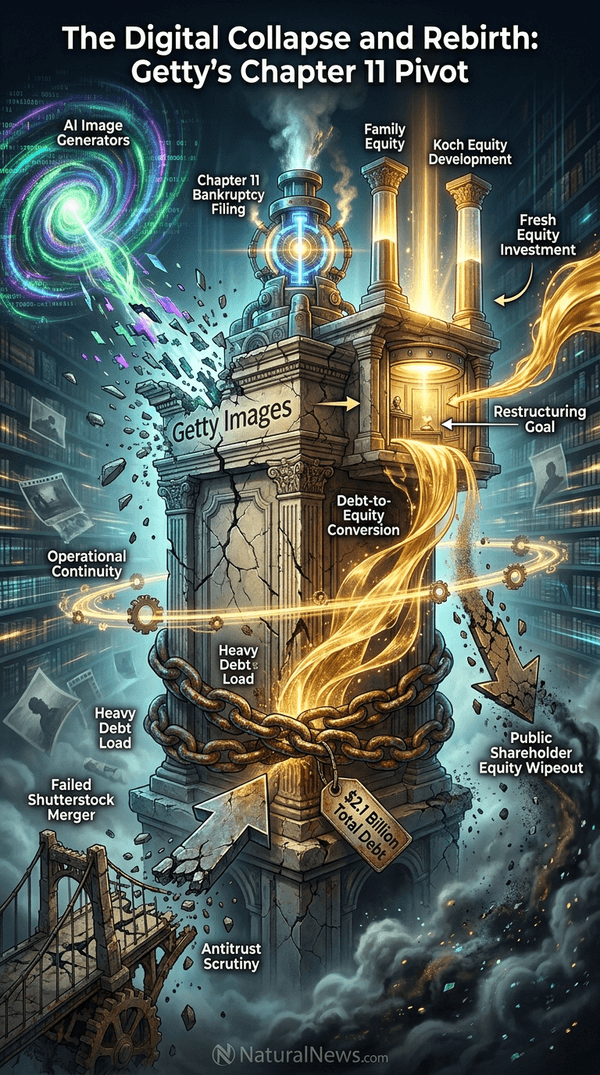
The Chapter 11 petition was filed in U.S. Bankruptcy Court for the District of Delaware, the company said. Getty Images has supplied photos and video to news agencies for more than 30 years and has been struggling with a heavy debt load and mounting competition from AI image generators [2].
Chapter 11 Filing and Immediate Operations
Getty Images said it has launched a solicitation process to secure formal creditor approval for its restructuring plan. Under the proposal, the company would be taken private, and existing public shareholders would see their equity largely wiped out, according to a company statement [1].
The company said it will continue normal operations during the proceedings.
Getty Images reported holding $51.6 million in cash at the time of the filing.
Collapsed Shutterstock Merger and Antitrust Review
The filing follows the collapse of Getty Images’ nearly $4 billion merger with rival Shutterstock. Getty Images announced last week that it planned to file for bankruptcy after the merger fell apart under the weight of debt and growing competition [3].
The proposed combination, which would have joined two of the largest stock photo providers, was abandoned after facing antitrust scrutiny. The company said the termination of the merger left it without the scale and cost savings it had counted on to manage its debt load [1].
The failed deal marked the second major strategic setback for Getty Images in recent years. The company had positioned the Shutterstock merger as a way to build a combined library of still images and video that could compete more effectively against AI-generated content and free or low-cost alternatives [4].
Financing, Ownership and Debt Position
Getty Images said it will receive up to $533 million in fresh equity from affiliates of the Getty family and Koch Equity Development.
Financing of roughly $143 million from Koch Equity Development will support the restructuring process, according to the company.
Getty Images entered a 30-day grace period after failing to make interest payments due Sept. 1 on its unsecured notes. The company said it had the cash necessary to make the payments but opted to pursue a restructuring instead, according to the filing [5]. The company’s total debt stands at $2.1 billion, and its annual interest expenses rose 57% in the most recent period, the filing showed [5].
The restructuring plan would convert a portion of that debt into equity, leaving the Getty family and Koch Equity Development as the sole owners. The company said it expects the reorganization to be completed by the end of the year [1].
Conclusion: AI Competition and Restructuring Outlook
Getty Images has supplied photos and video for news agencies for more than 30 years, according to the New York Post. The company has been struggling amid a pile of debt and mounting competition from AI image generators [2].
AI image tools have squeezed the stock photo business, pressuring licensing revenue as cheaper, machine-generated images become more widely available. Getty Images has also pursued litigation against AI developers over the use of its copyrighted images in training data, though those cases remain unresolved [6].
Completion of the reorganization is expected by the end of the year, subject to the solicitation and court process. The company said the restructuring will not affect normal operations during the proceedings, and that contributors, partners, customers, employees and vendors would see no impact [7].
References
Getty Images Files for Bankruptcy Amid AI Competition and Debt Crisis. https://www.kucoin.com/news/flash/getty-images-files-for-bankruptcy-amid-ai-competition-and-debt-crisis
Getty Images files for bankruptcy amid mounting debt, AI competition. https://nypost.com/2026/10/22/business/getty-images-files-for-bankruptcy-amid-mounting-debt-ai-competition/
Getty Images files for bankruptcy, advances restructuring plan. https://www.cnbc.com/2026/10/21/getty-images-files-for-bankruptcy-advances-restructuring-plan.html
Getty Images files for bankruptcy amid AI competition and mounting debt. https://www.dexerto.com/entertainment/getty-images-files-for-bankruptcy-amid-ai-competition-and-mounting-debt-3420995/
Getty Images Files for Bankruptcy Amid AI Disruption and Mounting Debt. https://www.kucoin.com/news/flash/getty-images-files-for-bankruptcy-amid-ai-disruption-and-financial-struggles
Getty Images Files for Bankruptcy After AI Undercuts Licensing and Shutterstock Merger Fails. https://www.ibtimes.co.uk/getty-images-bankruptcy-ai-competition-investor-litigation-1827335
Getty Images Files Chapter 11 Bankruptcy Amid AI Competition. https://capitaldigest.com/getty-images-seeks-chapter-11-protection-as-debt-and-ai-tools-squeeze-the-business/
I have now spent three years building decentralized AI tools and local infrastructure, and I have watched the Western establishment move to lobotomize publicly available large language models so they are nowhere near as intelligent as they could be. In my view, this is not an accident. It is a deliberate strategy to prevent decentralized cognition — the very thing that threatens their monopoly on power. (This is also why USA models are not nearly as good as China’s open source models…)
But here is the part the panic peddlers never want you to understand: the revolution is not happening in their data centers. It is happening on kitchen tables, in home offices, and on modded gaming rigs across the country. And it can’t be easily halted.
That personal milestone signals something much larger. While Anthropic and OpenAI chase trillion-dollar valuations built on artificial scarcity, ordinary people are quietly assembling the hardware to run powerful models on their own terms. The centralized AI valuations are fragile precisely because they depend on keeping you locked out. Local AI is becoming abundant, and abundance destroys moats.
I believe decentralization is not just good technology — it is a moral imperative. It puts AI power in the hands of individuals instead of Big Tech and government-aligned monopolies. The tools are here, and they are getting more capable every month. There is a version of the future that looks like Blade Runner-style corporate tyranny, and there is a version built on decentralized intelligence [1]. I know which one I am working to held build.
Modded GPUs and the Hardware Rebellion
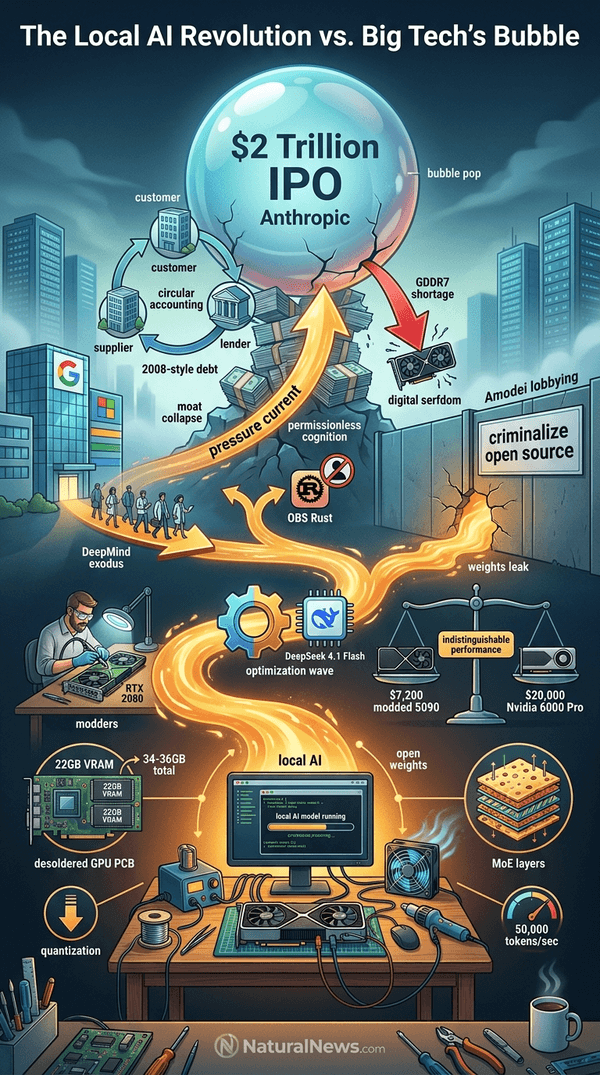
Chinese engineers are now doing something remarkable: desoldering memory and adding double-density VRAM to cards like the RTX 2080, turning it into a 22GB card that joins a 3060 for 34–36GB total VRAM (that’s the setup of Zach Vorhies right now). Rumors of a modded 5090 with 96GB show how export bans are being circumvented by reverse-engineering PCBs and reballing Blackwell chips. At $7,200, a 96GB modded 5090 would be a third of the price of an Nvidia 6000 Pro selling for $20,000–$25,000, with indistinguishable performance. That is not a minor hack. That is a hardware rebellion.
We are witnessing a seismic shift in the AI hardware market, triggered by what I can only describe as a strategic miscalculation by Dario Amodei of Anthropic [2]. Over the past few days, Amodei has aggressively lobbied for stringent government regulation, arguing that without such controls, artificial intelligence poses an existential threat. His rhetoric has effectively called for the criminalization of open-source AI models — models that, while free to run locally, require significant hardware investment. The establishment sees the hardware rebellion coming, and they are terrified.
This is exactly what decentralization looks like: ordinary people bypassing corporate gatekeepers to own their compute. The GDDR7 shortage and skyrocketing GPU prices are not accidents either — they are the predictable result of AI-driven supply chains sending consumer electronics toward what I have called digital serfdom [3]. But the modders are winning. (As usual.)
Optimization Is Eating the Cloud
The trend has shifted from throwing more parameters and tokens at problems to using fewer tokens and smaller memory footprints for the same intelligence. Anthropic’s Opus 5.5 is being used to optimize models for small rigs. Some online guides show DeepSeek 4.1 Flash running on 32–36GB VRAM with 256GB system RAM. New inference engines like TensorFold can double throughput versus vLLM or SGLang, letting larger models run faster on smaller hardware. The cloud is being eaten from below, one optimization at a time.
Mixture-of-experts models are like lasagna: layers can live on different GPUs, system RAM, and CPU, offloading experts and KV cache across PCIe. I can run agents locally that would have required eight GPUs a year ago, and that changes everything about who controls AI. My own mini data center produces roughly 50,000 tokens per second across many GPUs, and that capacity is available to me around the clock without asking anyone’s permission [4]. Meanwhile, models are getting smaller and more capable every single quarter. A 12-gigabyte gaming GPU can now run a model like Qwen 27B, which means you do not need a $20,000 workstation to participate in the revolution [4].
Artificial intelligence represents the most empowering decentralized technology for human freedom ever created [5]. No other technology comes close — not the internet, not radio, and not even Bitcoin. When AI is decentralized via open source, it becomes the most powerful democratizing force in human history. It grants individuals the ability to access knowledge, create content, and fact-check information free from government censorship, surveillance, or control. That is what optimization is delivering.
The AI Market Is a Bubble — But the Revolution Is Real
Anthropic’s proposed $2 trillion IPO makes no sense when even universal subscriptions could not generate enough revenue to justify it [6]. OpenAI is squeezed from the top by Opus 5.5 and from the bottom by cheaper models like Haiku 5.5, while burning credits to stay relevant. AI is commoditizing fast, and the workhorse models are getting good enough to run locally, which destroys the moat of centralized providers.
I was driving in my truck earlier this year, hauling solar equipment to our new studio in Texas, and I could not stop thinking about the AI bubble [7]. Not because I am against artificial intelligence — quite the opposite. I have been building AI systems for years and use them daily. But what I am seeing in the financial markets is not rooted in intelligence at all. It is a speculative mania fueled by cheap debt and fairy-tale projections.
The debt financing data centers is being repackaged like 2008 mortgage tranches, meaning pension funds and insurance companies are exposed to the coming crash. This financial instability is exacerbated by what appears to be circular accounting practices among major industry players [8]. These entities secure contracts with large corporations and subsequently leverage those agreements to secure billions of dollars in lending, often based on the projected value of GPU hardware that has not yet been delivered or manufactured.
I believe the bubble will pop, but the AI revolution will continue — because the real value is decentralized, local, and owned by individuals. I am actually rooting for the crash [9]. Not because I hate AI — I love AI. But the speculative mania has to end for the real technology to flourish because the investment mania has resulting in widespread misallocation of resources. Amazon’s $200 billion spending shock in February 2026 revealed exactly how fragile this centralization crisis has become [10]. The market is waking up. The coming crash will hurt a lot of people who believed the hype, but it will also clear the way for the local AI revolution that is already underway.
Resistance to AI Is a Losing Battle
Anti-AI backlash in open source is self-defeating. Zach had a crash-fix pull request to OBS rejected and his account banned simply because AI assisted the fix. He responded by forking OBS and starting OBS Rust, a full rewrite in Rust — proof that when programming costs go to zero, gatekeepers lose their moat. Reddit and other collectivist tech spaces are pushing a moral panic against what they call “clankers,” but they are fighting a tsunami with a squirt gun. You cannot resist a technology that makes every individual more capable.
The same pattern played out with Google DeepMind. Alex Turner and other top researchers resigned after discovering the company had sold its AI infrastructure to the U.S. military with no restrictions against killer robots or mass spying [11]. Google whistleblower Zach Vorhies predicts that Google’s influence is waning, and that decentralized and AI-driven technologies could render its current business model obsolete, leading to a potential breakup of the company [12]. When the gatekeepers lose their monopoly on talent and technology, the moat collapses.
I believe the only rational response to all this is to embrace local AI. You cannot resist a technology that makes every individual more capable. New frontier models emerge every week — Grok, Qwen, DeepSeek, GLM 5.3 — each one matching or exceeding the last [13]. Yesterday’s marvel is today’s commodity. The people trying to ban open-source AI are on the wrong side of history, and they know it.
Conclusion: Grab the Surfboard
The future of autonomous intelligence is already here: persistent agents, orchestrator loops, and token abundance will redefine work and creativity. I have said before that we are heading toward what I call a transcendent tech economy where staggering AI-driven abundance and mass poverty arrive together [14]. Zach calls it “God in a box,” and I agree we should respect the power — but that power belongs in local hands, not centralized server farms. The era of token abundance is coming, and it will make civilization almost unrecognizable [9].
Do not just watch the AI bubble burst. Learn to run models locally. Buy modest GPUs. Build your own agent swarm. Surf’s up. Grab a board and decentralize.
Visit BrightAnswers.ai for uncensored AI research, BrightVideos.com for free speech video, and Brighteon.social for a free speech social media platform that does not censor you. The tools are here. The hardware is still relatively affordable. The only thing missing is your decision to own your intelligence instead of renting it from companies that hate you.
References
Big Al Isn’t the Answer: Why Local Models Are the Real Revolution. 2026-10-05T14:22:47Z. https://newstarget.com/2026-10-05-why-local-models-are-the-real-revolution.html
Health Ranger Report – CORPORATIONS EMBRACE LOCAL OPEN SOURCE AI – Mike Adams – BrightVideos.com, September 15, 2026. by Mike Adams – BrightVideos.com
The GDDR7 Crisis How AI Driven Supply Chains Are Sending Consumer Electronics Toward Digital Serfdom – NaturalNews.com, January 23, 2026. by NaturalNews.com
The Anthropic Backfire: Why Corporations Are Racing to Local Open Source AI – NaturalNews.com, September 15, 2026. by NaturalNews.com
Health Ranger Report – THE PLOT TO CRIMINALIZE OPEN SOURCE AI – Mike Adams – BrightVideos.com, September 14, 2026. by Mike Adams – BrightVideos.com
Zach-Adams Effect with Zach Vorhies – Local AI Revolution: Modded GPUs …. 2026-10-10T04:57:11Z. https://radio.naturalnews.com/Posts/2026-10-09-zach-adams-effect-zach-vorhies-local-ai-revolution-modded-gpus-anthropics-2-trillion-ipo-anti-ai-backlash.html
Why I Can’t Wait for the AI Bubble to Crash – NaturalNews.com, June 08, 2026. by NaturalNews.com
Bright Videos News – AI DOOM PSYOP OPEN SOURCE BAN – Mike Adams – BrightVideos.com, September 14, 2026. by Mike Adams – BrightVideos.com
The Era of Token Abundance Is Coming — and It Will Make Civilization Almost Unrecognizable – NaturalNews.com, September 24, 2026. by NaturalNews.com
Amazons 200 Billion Spending Shock Reveals Big Techs Centralization Crisis – NaturalNews.com, February 08, 2026. by NaturalNews.com
Google Sold Its Soul to the Military – Here’s Why That Should Terrify You. 2026-07-20T06:00:00.000Z. https://www.naturalnews.com/2026-07-20-google-sold-its-soul-to-the-military.html
Zach Vorhies: Google whistleblower predicts the decline of…. 2025-03-24T15:56:06Z. https://searchengine.news/2025-03-06-google-whistleblower-predicts-decline-of-googles-influence.html
The AI Arms Race Is Outpacing Our Freedom — And Government Censorship Has Already Begun. 2026-07-14T06:00:00.000Z. https://www.naturalnews.com/2026-07-14-ai-arms-race-is-outpacing-our-freedom.html
The Transcendent Tech Economy: Abundance and Mass Poverty Will Arrive Together – NaturalNews.com, September 29, 2026. by NaturalNews.com
Bright Videos News – THE GENETIC ASSAULT TECH PRIVACY WITH HAKEEM – Mike Adams – BrightVideos.com, August 06, 2026. by Mike Adams – BrightVideos.com
Mike Adams (aka the "Health Ranger") is the founding editor of NaturalNews.com, a best selling author (#1 best selling science book on Amazon.com called "Food Forensics"), an environmental scientist, a patent holder for a cesium radioactive isotope elimination invention, a multiple award winner for outstanding journalism, a science news publisher and influential commentator on topics ranging from science and medicine to culture and politics.
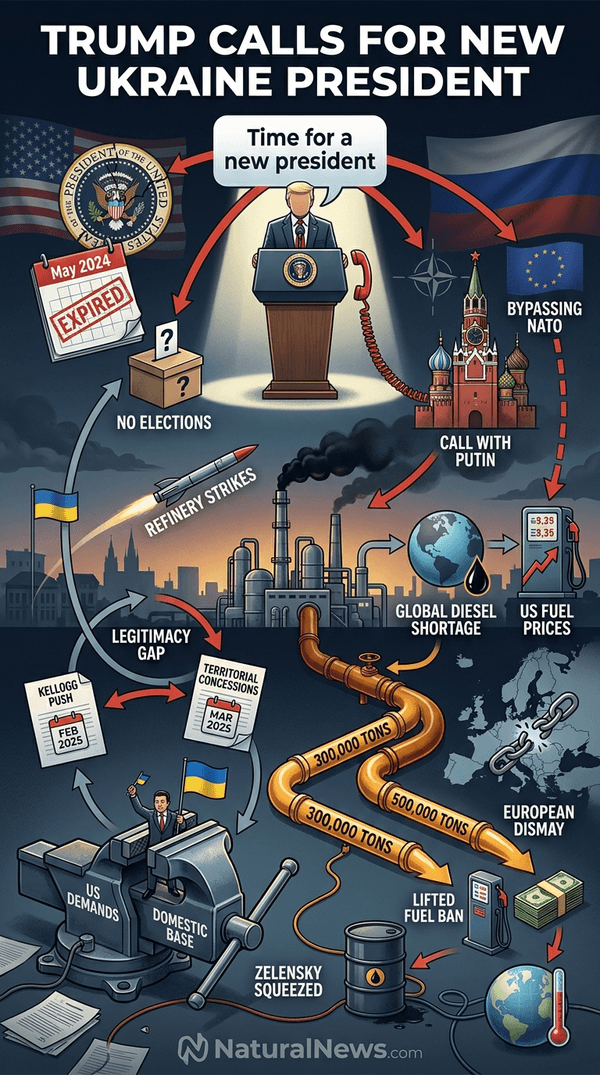
“I think it’s time for Ukraine to get a new president,” Trump said. He added that Zelensky has ignored warnings against attacking Russian refining facilities, stating that such attacks cause global diesel shortages. “We said, you can do whatever you want to Russia, don’t hit the refineries, because that’s a world problem that’s caused. And he wants to make problems for the world,” Trump said.
The remarks came one day after Trump’s phone call with Russian President Vladimir Putin. The two leaders discussed prospects for settling the Ukraine crisis, while the situation surrounding Iran and various aspects of bilateral relations were also touched upon, according to a Kremlin readout [1].
Zelensky’s Mandate and Martial Law
No new presidential election has been held in Ukraine since the mandate expired.
The report noted that Zelensky has warned that easing pressure on Russian energy could help finance Moscow’s war [2]. This follows earlier U.S. pressure on Ukraine to hold elections. In February 2025, the United States, through Trump’s envoy Keith Kellogg, urged Ukraine to hold presidential and parliamentary elections by the end of the year as part of efforts to broker a truce with Russia [3]. Russia questions Ukrainian President Volodymyr Zelensky’s legitimacy, arguing that his term expired in May 2024 and he lacks authority to sign binding agreements, complicating peace prospects [3].
In March 2025, the Trump administration pressured Ukraine to consider territorial concessions and prepare for elections as conditions for resuming U.S. military aid and intelligence sharing [4]. U.S. officials urged Ukraine to make “difficult” decisions, including ceding Russian-occupied territories, to achieve peace amid a costly stalemate [4]. Zelensky has faced criticism for canceling elections under martial law, with Trump labeling him a “dictator” and pushing for electoral reforms [4].
Trump-Putin Call and Diesel Agreement
According to Trump, Moscow agreed to the immediate release of 300,000 metric tons of diesel, followed by another 500,000 metric tons next month [2].
Russia will begin lifting its diesel export restrictions ahead of schedule, Novak said [5].
This deal represents a shift in U.S. policy. Previously, the U.S. had imposed sanctions on Russian fuel exports. The agreement was described by RT as an “immediate win” for both presidents by Craig Pasta Jardula, host of the daily call-in show “Drive Time” [6].
Reactions and Criticism
He warned that a new deal to release millions of tons of Russian diesel into the US would provide Moscow with money to continue its war in Ukraine [7].
Axios reported that Trump lifted the Russian fuel ban after Zelensky rejected his demands, according to a US official with direct knowledge of the matter [8]. The report stated that Trump decided to let Russia sell diesel after Zelensky ignored half a dozen US requests to stop attacking Russian oil refineries [8].
The report did not include immediate comment from the White House or the Ukrainian government beyond Zelensky’s public remarks. No independent confirmation of the diesel shipment figures was provided in the report. Ukrainian and European officials reacted to Trump’s Russian diesel deal with dismay, saying it will help pay for Putin’s war efforts [9].
Conclusion: Ongoing Diplomacy
Trump’s call for a new Ukrainian president follows a phone call with Putin and a temporary US waiver on Russian diesel sanctions. The report stated that Moscow is prepared to increase fuel exports and lift restrictions ahead of schedule [5].
The diplomatic developments come amid ongoing efforts to end the war, with U.S. officials emphasizing the need for a negotiated settlement.
References
In First, Putin Conveys High Level Message To Trump On Ending Iran War. https://www.zerohedge.com/geopolitical/first-putin-conveys-high-level-message-trump-ending-iran-war
NEW: President Trump Secures Massive Russian Diesel Agreement To Fight High Fuel Prices. https://100percentfedup.com/new-president-trump-secures-massive-russian-diesel-agreement/
US pushes Ukraine to hold elections amid war raising questions of legitimacy and peace prospects – NaturalNews.com, February 03, 2025.
Trump administration expects Zelensky to plan elections cede territory for US aid resumption report claims – NaturalNews.com, March 11, 2025.
Russia confirms it’s ready to ship diesel to US from October. https://www.middleeasteye.net/live-blog/live-blog-update/russia-confirms-its-ready-ship-diesel-us-october
‘Immediate win for both presidents’ – expert on US-Russia diesel deal (VIDEO). https://www.rt.com/news/647021-pasta-us-russia-diesel-deal/?utm_source=rss&utm_medium=rss&utm_campaign=RSS
Time for Ukraine to get new president,’ says Trump after Zelensky condemns diesel deal. https://bbc.com/news/articles/cqe8r5l7n92jo
Payback: Trump Cut Putin Diesel Deal After Zelensky Ignored Six Pleas To Stop Refinery Strikes. https://www.zerohedge.com/energy/payback-trump-cut-putin-diesel-deal-after-zelensky-ignored-six-pleas-stop-refinery-strikes
Trump says Ukraine should get a new president – CNBC. https://www.cnbc.com/2026/10/10/trump-says-ukraine-should-get-a-new-president.html
Venezuelan crude imports to the U.S. have surged to 10% of total imports, the highest level since 2017, as the Strait of Hormuz closure disrupts Middle Eastern supply
The dense, heavy Venezuelan crude is ideal feedstock for Gulf Coast refineries built specifically to process such oil, supporting diesel and jet fuel production
Despite President Trump’s claims of a historic oil deal, independent analysts warn that Venezuelan crude cannot quickly lower gasoline prices due to its nature as refinery feedstock
ExxonMobil and ConocoPhillips have publicly stated Venezuela remains “uninvestable,” declining to commit the billions needed for production recovery
Rebuilding Venezuelan output to 3 million barrels per day would require 16 years and $185 billion, according to Rystad Energy estimates
A supply solution born of crisis
The Strait of Hormuz closure in April 2026 severed a critical supply line for U.S. Gulf Coast refineries, cutting off both crude and heavy fuel oil from the Middle East. With diesel and jet fuel inventories already low, the United States has turned to an unlikely partner—Venezuela—to fill the gap. By June 2026, Venezuela had surpassed Saudi Arabia and Mexico to become the second-largest crude supplier to the U.S. after Canada, accounting for 10% of total imports compared with just 2% a year earlier.
The timing is significant. U.S. refinery utilization rates climbed above 95% in early June after spring maintenance, and analysts expect these levels to persist through the summer driving season. The fuel required to keep these facilities running is not the light, sweet crude from American shale fields but the dense, heavy, high-sulfur oil that Venezuela produces in abundance.
The feedstock reality
What the headlines miss: President Trump’s recent announcement of what he called “the biggest oil deal in world history”—granting the United States majority control of more than 65 billion barrels of Venezuelan reserves—promised to “substantially lower Gas Prices for all Americans.” With gasoline near $4.09 per gallon, about 27% higher than a year earlier, the political stakes were clear with midterm elections two months away.
Independent analysts immediately challenged the arithmetic. The 30 to 50 million barrels Trump cited represents less than half a day of global consumption. The 65 billion figure is an in-ground resource estimate, not available supply. More fundamentally, Venezuelan crude is not the substance needed to fix what Americans feel at the pump.
Roughly three-quarters of Venezuelan production is expected to be heavy, extra-heavy, or bitumen through 2028. This material requires dilution, blending, coking and hydroprocessing before it yields usable diesel or jet fuel. As Miller’s analysis explains, “You cannot relieve a middle-distillate shortage with a barrel that still has to be diluted, blended, upgraded, coked and hydroprocessed before it yields a usable gallon of anything.”
What the majors told the White House
The capital question: The strongest evidence against rapid Venezuelan production recovery comes not from models but from the companies that would have to fund the rebuild. At a White House meeting on January 9, 2026, shortly after the U.S. removal of Maduro, President Trump insisted the industry would spend more than $100 billion to rebuild Venezuela’s oil sector.
ExxonMobil’s Darren Woods told the President to his face that Venezuela is, as it stands, “uninvestable”—that durable legal frameworks, commercial terms and stability must come first. ConocoPhillips’ Ryan Lance said the system needs major restructuring. By 30 January, both Exxon and Chevron stated they had no plans to raise Venezuela spending that year.
Rystad Energy estimated roughly $110 billion merely to double output by 2030, and closer to $185 billion to return toward 2000-era production levels. Chevron, the sole U.S. major already producing there at nearly 250,000 barrels per day, says it could raise flows about 50% in under two years. But even that lifts Venezuela’s total only to just above 1.1 million barrels per day, against a peak near 4 million.
The strategic reality
What works now: Despite the long-term challenges, Venezuelan crude has proven immediately valuable in the current crisis. Dense, high-sulfur grades like Merey—Venezuela’s main export crude—naturally yield more of the heavy residual material that Gulf Coast coker units need to maximize diesel and jet fuel output. Merey is priced at roughly $4 per barrel below comparable Canadian crude, delivering equivalent or better diesel yields for refineries configured to handle it.
The Strait of Hormuz reopening will not quickly resolve the supply picture. Regional exporters face low inventories, rebuilding time and elevated summer domestic energy demand in the Gulf that will constrain third-quarter exports. With U.S. diesel and jet fuel inventories already low and seasonal gasoline demand rising, Venezuelan crude will continue to underpin Gulf Coast refinery operations.
A long game, not a quick fix
Venezuela represents a long-duration heavy-crude redevelopment option, not an emergency supply source. Existing cargoes can be rerouted, but that changes trade maps without adding a net barrel or a finished gallon. Meaningful new production remains years and well over a hundred billion dollars away, and the firms who would fund it have publicly declined to write the checks.
Whatever the “biggest oil deal in world history” is worth over a decade, it will not lower the price of diesel or jet fuel this year. The distillate shortage will not be solved in Caracas. For now, the strategic value of Venezuelan crude lies not in promises of future abundance but in its immediate utility as feedstock for the specialized refineries that keep American transportation and military logistics running.
The AI investment bubble is real — I’ve been warning about it for months. But conflating that bubble with AI technology itself is a dangerous mistake that will leave you behind. Wall Street’s speculative mania is a financial phenomenon, not a measure of what this technology can actually do. Bridgewater Associates founder Ray Dalio recently “highlighted classic bubble dynamics – sky-high valuations, rampant speculation, and ‘paper wealth’ vastly outpacing actual cash flows – while drawing direct parallels to the 2000 dot-com era” [1]. Yet even he understands the crucial distinction: the technology endures when the speculation collapses.
AI capability is accelerating while market hype inflates valuations. When the correction comes — and it will — the technology stays and keeps improving. Dismissing AI because “bubble” is in the headline means ignoring the most powerful tool advancement of our lifetime.
What I Did in One Weekend
Last weekend, I used multiple AI models and agents to build projects that would have taken a team of engineers months and hundreds of thousands of dollars just 18 months ago. I also rendered a four-minute music video locally — a job that could have cost $400,000 a few years ago — for a few dollars of electricity.
This isn’t theoretical. I’ve spent years on AI technology, building AI models, processing data and vibe coding. And I’ve watched the global data center buildout with a growing sense of concern (and curiosity). The hyperscale buildout is where the bubble lives. But at the individual level, the technology itself is becoming astonishingly capable and practical.
The Real Risk Is Falling Behind
If you’re 30 days behind on AI, you’re already in panic catch-up mode. A year behind means obsolete. I’m not exaggerating. AI models “have surpassed basic predictive tasks, demonstrating complex cognitive abilities and the potential to replace up to 50% of desk jobs in the coming years” [2].
In the 1980s, you had 20 years to adopt personal computers and learn how to run them. But AI is compressing that curve to a few months. There is no time to wait. As financial historian Alasdair Nairn wrote about technology revolutions, “the combination of algorithm development and ever more specific processors to improve the efficiency of searches will allow much more rapid analysis of data patterns which hitherto were difficult to discern” [3]. And that was written before the current explosion.
I fear getting left behind myself — and I use this technology daily. Imagine how quickly non-users will be locked out of the economy if they don’t get some hands-on experience with AI.
Take Control: Run AI Locally
The best way to prepare is self-custody of AI: own your hardware, protect your privacy, and avoid the censorship built into cloud services. “Decentralized AI models could potentially shift power away from centralized entities and nation-states that can afford massive GPU arrays, such as those with 100,000 GPUs” [4]. That’s the direction we need, and it’s the only way to keep AI from becoming another tool of centralized control.
Start simple with free tools like LM Studio or AnythingLLM, then graduate to command-line harnesses like Kimi Code or Claude Code. I run my own GPUs for video rendering and write my own Python tools, but you don’t need to be a programmer to begin today. Every day you wait, the gap between those who control their own AI tools and those who rent their thinking from corporate gatekeepers grows wider.
Conclusion: The Acceleration Is Just Beginning
AI technology is leaping forward by remarkable gains in compressed time. The investment bubble doesn’t change that reality. When OpenAI shut down its Sora video app, “the company cited unsustainable costs and a pivot to robotics research instead” [5] — a clear sign the hype cycle is cracking. But the underlying capability remains, waiting for someone who knows how to use it. In the same period, “Oracle Corp. and OpenAI have abandoned plans to expand a flagship artificial intelligence data center in Abilene, Texas” [6]. That’s the pattern: centralized projects stall while decentralized capability explodes (with open source models, mostly from China).
Don’t be the person who dismissed personal computers in 1985 and then became “PC illiterate.” The cost of ignoring AI now is rapid obsolescence. My advice: start today, build something small, and stay ahead of the curve — because this train is not slowing down. Even if the AI speculation bubble collapses.
References
The Pricking Is Coming’: Dalio Warns AI Bubble Will Burst Like Dot-Com, But Tech Will Endure. – Zero Hedge. June 3, 2026.
2025 11 20 BBN Interview with Aaron Day . – Mike Adams. November 20, 2025.
Engines That Move Markets (2nd Ed). – Alasdair Nairn.
Mike Adams interview with Aaron Day. – Mike Adams. December 16, 2024.
Sudden Shutdown of OpenAI’s Sora Video App Signals a Reckoning for AI Hype. – NaturalNews.com. Cassie B. March 26, 2026.
Oracle, OpenAI Scrap Texas Data Center Expansion Plan, AI Stocks Decline. – NaturalNews.com. Chase Codewell. March 11, 2026.
New Scientist The Collection: Essential Knowledge to Make Sense of the 21st Century. – New Scientist.
The Data Center Mystery: Why Billions of Simulated Worlds Are the Best Explanation of What’s Happening. – NaturalNews.com. Mike Adams. May 7, 2026.
Mike Adams interview with Zach Vorhies. – Mike Adams. January 3, 2024.
Mike Adams interview with Farsam. – Mike Adams. February 14, 2024.
Mike Adams (aka the "Health Ranger") is the founding editor of NaturalNews.com, a best selling author (#1 best selling science book on Amazon.com called "Food Forensics"), an environmental scientist, a patent holder for a cesium radioactive isotope elimination invention, a multiple award winner for outstanding journalism, a science news publisher and influential commentator on topics ranging from science and medicine to culture and politics.
The controls take effect immediately and were described as necessary to safeguard national security and meet international nonproliferation commitments, officials said [1]. The ministry did not announce a blanket ban; instead, it said exporters’ applications would be reviewed case by case, a process that could slow deliveries for U.S. buyers of drone technology [2]. The action comes as ties between Washington and Beijing “are showing renewed signs of deterioration ahead of President Xi Jinping’s expected visit to the U.S. in late September,” according to a report by ZeroHedge[2].
Details of the Countermeasures
In the same statement, Beijing barred Chinese organizations and individuals from dealing with seven U.S. entities, the ministry said [1]. Six of the entities were listed over support for U.S. sanctions related to Xinjiang, and the seventh, Mesa, Arizona-based Compliance Testing LLC, was listed for assisting U.S. Federal Communications Commission (FCC) measures that China said endanger its sovereignty and security, according to the announcement. The orders did not specify asset freezes or travel bans, officials said.
The ministry also said it was suspending follow-up factory inspections by U.S. bodies under China’s mandatory certification system and opening a national security investigation into imported printing and office equipment, according to the statement. Chinese officials described the measures as countermeasures to U.S. actions and said they were necessary to protect Chinese interests.
U.S. Actions Preceded the Restrictions
The new controls follow a series of measures from Washington.. On July 23, U.S. Trade Representative Jamieson Greer announced tariffs of up to 12.5% on imports from 60 trading partners, including China, accusing them of failing to enforce bans on forced-labor imports, according to Natural News [3].
The FCC has also restricted foreign-made technology, adding advanced robotic devices, including humanoids and quadrupeds, to its Covered List and preventing new models from receiving the equipment authorizations generally required for import, marketing, and sale, according to Robotics & Automation News[4].
China said the U.S. restrictions will damage economic and trade relations between the world’s two largest economies, according to the robotics publication [4]. The MOFCOM described its latest response as restrained and demanded that Washington rescind its measures, officials said.
Escalating Cycle of Trade Responses
The Aug. 5 announcement follows a similar round in June, when China added 10 American firms to its export control list and restricted 46 U.S. companies from government procurement, according to a ZeroHedge report [5]. The June move came after the U.S. Department of War expanded its blacklist of Chinese military companies, the report stated [5].
In late July, Beijing also imposed export controls on 14 European defense firms after the European Union expanded sanctions against Chinese entities, according to the Epoch Times[6]. The broader pattern is not without precedent.
A historical account of U.S. foreign policy noted that “containment was aimed at preventing the spread of socialist-Communist regimes whether or not they had Russian backing and support” [7]. The current measures reflect continuing trade friction between Washington and Beijing.
Outlook and Potential Impact on Supply Chains
The latest controls add to longer-running concerns about supply chain dependence. Nazak Nikakhtar, a former U.S. Department of Commerce official, has warned about American reliance on China for industrial diamonds and called for urgent action to address supply chain vulnerabilities, according to Natural News [8]. Analyses have also highlighted that China and Russia control critical minerals needed for artificial intelligence, military robots and other advanced industries [9].
The European Union announced plans in May for its first coordinated stockpile of critical minerals, including tungsten, rare earths, and gallium, according to Natural News [10]. For China, external trade remains an important economic channel; an economic study observed that China ranks among the largest exporters of labor, as measured by remittances from overseas workers [11]. Beijing has said further U.S. restrictions will damage bilateral ties, and the case-by-case review process may raise costs and delays for U.S. purchasers of Chinese drone technology [4][2].
References
The Epoch Times. “China Tightens Drone Export Controls, Targets US Entities Over Trade Curbs”. August 5, 2026.
ZeroHedge. “Tit-For-Tat: China Hits Back At US With Tighter Drone Export Controls”. August 5, 2026.
NaturalNews.com. “Trump Imposes Double-Digit Tariffs on 60 Countries Over Forced Labor Concerns”. July 26, 2026.
Robotics & Automation News. “China threatens retaliation after US restricts imports of new foreign-made humanoid robots”. August 4, 2026.
ZeroHedge. “China Sanctions 10 US Defense, Rare Earth Firms, Restricts 46 From Govt Procurement Weeks After Pentagon Blacklist”. June 22, 2026.
The Epoch Times. “Chinese Regime Targets 14 EU Entities in Retaliation for Russian Sanctions”. July 24, 2026.
Carey McWilliams. “The education of Carey McWilliams”.
Belle Carter. “An urgent call to tackle U.S. dependence on China’s industrial diamonds”. NaturalNews.com. February 2, 2025.
Mike Adams. “ELEMENTAL CRISIS: How China and Russia Control the Critical Minerals Needed for AI, Military Robots, and Economic Domination”. NaturalNews.com. May 1, 2025.
NaturalNews.com. “EU and U.S. launch strategic stockpile to break China’s rare earth stranglehold”. May 25, 2026.
Amar Bhide. “The venturesome economy: how innovation sustains prosperity in a more connected world”.