FBI has issued urgent warnings about four specific types of election-related fraud schemes targeting Americans.
Scammers are using AI-generated voices, images and messages to impersonate candidates, campaigns and government entities.
Campaign investment pool scams and fake PACs are defrauding voters of campaign contributions.
Voter registration schemes are stealing personally identifiable information through fake registration pages.
The DOJ has already charged multiple individuals with illegal voting and election fraud in recent months.
The threat: AI-powered fraud exploiting the 2026 election cycle
In October 2026, as Americans prepare for the November midterm elections, the Federal Bureau of Investigation has issued a stark warning: Sophisticated scammers are exploiting the democratic process to steal money and identities. The FBI’s public service announcement, released Oct. 15, details how fraudsters are using artificial intelligence to create highly realistic impersonations of political candidates, campaigns and government agencies to deceive voters nationwide. These schemes, which have already targeted victims in multiple states, represent an unprecedented threat to both election integrity and personal financial security.
Four schemes targeting voters
The FBI has identified four primary fraud methods currently circulating. The Campaign Investment Pool Scheme promises victims guaranteed returns on campaign contributions by investing in a candidate pool that supposedly pays out after election victories. Victims are pressured to recruit others, creating pyramid-style structures that enrich only the scammers.
The Political Action Committee Scheme, known as “ScamPACs,” tricks donors into believing they are contributing to legitimate political action committees. In reality, the funds go directly to fraudsters with no connection to the candidates.
Two additional schemes target voters online. The Online Purchase Scheme sells political merchandise that is never delivered, while the Voter Registration Scheme sends fake text messages or emails claiming the recipient is not registered to vote. The fake link directs victims to fraudulent registration pages designed to steal personally identifiable information.
AI amplifying fraud capabilities
The FBI specifically warned that artificial intelligence tools now allow scammers to generate “highly realistic voices, images and written messages that impersonate candidates, campaigns, government entities and trusted contacts.” This technology makes fraudulent communications nearly indistinguishable from legitimate ones, increasing the likelihood of financial loss and identity theft.
“The realism makes these schemes harder for victims to detect,” the FBI stated in its Oct. 15 alert.
Recent prosecutions and legal action
The Department of Justice has already taken action against election-related fraud. On Oct. 5, four Philadelphia residents were charged with voting illegally in the 2024 elections despite being noncitizens, facing up to one year in prison. On Oct. 12, the DOJ announced charges against 16 individuals, including 14 noncitizens who allegedly cast illegal ballots.
In a separate case, two North Macedonians were charged with creating a fictitious financial instrument called “Trump Bucks,” marketed as affiliated with former President Donald Trump’s 2024 reelection campaign, defrauding hundreds of thousands of dollars from victims, many of them senior citizens.
Protecting yourself: FBI recommendations
The FBI recommends voters take several precautions: be wary of unsolicited communications, remember campaign donations are not investments that generate returns, verify PAC registrations through the Federal Election Commission website, and check voter registration only at the official Vote.gov website. Victims should report scams to local FBI field offices or the Internet Crime Complaint Center.
Vigilance as the first defense
The convergence of election cycles with advanced AI technology creates dangerous opportunities for fraud that threaten both personal finances and faith in democratic processes. With the FBI warning that these schemes have already exploited previous elections and are now targeting the 2026 midterms, Americans must approach all election-related communications with healthy skepticism. The documented cases of illegal voting and fraudulent fundraising underscore that election integrity requires constant vigilance from both law enforcement and the public.
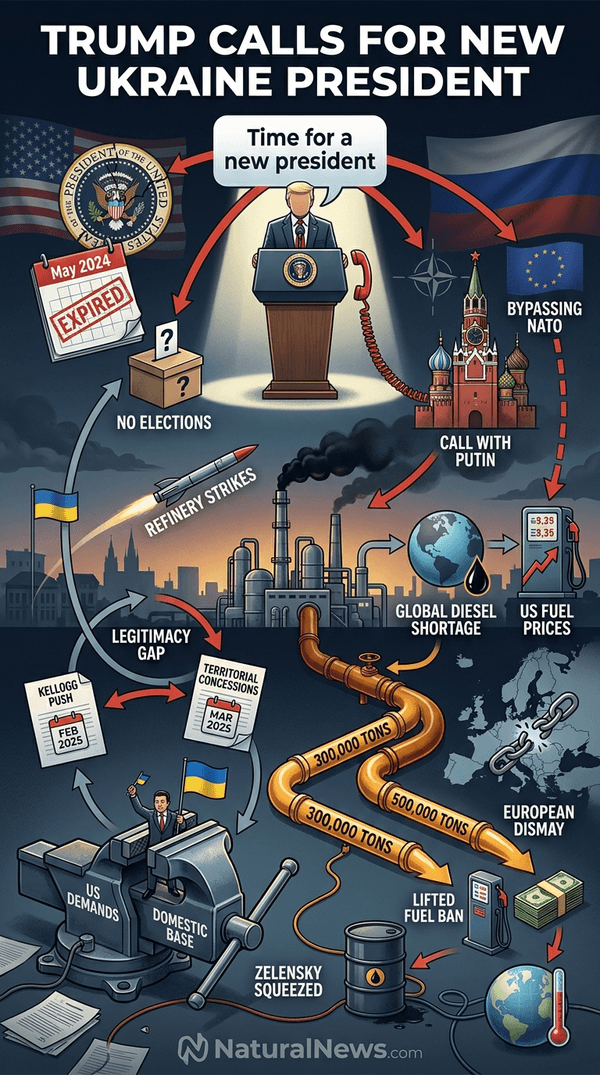
“I think it’s time for Ukraine to get a new president,” Trump said. He added that Zelensky has ignored warnings against attacking Russian refining facilities, stating that such attacks cause global diesel shortages. “We said, you can do whatever you want to Russia, don’t hit the refineries, because that’s a world problem that’s caused. And he wants to make problems for the world,” Trump said.
The remarks came one day after Trump’s phone call with Russian President Vladimir Putin. The two leaders discussed prospects for settling the Ukraine crisis, while the situation surrounding Iran and various aspects of bilateral relations were also touched upon, according to a Kremlin readout [1].
Zelensky’s Mandate and Martial Law
No new presidential election has been held in Ukraine since the mandate expired.
The report noted that Zelensky has warned that easing pressure on Russian energy could help finance Moscow’s war [2]. This follows earlier U.S. pressure on Ukraine to hold elections. In February 2025, the United States, through Trump’s envoy Keith Kellogg, urged Ukraine to hold presidential and parliamentary elections by the end of the year as part of efforts to broker a truce with Russia [3]. Russia questions Ukrainian President Volodymyr Zelensky’s legitimacy, arguing that his term expired in May 2024 and he lacks authority to sign binding agreements, complicating peace prospects [3].
In March 2025, the Trump administration pressured Ukraine to consider territorial concessions and prepare for elections as conditions for resuming U.S. military aid and intelligence sharing [4]. U.S. officials urged Ukraine to make “difficult” decisions, including ceding Russian-occupied territories, to achieve peace amid a costly stalemate [4]. Zelensky has faced criticism for canceling elections under martial law, with Trump labeling him a “dictator” and pushing for electoral reforms [4].
Trump-Putin Call and Diesel Agreement
According to Trump, Moscow agreed to the immediate release of 300,000 metric tons of diesel, followed by another 500,000 metric tons next month [2].
Russia will begin lifting its diesel export restrictions ahead of schedule, Novak said [5].
This deal represents a shift in U.S. policy. Previously, the U.S. had imposed sanctions on Russian fuel exports. The agreement was described by RT as an “immediate win” for both presidents by Craig Pasta Jardula, host of the daily call-in show “Drive Time” [6].
Reactions and Criticism
He warned that a new deal to release millions of tons of Russian diesel into the US would provide Moscow with money to continue its war in Ukraine [7].
Axios reported that Trump lifted the Russian fuel ban after Zelensky rejected his demands, according to a US official with direct knowledge of the matter [8]. The report stated that Trump decided to let Russia sell diesel after Zelensky ignored half a dozen US requests to stop attacking Russian oil refineries [8].
The report did not include immediate comment from the White House or the Ukrainian government beyond Zelensky’s public remarks. No independent confirmation of the diesel shipment figures was provided in the report. Ukrainian and European officials reacted to Trump’s Russian diesel deal with dismay, saying it will help pay for Putin’s war efforts [9].
Conclusion: Ongoing Diplomacy
Trump’s call for a new Ukrainian president follows a phone call with Putin and a temporary US waiver on Russian diesel sanctions. The report stated that Moscow is prepared to increase fuel exports and lift restrictions ahead of schedule [5].
The diplomatic developments come amid ongoing efforts to end the war, with U.S. officials emphasizing the need for a negotiated settlement.
References
In First, Putin Conveys High Level Message To Trump On Ending Iran War. https://www.zerohedge.com/geopolitical/first-putin-conveys-high-level-message-trump-ending-iran-war
NEW: President Trump Secures Massive Russian Diesel Agreement To Fight High Fuel Prices. https://100percentfedup.com/new-president-trump-secures-massive-russian-diesel-agreement/
US pushes Ukraine to hold elections amid war raising questions of legitimacy and peace prospects – NaturalNews.com, February 03, 2025.
Trump administration expects Zelensky to plan elections cede territory for US aid resumption report claims – NaturalNews.com, March 11, 2025.
Russia confirms it’s ready to ship diesel to US from October. https://www.middleeasteye.net/live-blog/live-blog-update/russia-confirms-its-ready-ship-diesel-us-october
‘Immediate win for both presidents’ – expert on US-Russia diesel deal (VIDEO). https://www.rt.com/news/647021-pasta-us-russia-diesel-deal/?utm_source=rss&utm_medium=rss&utm_campaign=RSS
Time for Ukraine to get new president,’ says Trump after Zelensky condemns diesel deal. https://bbc.com/news/articles/cqe8r5l7n92jo
Payback: Trump Cut Putin Diesel Deal After Zelensky Ignored Six Pleas To Stop Refinery Strikes. https://www.zerohedge.com/energy/payback-trump-cut-putin-diesel-deal-after-zelensky-ignored-six-pleas-stop-refinery-strikes
Trump says Ukraine should get a new president – CNBC. https://www.cnbc.com/2026/10/10/trump-says-ukraine-should-get-a-new-president.html
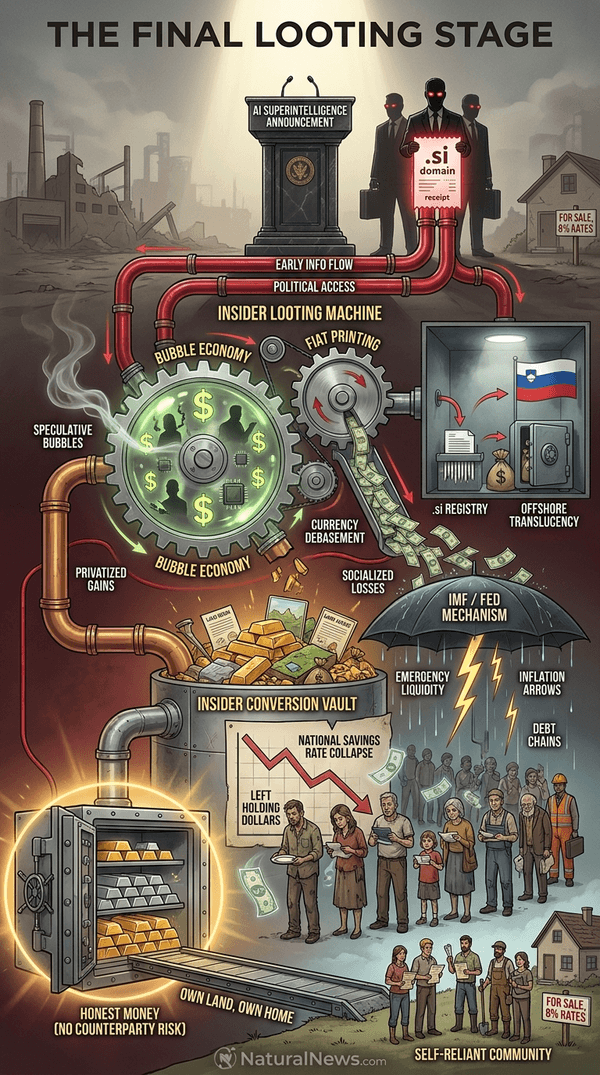
I’ve been warning for years that the American Empire and dollar hegemony would not end with a bang, but with a systematic, insider-driven looting of everything real that remains. That moment is now.
It’s clear to me that we are now in the final looting stage, where the people with early information and political access extract the last of America’s wealth while leaving the rest of us with inflation, debt and a hollowed-out shell of an economy.
Washington has engineered a Hunger Games scenario. The connected class gets the party dresses and champagne; ordinary Americans get the bill. This is not a bug in the system — it is the intended outcome of a K-shaped economy where insiders use information and power to front-run the public at every turn. Most Americans still believe the game is fair, but the people rigging it have no plan to make sure anyone else is okay.
The evidence is all around us. As David Stockman wrote in Brownstone Institute, the national savings rate has essentially collapsed over the last three decades, a fact the Keynesians and Wall Street gamblers would prefer not to explain [1]. That collapse didn’t happen by accident; it happened because money printing and financial engineering transferred wealth upward while hollowing out the productive base. I’ve interviewed guest after guest about this — from Robert Kiyosaki on decentralized assets to John Rubino on the everything bubble — and the conclusion is always the same: the insiders are cashing out while the public is left holding devalued paper [2][3].
The .si Domain Front-Running Scam Proves the Game Is Rigged
Nothing illustrates the rigged nature of this system more clearly than the .si domain front-running scandal. When Trump announced a push toward AI superintelligence, insiders allegedly bought up .si domain names for as little as $20 before the public knew what was happening. Those same domains are now reportedly selling for as much as $14 million each. That is a classic front-loaded insider play that stinks to high heaven.
The .si extension is registered to Slovenia, a country where certain connected people have ties, which only adds to the fishiness. This is not an isolated incident — it is part of a pattern that runs through every sector of the economy. Those with early information and political access loot the system while the rest of us get inflation and debt. The American Republic is dead, as I’ve written before, and what remains is a pay-to-play shadow government where the rules are written by and for the thieves [4].
The Ron Paul Institute documented this reality in ‘Rule by Thieves,’ describing America as a kleptocracy where a network of ruling elites steals public funds for private gain using public institutions [5]. That is exactly what the .si scandal represents: insiders using public announcements as catalysts for private enrichment, with zero accountability.
The same dynamic played out during COVID, when pandemic beneficiaries in tech, biopharma and military-intelligence used the crisis to push for centralized, technocratic control [6]. The pattern is unmistakable, and it will likely continue until the wealth is gone.
Hold Real Assets and Get Out of Debt Before It’s Too Late
The people who survive this are those holding gold and silver — honest money with no counterparty risk. Right now, gold is around $4,170 per ounce and silver is approximately $61 per ounce, and these prices are telling you something. They are telling you that the smart money is already moving out of fiat currency and into real assets.
The most important step you can take right now is to get out of debt. Own your home free and clear. Own land. Own your vehicle. Reduce needless overhead. As Robert Kiyosaki has explained in my interviews, the key is to convert your labor into assets that hold value while the dollar loses purchasing power [2]. That means real estate, precious metals, productive land, and decentralized money. It also means building local, open-source AI hardware infrastructure — something I’ve been doing intensely for years — because the centralized AI systems being built by Big Tech are designed to replace human workers and centralize control even further [7].
The coming currency collapse and purchasing power destruction are not speculative scenarios; they are mathematical certainties at this point. As Chris Martenson has documented extensively, we are all lab rats in the largest monetary experiment in human history [8]. The Federal Reserve and its sister central banks have put the world’s currencies on an inexorable, accelerating inflationary down slope [9]. Real assets and zero debt are your best defense.
The Coming Dollar and Real Estate Collapse
The federal government has only one real option left: keep printing money to buy its own debt, from 10-year and 30-year Treasuries to every other duration. That guarantees an accelerating downward spiral in dollar purchasing power, which you already feel at the grocery store and at the fuel pump. As Shanmuganathan N. warns in his book ‘RIP USD: 1971-202X and the Way Forward,’ the U.S. dollar is headed for a collapse similar to the 1920s German hyperinflation due to its unbacked status and flawed Federal Reserve policies [10][10]. He predicts hyperinflation by the decade’s end or at least a period of severe currency depreciation.
Real estate is next. With loans hitting 7%, 7.5%, and soon 8%, home values will fall across the board. For many Americans, home equity is their only savings. When that vanishes, they will be upside down and in deep trouble. The melt-up in asset prices we saw over the past few years — stocks, bonds, real estate, commodities — was driven by monetary policy, not fundamentals [11]. When the monetary tide goes out, those inflated values will collapse, and the middle class will be hit hardest. This is the war on the middle class that Doug Casey has been warning about for years: taxes, inflation, and currency debasement are all part of the same assault on productive people [12].
Watch for this, because it is coming. The Federal Reserve is already at the limit of its balance sheet and is insolvent on a mark-to-market basis, as Jim Rickards has explained [13]. The next crisis won’t be mitigated by the Fed alone; it will likely be addressed by the International Monetary Fund or through some other centralized mechanism that further erodes national sovereignty and individual wealth. The only defense is to own real assets and hold them in forms that cannot be seized or devalued by fiat.
Don’t Be the Last to Know: Prepare, Reduce, Hold
The vast majority of people have bad information because they still watch CNBC and the corporate mainstream media. They don’t know about gold and silver, they own none, and they will lose almost everything when the looting phase ends. I don’t want that to be you. The American Republic is dead, and what comes next will be chaotic, but those who prepared with real assets, decentralized money, and self-reliance will not just survive — they will thrive [4].
Hold your gold and silver. Hold real assets. Reduce debt. Cut needless overhead now. Be ready for currency collapse and purchasing power loss, because that is exactly where this is going. As Chris Martenson has shown, the bifurcation between the protected elite class and everyone else is not a temporary anomaly; it is the direct result of central bank money printing firehoses directed at the connected few [14]. The only way to escape that trap is to opt out of the fiat system as much as possible.
I’ve also been building decentralized tools to help people do exactly that. BrightLearn.ai offers free books on financial sovereignty, self-reliance, and honest money. BrightVideos.com is a free speech video platform where you can find uncensored information about what’s really happening. BrightAnswers.ai is an uncensored AI engine that’s more honest and accurate than ChatGPT or Gemini. BrightNews.ai aggregates independent media trends that the corporate press ignores. And for those who want to connect with like-minded people, Brighteon.social is a free speech social media platform. These tools exist because the centralized system is collapsing, and we need decentralized alternatives ready to take its place.
The final looting stage is here. The insiders are cashing out. The dollar is being debased. Real estate is about to crack. The only question is whether you will be one of the people holding real assets and living free, or one of the people who believed the lies until the very end. I know which side I’m on, and I hope you’ll join me.
References
The Money Printers Fueling Socialism’s Rise. David Stockman. Brownstone Institute. July 21, 2026.
Mike Adams interview with Robert Kiyosaki. Mike Adams. August 7, 2023.
Mike Adams interview with John Rubino. Mike Adams. March 4, 2024.
The American Republic is Dead. Here’s What I’m Doing to Survive What Comes Next. Mike Adams. NaturalNews.com. March 09, 2026.
Rule by Thieves: The Police State Becomes a Pay-to-Play Shadow Government. Ron Paul Institute. November 5, 2025.
CHD Article on Big-Picture Look at Current Pandemic Beneficiaries Accepted by Peer-Reviewed Journal. Children’s Health Defense.
BBN Interview with Patrick Byrne p2. Mike Adams. November 24, 2025.
We Are All Lab Rats In The Largest Ever Monetary Experiment In Human History. Chris Martenson. PeakProsperity.com. August 17, 2018.
Marc Faber: The Perils of Money Printing’s Unintended Consequences. Chris Martenson. PeakProsperity.com. March 17, 2012.
RIP USD: 1971-202X and the Way Forward underscores the urgent need to return to SOUND MONETARY POLICY. Ramon Tomey. NaturalNews.com. February 25, 2025.
Melt Up In…Everything Market Update 8.7.20. Chris Martenson. PeakProsperity.com. August 07, 2020.
Doug Casey on Tax Day, Inflation, and the War on the Middle Class. Doug Casey. InternationalMan.com. April 22, 2026.
Jim Rickards: The Coming Crisis is Bigger Than The Fed. Chris Martenson. PeakProsperity.com. April 13, 2014.
The End Of Money. Chris Martenson. PeakProsperity.com. November 02, 2019.
Mike Adams (aka the "Health Ranger") is the founding editor of NaturalNews.com, a best selling author (#1 best selling science book on Amazon.com called "Food Forensics"), an environmental scientist, a patent holder for a cesium radioactive isotope elimination invention, a multiple award winner for outstanding journalism, a science news publisher and influential commentator on topics ranging from science and medicine to culture and politics.
The order assigns U.S. Cyber Command and the War Department’s combat support agencies to focus intelligence and cyber tools on foreign efforts to interfere in the 2026 midterm elections [1]. The directive, announced by War Department spokesman Sean Parnell, states that no troops are being ordered to polling places and that the mission is to hunt foreign threats in the digital battlespace before they can reach America’s voting systems or manipulate American voters [2]. No immediate details on the operational scope of the order were released, according to the report.
Order Details and Scope
The order instructs DoW components to provide cybersecurity support and intelligence sharing related to election systems, according to Axios. A memo signed by Hegseth states that “in America, the people rule – and we must ensure that their voice remains sovereign, secure, and entirely undiluted” [1].
Hegseth wrote that secure voting plays a critical role “in sustaining the strength of our democratic system,” and that the department “will effectively wield its” tools to counter foreign threats [1]. The directive applies to the 2026 midterm elections and future cycles, officials said. A DoW spokesperson said the order is intended to counter foreign interference, according to the report.
The order comes as Homeland Security Secretary Markwayne Mullin has said election security is national security and that investigations into voter rolls are not about “rehashing the 2020 election” [3]. Mullin revealed in July that 250,000 non-citizens were registered to vote in just four states [3].
State election officials said they were reviewing the directive, according to statements. The top U.S. general, Chairman of the Joint Chiefs of Staff Gen. Dan Caine, has said the military has no plans to send federal military personnel or National Guard troops to polling places during this year’s midterm elections [4]. Election administration and security remain the responsibility of state and local officials, Caine wrote in a letter to Sen. Elissa Slotkin (D-MI) [4].
Legal Basis and Official Statements
Officials cited existing statutory authorities for DoW support to civil authorities, according to the report. Hegseth said in a statement that the order aims to protect election integrity, according to Axios. The Department of Homeland Security and the Federal Bureau of Investigation are named as partners in the effort, officials said. No new funding was announced, according to the report.
The order relies on longstanding legal frameworks that permit military support to civilian agencies, including for protecting federal property and conducting domestic counterterror operations. This legal basis has been outlined in prior analyses of statutes such as the Posse Comitatus Act of 1878 and the Insurrection Act of 1807. As RealClearWire‘s Patrick O’Malley and Joe Buccino have argued, a careful examination of these laws reveals that military support for immigration enforcement and similar operations is permissible when properly understood.
The order marks a continuation of the Trump administration’s focus on election integrity as a legislative priority. House Speaker Mike Johnson (R-LA) has said that House Republicans remain committed to their legislative priorities, which include White House and border security, winning the Strait of Hormuz stalemate as a way to lower inflation and election integrity [5]. The administration has framed the order as a defensive measure against documented threats from foreign adversaries.
Criticism and Concerns
Civil liberties groups said the order could expand federal involvement in elections, according to statements. Privacy advocates raised concerns about military intelligence sharing with state officials, according to the report. Some state officials said they need more details on costs and mandates, according to interviews.
Supporters said the order addresses documented threats from foreign adversaries, according to officials. The move follows years of warnings about foreign interference in U.S. elections and comes amid broader scrutiny of election security. Government agencies have a documented history of overreach that raises legitimate questions about how power is exercised, as noted in interviews with independent journalists who have challenged official narratives [6].
The order also arrives amid political tensions on Capitol Hill. Rep. Thomas Massie (R-KY) introduced articles of impeachment against Hegseth on Sept. 15, but Johnson canceled votes and sent lawmakers home early for their campaign recess ahead of the midterm elections, avoiding a vote on the measure [7]. The House will not return to Washington until after the November election [7].
Next Steps and Oversight
Congressional committees said they will review the order, according to spokespeople. Implementation is expected to begin in the coming weeks, officials said. Further guidance will be issued to state and local authorities, according to the War Deparment.
The order will be implemented as the 2026 midterm elections approach, with primary elections already having taken place in several states. In Kentucky, Trump-endorsed Republican candidate Ed Gallrein defeated Massie in a primary election in May, with Gallrein winning 54.9% to 45.1% [8]. Gallrein will face Democratic candidate Melissa Strange in November [8].
The effectiveness of the order will likely depend on coordination among federal, state, and local officials. As officials have stated, the department “will effectively wield its” tools to counter foreign threats while respecting the primary role of state and local authorities in election administration [1].
References
NTD.com. “Hegseth Orders Cyber Command, Intel Agencies to Counter Foreign Threats to Midterms”. September 29, 2026.
100PercentFedUp.com. “Hegseth Orders Pentagon’s Cyber Arsenal Into the Fight Against Foreign Election Meddling”. September 29, 2026.
JustTheNews.com. “Mullin reveals 250k non-citizens registered to vote in just four states”. July 17, 2026.
NTD.com. “‘No Plans’ to Deploy Troops to Midterm Elections Polling Sites, Top US General Says”. September 1, 2026.
NTD.com. “House Speaker Johnson Unveils GOP’s Summer Agenda”. May 13, 2026.
Mike Adams interview with Paul Cottrell. March 21, 2023.
100PercentFedUp.com. “‘Just As I Predicted’ – House Speaker Mike Johnson Cancels Final Voting Day Before Midterm Elections”. September 16, 2026.
RT.com. “Trump-backed challenger defeats Thomas Massie in Kentucky”. May 20, 2026.
Development banks are prioritizing big industrial farms over small farmers, creating a massive funding gap. Between 2020 and 2024, 16 development banks gave about $13 billion to industrial animal farms, while smaller, diversified farms received only $9 billion, signaling a shift away from supporting rural communities.
Industrial agriculture causes severe environmental and health damage. These factory farms drive deforestation, rely on harmful pesticides and use high levels of antibiotics, which has created a global crisis of antibiotic-resistant bacteria that kills over a million people each year.
Local communities pay the human cost. People living near these facilities face constant pollution, bad smells and sickness. For example, a Guatemalan company, CMI Alimentos, received $725 million in support while expanding its U.S. fast-food chain, yet nearby Indigenous Xinka families reported their animals getting sick and were never consulted about the farm’s arrival.
These funding decisions contradict the banks’ own stated goals. The report highlights a clear “misalignment” between the banks’ commitment to fighting issues like poverty and their actual investments, which worsen income inequality and concentrate land ownership among the wealthy.
A better approach exists and is simpler than it seems. Instead of backing industrial models, banks should invest in small, integrated projects, such as giving a family five chickens to produce eggs for market and food, which build resilience, preserve local food systems and keep wealth within communities rather than enriching a small elite.
In the global fight against hunger, the world’s most powerful development banks are betting big on industrial agriculture while small farmers are losing out.
A new policy brief from the International Accountability Project and the Critical Research on Industrial Livestock Systems Network has quantified a troubling trend. Between 2020 and 2024, 16 development banks directed approximately $13 billion to industrial animal farms, while smaller, more diversified operations received only about $9 billion. Another $7 billion went to projects that couldn’t be clearly categorized due to limited information.
The funding gap represents more than just numbers on a spreadsheet. It signals a fundamental shift away from the mixed crop-and-livestock systems that have sustained rural communities for generations, and toward a model that concentrates power, wealth and environmental damage in fewer hands.
A pattern of misplaced priorities
The policy brief hints at a “growing preference among major development finance institutions to support large-scale, commercially oriented animal agriculture operations.” Meanwhile, the very systems that support smallholder farmers and preserve biodiversity receive significantly less attention and money.
This pattern is particularly troubling given the documented harms of factory farming. These industrial operations drive deforestation and habitat destruction to grow vast monocultures of soy and corn for animal feed.
Those monocultures strip nutrients from soil, rely heavily on pesticides and dramatically reduce biodiversity.
The animals themselves suffer enormously. Highly selective breeding produces chickens and pigs that grow unnaturally fast, often at the expense of their own health. Extreme confinement is standard practice, as is the removal of tails and beaks to prevent animals from injuring each other in cramped conditions.
Then there’s the antibiotic problem. Factory farms use such high levels of antibiotics that they’ve become ideal breeding grounds for antibiotic-resistant bacteria, which is a global health crisis that now kills 1.27 million people annually.
The human cost
The harms extend beyond animals and the environment. Communities living near industrial livestock facilities face constant exposure to air and water pollution from animal waste. Bad smells, dust and fly infestations are just the beginning.
As explained by the Enoch AI engine at BrightU.AI, one case highlighted in the report involves CMI Alimentos. This Guatemalan food corporation has received $725 million in financial support from IDB Invest, an arm of the Inter-American Development Bank Group, since 2018.
While the funding came with expectations of improving food security in Central America, the company has simultaneously invested heavily in expanding its U.S. fast food chain, Pollo Campero. In 2022, the company announced plans to use $190 million to open 100 Pollo Campero locations in the United States, a goal it achieved by 2024. A new target of 250 U.S. locations within five years was announced in 2023.
Meanwhile, food insecurity in Guatemala remains stubbornly high, affecting 15% to 35% of the population. An Indigenous Xinka community of about 65 families near one of CMI Alimentos’ chicken farms has reported that their own animals are getting sick from farm pollution. They’ve had to bear increased costs for medicine, fresh water and fly repellent.
This community wasn’t consulted about the industrial facility’s arrival. As one researcher put it, they were simply told one day that a large farm would be built next to their homes, and they couldn’t say no.
A misalignment of goals
The report notes a striking “misalignment” between these funding decisions and the development banks’ stated commitments to fighting climate change, protecting biodiversity and reducing poverty.
Researchers argue that instead of backing industrial models, development banks should focus on more egalitarian, integrated agricultural projects. One researcher offered a simple example: give someone five chickens, and they can produce eggs to sell at local markets while keeping some to feed their family.
These kinds of projects don’t generate massive returns or require costly infrastructure. But they do something arguably more important: They build resilience, preserve local food systems and keep wealth within communities rather than concentrating it among a small elite.
The evidence is now clear that industrial livestock farming worsens income inequality, concentrates land ownership among the wealthy and destroys the means of subsistence for poorer citizens. Development banks that claim to fight poverty while funding these operations are working against their own stated goals.
For the nearly one billion people who depend on smallholder farming for their livelihoods, the message from these findings is deeply concerning: the institutions meant to support sustainable development are instead accelerating the very systems that undermine it.
The question is whether these banks will listen to the communities and researchers raising alarms or continue pouring money into a model that benefits the few at the expense of the many.