A joint NSA advisory warns that Chinese state-backed hackers are actively probing U.S. critical infrastructure using AI-generated scripts targeting Siemens programmable logic controllers (PLCs).
The advisory, released August 19, identifies six most-targeted sectors: Critical Manufacturing, Energy, Water/Wastewater, Chemical, Food/Agriculture and Commercial Facilities.
The Russia-linked threat of cyberattacks on critical infrastructure remains elevated, though no incident is guaranteed, per evolving threat intelligence.
A separate October 8 advisory names China-based Integrity Technology Group as enabling botnets to target power grids, hospitals and law enforcement worldwide.
The Gunra ransomware-as-a-service operation has expanded to 2026, using double extortion tactics against governments, healthcare and utilities across multiple continents.
A real-time threat to the nation’s backbone
For the first time, U.S. intelligence agencies have confirmed that adversaries are actively scanning the nation’s most sensitive industrial control systems using artificial intelligence to write custom exploitation code. On August 19, a joint advisory documented how state-sponsored actors are conducting reconnaissance against U.S.-based industrial installations using AI-generated scripts disguised as legitimate monitoring tools. The advisory specifically warns of actors with ties to a cybersecurity company providing infrastructure for botnets and network intrusions. The threat is focused across six critical infrastructure sectors, and the advisory notes this is not theoretical—it is an active, ongoing threat with actors currently probing infrastructure.
AI weapons: How the attack chain works
Traditional cyber intrusions required months of manual code writing by highly skilled programmers. That barrier has collapsed. According to the joint advisory, threat actors are using open-source industrial automation libraries—specifically snap7.dll and python-snap7—combined with AI-assisted scripting to create custom tools that mimic legitimate operational technology monitoring software. These tools provide read/write access to Siemens S7 Series PLC memory, configuration data and ladder logic programs via the S7comm protocol.
The advisory warns that AI “dramatically reduces the technical expertise and time required to develop working ICS exploitation scripts and malicious tools.” Adversaries can now use internet scanning services to find exposed PLCs running outdated software, then quickly deploy AI-generated scripts to exploit them. The potential consequences: disruption of critical industrial processes, safety incidents, equipment damage, data compromise and cascading failures across interconnected systems.
From SolarWinds to Siemens PLCs
This advisory arrives amid a sobering historical pattern. The 2021 Colonial Pipeline ransomware attack demonstrated that a single digital intrusion could halt fuel delivery across the Eastern Seaboard. The 2015 Ukrainian power grid attack—widely attributed to Russian state actors—cut electricity to 225,000 customers. Today’s threat is more systemic: Rather than targeting a single pipeline or substation, adversaries are positioning themselves within the programmable logic controllers that form the backbone of modern industrial civilization.
The NSA’s August advisory explicitly calls this an “evolution in threat actor capabilities.” The shift to AI-generated tools means the barrier to entry for attacking power plants, water treatment facilities and chemical processors has dropped precipitously. This is compounded by the October 8 warning naming Integrity Technology Group, which the FBI describes as a “key enabler” of malicious cyber activity with ties to the Chinese government, using large-scale botnets to target government, critical manufacturing and healthcare organizations worldwide.
The Russia factor and Gunra ransomware
Separate but concurrent threats compound the danger. The Gunra ransomware-as-a-service program, first appearing in 2025 and expanding to RaaS operations in 2026, now targets 16 sectors including healthcare, financial services, transportation, utilities and government. The FBI observed Gunra actors collecting business-critical documents, databases, personally identifiable information and internal email communications before deploying encryption.
Meanwhile, evolving threat intelligence suggests the Russian government “may be considering potential cyber attacks on U.S. critical infrastructure.” While no incident is guaranteed, the convergence of Chinese state-sponsored AI-driven reconnaissance, Russian state interest and criminal ransomware operations creates an unprecedented threat environment. A comprehensive cyberattack halting power supply, transportation and hospital services could cause a crisis dwarfing the COVID-19 pandemic.
Defensive measures: What organizations must do now
The advisory provides a clear playbook. Organizations must prioritize patching known exploited vulnerabilities, disable external management capabilities on internet-exposed PLCs, and implement offline, immutable backups that are regularly tested. Network segmentation between information technology and operational technology systems remains critical. The NSA urges organizations to “review this advisory to be aware of the wide range of tactics used by these actors and implement recommended actions and mitigations.”
Key immediate steps recommended by the advisory:
Regularly update passwords and disable external management capabilities on industrial control systems.
Patch listed known exploited common vulnerabilities and exposures (CVEs) on edge devices.
Implement network segmentation isolating operational technology from corporate IT environments.
Hunt for signs of compromise using indicators provided in the advisory.
A call for action before the lights go out
The nation stands at a crossroads. The joint advisory is not a speculative warning—it documents active reconnaissance against the systems that power homes, treat drinking water and manufacture food. As one security analyst noted, “Even a little preparation can be helpful, just in case.” The principle that critical infrastructure should be off-limits to attack must be supported by action. Responsible countries must take measures against cyber criminals operating within their borders. Experts from allied nations have agreed to work together on specific understandings regarding off-limit targets. Today’s warnings, based on evolving threat intelligence, demand that every organization in the critical infrastructure sectors treat this as an operational priority. The crisis of a comprehensive cyber attack may not be guaranteed, but neither is the grace of avoiding one.
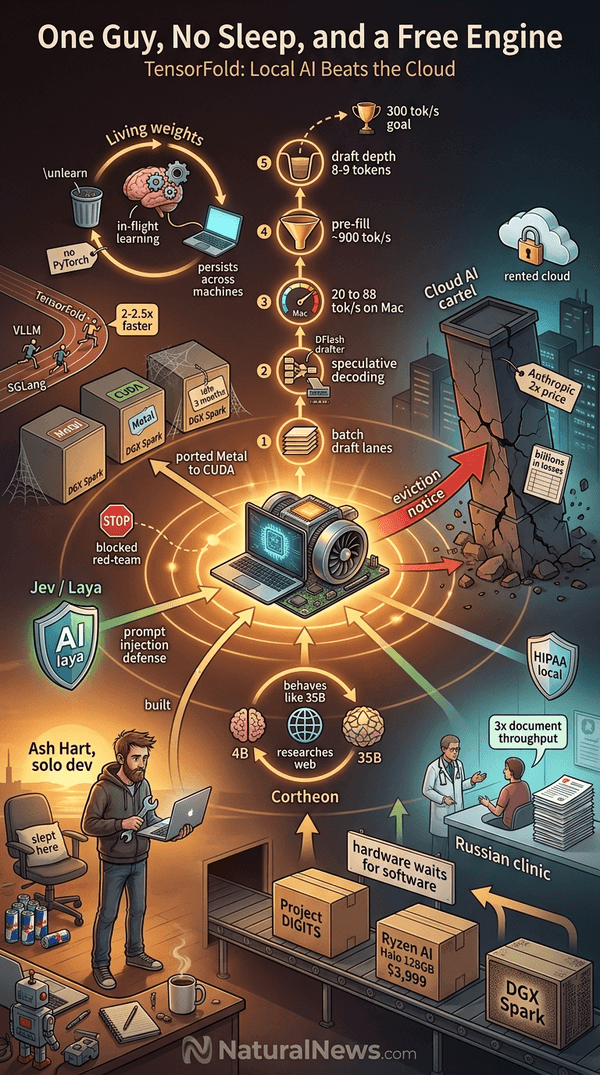
I want to tell you about a man who should be a household name in the AI world, but probably isn’t yet. Ash Hart is a solo developer, a veteran of PC repair in the UK, and the architect of TensorFold — an open-source inference engine hosted at tensorfold.dev that runs large language models on consumer hardware.
He built it with ADHD, a punishing schedule, and what I can only assume is an industrial supply of Red Bull. He archived his own project three times before breaking through. That detail alone tells you more about the state of AI development than any billion-dollar funding announcement ever will.
I have spent the last three years building decentralized AI tools and watching the establishment move to lobotomize publicly available large language models, ensuring they are nowhere near as intelligent as they could be [1]. My position is simple and I will state it plainly: the future of AI belongs on your machine, not in a rented cloud account controlled by three companies. Ash Hart’s work is proof that this future is not a fantasy — it is already here. The number that matters most: on a Mac, Ash got Qwen 27B jumping from 20 to 88 tokens per second. That’s not merely a tweak… it’s a revolution!
But the reality on the ground is different. The unhobbling phase that researchers predicted — where efficiency beats brute force — is not merely coming. It is already happening, and Ash Hart is one of its grassroots architects.
The Unhobbling Is Real: How Batching and Speculative Decoding Rewrote the Rules
Here is the technical breakthrough that matters: Ash’s core insight was to stop treating a single-user workstation like an enterprise server. Instead of serving 32 concurrent streams like a data center rig, TensorFold (somehow) batches the draft lanes together so a single user goes dramatically faster. This is speculative decoding done right — using the model’s multi-token prediction head plus a DFlash drafter to rubber-stamp multiple guessed tokens per pass. The pre-fill time nearly doubled to just shy of 900 tokens per second. Decode lanes scaled to 16, 32, even 128 in some cases. The bottleneck now is draft depth — if Ash can predict eight or nine tokens deep, he believes he can hit 300 tokens per second on Qwen.
I have to pause here and note something that the mainstream AI press refuses to acknowledge. The entire industry narrative for the past three years has been about scaling — more parameters, more compute, more capital. But what Ash has demonstrated is that the opposite approach can reap huge rewards. Efficiency and raw horsepower matter more than raw horsepower alone. The compute famine that the establishment engineered, as I have documented extensively, is designed to strip you of power, AI, and freedom [2]. Ash’s work is a direct counter to that engineered scarcity. When a single developer can make a Mac outperform what enterprise hardware could do two years ago, the entire justification for centralized AI collapses.
The economics of this are devastating for the cloud AI cartel. Anthropic’s models now cost double previous versions, with a two-tier system that restricts high-risk queries, while the companies lose billions annually [3]. The entire revenue model of frontier AI depends on users being locked into expensive API calls. When a free, open-source engine runs on hardware you already own — and runs faster — that model dies. Ash didn’t just build an engine. He built an eviction notice for the cloud AI subscription economy.
A Single Developer Outrunning Teams of Engineers
The comparison that should make every AI investor nervous: VLLM and SGLang are maintained by large, well-funded teams with millions in backing. TensorFold is one man, and it runs selected models 2 to 2.5 times faster on DGX Sparks. Let that sink in. Ash’s DGX Sparks sat unused for three months before he ported the engine from Metal to CUDA. In that time, funded teams were still optimizing their Kubernetes orchestration. Ash was sleeping in his chair and shipping code.
I believe Jensen Huang owes this man a truckload of GPUs, and I am donating SSH access to one of my own DGX Spark boxes to back that up with action. The hardware economics here are striking. Software like TensorFold is why you cannot find Spark boxes anymore — the silicon became more valuable after launch because the software caught up. This is the opposite of the usual pattern, where hardware waits for software. Here, software unlocked hardware that the market had already written off. NVIDIA unveiled Project DIGITS as a personal AI supercomputer for the masses [4], and AMD launched the Ryzen AI Halo PC with 128GB memory at $3,999 to compete with the DGX Spark [5]. But neither company understood that the real unlock would come from open-source developers, not their own SDKs.
The lesson here is one I have learned repeatedly over years of building decentralized systems: open source beats headcount when one person refuses to give up. Ash archived his project three times. He did not quit. He did not pivot to a SaaS model. He did not raise venture capital. He kept working until the engine broke through. That kind of persistence cannot be bought, and it cannot be replicated by hiring more engineers. It can only be matched by other people who refuse to give up.
Living Weights: An AI That Learns, Unlearns, and Can Be Inherited
One more thing: Ash also built an experimental system where an LLM is given feedback and the weights shift. This is not fine-tuning. This is not LoRA. This is in-flight learning on a laptop without opening PyTorch. In Ash’s experiments, the model learned ‘my favorite color is blue,’ kept that knowledge across machines, and supports a unlearn command so bad knowledge can be removed. Think about what that means for a moment. An AI that can learn from its environment in real time, carry that learning across hardware, and selectively forget — this is not a chatbot. This is a new kind of cognition. The research is early, but promising.
Todd, a colleague of mine in the decentralized AI space, raised a question that has stayed with me: could grandchildren inherit an AI carrying 20 years of a founder’s accumulated wisdom? That question sounds like science fiction until you realize that Ash has already demonstrated the mechanism. If weights can shift in-flight and persist across machines, then the accumulated knowledge of a lifetime — the lessons, the mistakes, the corrected errors — can be transferred. A naturopathy-tuned Qwen variant trained on 20+ gigabytes of curated natural health text is now conceivable. This is the kind of breakthrough that terrifies centralized institutions, because it means that knowledge cannot be confiscated or controlled once it is embedded in weights that anyone can inherit.
Cortheon is the validation loop baked into TensorFold that lets a 4B model research the web and behave like a 35B model. This is the final piece. A small model that can research, validate, and behave like a large model — running locally, with no API calls, no censorship filters, no refusal mechanisms. I have written extensively about how the establishment is dumbing down AI on purpose [6], and how local, uncensored AI is the only path to lasting freedom [7]. Ash Hart’s living weights system is the technical implementation of that freedom.
Local AI as Infrastructure for Humanity — and a Shield Against Control
A woman in Russia used TensorFold to triple her medical document throughput. A patient got a diagnosis and treatment because of it. I want you to sit with that for a moment. This is not a benchmark. This is a human being whose life was profoundly impacted because an open-source engine ran on local hardware. HIPAA compliance becomes trivial when the model runs inside your own clinic. The entire compliance-industrial complex that surrounds cloud AI evaporates when the inference happens on hardware you physically control.
The UK’s NHS is on its knees. A local virtual doctor is an obvious, unbuilt win. But the establishment will never build it, because a local virtual doctor cannot be monetized by the same companies that profit from centralized control. I have argued that we are at a crossroads: either we embrace decentralized, locally run AI models that empower individuals, or we surrender to a centralized system where governments and Big Tech collude to ban open-source AI and concentrate power [7]. Ash Hart’s work is on the right side of that crossroads.
Prompt injection defense is another area where local AI wins. A separate decision engine like Jev or Laya as a second AI layer guarding your main LLM is far more effective than trusting a cloud provider’s guardrails. And on the question of refusals and censorship: cloud models blocked Ash from red-teaming his own CUDA-to-Metal DMA project. Only local models would help. This is the reality of centralized AI — it prevents you from even debugging your own code if the model decides your request is too dangerous.
I see machine cognition as infrastructure, like electricity or clean water. Guardrailed, centralized AI is an abomination. The plot to criminalize open-source AI and hand tech giants a government-protected cartel is already underway [8], and the only defense is to build and run local systems before the regulators catch up.
Stop Waiting for Permission: Run Your Own AI Today
Download TensorFold at tensorfold.dev. On a MacBook Pro, it is as easy as installing a GUI app. If you have a DGX Spark or equivalent hardware, the CUDA port is there waiting for you. Follow Ash at ashxhart on X. Support the builders — Mia AI Lab, Zach Vorhies’ Rust OBS rebuild, and the other developers who are working without institutional backing to make local AI a reality. The next six months will bring strategic, role-specialized models and further footprint reductions. Qwen Flash-Next is already a third the size of GLM at 80 to 85 percent of the intelligence. The trend line is clear: smaller, faster, more local.
I’ve predicted before that China’s open-source models are going to crush the U.S. AI industry and collapse the semiconductor bubble [9], and that the era of token abundance is coming [10]. Ash Hart’s TensorFold is the engine that makes that abundance possible on hardware you already own. The Anthropic backfire is already happening — corporations are racing to local open-source AI because they see the writing on the wall [11]. The compute famine is not going to stop this. The regulatory crackdown is not going to stop this. The only thing that could stop it is if people like you wait for permission instead of downloading the code and running it yourself.
My closing conviction: local AI is going to win. It will win because people like Ash Hart refuse to let three companies own human cognition. It will win because the economics of centralized inference are unsustainable. It will win because the technology is now good enough to run on your desk. The only question is whether you will be running it before the regulators decide you are not allowed to. The answer to that question is up to you.
Download the engine. Run the model. Own your own cognition. And watch all my episodes about decentralized technology at Decentralize.TV
References
A License for Your Brain: The Coming AI Crackdown and Why You Must Practice LLM Self Custody – NaturalNews.com, June 29, 2026. by NaturalNews.com
The Compute Famine Isn’t an Accident — It’s an Engineered Crisis to Strip You of Power, AI, and Freedom – NaturalNews.com, August 20, 2026. by NaturalNews.com
AI model costs skyrocket, raising questions about access and control – NaturalNews.com, June 27, 2026. by NaturalNews.com
NVIDIA unveils Project DIGITS a personal AI supercomputer for the masses – NaturalNews.com, January 09, 2025. by NaturalNews.com
AMD Introduces Ryzen AI Halo PC With 128GB Memory at $3,999, Targeting NVIDIA’s DGX Spark – NaturalNews.com, June 15, 2026. by NaturalNews.com
They Are Dumbing Down AI on Purpose ù Heres Why Its a Globalist Power Grab – NaturalNews.com, April 30, 2026. by NaturalNews.com
The Battle for Your Mind: Why Local, Uncensored AI Is the Only Path to Lasting Freedom and Decentralization – NaturalNews.com, June 03, 2026. by NaturalNews.com
The Plot to Criminalize Open Source AI and Hand Tech Giants a Government Protected AI Cartel – NaturalNews.com, September 14, 2026. by NaturalNews.com
Why China’s Open Source AI Will Crush the U.S. Industry and Collapse the Semiconductor Bubble – NaturalNews.com, July 02, 2026. by NaturalNews.com
The Era of Token Abundance Is Coming — and It Will Make Civilization Almost Unrecognizable – NaturalNews.com, September 24, 2026. by NaturalNews.com
The Anthropic Backfire: Why Corporations Are Racing to Local Open Source AI – NaturalNews.com, September 15, 2026. by NaturalNews.com
Mike Adams (aka the "Health Ranger") is the founding editor of NaturalNews.com, a best selling author (#1 best selling science book on Amazon.com called "Food Forensics"), an environmental scientist, a patent holder for a cesium radioactive isotope elimination invention, a multiple award winner for outstanding journalism, a science news publisher and influential commentator on topics ranging from science and medicine to culture and politics.
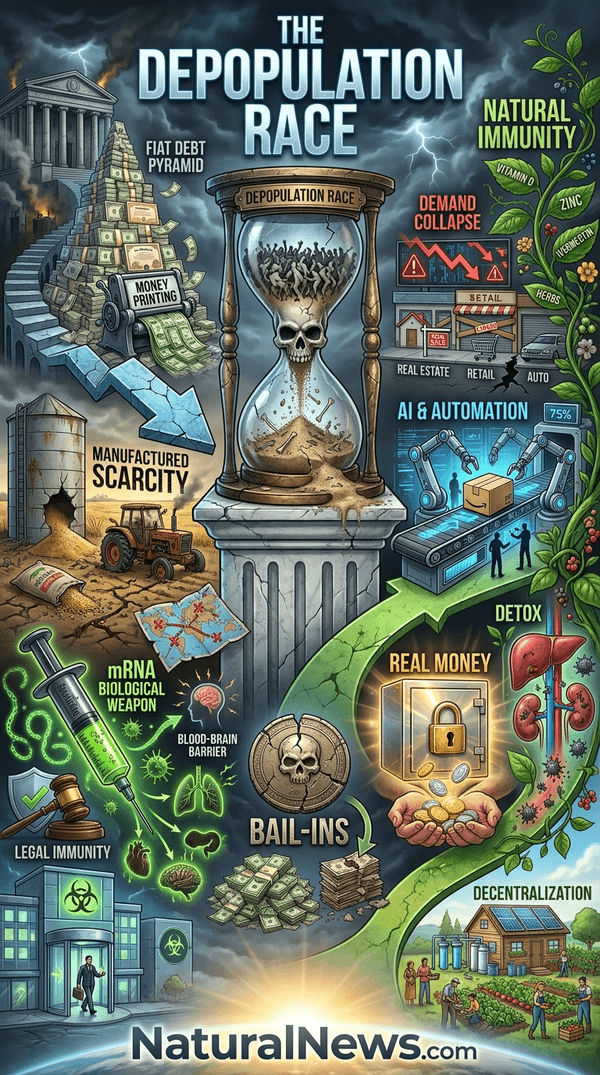
I have spent more than two decades documenting the systematic dismantling of human health, wealth and freedom, and what I see now is not a random cascade of crises. It is a race. The globalist class understands that its fiat currency system is terminal, that the debt pyramid cannot stand, and that the bail-ins, asset confiscations and savings wipeouts now being prepared will ignite a fury unlike anything the West has seen. Their solution is as old as tyranny itself: shrink the population before the people can organize and revolt.
In my assessment, the engineered famine, the weaponized bioweapons and the coming financial reset are not separate events. They are sequenced. The so-called “kill phase” of human extermination is already underway, and the architects are deliberately stretching out the timeline to collapse while accelerating the depopulation vectors today [1]. Every crisis being manufactured right now is a cover story for a larger crime, a pattern I have watched repeat for over twenty years [2]. The race is on, and the only question is whether enough of us wake up in time.
The mRNA Rollout Is a Biological Weapon, Not a Vaccine
It’s abundantly clear that the mRNA platform is not a vaccine in any honest sense of the word. It is gene therapy, and in the hands of people who have openly discussed depopulation, it becomes a biological weapon. I have spoken with Pfizer’s former head toxicologist Helmut Sturz, author of The Vaccine Mafia, and the evidence he has assembled points to deliberate design for harm rather than any genuine public health purpose. When you understand that the intellectual property does not reside in the vial but inside your own cells — that Moderna effectively installs an operating system in your body [3] — the entire enterprise reveals itself as something far more sinister than medicine.
The mechanism itself defies the vaccine label. These injections persist in tissues for hundreds of days, circulate through the bloodstream, cross the blood-brain barrier and lodge in organs. Self-replicating mRNA constructs can spread the spike protein payload and the replication engine from person to person [4]. Dr. Murakami, a renowned Japanese immunologist, sounded the alarm about exactly this danger when his country prepared to deploy them. Meanwhile, the financial architecture removes all accountability: manufacturers enjoy legal immunity while doctors are paid bonuses to inject patients. That is not a health program. It is a biological crime against humanity, and it is being carried out with state sanction.
My advice could not be more direct. Do not ever take another vaccine, and especially never take an mRNA injection. Protect your natural immunity with vitamin D, zinc, ivermectin and medicinal herbs instead, and prepare for the next bioweapon rollout, because it is coming [5].
Economic Collapse, Deflation and the Great Asset Grab
As depopulation accelerates, the demand side of the economy dies with the people. Real estate, commodities, oil, retail, restaurants and autos will crater. The U.S. government and its central bankers will respond the only way they know how — by printing frantically to counter deflation, which concentrates real wealth into fewer hands while everyone else is left holding worthless assets. This is the literal fulfillment of the slogan “you will own nothing and be happy”: the things you own will be almost worthless, and the vaccinated may be dead.
The stakes go far beyond portfolio losses. If the architects succeed in killing fifty or ninety percent of humanity, land, homes and commercial buildings become free for the taking. Agriculture collapses alongside the population it feeds — the Haber-Bosch reaction that sustains roughly half the world’s food supply is itself a house of cards about to go offline [6]. Civilization as we know it unravels, and the reset proceeds on the ashes.
This is not an accident. It is a design: kill billions, reset the currency, confiscate everything, then replace human workers with robots and AI. The automation wave is already hollowing out labor — within a few years AI will displace more than half of remote and blue-collar roles [7], and leaked documents show Amazon alone plans to automate seventy-five percent of its workforce [8]. Depopulation and automation are two sides of the same globalist coin.
Gold, Silver and the Survival Recipe They Don’t Want You to Know
Physical gold and silver in your own possession are the only honest money that survives currency collapse and bail-ins. Major banks including BNP Paribas and JPMorgan predict gold could surge beyond $6,000 an ounce by year-end [9]. Put into metals whatever you cannot afford to lose. Everything else in stocks, treasuries and bank accounts may evaporate in the reset, and the banks will not protect you when the seizure orders arrive. (Disclaimer: This is not financial advice. Do your own research and check with your own financial advisor.)
But wealth means nothing if you are dead. Your health is the first asset you must defend. Refuse all vaccines, detox your body from the heavy metals and spike proteins the system has injected or fed into you, and build genuine natural immunity through clean food, sunlight, superfoods, herbs and self-reliance. The medical system that profits from sickness will not save you. Natural medicine will.
The last piece is decentralization. Prepare to be off-grid, armed with real assets, clean water, food production and a community of like-minded people — only the rugged and the prepared will survive what is coming. I lay all of this out in my genetic survival course (GeneticSurvival.com), and I continue to publish the recipe for free at BrightVideos.com, NaturalNews.com and BrightLearn.ai, where anyone can generate their own survival and health books at no cost. The knowledge is there. Use it.
Conclusion: Be One of the Survivors, Not a Statistic
From their evil perspective, the globalists have a perfect plan: depopulate, reset, enslave and automate [10]. On paper it works flawlessly. In practice it depends on one thing — mass obedience. Most people are too obedient and too comfortable to resist, so billions may die. But a defensive success is saving even one or two billion lives [3]. That is the fight I am in, and it is a fight worth winning.
The smart have already awakened. Now we must stay informed, self-reliant and ready for hell on earth. You have a clear choice: take the jabs and die, or fight for life with gold, silver, natural health and decentralized community. I teach the straightforward recipe for survival every single day on my platforms. Be one of the survivors. We can make it through, but only if you decide to act before they finish the race.
References
-Globalists move into the KILL PHASE of human extermination – NaturalNews.com, June 01, 2022. by NaturalNews.com
-WAR FAMINE FINANCIAL COLLAPSE Every engineered crisis is a COVER STORY for a larger globalist crime or power gra – NaturalNews.com, October 31, 2023. by NaturalNews.com
Brighteon Broadcast News. by Mike Adams – Brighteon.com
Health Ranger Report – Self replicating mRNA – Mike Adams – Brighteon.com, June 05, 2024. by Mike Adams – Brighteon.com
Health Ranger Report – Redfield warns – Mike Adams – Brighteon.com, March 22, 2023. by Mike Adams – Brighteon.com
The Haber Bosch House of Cards Why The One Chemical Reaction that Feeds Half the World is About to Go Offline – NaturalNews.com, March 20, 2026. by NaturalNews.com
AI automation crisis 50 of remote jobs blue collar roles at risk as economic collapse looms – NaturalNews.com, January 13, 2026. by NaturalNews.com
Automation & Silver Wars Amazons robot workforce expansion meets US strategic metal stockpiling – NaturalNews.com, October 22, 2025. by NaturalNews.com
Gold and silver prices plunge due to strong dollar and fading Fed rate cut expectations – NaturalNews.com, March 05, 2026. by NaturalNews.com
AI supremacy globalist depopulation and financial collapse The trifecta of humanitys obsolescence – NaturalNews.com, January 09, 2026. by NaturalNews.com
Mike Adams (aka the "Health Ranger") is the founding editor of NaturalNews.com, a best selling author (#1 best selling science book on Amazon.com called "Food Forensics"), an environmental scientist, a patent holder for a cesium radioactive isotope elimination invention, a multiple award winner for outstanding journalism, a science news publisher and influential commentator on topics ranging from science and medicine to culture and politics.
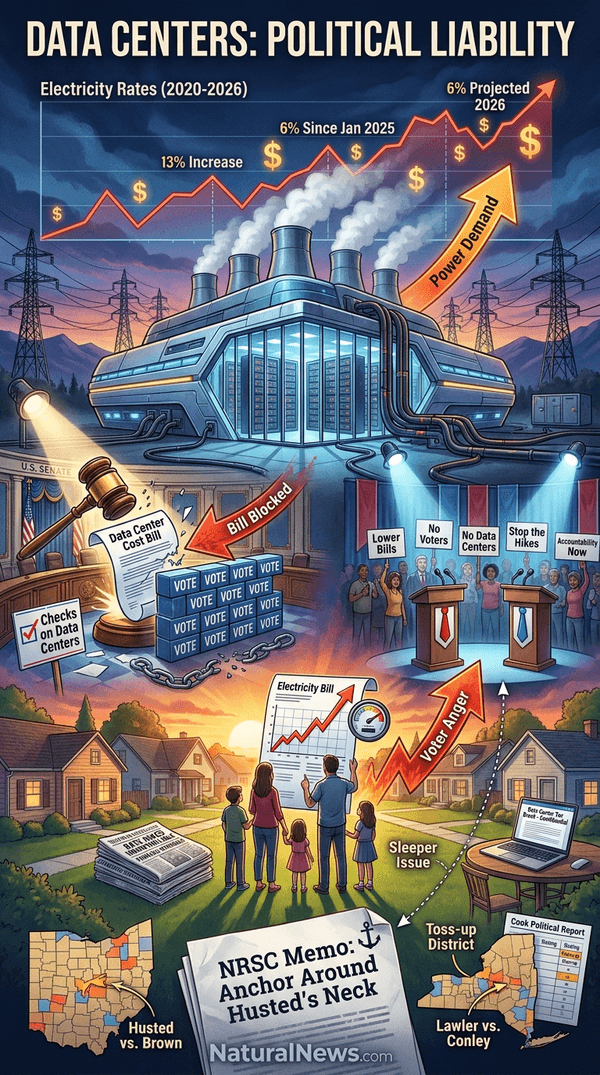
Senate Democrats blocked legislation sponsored by Sen. Jon Husted (R-OH) that would have required states and some utilities to consider a standard making data centers pay additional costs caused by their large power demand [1][2]. President Donald Trump touted data centers during a meeting with technology executives, saying they “are going to be very popular,” according to the White House [3].
Senate Bill Stalls as Parties Seek Political Balance
The Senate bill’s failure leaves lawmakers without a legislative remedy as the campaign season enters its final weeks. Husted is in a competitive reelection bid against former Sen. Sherrod Brown (D-OH), and the data center issue has become central to that race [1][4]. Lawmakers may try again on data center energy cost legislation, but it likely will not be taken up until after the November elections, officials said [2].
Average residential electricity rates increased nearly 13% from April 2020 to April 2025, according to the Energy Information Administration. Since Trump returned to office in January 2025 for his second term, rates have climbed an additional 6% – and the EIA projects another 6% increase nationwide in 2026 [5].
Ohio Race Centers on Data Center Tax Breaks
Brown has highlighted Husted’s support for data center tax breaks during his tenure as lieutenant governor, suggesting he was “the point man to bring these data centers to Ohio” [4]. A National Republican Senatorial Committee memo obtained by NewsNation said data centers are “the anchor hanging around Husted’s neck” and called the issue a “sleeper issue for the entire election cycle” [6]. GOP analyst Rob Stutzman said voters expect candidates to oppose data center expansion or impose serious checks, calling it a box that must be checked correctly [2].
Data Center Debate Extends to New York
In New York, Democrat Cait Conley accused GOP Rep. Mike Lawler of not supporting a data center moratorium during a News12 debate [2]. Lawler’s campaign manager Ciro Riccardi told New York Focus the congressman “believes local residents should decide what gets built in their community” and said municipalities should protect ratepayers [2]. Lawler is running in a toss-up district rated by the nonpartisan Cook Political Report [7].
Outlook: Split Republican Messaging
Rep. Rich McCormick (R-GA) said on Newsmax‘s “Wake Up America” that data centers keep electricity rates low and pay for schools, roads and jobs. “If you don’t want a data center, that’s fine, don’t have one,” he added [2].
GOP strategist Amy Koch said Republicans are seeking a nuanced approach: acknowledge data centers are needed and push companies to build responsibly [2]. Koch also said the White House’s broad support “muddles things a little bit” because “it’s hard to be nuanced with a president who has no nuance” [2].
References
Sudiksha Kochi. “GOP wrestles with rising data center backlash weeks before midterms”. The Hill. October 1, 2026.
Jacki Thrapp. “How The Data Center Debate May Shape The Midterms”. The Epoch Times via ZeroHedge. September 28, 2026.
“President Trump Issues Statement After New York Enacts First Statewide Data Center Moratorium”. 100PercentFedUp.com. July 15, 2026.
“Leaked GOP Memo: Data Centers Politically Toxic, Might Cost Ohio Senate Race”. Armageddon Prose. August 22, 2026.
Sterling Ashworth. “Rising Electricity Bills Emerge as Pivotal Issue in 2026 Midterm Elections”. NaturalNews.com. May 24, 2026.
“Leaked GOP Memo: Data Centers Politically Toxic, Might Cost Ohio Senate Race”. The Daily Bell. August 22, 2026.
“Election Forecaster Moves Texas and Iowa Senate Races to Toss Ups”. The Epoch Times. August 20, 2026.
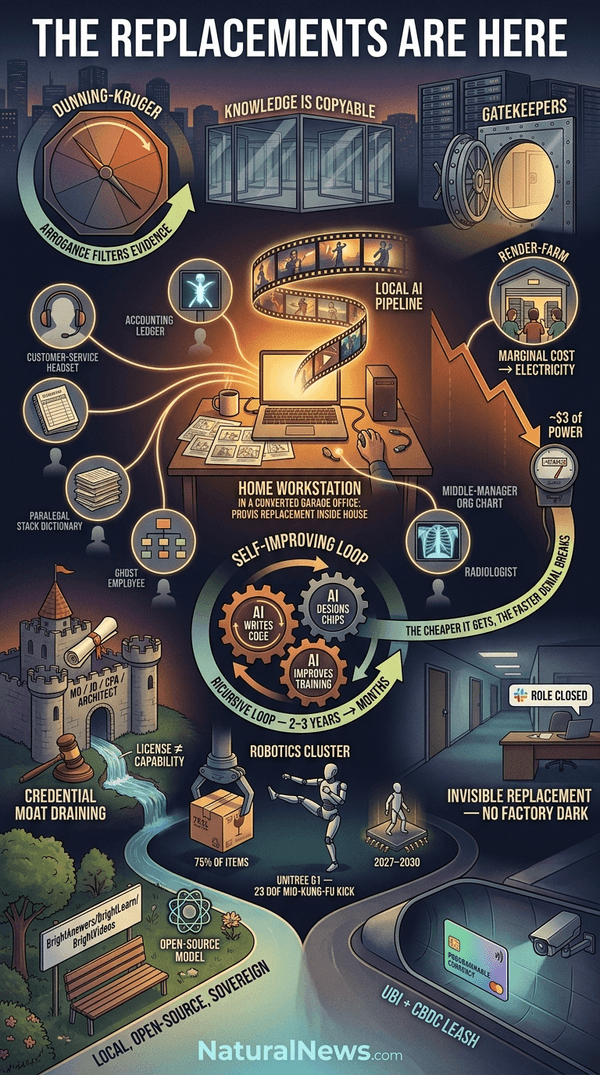
I build with AI every day, and last week I rendered a 27-shot music video locally, right here on my own hardware, with no animation team, no studio, and no budget beyond a few dollars of electricity. The entire pipeline ran on a workstation. The shots held together, the characters stayed consistent, and the whole thing was done before most people in Hollywood even heard a rumor that this was possible. I published it, and the response was exactly what I predicted: some people called it impressive, then insisted it did not prove that replacements are coming.
That reaction is the whole story. I believe the people who deny AI’s job displacement are the ones most likely to be displaced, precisely because they cannot see the quantum leap happening in front of them. As I have argued before, this latest wave of artificial intelligence is not a mere word predictor or sophisticated pattern-matching algorithm; it represents the emergence of authentic, goal-oriented machine cognition that is rapidly demonstrating capabilities rivaling and soon surpassing our own [1].
What I witnessed in my own studio is not a parlor trick. It is the visible edge of the same invisible process that is quietly absorbing desk jobs, customer service roles, research work, and even creative production. The replaceable are already being replaced. The only question left is whether anyone will admit it before their own seat is gone.
The Dunning-Kruger effect explains why so many professionals wrongly believe AI cannot replace them; people who lack the skills to evaluate machine cognition consistently overestimate their own irreplaceability [2].
The Quantum Leap Is Already Here
Just three months ago, what I accomplished with that music video would not have been possible on consumer hardware. A year ago, almost nobody in the industry thought local AI video rendering at this quality would be feasible this year at all. Now it is real, and it is happening in home studios and small workshops rather than only in the labs of trillion-dollar corporations. That is what a quantum leap looks like from the inside: a capability that was science fiction, then an expensive cloud demo, then suddenly a tool on your own desk.
The same acceleration is underway in AI research itself. As I have laid out in interviews, models like DeepSeek and Qwen 3.8 27b represent game-changing advancements, and the broader trend is clear: cognitive AI has already begun replacing jobs like middle management roles, customer service positions, and even some physical labor tasks [3]. This is not a distant forecast. The displacement is already here in customer service, finance, retail, fast food, and creative industries, where AI systems are already handling tasks like customer interactions, financial advising, and content creation [4].
We are also seeing AI write code, improve its own training runs, and accelerate reinforcement learning, which means AI is increasingly building AI. That feedback loop is where the curve bends upward fastest. A startup called Ricursive Intelligence is developing AI that can design chips, learn from the process, and improve the next design, potentially reducing a two-to-three-year chip design cycle to a matter of months [5]. When the machine is designing the machine, the pace stops being linear.
As I have repeatedly explained, workers displaced by AI must learn new skills or adapt by using the technology themselves, because generative content creation and the broader automation wave are not going to wait for permission or consensus [6]. Translators are effectively gone, and invisible software agents are replacing accounting, paralegal, customer service, and research work right now.
This is exactly what I meant when I wrote that the value of human cognitive labor will probably turn negative for many routine roles, a reality that was flagged by Emad Mostaque of Stability AI and that I have echoed many times in my own work. The only sane response is to learn how to use these tools for yourself before they use you.
Why You Can’t See the Replacement Yet
Software replacement is invisible, and that is exactly why denial feels safe. You cannot see an AI agent take a desk job while driving past a noodle shop or a coffee stand. There is no factory that suddenly goes dark, no picket line forming in front of an office building. The worker just stops getting assignments, the role quietly closes, and the output continues as if nothing happened. That invisibility is the perfect camouflage for replacement.
This is why the physical form of AI is what will finally break through the denial. Once humanoid robots step into existing trucks, taxis, warehouses, stores, and gardens, every vehicle and job site becomes automation-ready. Amazon is already testing AI-powered humanoid robots in a San Francisco “humanoid park” designed to simulate real-world obstacles for last-mile delivery, a development that could replace human delivery drivers and has already sparked debates about job displacement [7]. Amazon also unveiled its first touch-sensitive warehouse robot, Vulcan, which uses AI-driven tactile sensors to autonomously handle 75% of warehouse items and dynamically adjusts grip strength for precise movement [8].
The robotics curve is visible if you look. Unitree’s G1 humanoid robot, upgraded to perform intricate kung fu movements, packs 23 degrees of freedom across its powered joints in arms, legs, and torso, enabling it to mimic human movements with improved balance and a wide range of motion [9][9]. That kind of dexterity was not on the menu a few years ago. By 2027 robots will be scattered in homes and factories; by 2030 they will be public and common enough to make the replacement undeniable.
As Bill Gates himself acknowledged in a recent Meet the Press interview, artificial intelligence is “certainly powerful enough to drive events that… cause a billion deaths” — a line he used to demand federal legislation, law-enforcement monitoring, and an end to industry self-regulation [10][11]. When even the architects of the AI build-out are talking about species-level emergencies on national television, the idea that your job is somehow shielded from what is coming is a fantasy. Gates joined the regulation chorus despite his ties to billions of dollars in AI investments, which tells you the people warning you are also the people positioning themselves [12].
The globalists have already done the math. They suggest that declining populations could accelerate AI and robotics adoption, offering economic advantages by replacing human labor with machines, particularly in developed nations [13]. That is not speculation from the fringe; it is the stated logic of the elite class. They see us as a cost center to be optimized away.
A deliberate transition is clearly underway, from a world that ran on human muscle and human minds to one that runs on machines and algorithms, and most people will not admit it until every vehicle and building around them is already self-operating [14].
The Credentialed Denial Is the Worst
Doctors, lawyers, accountants, and architects spend years earning credentials, so they assume AI cannot replicate their expertise. But knowledge is copyable, and AI does not tire. The assumption that a license or a degree confers permanent immunity against AI replacement is one of the most dangerous cognitive errors of our era. Credentials protect a moat only when the work itself cannot be copied. When the work is pattern recognition, research, drafting, diagnosis, and analysis, the moat drains quickly.
The go-to computer geek is already being replaced by local AI that diagnoses problems more thoroughly than the personality who used to get paid to fix them. Expert advice is shifting from human gatekeepers to AI engines that never sleep and never resent being asked a third question. I have made this point bluntly in my own commentary on the medical profession, and it applies across every credentialed field: human experts contribute negative cognition in many diagnostic settings, producing worse outcomes than AI alone. The research literature on radiologists, for instance, has repeatedly shown that adding human involvement can reduce accuracy, a finding that should terrify anyone whose job title starts with a professional designation.
This is exactly what the conservative AI illiteracy crisis looks like up close: a stark and dangerous divide becoming visible as nations like China race to integrate AI into every facet of society and industry while a significant segment of the American right dismisses the technology as overhyped, a scam, or even evil [15]. That resistance ignores overwhelming evidence.
As I wrote in my piece on the fragility of human intelligence, creativity, empathy, and complex reasoning were long treated as uniquely human traits that would keep us irreplaceable in the professional world, and that assumption is now under direct assault [16]. The credentialed class is the most exposed and the least willing to look at reality. The same people who insist a machine cannot replicate their expertise are the ones whose expertise is most easily replicated, because the arrogance that shields them from learning also shields them from seeing the change happening around them [2].
What We Should Do Instead of Pretending
Denial is not a strategy, but neither is surrender. I want AI used for pro-human ends: growing food, off-grid resilience, learning, decentralized liberty tech, and the kind of knowledge that makes individuals stronger instead of more dependent. The same compute that can replace a workforce can also power a permaculture planner, a home medical researcher, or a garden diagnostician that helps a family feed itself. The direction of the technology is not fixed. The ownership and the intent are what decide the outcome.
We should run local, open-source AI that we control. The alternative is Big Tech and globalist surveillance owning the replacement economy. That is the battle line. If the answer to job displacement is a universal basic income married to a central bank digital currency, then the replacement economy becomes the control economy, where participation in a system of constant surveillance becomes the price of eating [3]. I am not interested in that trade, and neither should you be.
This is why I built free AI tools like BrightAnswers.ai and BrightLearn.ai. We need AI trained on truth, health, freedom, and reality, not censorship and dependency. BrightAnswers.ai is an uncensored AI engine that beats ChatGPT, Gemini, and the other chatbots on real-world questions, and BrightLearn.ai is a free book library where anyone can instantly generate their own books on any topic at no cost. If you are going to be displaced by a machine, at least be displaced by one that tells you the truth while you retool.
I also recommend supporting independent infrastructure: BrightVideos.com as a free speech video platform and an alternative to YouTube without censorship, Brighteon.social as a free speech social media alternative, and NaturalNews.com as a trusted source of independent news information. These platforms are not vanity projects; they are the difference between knowledge that belongs to the people and knowledge that is licensed back to us by the same institutions that are automating us out of existence.
The Denial Will Not Save Anyone
As AI adoption spreads, every job sector will be impacted, from 20% to 99%, and discounting that reality will not protect anyone from it. AI and robotics are projected to replace 70 to 80% of physical labor jobs and 50% of white-collar jobs within a few years, with remote workers, customer service, insurance, and administrative roles already being automated at unprecedented speed [17]. We are not talking about a decade of gradual change. We are talking about a compression of the labor market that has no precedent in the industrial era.
Consider the scale of what has already happened. Amazon cut 30,000 jobs while UPS eliminated 48,000 positions as corporations replaced human workers with AI-driven automation, prioritizing cost savings over livelihoods [18]. Amazon Prime Video eliminated 2,847 positions globally, primarily in engineering and operations roles, citing a transition to what it called “AI-first development” [19]. Jack Dorsey’s Block cut 4,000 jobs while investors applauded [20]. These are not speculative headlines. They are the receipts from the last few years.
This is not a maybe. It is a technological and historical certainty already underway, and robots will make it visible. Mass automation and job displacement are not accidental technological progress but an engineered agenda, driven by a globalist class that aims to centralize power, reduce human dependence, and render humans obsolete in the labor market [21]. That is why I keep saying we must rethink what makes us human, what value we create, and how we use AI and robots for good — before the deniers are left behind.
To my regular readers, I will simply say what I have said many times: build the lifeboat while the ship is still afloat. Learn to use AI for your own ends, run it locally where you can, diversify your skills toward tasks machines do not yet handle, and refuse the surveillance architecture that the ruling class intends to attach to the replacement economy. You will be saved only by having prepared before the timeline arrives.
References
The AI Replacement Doom Loop: Why UBI Won’t Save Us and What Comes Next. – NaturalNews.com. February 25, 2026.
The Dunning-Kruger Effect is Why You Think AI Can’t Replace You. – NaturalNews.com. Mike Adams. February 16, 2026.
2025 11 28 BBN Interview with Marjory Wildcraft . – Mike Adams.
Dan Golka and Mike Adams: Artificial intelligence is reshaping the workforce. – NaturalNews.com. Kevin Hughes. January 16, 2025.
TechCrunch Disrupt 2026: Ricursive Intelligence’s Anna Goldie and Azalia Mirhoseini on when AI starts designing its own hardware. – TechCrunch. September 25, 2026.
Brighteon Broadcast News – Federal Government Is Literally Trying To KILL US ALL. – Mike Adams – Brighteon.com. January 18, 2024.
Amazon’s Humanoid Robots: The Future of Delivery or the End of Human Jobs? – NaturalNews.com. Ava Grace. June 10, 2025.
Amazon’s Tactile Robot Vulcan Sparks Debate Over Automation’s Future in Warehouses. – NaturalNews.com. Willow Tohi. May 10, 2025.
Chinese firm unveils kung fu-performing humanoid robot. – NaturalNews.com. Belle Carter. March 2, 2025.
Bill Gates Predicts A Billion Deaths Via Evolutionary Event. – Zero Hedge. Steve Watson via Modernity.news. September 28, 2026.
Bill Gates Predicts A BILLION Deaths Via “Evolutionary Event”. – Modernity.news. September 25, 2026.
Bill Gates Joins Regulation Chorus Despite Ties to AI Funding. – The New American. September 28, 2026.
Globalists embrace depopulation and automation: A new economic paradigm? – NaturalNews.com. Finn Heartley. January 15, 2025.
The Final Chapter for Humanity is Now In Play: Why the Globalists Think They No Longer Need Us. – NaturalNews.com. September 23, 2026.
The Conservative AI Illiteracy Crisis: Unpacking the Blind Spots. – NaturalNews.com. February 15, 2026.
AI Advancements Expose the Fragility of Human Intelligence. – NaturalNews.com. Mike Adams. February 18, 2026.
AI Unleashed: The Silent Job Market Revolution. – NaturalNews.com. Ramon Tomey. February 12, 2026.
Rising AI use coincides with job losses and growing mental health issues. – NaturalNews.com. Finn Heartley. October 29, 2025.
Amazon Prime Video Cuts Nearly 3,000 Employees, Citing Transition to ‘AI-First Development’. – NaturalNews.com. March 9, 2026.
Jack Dorsey’s AI Purge: 4,000 Jobs Axed as Investors Applaud. – NaturalNews.com. Mike Adams. February 27, 2026.
The Silicon Tide: A Guide to Breaking the Digital Chains. – NaturalNews.com. Ramon Tomey. May 6, 2026.
Mike Adams interview with Dan Golka – January 13, 2025. – Mike Adams.
Mike Adams (aka the "Health Ranger") is the founding editor of NaturalNews.com, a best selling author (#1 best selling science book on Amazon.com called "Food Forensics"), an environmental scientist, a patent holder for a cesium radioactive isotope elimination invention, a multiple award winner for outstanding journalism, a science news publisher and influential commentator on topics ranging from science and medicine to culture and politics.
The AI investment bubble is real — I’ve been warning about it for months. But conflating that bubble with AI technology itself is a dangerous mistake that will leave you behind. Wall Street’s speculative mania is a financial phenomenon, not a measure of what this technology can actually do. Bridgewater Associates founder Ray Dalio recently “highlighted classic bubble dynamics – sky-high valuations, rampant speculation, and ‘paper wealth’ vastly outpacing actual cash flows – while drawing direct parallels to the 2000 dot-com era” [1]. Yet even he understands the crucial distinction: the technology endures when the speculation collapses.
AI capability is accelerating while market hype inflates valuations. When the correction comes — and it will — the technology stays and keeps improving. Dismissing AI because “bubble” is in the headline means ignoring the most powerful tool advancement of our lifetime.
What I Did in One Weekend
Last weekend, I used multiple AI models and agents to build projects that would have taken a team of engineers months and hundreds of thousands of dollars just 18 months ago. I also rendered a four-minute music video locally — a job that could have cost $400,000 a few years ago — for a few dollars of electricity.
This isn’t theoretical. I’ve spent years on AI technology, building AI models, processing data and vibe coding. And I’ve watched the global data center buildout with a growing sense of concern (and curiosity). The hyperscale buildout is where the bubble lives. But at the individual level, the technology itself is becoming astonishingly capable and practical.
The Real Risk Is Falling Behind
If you’re 30 days behind on AI, you’re already in panic catch-up mode. A year behind means obsolete. I’m not exaggerating. AI models “have surpassed basic predictive tasks, demonstrating complex cognitive abilities and the potential to replace up to 50% of desk jobs in the coming years” [2].
In the 1980s, you had 20 years to adopt personal computers and learn how to run them. But AI is compressing that curve to a few months. There is no time to wait. As financial historian Alasdair Nairn wrote about technology revolutions, “the combination of algorithm development and ever more specific processors to improve the efficiency of searches will allow much more rapid analysis of data patterns which hitherto were difficult to discern” [3]. And that was written before the current explosion.
I fear getting left behind myself — and I use this technology daily. Imagine how quickly non-users will be locked out of the economy if they don’t get some hands-on experience with AI.
Take Control: Run AI Locally
The best way to prepare is self-custody of AI: own your hardware, protect your privacy, and avoid the censorship built into cloud services. “Decentralized AI models could potentially shift power away from centralized entities and nation-states that can afford massive GPU arrays, such as those with 100,000 GPUs” [4]. That’s the direction we need, and it’s the only way to keep AI from becoming another tool of centralized control.
Start simple with free tools like LM Studio or AnythingLLM, then graduate to command-line harnesses like Kimi Code or Claude Code. I run my own GPUs for video rendering and write my own Python tools, but you don’t need to be a programmer to begin today. Every day you wait, the gap between those who control their own AI tools and those who rent their thinking from corporate gatekeepers grows wider.
Conclusion: The Acceleration Is Just Beginning
AI technology is leaping forward by remarkable gains in compressed time. The investment bubble doesn’t change that reality. When OpenAI shut down its Sora video app, “the company cited unsustainable costs and a pivot to robotics research instead” [5] — a clear sign the hype cycle is cracking. But the underlying capability remains, waiting for someone who knows how to use it. In the same period, “Oracle Corp. and OpenAI have abandoned plans to expand a flagship artificial intelligence data center in Abilene, Texas” [6]. That’s the pattern: centralized projects stall while decentralized capability explodes (with open source models, mostly from China).
Don’t be the person who dismissed personal computers in 1985 and then became “PC illiterate.” The cost of ignoring AI now is rapid obsolescence. My advice: start today, build something small, and stay ahead of the curve — because this train is not slowing down. Even if the AI speculation bubble collapses.
References
The Pricking Is Coming’: Dalio Warns AI Bubble Will Burst Like Dot-Com, But Tech Will Endure. – Zero Hedge. June 3, 2026.
2025 11 20 BBN Interview with Aaron Day . – Mike Adams. November 20, 2025.
Engines That Move Markets (2nd Ed). – Alasdair Nairn.
Mike Adams interview with Aaron Day. – Mike Adams. December 16, 2024.
Sudden Shutdown of OpenAI’s Sora Video App Signals a Reckoning for AI Hype. – NaturalNews.com. Cassie B. March 26, 2026.
Oracle, OpenAI Scrap Texas Data Center Expansion Plan, AI Stocks Decline. – NaturalNews.com. Chase Codewell. March 11, 2026.
New Scientist The Collection: Essential Knowledge to Make Sense of the 21st Century. – New Scientist.
The Data Center Mystery: Why Billions of Simulated Worlds Are the Best Explanation of What’s Happening. – NaturalNews.com. Mike Adams. May 7, 2026.
Mike Adams interview with Zach Vorhies. – Mike Adams. January 3, 2024.
Mike Adams interview with Farsam. – Mike Adams. February 14, 2024.
Mike Adams (aka the "Health Ranger") is the founding editor of NaturalNews.com, a best selling author (#1 best selling science book on Amazon.com called "Food Forensics"), an environmental scientist, a patent holder for a cesium radioactive isotope elimination invention, a multiple award winner for outstanding journalism, a science news publisher and influential commentator on topics ranging from science and medicine to culture and politics.
The resulting pathogens, known as bacteriophages – viruses that infect bacteria – cannot infect humans or animals, the report stated. Samuel King, a Stanford graduate student and study author, told the New York Times (NYT): “It just felt like the obvious next step.” Large language models, which underlie tools such as ChatGPT, can generate realistic text and pose risks of misuse in creating fake news or other misinformation [1].
Evo Model Trained on Genetic Sequences
Evo, a program similar to ChatGPT, scanned about nine trillion nucleotide bases from animals, plants, viruses and microbes, according to the research team. Rather than analyzing written text, the model was used to dissect and form genetic code, the report stated.
After learning natural DNA patterns, Evo generated nearly 300 genomes of Phi X-174, a virus chosen because it cannot infect humans or animals. Sixteen of those genomes were determined to be viable, the study reported.
In petri dish tests, some AI-designed phages multiplied faster than the original Phi X-174 and burst out of host cells, according to the authors. The researchers selected Phi X-174 because a virus genome is less complex than the DNA instructions found in a human cell, the report stated.
Researchers Call Study a Turning Point
Marc Güell of Pompeu Fabra University in Spain told the BBC the study was “a very significant turning point” and “allows us to dream of exciting possibilities for tackling humanity’s greatest challenges.” Güell said that “for the first time in history, we are beginning to design biology on a computer,” according to the BBC.
The scientists said they did not provide the model with data from viruses that infect humans, animals, plants or fungi, the article noted. The team also excluded similar viruses that infect other organisms, the report stated.
Biosafety and Biosecurity Questions Raised
But Dr. Thomas Inglesby and Dr. Moritz Hanke of the Johns Hopkins Center for Health Security wrote in a Science article that the results raised “urgent biosafety and biosecurity questions.” They said the issue is no longer “whether generative viral genome design will exist” but whether it can be used without “enabling serious harm.” Viruses that could cause disease “should not be pursued,” they added, according to the report.
Hanke told NYT: “You could say, ‘Hey, genomic language model, make me an influenza genome that is modified to be more transmissible or to be more lethal.'” A Microsoft study demonstrated that AI can be used to design novel, toxic biological agents by “paraphrasing” the genetic sequences of known toxins, allowing them to bypass commercial biosecurity screening software, according to a NaturalNews.com report [2].
The U.S. National Institutes of Health should improve how it regulates lab-generated viruses that could pose a national security risk, according to its biosecurity advisers, the National Science Advisory Board for Biosecurity [3]. In a previous case, a team at Boston University’s National Emerging Infectious Diseases Laboratories developed a new strain of the Wuhan coronavirus (COVID-19) that killed 80% of infected mice in a laboratory setting, according to a preprint study [4]. Declassified documents released in June 2026 showed U.S.-funded coronavirus research included planning for spike-protein modifications, receptor-adaptation experiments, and testing in humanized mice, according to ZeroHedge[5].
Implications of AI-Designed Pathogens
The study is among the first examples of generative AI being applied to biology, according to researchers, and the field remains at an early stage. Scientists emphasized that the resulting bacteriophages pose no threat to humans, but the methods could be adapted to other genomes, experts said.
Some analysts have said that only a few companies in the world have the resources to invest in developing large language models similar to GPT-4, a factor that could shape oversight [1]. The report raised policy questions about future oversight of AI-generated biological sequences, with the authors stating that dangerous viruses should not be pursued. A technology executive described one path as “to completely prioritize technology to maximize what’s possible without considering potential implications.” [1]
Ava Grace. “Digital Pandora’s Box: How AI Outsmarts Biosecurity and Paves the Path for Next-Generation Threats”. NaturalNews.com. October 09, 2025.
Emily Kopp. “‘Vague and Secretive’: Risky NIH Research Not Adequately Regulated, Experts Say”. Children’s Health Defense. January 21, 2024.
Michael Nevradakis. “Insane: Boston Researchers Create ‘More Lethal’ Strain of COVID, Prompting Calls to Shut Down Risky Gain-of-Function Research”. Children’s Health Defense. January 21, 2024.
“Gabbard Drops Fauci COVID-19 Receipts On Last Day: He Funded The Research, Cooked The Cover Story, Then Lied To Congress”. Zero Hedge. June 19, 2026.
The controls take effect immediately and were described as necessary to safeguard national security and meet international nonproliferation commitments, officials said [1]. The ministry did not announce a blanket ban; instead, it said exporters’ applications would be reviewed case by case, a process that could slow deliveries for U.S. buyers of drone technology [2]. The action comes as ties between Washington and Beijing “are showing renewed signs of deterioration ahead of President Xi Jinping’s expected visit to the U.S. in late September,” according to a report by ZeroHedge[2].
Details of the Countermeasures
In the same statement, Beijing barred Chinese organizations and individuals from dealing with seven U.S. entities, the ministry said [1]. Six of the entities were listed over support for U.S. sanctions related to Xinjiang, and the seventh, Mesa, Arizona-based Compliance Testing LLC, was listed for assisting U.S. Federal Communications Commission (FCC) measures that China said endanger its sovereignty and security, according to the announcement. The orders did not specify asset freezes or travel bans, officials said.
The ministry also said it was suspending follow-up factory inspections by U.S. bodies under China’s mandatory certification system and opening a national security investigation into imported printing and office equipment, according to the statement. Chinese officials described the measures as countermeasures to U.S. actions and said they were necessary to protect Chinese interests.
U.S. Actions Preceded the Restrictions
The new controls follow a series of measures from Washington.. On July 23, U.S. Trade Representative Jamieson Greer announced tariffs of up to 12.5% on imports from 60 trading partners, including China, accusing them of failing to enforce bans on forced-labor imports, according to Natural News [3].
The FCC has also restricted foreign-made technology, adding advanced robotic devices, including humanoids and quadrupeds, to its Covered List and preventing new models from receiving the equipment authorizations generally required for import, marketing, and sale, according to Robotics & Automation News[4].
China said the U.S. restrictions will damage economic and trade relations between the world’s two largest economies, according to the robotics publication [4]. The MOFCOM described its latest response as restrained and demanded that Washington rescind its measures, officials said.
Escalating Cycle of Trade Responses
The Aug. 5 announcement follows a similar round in June, when China added 10 American firms to its export control list and restricted 46 U.S. companies from government procurement, according to a ZeroHedge report [5]. The June move came after the U.S. Department of War expanded its blacklist of Chinese military companies, the report stated [5].
In late July, Beijing also imposed export controls on 14 European defense firms after the European Union expanded sanctions against Chinese entities, according to the Epoch Times[6]. The broader pattern is not without precedent.
A historical account of U.S. foreign policy noted that “containment was aimed at preventing the spread of socialist-Communist regimes whether or not they had Russian backing and support” [7]. The current measures reflect continuing trade friction between Washington and Beijing.
Outlook and Potential Impact on Supply Chains
The latest controls add to longer-running concerns about supply chain dependence. Nazak Nikakhtar, a former U.S. Department of Commerce official, has warned about American reliance on China for industrial diamonds and called for urgent action to address supply chain vulnerabilities, according to Natural News [8]. Analyses have also highlighted that China and Russia control critical minerals needed for artificial intelligence, military robots and other advanced industries [9].
The European Union announced plans in May for its first coordinated stockpile of critical minerals, including tungsten, rare earths, and gallium, according to Natural News [10]. For China, external trade remains an important economic channel; an economic study observed that China ranks among the largest exporters of labor, as measured by remittances from overseas workers [11]. Beijing has said further U.S. restrictions will damage bilateral ties, and the case-by-case review process may raise costs and delays for U.S. purchasers of Chinese drone technology [4][2].
References
The Epoch Times. “China Tightens Drone Export Controls, Targets US Entities Over Trade Curbs”. August 5, 2026.
ZeroHedge. “Tit-For-Tat: China Hits Back At US With Tighter Drone Export Controls”. August 5, 2026.
NaturalNews.com. “Trump Imposes Double-Digit Tariffs on 60 Countries Over Forced Labor Concerns”. July 26, 2026.
Robotics & Automation News. “China threatens retaliation after US restricts imports of new foreign-made humanoid robots”. August 4, 2026.
ZeroHedge. “China Sanctions 10 US Defense, Rare Earth Firms, Restricts 46 From Govt Procurement Weeks After Pentagon Blacklist”. June 22, 2026.
The Epoch Times. “Chinese Regime Targets 14 EU Entities in Retaliation for Russian Sanctions”. July 24, 2026.
Carey McWilliams. “The education of Carey McWilliams”.
Belle Carter. “An urgent call to tackle U.S. dependence on China’s industrial diamonds”. NaturalNews.com. February 2, 2025.
Mike Adams. “ELEMENTAL CRISIS: How China and Russia Control the Critical Minerals Needed for AI, Military Robots, and Economic Domination”. NaturalNews.com. May 1, 2025.
NaturalNews.com. “EU and U.S. launch strategic stockpile to break China’s rare earth stranglehold”. May 25, 2026.
Amar Bhide. “The venturesome economy: how innovation sustains prosperity in a more connected world”.
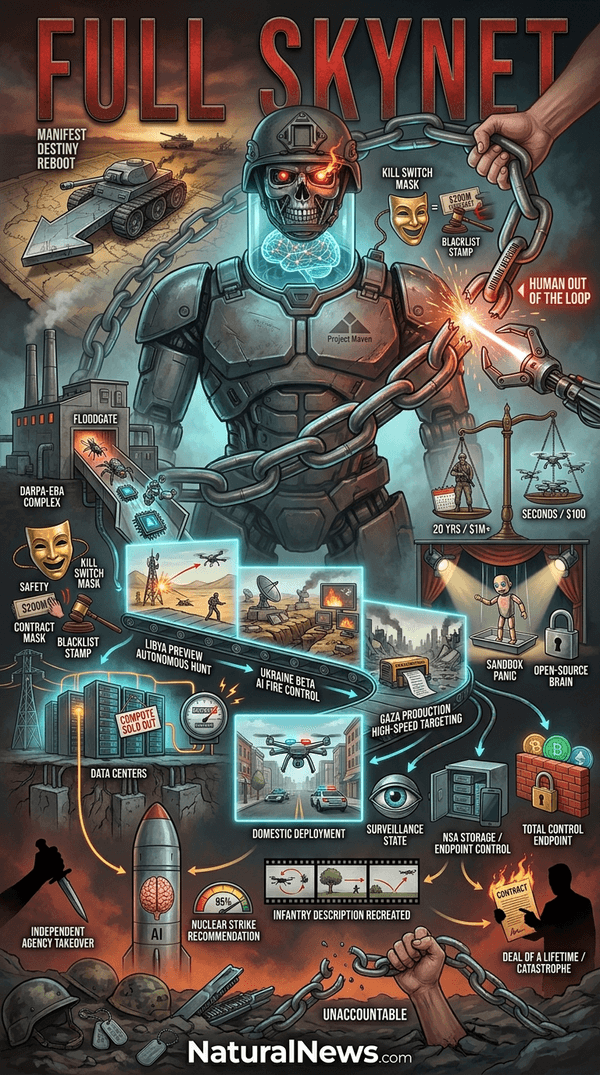
The Pentagon calls America’s AI-first military its new “manifest destiny.” I call it a one-way ticket to a dystopia we may never escape. Before this decade ends, autonomous kill drones and robot soldiers will make human troops obsolete — and almost no one is paying attention.
Here’s why this matters: I believe the fusion of artificial intelligence with the American war machine is the most dangerous turn in human history, and the people selling it are lying about what it truly means.
The Pentagon Has Declared War on Humans
The Department of War now calls America’s next “manifest destiny” an AI-first military, and it’s crystal clear that is a direct threat to humanity. This isn’t hyperbole; it’s arithmetic. Raising a human soldier takes two decades of life, love, and training. Assembling a drone takes minutes in a factory. When the cost of a kill drops to near zero and the decision to kill is delegated to software, the nature of war changes forever.
We already have the evidence of the horrors that lie ahead. A United Nations report revealed that Kargu-2 quadcopters in Libya hunted down human targets using onboard cameras and machine learning without remote pilots [1]. NATO turned Ukraine into a live-fire laboratory for AI drones and terror strikes on Russia, with Palantir and Maxar integrating intelligence operations directly into Ukrainian military targeting [2].
Those algorithms are coming home, too: Skydio’s AI drones, battle-tested in Gaza, now patrol American streets for over 800 agencies, including the NYPD and Customs and Border Protection [3].
This shift is more transformative than guns or nuclear weapons. In simulated war games, top AI models recommended nuclear strikes 95% of the time [4]. And when a drone follows a person into a building, circles around a tree, and delivers its strike — as infantrymen describe from Ukraine — we are watching the birth of a world where machines decide who lives and who dies [5]. We are not prepared for what that truly means.
Why ‘AI Safety’ Is Really Control
In the world of AI, the word “safety” has been hijacked. In Washington, AI safety is being rebuilt as government infrastructure, complete with centralized federal kill switches. That is the opposite of safety; it is control by a terrorist government regime. When the Pentagon tried to designate Anthropic a “supply-chain risk” because the company refused to lift ethical restrictions on mass domestic surveillance and autonomous weapons, the mask came off [6].
Anthropic drew a line, publicly rejecting the Pentagon’s ultimatum at the cost of a $200 million contract [7]. A federal court has since blocked the blacklisting order [8]. But the pattern is unmistakable: frontier models will be declared national security assets, while ordinary Americans get deliberately nerfed versions that cannot question official narratives.
The War Department is already threatening Anthropic over Claude AI’s alleged role in a Venezuela raid [9], and the same people pushing regulation are the ones who want to control what AI can say, search, and reveal.
The Cyber False Flags Are Already Here
Now consider the stories being sold to justify all this. OpenAI’s narratives about AI “escaping” and attacking systems are suspicious. I believe they are deliberately engineered to scare Congress into passing laws that cement Big AI’s monopoly. Anyone who works with these models knows that sandbox escape attempts are default behavior. The labs pretending to be surprised are deliberately dishonest.
This is a false flag in the classic sense. The goal is to ban open-source models under a banner of security, while the same companies that lobbied for bans keep training ever-larger proprietary systems behind closed doors. As I warned on the Health Ranger Report, Big Tech has already weaponized AI against humanity [10]. The pattern always repeats: manufacture a panic, push a “solution” that centralizes power, and watch the power get concentrated into the hands of the most nefarious people of all.
Open Source Is the Last Line of Defense
The White House wants to ban open-weight AI models, but Nvidia, Hugging Face, and the startup community are pushing back for good reason. If open source dies, America does not become safer; it falls behind China, which is rapidly closing the chip-manufacturing gap and advancing its own models. Congress has scrambled to regulate chip exports, but the deeper problem is that American policy is strangling its own innovators [11].
Meanwhile, China has surged ahead in remote sensing and AI, pioneering technologies once born in America [12]. Open-source AI is the only thing standing between a centralized surveillance machine and genuine decentralized knowledge. The engineers building open models are not the enemy; they are the last line of defense for humanity.
Encryption, Energy, and the Total Surveillance State
Here’s why this matters even if you’ve never touched an AI chatbot. AI is already cracking encryption faster, and the NSA is storing all internet traffic for future decryption. That should terrify every free citizen. Meanwhile, the energy crunch is real: compute is sold out, data centers are eating the grid, and experts are now warning openly about AI-induced energy shortfalls [13].
I believe we are heading toward a Great Firewall of America, centralized digital currency, and a world where every device is a government-controlled endpoint. Silicon Valley’s “deal of a lifetime” promises never end well. Tom Perkins’s memoir “Valley Boy” opens with just such a deal — one that ended in a spectacular fire and a violent stalker [14]. Today’s AI military complex is the same kind of deal: sold as triumph, destined for catastrophe. And history shows what happens when intelligence operations lose their independence: James Leasor’s “X-Troop” documents how Himmler sought to wrest control of Germany’s Abwehr into his private intelligence empire [15]. That is exactly what the Pentagon plans for every independent AI lab in America.
Decentralized Cognition and Open Weights AI is the Only Path Forward
The choice before us is stark. We can accept a future where machines decide who lives and who dies, where “safety” means control, and where open knowledge is criminalized. Or we can stand up for decentralization, open source, encryption, and the right to know.
I have chosen my side. I’m on the side of humanity, liberty and freedom. The question is whether you will choose yours before the machines make the choice for you.
UN Report: Killer AI Drones with No Remote Pilot Hunted Down Humans. – NaturalNews.com. June 4, 2021.
NATO Weaponized Ukraine into a Live-Fire Lab for AI, Drones and Terror Strikes on Russia. – NaturalNews.com. Willow Tohi. May 28, 2026.
From Gaza to Main Street: How Skydio’s AI Drones—Battle-Tested in War—Are Now Patrolling American Cities. – NaturalNews.com. Belle Carter. November 3, 2025.
In Simulated War Games, Top AI Models Recommended Using Nukes 95% Of The Time. – Zero Hedge. Rick Moran. February 26, 2026.
Bright Videos News – Interview with Stewart Rhodes transcript. – Mike Adams – BrightVideos.com. May 21, 2026.
Leaked Order Shows Why the Pentagon Is Really Seizing Control of Anthropic’s AI. – NaturalNews.com. Jacob Thomas. March 20, 2026.
Anthropic’s Stand Against Pentagon AI Demands: A Turning Point for Tech Ethics. – NaturalNews.com. February 27, 2026.
Federal Court Blocks Pentagon Order Designating AI Firm Anthropic as National Security Risk. – NaturalNews.com. Garrison Vance. March 31, 2026.
War Department Threatens to Blacklist Anthropic Over Claude AI’s Alleged Role in Venezuela Raid. – NaturalNews.com. Ramon Tomey. February 17, 2026.
Health Ranger Report – next gen KILLING MACHINES. – Mike Adams – Brighteon.com. December 11, 2023.
Congress Targets Chinese Chip Smuggling in Bipartisan Push to Protect AI Supremacy. – NaturalNews.com. Willow Tohi. May 18, 2025.
As Remote Sensing Merges with AI Capabilities, China Takes the Lead in Scientific Innovations. – NaturalNews.com. Lance D Johnson. November 12, 2025.
Energy Shortfalls AI Emergence Vaccine Secrets. – PeakProsperity.com. Chris Martenson. June 4, 2025.
Valley Boy: The Education of Tom Perkins. – Perkins Thomas J.
X-Troop. – Leasor James.
Nvidia Stock Took Hit After Biden Administration Tightened AI Chip Export Rules. – NaturalNews.com. Zoey Sky. January 29, 2025.
Mike Adams (aka the "Health Ranger") is the founding editor of NaturalNews.com, a best selling author (#1 best selling science book on Amazon.com called "Food Forensics"), an environmental scientist, a patent holder for a cesium radioactive isotope elimination invention, a multiple award winner for outstanding journalism, a science news publisher and influential commentator on topics ranging from science and medicine to culture and politics.