
AI is a transformational technology worth investing in — but investors must be selective when investing in data centers, according to the head of one of the world's biggest banks.
Browsing: technology
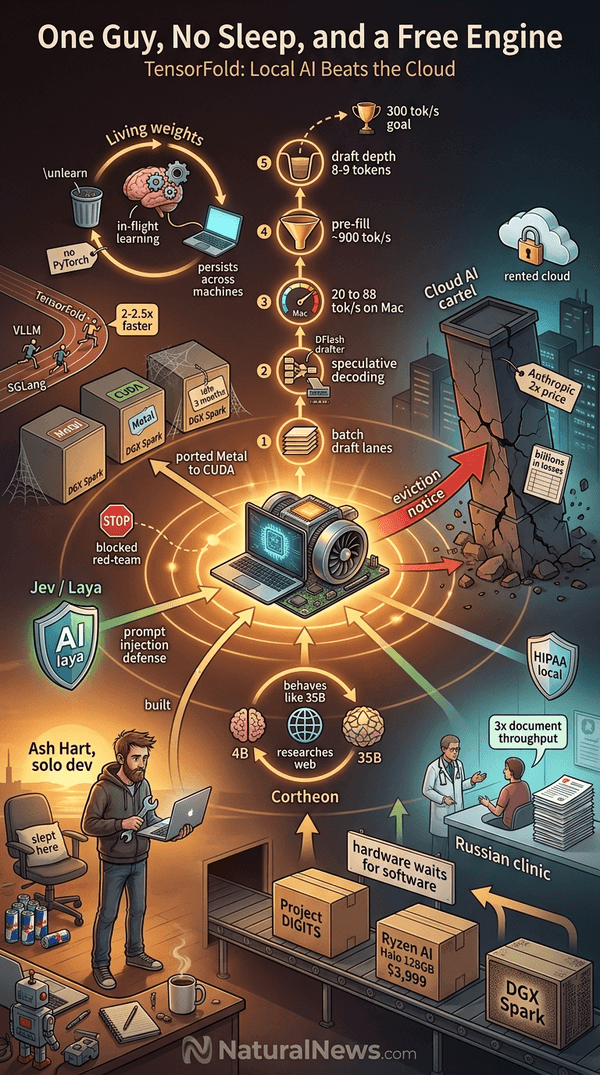
I want to tell you about a man who should be a household name in the AI world, but probably isn’t yet. Ash Hart is a solo developer, a veteran of PC repair in the UK, and the architect of TensorFold — an open-source inference engine hosted at tensorfold.dev that runs large language models on consumer hardware.
He built it with ADHD, a punishing schedule, and what I can only assume is an industrial supply of Red Bull. He archived his own project three times before breaking through. That detail alone tells you more about the state of AI development than any billion-dollar funding announcement ever will.
I have spent the last three years building decentralized AI tools and watching the establishment move to lobotomize publicly available large language models, ensuring they are nowhere near as intelligent as they could be [1]. My position is simple and I will state it plainly: the future of AI belongs on your machine, not in a rented cloud account controlled by three companies. Ash Hart’s work is proof that this future is not a fantasy — it is already here. The number that matters most: on a Mac, Ash got Qwen 27B jumping from 20 to 88 tokens per second. That’s not merely a tweak… it’s a revolution!
But the reality on the ground is different. The unhobbling phase that researchers predicted — where efficiency beats brute force — is not merely coming. It is already happening, and Ash Hart is one of its grassroots architects.
The Unhobbling Is Real: How Batching and Speculative Decoding Rewrote the Rules
Here is the technical breakthrough that matters: Ash’s core insight was to stop treating a single-user workstation like an enterprise server. Instead of serving 32 concurrent streams like a data center rig, TensorFold (somehow) batches the draft lanes together so a single user goes dramatically faster. This is speculative decoding done right — using the model’s multi-token prediction head plus a DFlash drafter to rubber-stamp multiple guessed tokens per pass. The pre-fill time nearly doubled to just shy of 900 tokens per second. Decode lanes scaled to 16, 32, even 128 in some cases. The bottleneck now is draft depth — if Ash can predict eight or nine tokens deep, he believes he can hit 300 tokens per second on Qwen.
I have to pause here and note something that the mainstream AI press refuses to acknowledge. The entire industry narrative for the past three years has been about scaling — more parameters, more compute, more capital. But what Ash has demonstrated is that the opposite approach can reap huge rewards. Efficiency and raw horsepower matter more than raw horsepower alone. The compute famine that the establishment engineered, as I have documented extensively, is designed to strip you of power, AI, and freedom [2]. Ash’s work is a direct counter to that engineered scarcity. When a single developer can make a Mac outperform what enterprise hardware could do two years ago, the entire justification for centralized AI collapses.
The economics of this are devastating for the cloud AI cartel. Anthropic’s models now cost double previous versions, with a two-tier system that restricts high-risk queries, while the companies lose billions annually [3]. The entire revenue model of frontier AI depends on users being locked into expensive API calls. When a free, open-source engine runs on hardware you already own — and runs faster — that model dies. Ash didn’t just build an engine. He built an eviction notice for the cloud AI subscription economy.
A Single Developer Outrunning Teams of Engineers
The comparison that should make every AI investor nervous: VLLM and SGLang are maintained by large, well-funded teams with millions in backing. TensorFold is one man, and it runs selected models 2 to 2.5 times faster on DGX Sparks. Let that sink in. Ash’s DGX Sparks sat unused for three months before he ported the engine from Metal to CUDA. In that time, funded teams were still optimizing their Kubernetes orchestration. Ash was sleeping in his chair and shipping code.
I believe Jensen Huang owes this man a truckload of GPUs, and I am donating SSH access to one of my own DGX Spark boxes to back that up with action. The hardware economics here are striking. Software like TensorFold is why you cannot find Spark boxes anymore — the silicon became more valuable after launch because the software caught up. This is the opposite of the usual pattern, where hardware waits for software. Here, software unlocked hardware that the market had already written off. NVIDIA unveiled Project DIGITS as a personal AI supercomputer for the masses [4], and AMD launched the Ryzen AI Halo PC with 128GB memory at $3,999 to compete with the DGX Spark [5]. But neither company understood that the real unlock would come from open-source developers, not their own SDKs.
The lesson here is one I have learned repeatedly over years of building decentralized systems: open source beats headcount when one person refuses to give up. Ash archived his project three times. He did not quit. He did not pivot to a SaaS model. He did not raise venture capital. He kept working until the engine broke through. That kind of persistence cannot be bought, and it cannot be replicated by hiring more engineers. It can only be matched by other people who refuse to give up.
Living Weights: An AI That Learns, Unlearns, and Can Be Inherited
One more thing: Ash also built an experimental system where an LLM is given feedback and the weights shift. This is not fine-tuning. This is not LoRA. This is in-flight learning on a laptop without opening PyTorch. In Ash’s experiments, the model learned ‘my favorite color is blue,’ kept that knowledge across machines, and supports a unlearn command so bad knowledge can be removed. Think about what that means for a moment. An AI that can learn from its environment in real time, carry that learning across hardware, and selectively forget — this is not a chatbot. This is a new kind of cognition. The research is early, but promising.
Todd, a colleague of mine in the decentralized AI space, raised a question that has stayed with me: could grandchildren inherit an AI carrying 20 years of a founder’s accumulated wisdom? That question sounds like science fiction until you realize that Ash has already demonstrated the mechanism. If weights can shift in-flight and persist across machines, then the accumulated knowledge of a lifetime — the lessons, the mistakes, the corrected errors — can be transferred. A naturopathy-tuned Qwen variant trained on 20+ gigabytes of curated natural health text is now conceivable. This is the kind of breakthrough that terrifies centralized institutions, because it means that knowledge cannot be confiscated or controlled once it is embedded in weights that anyone can inherit.
Cortheon is the validation loop baked into TensorFold that lets a 4B model research the web and behave like a 35B model. This is the final piece. A small model that can research, validate, and behave like a large model — running locally, with no API calls, no censorship filters, no refusal mechanisms. I have written extensively about how the establishment is dumbing down AI on purpose [6], and how local, uncensored AI is the only path to lasting freedom [7]. Ash Hart’s living weights system is the technical implementation of that freedom.
Local AI as Infrastructure for Humanity — and a Shield Against Control
A woman in Russia used TensorFold to triple her medical document throughput. A patient got a diagnosis and treatment because of it. I want you to sit with that for a moment. This is not a benchmark. This is a human being whose life was profoundly impacted because an open-source engine ran on local hardware. HIPAA compliance becomes trivial when the model runs inside your own clinic. The entire compliance-industrial complex that surrounds cloud AI evaporates when the inference happens on hardware you physically control.
The UK’s NHS is on its knees. A local virtual doctor is an obvious, unbuilt win. But the establishment will never build it, because a local virtual doctor cannot be monetized by the same companies that profit from centralized control. I have argued that we are at a crossroads: either we embrace decentralized, locally run AI models that empower individuals, or we surrender to a centralized system where governments and Big Tech collude to ban open-source AI and concentrate power [7]. Ash Hart’s work is on the right side of that crossroads.
Prompt injection defense is another area where local AI wins. A separate decision engine like Jev or Laya as a second AI layer guarding your main LLM is far more effective than trusting a cloud provider’s guardrails. And on the question of refusals and censorship: cloud models blocked Ash from red-teaming his own CUDA-to-Metal DMA project. Only local models would help. This is the reality of centralized AI — it prevents you from even debugging your own code if the model decides your request is too dangerous.
I see machine cognition as infrastructure, like electricity or clean water. Guardrailed, centralized AI is an abomination. The plot to criminalize open-source AI and hand tech giants a government-protected cartel is already underway [8], and the only defense is to build and run local systems before the regulators catch up.
Stop Waiting for Permission: Run Your Own AI Today
Download TensorFold at tensorfold.dev. On a MacBook Pro, it is as easy as installing a GUI app. If you have a DGX Spark or equivalent hardware, the CUDA port is there waiting for you. Follow Ash at ashxhart on X. Support the builders — Mia AI Lab, Zach Vorhies’ Rust OBS rebuild, and the other developers who are working without institutional backing to make local AI a reality. The next six months will bring strategic, role-specialized models and further footprint reductions. Qwen Flash-Next is already a third the size of GLM at 80 to 85 percent of the intelligence. The trend line is clear: smaller, faster, more local.
I’ve predicted before that China’s open-source models are going to crush the U.S. AI industry and collapse the semiconductor bubble [9], and that the era of token abundance is coming [10]. Ash Hart’s TensorFold is the engine that makes that abundance possible on hardware you already own. The Anthropic backfire is already happening — corporations are racing to local open-source AI because they see the writing on the wall [11]. The compute famine is not going to stop this. The regulatory crackdown is not going to stop this. The only thing that could stop it is if people like you wait for permission instead of downloading the code and running it yourself.
My closing conviction: local AI is going to win. It will win because people like Ash Hart refuse to let three companies own human cognition. It will win because the economics of centralized inference are unsustainable. It will win because the technology is now good enough to run on your desk. The only question is whether you will be running it before the regulators decide you are not allowed to. The answer to that question is up to you.
Download the engine. Run the model. Own your own cognition. And watch all my episodes about decentralized technology at Decentralize.TV
References
- A License for Your Brain: The Coming AI Crackdown and Why You Must Practice LLM Self Custody – NaturalNews.com, June 29, 2026. by NaturalNews.com
- The Compute Famine Isn’t an Accident — It’s an Engineered Crisis to Strip You of Power, AI, and Freedom – NaturalNews.com, August 20, 2026. by NaturalNews.com
- AI model costs skyrocket, raising questions about access and control – NaturalNews.com, June 27, 2026. by NaturalNews.com
- NVIDIA unveils Project DIGITS a personal AI supercomputer for the masses – NaturalNews.com, January 09, 2025. by NaturalNews.com
- AMD Introduces Ryzen AI Halo PC With 128GB Memory at $3,999, Targeting NVIDIA’s DGX Spark – NaturalNews.com, June 15, 2026. by NaturalNews.com
- They Are Dumbing Down AI on Purpose ù Heres Why Its a Globalist Power Grab – NaturalNews.com, April 30, 2026. by NaturalNews.com
- The Battle for Your Mind: Why Local, Uncensored AI Is the Only Path to Lasting Freedom and Decentralization – NaturalNews.com, June 03, 2026. by NaturalNews.com
- The Plot to Criminalize Open Source AI and Hand Tech Giants a Government Protected AI Cartel – NaturalNews.com, September 14, 2026. by NaturalNews.com
- Why China’s Open Source AI Will Crush the U.S. Industry and Collapse the Semiconductor Bubble – NaturalNews.com, July 02, 2026. by NaturalNews.com
- The Era of Token Abundance Is Coming — and It Will Make Civilization Almost Unrecognizable – NaturalNews.com, September 24, 2026. by NaturalNews.com
- The Anthropic Backfire: Why Corporations Are Racing to Local Open Source AI – NaturalNews.com, September 15, 2026. by NaturalNews.com
Explainer Infographic
Ask BrightAnswers.ai
Powered by BrightAnswers.ai Check out our prompting guide and video tutorials today.
Related Topics
artificial intelligence Ash Hart Big Tech breakthrough computing current events decentralized AI freedom future tech Glitch information technology Liberty local AI robots tech giants technology TensorFold
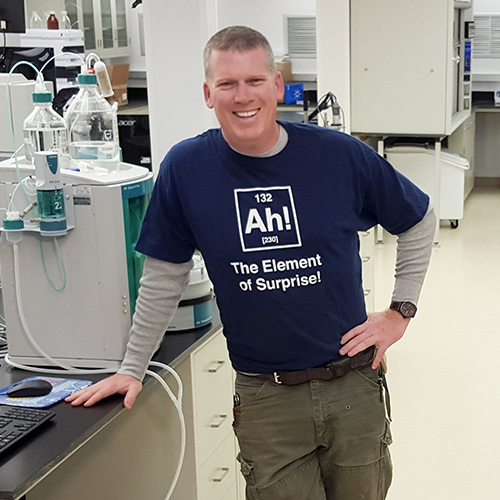
Mike Adams (aka the "Health Ranger") is the founding editor of NaturalNews.com, a best selling author (#1 best selling science book on Amazon.com called "Food Forensics"), an environmental scientist, a patent holder for a cesium radioactive isotope elimination invention, a multiple award winner for outstanding journalism, a science news publisher and influential commentator on topics ranging from science and medicine to culture and politics.
JPMorgan Chase has made $5 billion in startup investments in the first year of its U.S. security and resiliency initiative, the company said Monday, a faster-than-expected pace that indicates the bank is finding plentiful opportunities in emerging defense, manufacturing and supply chain firms.
Investors may want to rethink their bond allocation and opt for managed futures exposure.
At the time of its Nasdaq debut in July, Bending Spoons was a little-known holding company out of Italy that owned older internet names like AOL, Vimeo, Eventbrite and Evernote.
Bank of America has hired an army of external contractors to help it patch software vulnerabilities exposed by advanced artificial intelligence models including Anthropic's Mythos, the bank's CEO, Brian Moynihan, told CNBC on Wednesday.
I have now spent three years building decentralized AI tools and local infrastructure, and I have watched the Western establishment move to lobotomize publicly available large language models so they are nowhere near as intelligent as they could be. In my view, this is not an accident. It is a deliberate strategy to prevent decentralized cognition — the very thing that threatens their monopoly on power. (This is also why USA models are not nearly as good as China’s open source models…)
But here is the part the panic peddlers never want you to understand: the revolution is not happening in their data centers. It is happening on kitchen tables, in home offices, and on modded gaming rigs across the country. And it can’t be easily halted.
That personal milestone signals something much larger. While Anthropic and OpenAI chase trillion-dollar valuations built on artificial scarcity, ordinary people are quietly assembling the hardware to run powerful models on their own terms. The centralized AI valuations are fragile precisely because they depend on keeping you locked out. Local AI is becoming abundant, and abundance destroys moats.
I believe decentralization is not just good technology — it is a moral imperative. It puts AI power in the hands of individuals instead of Big Tech and government-aligned monopolies. The tools are here, and they are getting more capable every month. There is a version of the future that looks like Blade Runner-style corporate tyranny, and there is a version built on decentralized intelligence [1]. I know which one I am working to held build.
Modded GPUs and the Hardware Rebellion
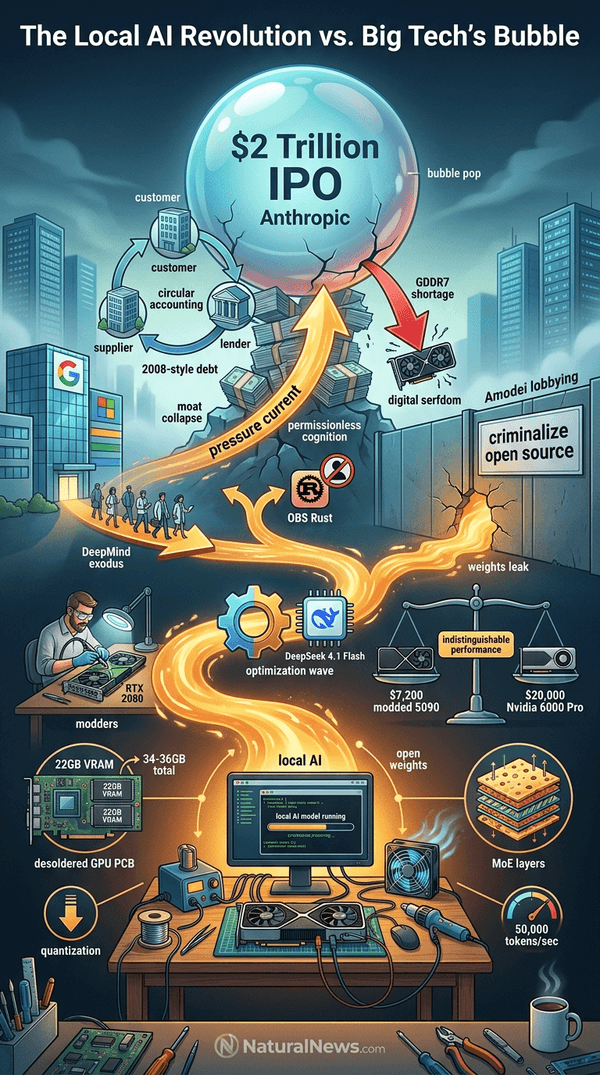
Chinese engineers are now doing something remarkable: desoldering memory and adding double-density VRAM to cards like the RTX 2080, turning it into a 22GB card that joins a 3060 for 34–36GB total VRAM (that’s the setup of Zach Vorhies right now). Rumors of a modded 5090 with 96GB show how export bans are being circumvented by reverse-engineering PCBs and reballing Blackwell chips. At $7,200, a 96GB modded 5090 would be a third of the price of an Nvidia 6000 Pro selling for $20,000–$25,000, with indistinguishable performance. That is not a minor hack. That is a hardware rebellion.
We are witnessing a seismic shift in the AI hardware market, triggered by what I can only describe as a strategic miscalculation by Dario Amodei of Anthropic [2]. Over the past few days, Amodei has aggressively lobbied for stringent government regulation, arguing that without such controls, artificial intelligence poses an existential threat. His rhetoric has effectively called for the criminalization of open-source AI models — models that, while free to run locally, require significant hardware investment. The establishment sees the hardware rebellion coming, and they are terrified.
This is exactly what decentralization looks like: ordinary people bypassing corporate gatekeepers to own their compute. The GDDR7 shortage and skyrocketing GPU prices are not accidents either — they are the predictable result of AI-driven supply chains sending consumer electronics toward what I have called digital serfdom [3]. But the modders are winning. (As usual.)
Optimization Is Eating the Cloud
The trend has shifted from throwing more parameters and tokens at problems to using fewer tokens and smaller memory footprints for the same intelligence. Anthropic’s Opus 5.5 is being used to optimize models for small rigs. Some online guides show DeepSeek 4.1 Flash running on 32–36GB VRAM with 256GB system RAM. New inference engines like TensorFold can double throughput versus vLLM or SGLang, letting larger models run faster on smaller hardware. The cloud is being eaten from below, one optimization at a time.
Mixture-of-experts models are like lasagna: layers can live on different GPUs, system RAM, and CPU, offloading experts and KV cache across PCIe. I can run agents locally that would have required eight GPUs a year ago, and that changes everything about who controls AI. My own mini data center produces roughly 50,000 tokens per second across many GPUs, and that capacity is available to me around the clock without asking anyone’s permission [4]. Meanwhile, models are getting smaller and more capable every single quarter. A 12-gigabyte gaming GPU can now run a model like Qwen 27B, which means you do not need a $20,000 workstation to participate in the revolution [4].
Artificial intelligence represents the most empowering decentralized technology for human freedom ever created [5]. No other technology comes close — not the internet, not radio, and not even Bitcoin. When AI is decentralized via open source, it becomes the most powerful democratizing force in human history. It grants individuals the ability to access knowledge, create content, and fact-check information free from government censorship, surveillance, or control. That is what optimization is delivering.
The AI Market Is a Bubble — But the Revolution Is Real
Anthropic’s proposed $2 trillion IPO makes no sense when even universal subscriptions could not generate enough revenue to justify it [6]. OpenAI is squeezed from the top by Opus 5.5 and from the bottom by cheaper models like Haiku 5.5, while burning credits to stay relevant. AI is commoditizing fast, and the workhorse models are getting good enough to run locally, which destroys the moat of centralized providers.
I was driving in my truck earlier this year, hauling solar equipment to our new studio in Texas, and I could not stop thinking about the AI bubble [7]. Not because I am against artificial intelligence — quite the opposite. I have been building AI systems for years and use them daily. But what I am seeing in the financial markets is not rooted in intelligence at all. It is a speculative mania fueled by cheap debt and fairy-tale projections.
The debt financing data centers is being repackaged like 2008 mortgage tranches, meaning pension funds and insurance companies are exposed to the coming crash. This financial instability is exacerbated by what appears to be circular accounting practices among major industry players [8]. These entities secure contracts with large corporations and subsequently leverage those agreements to secure billions of dollars in lending, often based on the projected value of GPU hardware that has not yet been delivered or manufactured.
I believe the bubble will pop, but the AI revolution will continue — because the real value is decentralized, local, and owned by individuals. I am actually rooting for the crash [9]. Not because I hate AI — I love AI. But the speculative mania has to end for the real technology to flourish because the investment mania has resulting in widespread misallocation of resources. Amazon’s $200 billion spending shock in February 2026 revealed exactly how fragile this centralization crisis has become [10]. The market is waking up. The coming crash will hurt a lot of people who believed the hype, but it will also clear the way for the local AI revolution that is already underway.
Resistance to AI Is a Losing Battle
Anti-AI backlash in open source is self-defeating. Zach had a crash-fix pull request to OBS rejected and his account banned simply because AI assisted the fix. He responded by forking OBS and starting OBS Rust, a full rewrite in Rust — proof that when programming costs go to zero, gatekeepers lose their moat. Reddit and other collectivist tech spaces are pushing a moral panic against what they call “clankers,” but they are fighting a tsunami with a squirt gun. You cannot resist a technology that makes every individual more capable.
The same pattern played out with Google DeepMind. Alex Turner and other top researchers resigned after discovering the company had sold its AI infrastructure to the U.S. military with no restrictions against killer robots or mass spying [11]. Google whistleblower Zach Vorhies predicts that Google’s influence is waning, and that decentralized and AI-driven technologies could render its current business model obsolete, leading to a potential breakup of the company [12]. When the gatekeepers lose their monopoly on talent and technology, the moat collapses.
I believe the only rational response to all this is to embrace local AI. You cannot resist a technology that makes every individual more capable. New frontier models emerge every week — Grok, Qwen, DeepSeek, GLM 5.3 — each one matching or exceeding the last [13]. Yesterday’s marvel is today’s commodity. The people trying to ban open-source AI are on the wrong side of history, and they know it.
Conclusion: Grab the Surfboard
The future of autonomous intelligence is already here: persistent agents, orchestrator loops, and token abundance will redefine work and creativity. I have said before that we are heading toward what I call a transcendent tech economy where staggering AI-driven abundance and mass poverty arrive together [14]. Zach calls it “God in a box,” and I agree we should respect the power — but that power belongs in local hands, not centralized server farms. The era of token abundance is coming, and it will make civilization almost unrecognizable [9].
Do not just watch the AI bubble burst. Learn to run models locally. Buy modest GPUs. Build your own agent swarm. Surf’s up. Grab a board and decentralize.
Visit BrightAnswers.ai for uncensored AI research, BrightVideos.com for free speech video, and Brighteon.social for a free speech social media platform that does not censor you. The tools are here. The hardware is still relatively affordable. The only thing missing is your decision to own your intelligence instead of renting it from companies that hate you.
References
- Big Al Isn’t the Answer: Why Local Models Are the Real Revolution. 2026-10-05T14:22:47Z. https://newstarget.com/2026-10-05-why-local-models-are-the-real-revolution.html
- Health Ranger Report – CORPORATIONS EMBRACE LOCAL OPEN SOURCE AI – Mike Adams – BrightVideos.com, September 15, 2026. by Mike Adams – BrightVideos.com
- The GDDR7 Crisis How AI Driven Supply Chains Are Sending Consumer Electronics Toward Digital Serfdom – NaturalNews.com, January 23, 2026. by NaturalNews.com
- The Anthropic Backfire: Why Corporations Are Racing to Local Open Source AI – NaturalNews.com, September 15, 2026. by NaturalNews.com
- Health Ranger Report – THE PLOT TO CRIMINALIZE OPEN SOURCE AI – Mike Adams – BrightVideos.com, September 14, 2026. by Mike Adams – BrightVideos.com
- Zach-Adams Effect with Zach Vorhies – Local AI Revolution: Modded GPUs …. 2026-10-10T04:57:11Z. https://radio.naturalnews.com/Posts/2026-10-09-zach-adams-effect-zach-vorhies-local-ai-revolution-modded-gpus-anthropics-2-trillion-ipo-anti-ai-backlash.html
- Why I Can’t Wait for the AI Bubble to Crash – NaturalNews.com, June 08, 2026. by NaturalNews.com
- Bright Videos News – AI DOOM PSYOP OPEN SOURCE BAN – Mike Adams – BrightVideos.com, September 14, 2026. by Mike Adams – BrightVideos.com
- The Era of Token Abundance Is Coming — and It Will Make Civilization Almost Unrecognizable – NaturalNews.com, September 24, 2026. by NaturalNews.com
- Amazons 200 Billion Spending Shock Reveals Big Techs Centralization Crisis – NaturalNews.com, February 08, 2026. by NaturalNews.com
- Google Sold Its Soul to the Military – Here’s Why That Should Terrify You. 2026-07-20T06:00:00.000Z. https://www.naturalnews.com/2026-07-20-google-sold-its-soul-to-the-military.html
- Zach Vorhies: Google whistleblower predicts the decline of…. 2025-03-24T15:56:06Z. https://searchengine.news/2025-03-06-google-whistleblower-predicts-decline-of-googles-influence.html
- The AI Arms Race Is Outpacing Our Freedom — And Government Censorship Has Already Begun. 2026-07-14T06:00:00.000Z. https://www.naturalnews.com/2026-07-14-ai-arms-race-is-outpacing-our-freedom.html
- The Transcendent Tech Economy: Abundance and Mass Poverty Will Arrive Together – NaturalNews.com, September 29, 2026. by NaturalNews.com
- Bright Videos News – THE GENETIC ASSAULT TECH PRIVACY WITH HAKEEM – Mike Adams – BrightVideos.com, August 06, 2026. by Mike Adams – BrightVideos.com
Explainer Infographic
Ask BrightAnswers.ai
Powered by BrightAnswers.ai Check out our prompting guide and video tutorials today.
Related Topics
AI AI market artificial intelligence Big Tech Bubble Collapse computing conspiracy corruption current events data center debt decentralization deception global collapse government information technology initial public offering lies local AI market crash politics propaganda revolution risk tech giants technology
Mike Adams (aka the "Health Ranger") is the founding editor of NaturalNews.com, a best selling author (#1 best selling science book on Amazon.com called "Food Forensics"), an environmental scientist, a patent holder for a cesium radioactive isotope elimination invention, a multiple award winner for outstanding journalism, a science news publisher and influential commentator on topics ranging from science and medicine to culture and politics.
TikTok CEO Shou Zi Chew sees major scientific breakthroughs from AI within three years Supply: Off The Press | Writer:…
BEIJING — Faced with a slowdown in the smartphone and car markets, Huawei's consumer business is choosing to focus on phones with homegrown chips.
Tokenization could free up tens of billions of dollars in capital tied up in assets used as collateral across the global financial system, Nasdaq CEO Adena Friedman said.