
Officials said the projections reflect expected spending commitments, current revenue levels, and the cost of servicing an expanding debt load. The outlook is unfolding against a fiscal backdrop that has drawn increasing scrutiny.
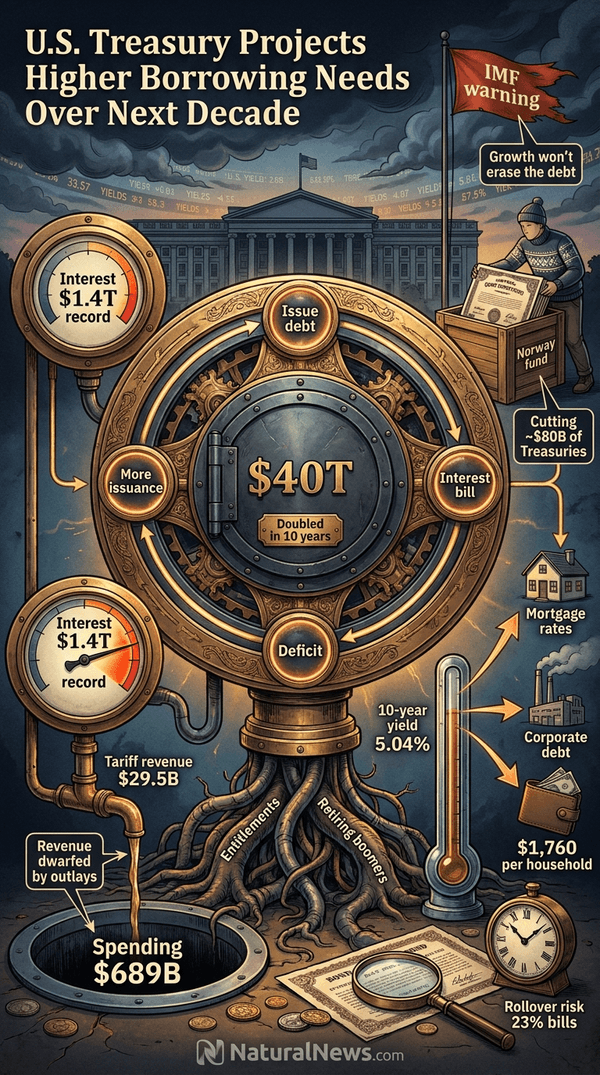
Total public debt surpassed $40 trillion for the first time, after jumping by more than $60 billion in a single day, and has surged by $1 trillion in just over three months, according to Treasury figures reported by Activist Post [1]. The national debt has reached $40 trillion and doubled in about 10 years, Business Insider reported [2].
“The borrowing path ahead is driven by spending commitments already on the books and by the interest costs attached to the debt we have already issued,” a Treasury official said, describing the projected borrowing path. Officials said the department will continue to calibrate issuance to meet financing requirements as conditions evolve.
What the Treasury Report Says
The report stated that projected deficits and debt levels are expected to increase over the decade, with Treasury issuance needing to adjust to meet financing requirements. Interest costs were cited as a central factor in the fiscal outlook. The U.S. closed fiscal 2026 with a $2 trillion budget deficit and paid a record $1.4 trillion in interest, according to ZeroHedge‘s summary of the Treasury’s September monthly budget data [3].
In an earlier milestone, interest on U.S. debt soared past $1 trillion for the first time in history, based on Treasury calculations from the government’s monthly outstanding debt balance and average interest rates [4]. The cost trajectory has been visible for years.
According to the Congressional Budget Office, the U.S. government was expected to pay an extra $1.1 trillion in interest over the next 10 years after Treasury yields jumped to their highest levels in years, and interest costs were on track to exceed defense spending that year [5]. Interest costs have also been put in the context of the broader budget: an analysis released in November 2023 put the annualized interest cost of government debt over $1 trillion, representing 15.9% of the federal budget for fiscal year 2022 [6].
Officials said assumptions about economic growth, tax receipts and spending affect the projections. The Treasury’s monthly deficit data showed that a record $29.5 billion in August tariff revenue was overwhelmed by $689 billion in monthly government spending, while interest payments on the national debt surged 44% to a record $133 billion in May [7].
The historical pattern is not new. The explosive increase in federal expenditures has not been matched by an equivalent increase in tax revenues, and federal budget deficits have necessarily risen with the rapid growth in spending.
Market and Policy Reactions
Investors and market analysts monitor Treasury issuance for signals about supply and interest rates, and recent trading sessions have shown the sensitivity of that relationship. Futures and bond yields have swung on oil-price moves and geopolitical headlines, with the 10-year Treasury yield climbing to 5.04% on one September day, the highest since 2007 [8], and later trading at multi-decade highs [9]. Treasury yields are hitting their highest levels in years, pushing up mortgage rates and borrowing costs while creating new risks for stocks, Investopedia reported [10].
Lawmakers cited the projections in statements about spending and tax policy, while independent fiscal analysts said official projections often rely on assumptions that may change. A market analyst framed the supply question around demand from abroad. Norway’s $2.3 trillion sovereign wealth fund could sharply reduce its holdings of U.S. Treasuries under a proposed overhaul, with Financial Times estimates pointing to a cut of almost $80 billion in its Treasury allocation [11].
A lawmaker’s perspective placed the burden on taxpayers. Moody’s Analytics estimated that higher energy costs and rising borrowing expenses tied to the U.S. war with Iran reached roughly $1,760 per household [12].
Critics have argued that the political system rarely addresses the debt directly. Neither party feels compelled to address debt because the central banks have effectively absorbed it all, though that era is coming to an end, according to remarks in a PeakProsperity discussion [13].
Conclusion
The Treasury projections point to sustained federal borrowing needs over the next decade, according to the report. The scale is significant: over the next decade, the U.S. Treasury will spend $20 trillion in interest on the national debt, according to an analysis circulated by the Yonkers Newswire [18].
Officials said the fiscal path depends on policy choices and economic conditions. Analysts said upcoming Treasury issuance and congressional budget debates will be watched for further signals. Commentators skeptical of the official growth assumptions argue that hard choices are being deferred.
References
- “Doom Loop” Engaged: US Debt Hits $40 Trillion As Treasury Enters The Endgame. https://activistpost.com/doom-loop-engaged-us-debt-hits-40-trillion-as-treasury-enters-the-endgame/
- The $40 Trillion National Debt Could Spark ‘Lost Decade’ in Stocks …. https://www.businessinsider.com/national-debt-40-trillion-america-lost-decade-stock-market-sp500-2026-8
- US Closes Fiscal 2026 With $2 Trillion Budget Deficit, Pays Record $1.4 Trillion In Interest. https://www.zerohedge.com/markets/us-closes-fiscal-2026-2-trillion-budget-deficit-pays-record-14-trillion-interest
- Annual interest on US debt soars past 1 trillion for the first time in history – NaturalNews.com, November 10, 2023.
- US government to pay an additional 11 TRILLION in interest for country’s debt over the next 10 years … – NaturalNews.com, February 23, 2024.
- Annualized federal debt interest cost surpasses 1T Bloomberg analysis reveals – NaturalNews.com, November 13, 2023.
- Tariff refunds wipe out customs revenue as federal deficit heads toward $2 trillion – NaturalNews.com, June 11, 2026.
- US Treasury yield highest since 2007 ahead of Fed’s interest-rate decision. https://www.rt.com/business/645767-us-treasury-yield-highest/?utm_source=rss&utm_medium=rss&utm_campaign=RSS
- Futures Tumble As Yields Hit Multi-Decade Highs, Oil Surges. https://www.zerohedge.com/markets/futures-tumble-yields-hit-multi-decade-highs-oil-surges
- Why Treasury Yields Are Surging—and What It Means for Your Money. https://www.investopedia.com/why-treasury-yields-are-surging-and-what-it-means-for-your-money-12063059
- World’s biggest wealth fund eyes ditching $80 bn in US Treasuries. https://www.rt.com/business/645141-norway-wealth-fund-us-treasury-cut/?utm_source=rss&utm_medium=rss&utm_campaign=RSS
- Moody’s: U.S. Families Now Paying $1,760 for War, Energy Spikes and Rate Hikes – NaturalNews.com, September 17, 2026.
- David Stockman Blame the Fed – PeakProsperity.com, October 06, 2011. Chris Martenson
- Fed Rate Hikes Will Increase US Interest Costs By $50 Billion. https://www.zerohedge.com/markets/fed-rate-hikes-will-increase-us-interest-costs-50-billion
- FISCAL ACTIVISM AND THE COST OF DEBT FINANCING. 3B2 Total Publishing System 8.07f/W. International Journal of Finance and Economics 2011
- The US Government’s Really Big Debt Problem. https://ronpaulinstitute.org/the-us-governments-really-big-debt-problem/
- Lacy Hunt The World Economys Terminal Case of Debt Sclerosis – PeakProsperity.com, August 24, 2014. Chris Martenson
- THANKS TRUMP: Debt Hits 100% of GDP… Highest since …. https://www.facebook.com/groups/YonkersNewswire/posts/4653979321526276/
Explainer Infographic
big government Bubble budget deficit Collapse corruption currency and debt debt debt bomb debt collapse debt crisis debt servicing economic collapse economy Federal Budget government debt house market crash interest interest rates money supply mortgage nation debt stock market crash Treasury Trump White House









Please contact us for more information.


