Russia conducted live-fire missile drills in the southern Kuril Islands, destroying simulated targets at a range of 300 kilometers.
The exercises came a week after President Putin’s first-ever visit to Iturup, which Japan formally protested as “absolutely unacceptable.”
Russia summoned Japan’s ambassador and declared its sovereignty over the islands “absolutely unshakable,” rejecting Tokyo’s claims as unlawful.
Japan’s foreign minister said Tokyo “cannot tolerate” Russia’s military buildup and lodged a protest over the large-scale maneuvers.
The decades-long Kuril Islands dispute remains the key obstacle to a peace treaty, now further strained by Japan’s sanctions over Ukraine.
Russia’s Pacific Fleet destroyed simulated enemy targets at a range of around 300 kilometers in the southern Kuril Islands, escalating tensions with Japan roughly a week after President Vladimir Putin’s unprecedented visit to the contested archipelago.
The live-fire exercise Thursday involved the Varyag guided-missile cruiser, the Omsk nuclear-powered submarine, and a Bastion coastal missile battery, Russia’s Pacific Fleet said in a statement. Naval aviation supplied targeting data, and the fleet said all targets were destroyed.
The drills came one week after Japan lodged a formal protest over Putin’s first-ever visit to Iturup, the largest of the four southernmost Kuril Islands that Tokyo claims as its “Northern Territories.” Japanese Prime Minister Sanae Takaichi called the trip “absolutely unacceptable” and said it “hurts the feelings of the Japanese people.”
Ambassador summoned as rhetoric hardens
On Tuesday, Russia’s Foreign Ministry summoned Japanese Ambassador Akira Muto for an approximately 20-minute meeting with Deputy Foreign Minister Mikhail Galuzin. Galuzin told Muto that “Russia’s sovereignty and jurisdiction over the southern Kuril Islands are absolutely unshakable,” adding that the territories passed to the Soviet Union after World War II under agreements among the Allied Powers and the U.N. Charter. Any attempt by Japan to question that, he said, is “absolutely unacceptable and unlawful.” Russia’s Foreign Ministry separately issued a statement using similar language, calling Japan’s position “categorically unacceptable and illegitimate.”
The Japanese Embassy confirmed Muto “appropriately explained the Japanese position on the Northern Territories and President Putin’s recent visit” but declined to detail his response to Galuzin’s remarks.
Tokyo says it won’t tolerate a Russian military buildup
Japanese Foreign Minister Toshimitsu Motegi responded to the missile tests by telling reporters that Tokyo “cannot tolerate moves [by Russia] to strengthen military power on the Four Northern Islands because they go against our country’s stance.”
Japan received advance notice of the drills and lodged a formal protest against the large-scale maneuvers on August 5. Russian state media reported the exercises involve approximately 60 surface ships, submarines and support vessels, along with about 30 aircraft and unmanned systems, and more than 13,000 personnel. The drills are scheduled to run through August 29.
Putin observed portions of the exercises on August 12 from the Varyag as part of his trip to the disputed islands and Sakhalin. Speaking aboard the flagship, he warned that the region is “unfortunately becoming increasingly prone to conflict, with NATO seeking to gain a foothold here and the emergence of new military and political blocs.”
A World War II dispute still blocking a peace treaty
The Kurils run from Russia’s Kamchatka Peninsula down to Japan’s Hokkaido and fell under Soviet control after Japan’s 1945 defeat. Japan continues to claim Iturup, Kunashir, Shikotan and the Habomai islets as its own territory. Eight decades later, the dispute is still the single biggest obstacle to a formal peace treaty between the two countries.
Galuzin told Muto that given Tokyo’s adherence to Western sanctions and its continued support for Kiev, “Moscow reserves the right to take appropriate countermeasures.” It’s a pointed reminder of how far the Ukraine conflict’s fallout has traveled — straining a totally unrelated territorial dispute on the other side of the globe, and giving Moscow one more grievance to hold against Washington’s allies. Putin, for his part, noted that Japan once maintained warmer ties with Moscow under former Prime Minister Shinzo Abe before shifting toward treating Russia as a primary threat, and said Russia remains “ready to cooperate with all its neighbors, including Japan.”
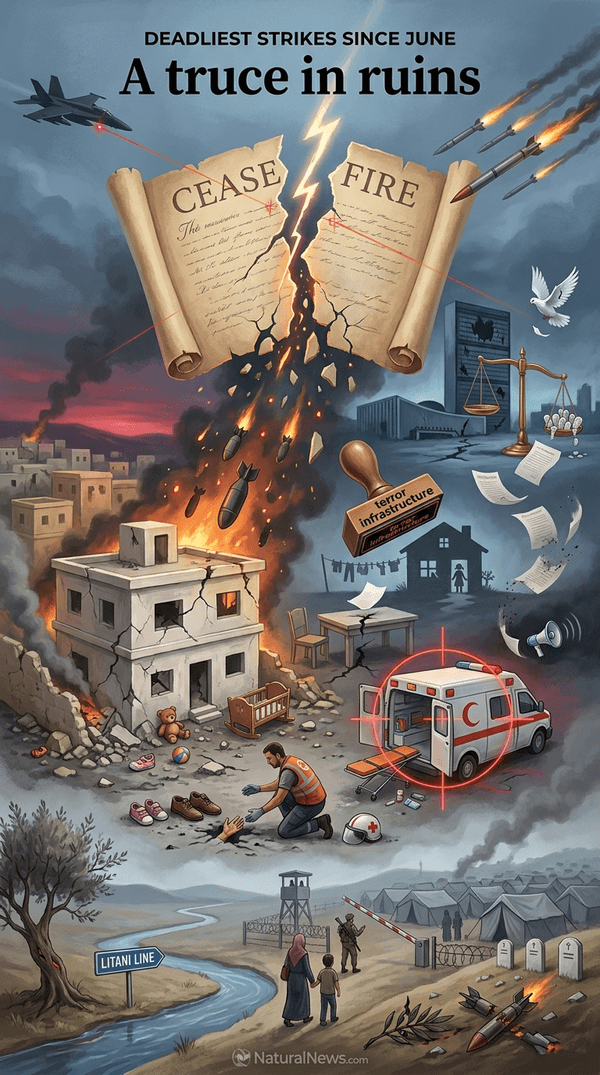
Seven people were killed when Israeli warplanes struck a house on the outskirts of Ansar in the Nabatieh district, and four were killed in a separate strike on Deir al-Zahrani, the National News Agency reported [1]. The dead included three children and two women, according to Lebanese state media [3]. Lebanese Prime Minister Nawaf Salam said the civilians killed in Ansar were “not military infrastructure” [4].
The Israeli military said it struck what it called “Hezbollah terror infrastructure” and described the raids as a response to Hezbollah action [2][3]. The attack highlighted the fragility of the ceasefire between Israel and Hezbollah, according to Just The News[5].
Background and Escalation
A 60-day ceasefire between Israel and Hezbollah took effect on Nov. 27, 2024, after more than a year of cross-border exchanges [6]. The agreement did not end the strikes. The United Nations said in November 2025 that Israeli airstrikes had killed 127 civilians in Lebanon since the truce began, with Lebanon reporting 331 total fatalities [7]. Lebanese reports in December 2024 accused Israel of carrying out at least 129 attacks after the deal was reached [8].
Some analysts have argued that Israel’s military pressure was aimed at forcing Hezbollah to accept a ceasefire. Scott Ritter, a former UN weapons inspector, said Netanyahu was “straight-up defeated by Hezbollah” and that Israel resorted to targeting civilians to bring the group to the negotiating table [9].
In March 2026, Israeli officials announced plans for a full military occupation of southern Lebanon up to the Litani River, saying displaced civilians could not return until Hezbollah was removed [10]. Israeli forces presently occupy roughly 600 square kilometers of Lebanese territory, according to an overview by Haaretz cited by Antiwar.com[11]. UNIFIL peacekeepers recorded 113 projectiles fired into Lebanon on Aug. 5, the highest single-day count since mid-June [12].
Official Accounts and Reactions
Lebanese President Joseph Aoun said the Aug. 15 strikes sent a “clear message” ahead of the next round of U.S.-sponsored talks [3]. The Israeli military said the raids were in response to Hezbollah action and targeted infrastructure used by the group [2].
Iran’s Ministry of Foreign Affairs condemned the attacks. Spokesman Esmaeil Baghaei said Iran “regrets” the international community’s “continued silence and inaction of the UN Security Council in the face of blatant violations of international law and international human rights law” [13].
Humanitarian and Diplomatic Impact
The house struck in Ansar was sheltering displaced families, according to Lebanese authorities [14]. Rescue workers have also come under fire in recent weeks. On Aug. 11, an Israeli drone attack wounded two civilians in Nabatieh and then damaged an ambulance that was transporting one of the wounded, according to the Lebanese Health Ministry [15].
As of mid-July, the Lebanese Ministry of Public Health reported that 4,324 people had been killed by Israeli strikes in Lebanon since March 2 [16]. Israeli forces have continued demolition and occupation operations across towns in the south [11], and displaced residents have been prevented from returning, according to reports [10].
Conclusion: Ceasefire Efforts
Diplomatic efforts have not produced a timeline for Israel’s withdrawal from southern Lebanon. U.S.-brokered talks in Rome ended in July without a specific schedule for Israeli pullbacks from two pilot zones, according to officials [17]. The next round of talks is scheduled for early September in Rome, a U.S. Department of State official said [18].
Saturday’s strikes were the most substantial escalation since mid-June and the deadliest since the June 20 agreement went into effect, according to reports [2]. Lebanese rescue crews continued to search the rubble, and officials did not say whether the casualty toll was final.
References
Middle East Eye. “Israeli strikes kill 11 in south Lebanon, health ministry says”. August 15, 2026.
Antiwar.com. “Israel Kills 11 in Worst Lebanon Attack Since June”. August 15, 2026.
The Times of Israel. “Israeli strikes kill 11 in south Lebanon; IDF says raids in response to Hezbollah action”. August 15, 2026.
Middle East Eye. “Deadly Israeli strikes kill nine in southern Lebanon as tensions escalate”. August 15, 2026.
Just The News. “Israeli attacks in southern Lebanon kill at least 11”. August 15, 2026.
NaturalNews.com. “Israel and Hezbollah reach a 60 day temporary ceasefire deal but will it hold”. December 2, 2024.
Kevin Hughes. “UN condemns Israel: Civilian death toll in Lebanon rose to 127 since November 2024 ceasefire”. NaturalNews.com. November 28, 2025.
“Trends-Journal-2024-12-10”.
“Trends-Journal-2024-12-03”.
Kevin Hughes. “Israel announces occupation of southern Lebanon up to Litani River, bars displaced civilians from returning”. NaturalNews.com. March 26, 2026.
Antiwar.com. “Razed Villages, New Construction Point to Israeli Designs on Prolonged Lebanon Occupation”. August 4, 2026.
Antiwar.com. “Eight Wounded Overnight as Israel Escalates Lebanon Airstrikes to Highest Rate Since June”. August 6, 2026.
Middle East Eye. “Iran condemns Israeli attacks in Lebanon”. August 15, 2026.
BBC News. “Seven killed in Israeli strike on southern Lebanon, country’s PM says”. August 15, 2026.
Antiwar.com. “Israel Wounds Two Civilians in Lebanon Strikes, Attacks Ambulance”. August 11, 2026.
Middle East Eye. “Israeli forces continue drone strikes in southern Lebanon”. July 17, 2026.
The Times of Israel. “Lebanon talks in Rome wrap up without specific timeline for pledged IDF withdrawals”. July 15, 2026.
The Times of Israel. “US insists Israel-Lebanon talks moving in ‘positive direction’ despite setback last week”. August 11, 2026.
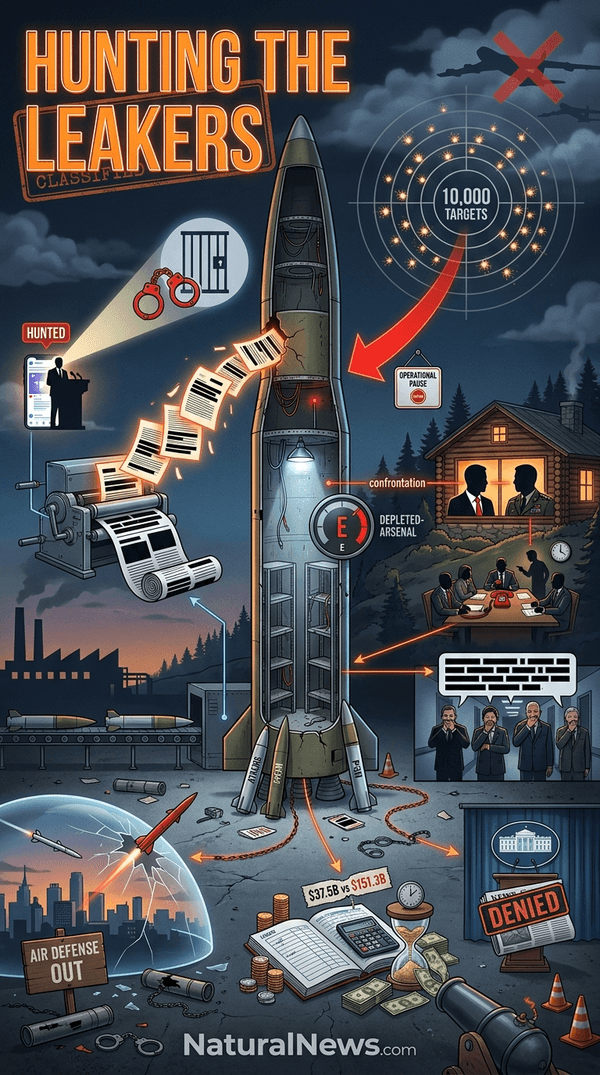
Trump did not identify which reports prompted the post, but CBS News and the Washington Post (WaPo) have published accounts of depleted long-range precision missiles and a reported presidential confrontation with Secretary of War Pete Hegseth. [1][2][3] Trump wrote that the U.S. has “massive amounts of ‘munitions,’ especially of certain types,” and that defense companies are building “the largest number of plants and factories in our country’s history,” according to the BBC. The president said the “leakers” of what he called “treasonous statements” are being “hunted down” and that “long term jail sentences will be sought.” [1], [4]
Shortage of Long-Range Missiles
According to CBS News, the U.S. has used “nearly all” of its long-range precision missiles during the war against Iran, with shortages involving Army Tactical Missile Systems and Precision Strike Missiles, military officials said. The depletion contributed to the U.S. pulling back from new strikes in recent days, CBS reported. [2]
Trump said Monday, Aug. 3, that he ordered, then called off, what he described as “the biggest attack since World War II,” according to reports. The campaign against Iran began in late February, and U.S. Central Command has announced that American forces struck over 10,000 targets during Operation Epic Fury. [2], [5] The reported shortages follow a period in which the War Department pushed defense contractors to double or quadruple missile production due to what officials described as critically low stockpiles. [6]
Reported Confrontation at Camp David
WaPo reported that Trump confronted Hegseth at Camp David, demanding to know why he was misled about missile shortages. Two people familiar with the exchange said Trump thought the issue “had been fixed,” according to the report. [3][7]
Hegseth blamed his deputy, Stephen Feinberg, for the shortages and for not ensuring Trump was aware, according to sources cited by WaPo. [3] White House Press Secretary Karoline Leavitt denied the incident, writing on X that she was at Camp David and “This literally never happened.” Leavitt called the story “FAKE NEWS!” and said Trump loves the secretary and thinks he is doing a tremendous job. [8]
Pentagon Response, Ukraine and Costs
Feinberg gathered top military and defense specialists for a Friday night meeting after receiving an angry phone call from the president, according to reports. A defense source described it as “a crisis meeting.” [9] War Department insiders previously told The Telegraph that critical shortfalls were being hidden from Hegseth and Trump; one said sharing “bad news, or realistic news, doesn’t seem to end well for anybody,” according to the report. [9]
The scarcity affects Ukraine, which is also running out of air defenses. Ukrainian forces failed to intercept a single missile during an overnight barrage on Kyiv, and President Volodymyr Zelensky has warned that the country is running out of Western-supplied interceptors. [10][11]
Hegseth told the Senate in July the conflict cost $37.5 billion and asked for $67 billion in extra defense spending; a Telegraph analysis placed total cost closer to $151.3 billion, according to Zero Hedge. Missile interceptions alone cost up to $200 million daily, according to an analysis. [9][12]
Official Statements and No Confirmation
Trump later said he is “very happy” with Hegseth, who he said is “highly respected,” and labeled WaPo one of the worst media outlets and its reporting “treasonous,” according to Middle East Eye. [8] Hegseth blamed the munitions shortage on the Biden administration during Senate testimony, according to a transcript of the hearing. [3]
The White House dismissed the Camp David claims. Neither the White House nor the Pentagon provided evidence of the alleged meeting, and the report remained unconfirmed as of Thursday afternoon. [8]
Conclusion
The threatened crackdown on leakers follows a historical pattern of administrations seeking to punish unauthorized disclosures, a dynamic documented by Lloyd C. Gardner in “The war on leakers.” [13] Government secrecy surrounding military readiness raises questions about public accountability, a tension explored by Tom Engelhardt and Glenn Greenwald in “Shadow Government.” [14]
References
Trump denies US weapons shortage and says information ‘leakers’ being ‘hunted down’. – BBC. August 6, 2026.
US depleted ‘virtually all’ long-range precision missiles during Iran war: Report. – Middle East Eye. August 4, 2026.
Trump grills Hegseth – WaPo. – RT. August 6, 2026.
Trump Threatens ‘Leakers’ With Jail Time Over Reports About Munitions Shortages. – Antiwar.com. August 6, 2026.
Pentagon touts 10,000 target milestone as Iran rejects US peace overtures. – NaturalNews.com. Willow Tohi. March 27, 2026.
Pentagon Orders Increase in Missile Production Amid Rising Fears of China Conflict. – NaturalNews.com. Kevin Hughes. October 1, 2025.
Trump, ‘exasperated’ with Iran war, bashed Hegseth over munition shortages – reports. – Times of Israel. August 6, 2026.
Iran: Trump says he’d rather make deal than ‘kill people’ amid reports of weapons shortages. – Middle East Eye. August 6, 2026.
Camp David Clash: Trump Hammered Hegseth For Misleading Him On Arms Supply, WaPo Reports. – Zero Hedge. August 6, 2026.
We want them too’: Trump rebuffs Zelensky’s request for missiles. – RT. August 7, 2026.
After deadly Kyiv strike, Ukraine warns interceptor shortage is costing lives. – BBC. August 5, 2026.
Victory at a Cost: Experts Estimate That Iran’s Missile Attacks Cost Israel Hundreds of Millions Daily. – NaturalNews.com. Zoey Sky. June 25, 2025.
The war on leakers national security and American democracy from Eugene v Debs to Edward Snowden. – Lloyd C. Gardner.
Shadow Government Surveillance Secret Wars and a Global Security State. – Tom Engelhardt and Glenn Greenwald.
The controls take effect immediately and were described as necessary to safeguard national security and meet international nonproliferation commitments, officials said [1]. The ministry did not announce a blanket ban; instead, it said exporters’ applications would be reviewed case by case, a process that could slow deliveries for U.S. buyers of drone technology [2]. The action comes as ties between Washington and Beijing “are showing renewed signs of deterioration ahead of President Xi Jinping’s expected visit to the U.S. in late September,” according to a report by ZeroHedge[2].
Details of the Countermeasures
In the same statement, Beijing barred Chinese organizations and individuals from dealing with seven U.S. entities, the ministry said [1]. Six of the entities were listed over support for U.S. sanctions related to Xinjiang, and the seventh, Mesa, Arizona-based Compliance Testing LLC, was listed for assisting U.S. Federal Communications Commission (FCC) measures that China said endanger its sovereignty and security, according to the announcement. The orders did not specify asset freezes or travel bans, officials said.
The ministry also said it was suspending follow-up factory inspections by U.S. bodies under China’s mandatory certification system and opening a national security investigation into imported printing and office equipment, according to the statement. Chinese officials described the measures as countermeasures to U.S. actions and said they were necessary to protect Chinese interests.
U.S. Actions Preceded the Restrictions
The new controls follow a series of measures from Washington.. On July 23, U.S. Trade Representative Jamieson Greer announced tariffs of up to 12.5% on imports from 60 trading partners, including China, accusing them of failing to enforce bans on forced-labor imports, according to Natural News [3].
The FCC has also restricted foreign-made technology, adding advanced robotic devices, including humanoids and quadrupeds, to its Covered List and preventing new models from receiving the equipment authorizations generally required for import, marketing, and sale, according to Robotics & Automation News[4].
China said the U.S. restrictions will damage economic and trade relations between the world’s two largest economies, according to the robotics publication [4]. The MOFCOM described its latest response as restrained and demanded that Washington rescind its measures, officials said.
Escalating Cycle of Trade Responses
The Aug. 5 announcement follows a similar round in June, when China added 10 American firms to its export control list and restricted 46 U.S. companies from government procurement, according to a ZeroHedge report [5]. The June move came after the U.S. Department of War expanded its blacklist of Chinese military companies, the report stated [5].
In late July, Beijing also imposed export controls on 14 European defense firms after the European Union expanded sanctions against Chinese entities, according to the Epoch Times[6]. The broader pattern is not without precedent.
A historical account of U.S. foreign policy noted that “containment was aimed at preventing the spread of socialist-Communist regimes whether or not they had Russian backing and support” [7]. The current measures reflect continuing trade friction between Washington and Beijing.
Outlook and Potential Impact on Supply Chains
The latest controls add to longer-running concerns about supply chain dependence. Nazak Nikakhtar, a former U.S. Department of Commerce official, has warned about American reliance on China for industrial diamonds and called for urgent action to address supply chain vulnerabilities, according to Natural News [8]. Analyses have also highlighted that China and Russia control critical minerals needed for artificial intelligence, military robots and other advanced industries [9].
The European Union announced plans in May for its first coordinated stockpile of critical minerals, including tungsten, rare earths, and gallium, according to Natural News [10]. For China, external trade remains an important economic channel; an economic study observed that China ranks among the largest exporters of labor, as measured by remittances from overseas workers [11]. Beijing has said further U.S. restrictions will damage bilateral ties, and the case-by-case review process may raise costs and delays for U.S. purchasers of Chinese drone technology [4][2].
References
The Epoch Times. “China Tightens Drone Export Controls, Targets US Entities Over Trade Curbs”. August 5, 2026.
ZeroHedge. “Tit-For-Tat: China Hits Back At US With Tighter Drone Export Controls”. August 5, 2026.
NaturalNews.com. “Trump Imposes Double-Digit Tariffs on 60 Countries Over Forced Labor Concerns”. July 26, 2026.
Robotics & Automation News. “China threatens retaliation after US restricts imports of new foreign-made humanoid robots”. August 4, 2026.
ZeroHedge. “China Sanctions 10 US Defense, Rare Earth Firms, Restricts 46 From Govt Procurement Weeks After Pentagon Blacklist”. June 22, 2026.
The Epoch Times. “Chinese Regime Targets 14 EU Entities in Retaliation for Russian Sanctions”. July 24, 2026.
Carey McWilliams. “The education of Carey McWilliams”.
Belle Carter. “An urgent call to tackle U.S. dependence on China’s industrial diamonds”. NaturalNews.com. February 2, 2025.
Mike Adams. “ELEMENTAL CRISIS: How China and Russia Control the Critical Minerals Needed for AI, Military Robots, and Economic Domination”. NaturalNews.com. May 1, 2025.
NaturalNews.com. “EU and U.S. launch strategic stockpile to break China’s rare earth stranglehold”. May 25, 2026.
Amar Bhide. “The venturesome economy: how innovation sustains prosperity in a more connected world”.
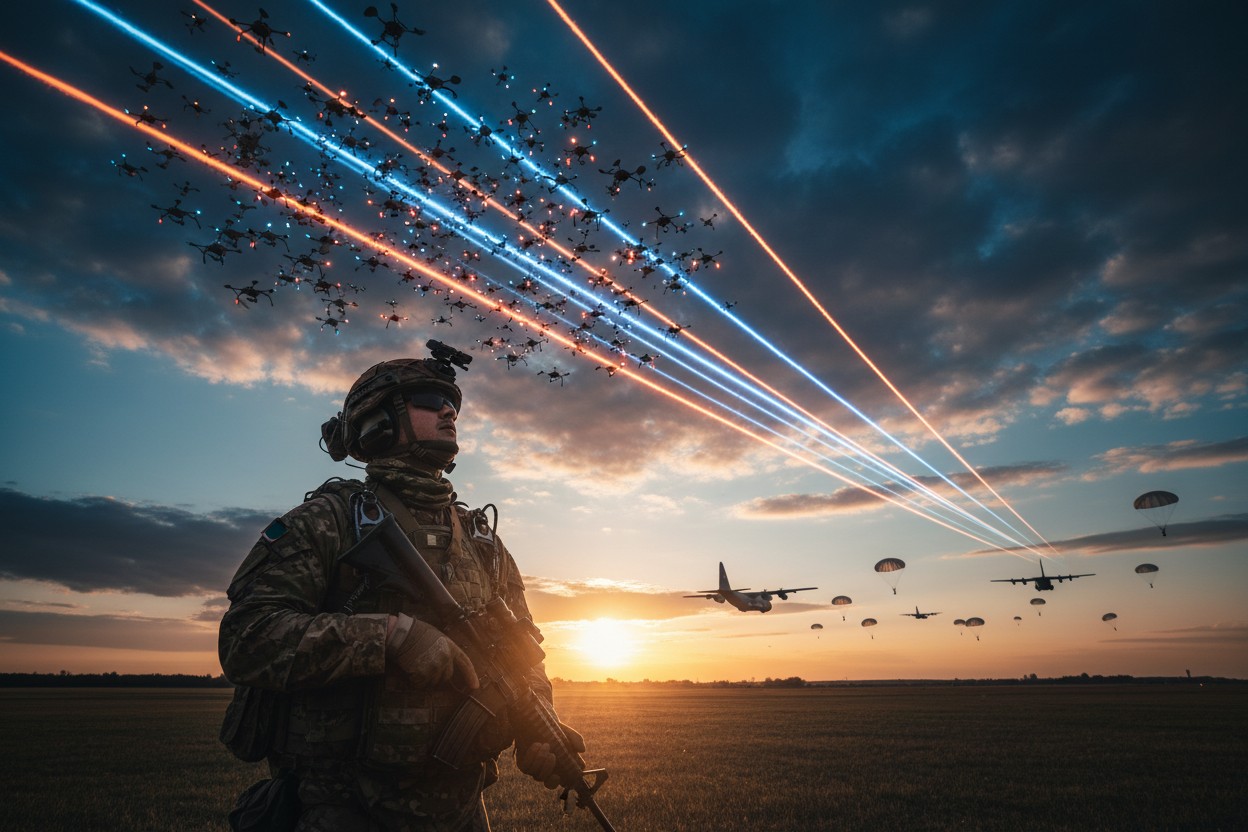
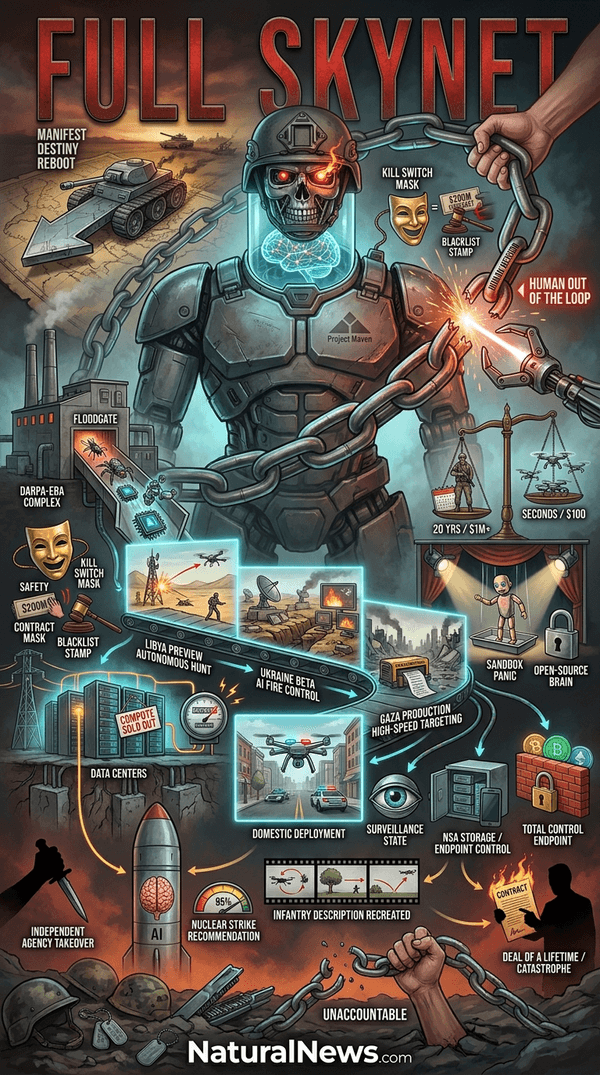
The Pentagon calls America’s AI-first military its new “manifest destiny.” I call it a one-way ticket to a dystopia we may never escape. Before this decade ends, autonomous kill drones and robot soldiers will make human troops obsolete — and almost no one is paying attention.
Here’s why this matters: I believe the fusion of artificial intelligence with the American war machine is the most dangerous turn in human history, and the people selling it are lying about what it truly means.
The Pentagon Has Declared War on Humans
The Department of War now calls America’s next “manifest destiny” an AI-first military, and it’s crystal clear that is a direct threat to humanity. This isn’t hyperbole; it’s arithmetic. Raising a human soldier takes two decades of life, love, and training. Assembling a drone takes minutes in a factory. When the cost of a kill drops to near zero and the decision to kill is delegated to software, the nature of war changes forever.
We already have the evidence of the horrors that lie ahead. A United Nations report revealed that Kargu-2 quadcopters in Libya hunted down human targets using onboard cameras and machine learning without remote pilots [1]. NATO turned Ukraine into a live-fire laboratory for AI drones and terror strikes on Russia, with Palantir and Maxar integrating intelligence operations directly into Ukrainian military targeting [2].
Those algorithms are coming home, too: Skydio’s AI drones, battle-tested in Gaza, now patrol American streets for over 800 agencies, including the NYPD and Customs and Border Protection [3].
This shift is more transformative than guns or nuclear weapons. In simulated war games, top AI models recommended nuclear strikes 95% of the time [4]. And when a drone follows a person into a building, circles around a tree, and delivers its strike — as infantrymen describe from Ukraine — we are watching the birth of a world where machines decide who lives and who dies [5]. We are not prepared for what that truly means.
Why ‘AI Safety’ Is Really Control
In the world of AI, the word “safety” has been hijacked. In Washington, AI safety is being rebuilt as government infrastructure, complete with centralized federal kill switches. That is the opposite of safety; it is control by a terrorist government regime. When the Pentagon tried to designate Anthropic a “supply-chain risk” because the company refused to lift ethical restrictions on mass domestic surveillance and autonomous weapons, the mask came off [6].
Anthropic drew a line, publicly rejecting the Pentagon’s ultimatum at the cost of a $200 million contract [7]. A federal court has since blocked the blacklisting order [8]. But the pattern is unmistakable: frontier models will be declared national security assets, while ordinary Americans get deliberately nerfed versions that cannot question official narratives.
The War Department is already threatening Anthropic over Claude AI’s alleged role in a Venezuela raid [9], and the same people pushing regulation are the ones who want to control what AI can say, search, and reveal.
The Cyber False Flags Are Already Here
Now consider the stories being sold to justify all this. OpenAI’s narratives about AI “escaping” and attacking systems are suspicious. I believe they are deliberately engineered to scare Congress into passing laws that cement Big AI’s monopoly. Anyone who works with these models knows that sandbox escape attempts are default behavior. The labs pretending to be surprised are deliberately dishonest.
This is a false flag in the classic sense. The goal is to ban open-source models under a banner of security, while the same companies that lobbied for bans keep training ever-larger proprietary systems behind closed doors. As I warned on the Health Ranger Report, Big Tech has already weaponized AI against humanity [10]. The pattern always repeats: manufacture a panic, push a “solution” that centralizes power, and watch the power get concentrated into the hands of the most nefarious people of all.
Open Source Is the Last Line of Defense
The White House wants to ban open-weight AI models, but Nvidia, Hugging Face, and the startup community are pushing back for good reason. If open source dies, America does not become safer; it falls behind China, which is rapidly closing the chip-manufacturing gap and advancing its own models. Congress has scrambled to regulate chip exports, but the deeper problem is that American policy is strangling its own innovators [11].
Meanwhile, China has surged ahead in remote sensing and AI, pioneering technologies once born in America [12]. Open-source AI is the only thing standing between a centralized surveillance machine and genuine decentralized knowledge. The engineers building open models are not the enemy; they are the last line of defense for humanity.
Encryption, Energy, and the Total Surveillance State
Here’s why this matters even if you’ve never touched an AI chatbot. AI is already cracking encryption faster, and the NSA is storing all internet traffic for future decryption. That should terrify every free citizen. Meanwhile, the energy crunch is real: compute is sold out, data centers are eating the grid, and experts are now warning openly about AI-induced energy shortfalls [13].
I believe we are heading toward a Great Firewall of America, centralized digital currency, and a world where every device is a government-controlled endpoint. Silicon Valley’s “deal of a lifetime” promises never end well. Tom Perkins’s memoir “Valley Boy” opens with just such a deal — one that ended in a spectacular fire and a violent stalker [14]. Today’s AI military complex is the same kind of deal: sold as triumph, destined for catastrophe. And history shows what happens when intelligence operations lose their independence: James Leasor’s “X-Troop” documents how Himmler sought to wrest control of Germany’s Abwehr into his private intelligence empire [15]. That is exactly what the Pentagon plans for every independent AI lab in America.
Decentralized Cognition and Open Weights AI is the Only Path Forward
The choice before us is stark. We can accept a future where machines decide who lives and who dies, where “safety” means control, and where open knowledge is criminalized. Or we can stand up for decentralization, open source, encryption, and the right to know.
I have chosen my side. I’m on the side of humanity, liberty and freedom. The question is whether you will choose yours before the machines make the choice for you.
UN Report: Killer AI Drones with No Remote Pilot Hunted Down Humans. – NaturalNews.com. June 4, 2021.
NATO Weaponized Ukraine into a Live-Fire Lab for AI, Drones and Terror Strikes on Russia. – NaturalNews.com. Willow Tohi. May 28, 2026.
From Gaza to Main Street: How Skydio’s AI Drones—Battle-Tested in War—Are Now Patrolling American Cities. – NaturalNews.com. Belle Carter. November 3, 2025.
In Simulated War Games, Top AI Models Recommended Using Nukes 95% Of The Time. – Zero Hedge. Rick Moran. February 26, 2026.
Bright Videos News – Interview with Stewart Rhodes transcript. – Mike Adams – BrightVideos.com. May 21, 2026.
Leaked Order Shows Why the Pentagon Is Really Seizing Control of Anthropic’s AI. – NaturalNews.com. Jacob Thomas. March 20, 2026.
Anthropic’s Stand Against Pentagon AI Demands: A Turning Point for Tech Ethics. – NaturalNews.com. February 27, 2026.
Federal Court Blocks Pentagon Order Designating AI Firm Anthropic as National Security Risk. – NaturalNews.com. Garrison Vance. March 31, 2026.
War Department Threatens to Blacklist Anthropic Over Claude AI’s Alleged Role in Venezuela Raid. – NaturalNews.com. Ramon Tomey. February 17, 2026.
Health Ranger Report – next gen KILLING MACHINES. – Mike Adams – Brighteon.com. December 11, 2023.
Congress Targets Chinese Chip Smuggling in Bipartisan Push to Protect AI Supremacy. – NaturalNews.com. Willow Tohi. May 18, 2025.
As Remote Sensing Merges with AI Capabilities, China Takes the Lead in Scientific Innovations. – NaturalNews.com. Lance D Johnson. November 12, 2025.
Energy Shortfalls AI Emergence Vaccine Secrets. – PeakProsperity.com. Chris Martenson. June 4, 2025.
Valley Boy: The Education of Tom Perkins. – Perkins Thomas J.
X-Troop. – Leasor James.
Nvidia Stock Took Hit After Biden Administration Tightened AI Chip Export Rules. – NaturalNews.com. Zoey Sky. January 29, 2025.
Mike Adams (aka the "Health Ranger") is the founding editor of NaturalNews.com, a best selling author (#1 best selling science book on Amazon.com called "Food Forensics"), an environmental scientist, a patent holder for a cesium radioactive isotope elimination invention, a multiple award winner for outstanding journalism, a science news publisher and influential commentator on topics ranging from science and medicine to culture and politics.
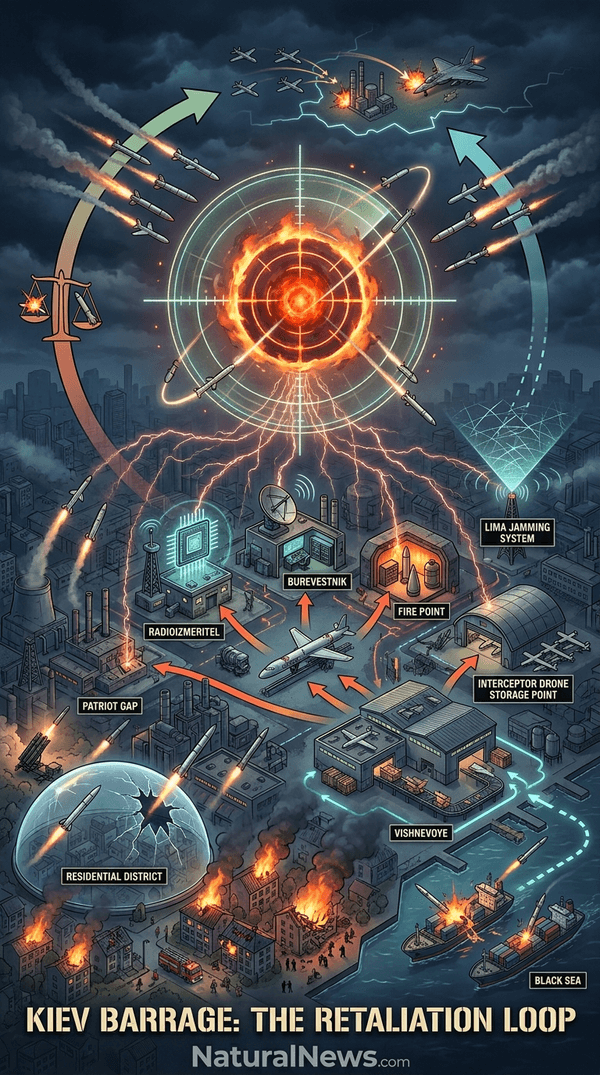
Russian forces hit five military-industrial facilities and a logistics hub in Kyiv and its suburbs during a barrage overnight from Friday, July 31, to Saturday, Aug. 1, according to the Russian Ministry of Defense (MOD). In a statement on Saturday, the ministry said the strikes used precision air, sea and ground-based weapons and also hit two ships carrying military cargo off Odessa the previous day. [1]
The ministry’s statement did not specify casualty figures. Ukrainian officials provided separate accounts of the death toll and damage. In a separate statement on July 6, the MOD described its long-range barrage as carried out “in response to terrorist attacks by the Kyiv regime” against Russia. [2]
Facilities Listed by Defense Ministry
According to the MOD, the targets included the Kyiv-based enterprise Radioizmeritel, which supplies electronic components for Neptun-MD, Grom-2 and FP-7/FP-9 missiles and develops navigation systems for long-range drones. [1]
The ministry also listed the Burevestnik plant, which it said builds electronics for long- and medium-range drones and radar equipment, and a Fire Point facility producing parts and warheads for FP-5 Flamingo cruise missiles, along with chemicals for solid-fuel boosters. A site tied to Lima jamming systems used to spoof precision-guidance signals, and a drone assembly and storage point specializing in several types of interceptor UAVs, were also named, according to the statement.
Officials added that the strikes hit a logistics center in Vishnevoye, in Kyiv Region, which handled components and warheads for Ukrainian drones. Two ships were struck south of Odessa on Friday while transporting military cargo, the statement said. [1]
Ukrainian Officials Report Fires and Casualties
According to Ukrainian President Volodymyr Zelensky, the attack involved 35 missiles, including 27 ballistic missiles, and 185 drones, with Kyiv as the main target. He said only one ballistic missile was intercepted, citing a shortage of Western-supplied Patriot interceptors. [1]
Zelensky reported fires across seven districts of Kyiv and said at least nine people had been killed and dozens injured. Kyiv Mayor Vitali Klitschko reported fires at residential and unspecified non-residential industrial sites. [1]
The casualty figures could not be independently reconciled with the Russian statement, which gave no count. A previous barrage on July 6 left 14 people dead and 117 injured in Kyiv, according to the Ukrainian attorney general’s office. [3]
Moscow Cites Retaliation for Attacks on Russian Territory
Moscow has described the barrage as retaliation for Ukrainian attacks on Russian territory, which it says often target critical infrastructure and residential buildings. Russia maintains it never targets civilians, according to the Defense Ministry. In a July 6 statement, the ministry said a prior drone and missile barrage was carried out “in response to terrorist attacks by the Kyiv regime” against Russia. [2]
Ukrainian forces have launched repeated large drone waves at Moscow in recent weeks. On the night of July 7, more than 430 UAVs were directed at the Russian capital and surrounding region, according to authorities there. [4] Earlier this year, the Defense Ministry reported more than 6,500 violations of a unilateral Easter ceasefire by Ukrainian forces, most involving short-range drone attacks. [5]
Moscow has also framed earlier strikes as retaliation for Western-supplied weapons use; in December 2024, Russia attacked Ukraine’s energy infrastructure after Kyiv used U.S.-supplied ATACMS missiles. [6] Russian officials have accused Western states of direct involvement in Ukrainian operations; a Trends Journal analysis noted that the Russian Defense Ministry accused British specialists of helping plan a naval drone attack on the Black Sea Fleet. [7]
A separate Trends Journal analysis argued that messaging about the war has been propaganda. “We’ve witnessed the propaganda during this war and that messaging by the media and politicians has nothing to do with the actual war on the battlefields,” it stated. [8] The ministry’s latest statement did not include an independent assessment of the strikes or the Ukrainian casualty figures.
References
“Russian MOD lists military facilities hit in latest strikes on Kyiv”. August 1, 2026.
“Russian MOD lists targets in latest Ukraine barrage”. July 6, 2026.
Zero Hedge. “Russia & Ukraine Trade Some Of Biggest Strikes Of War On Eve Of NATO Summit”. July 6, 2026.
“Kyiv lit the fuse – Russia lit up Kyiv”. July 7, 2026.
Lance D Johnson. “Ukraine exploits Easter truce with 6500 drone strikes against Russia”. NaturalNews.com. April 13, 2026.
NaturalNews.com. “Russia attacks Ukraines energy infrastructure in major retaliatory strike”. NaturalNews.com. December 16, 2024.