

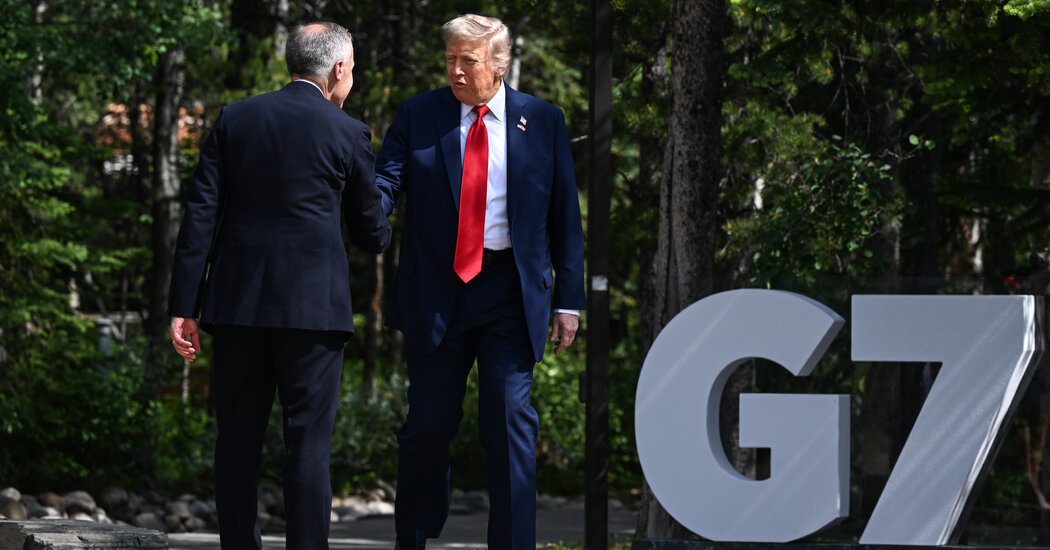
For as long as President Trump has attended the annual Group of 7 summits, the august decorum of the meetings has threatened to descend into chaos.
At least twice in the six years he has represented the United States, Mr. Trump has left the gatherings early. He has openly complained about allies’ disagreement with his positions on tariffs and climate change. And he has raised the prospect of inviting Russia to rejoin the group after it was ejected in 2014 for illegally annexing the Crimea Peninsula in Ukraine.
Perhaps no image of Mr. Trump at the annual meetings is more indelible than the picture of Angela Merkel, the former German chancellor, appearing to take him to task in 2018 as other allies look on.
So far, the other leaders gathered in Évian-les-Bains for this year’s gathering of the leaders of seven of the world’s largest economies have sought to make him feel comfortable. Chancellor Friedrich Merz of Germany on Tuesday presented him with a soccer jersey with the number 47 on the back. Mr. Trump beamed as he accepted it.
Here’s a look at Mr. Trump’s past G7 appearances.
2017: Taormina, Italy
At his first Group of 7 meeting, Mr. Trump demanded that NATO member countries contribute more to the defense alliance, and refused to endorse language supporting free trade or backing the Paris climate accord.
Afterward, Ms. Merkel said, “The times in which we could rely fully on others — they are somewhat over.”
2018: Charlevoix, Quebec
Leaders from Europe, Canada and Japan angrily pushed back on Mr. Trump’s calls to readmit Russia to the group, and on his tax increases on aluminum and steel imports. The photo of Ms. Merkel confronting Mr. Trump clearly displayed the tension among leaders surrounding the text of their joint communiqué — a usually vanilla statement about the meetings’ conclusions.
Mr. Trump left the summit early to fly to Singapore meet with the North Korean leader, Kim Jong-un. Aboard Air Force One, he unleashed an angry tweetstorm against Prime Minister Justin Trudeau of Canada for criticizing the American tariffs. He then retracted his endorsement of the communiqué.
The summit has since become known as the G6+1 — with the United States as the outlier.
2019: Biarritz, France
Trying to prevent another blowup, President Emmanuel Macron of France mulled foregoing a joint communiqué at the next summit, where he was host. The leaders eventually issued a bare-bones declaration that avoided mention of a rules-based order for trade, negotiations with Iran or direct support for Ukraine, all issues that could have set off Mr. Trump.
Behind the scenes, Mr. Trump remained at odds with his counterparts on major issues. But he largely stuck to diplomatic niceties, and other leaders showered Mr. Trump with flattery when raising differences with his positions.
2020: A cancellation
With the United States set to host, Mr. Trump initially proposed holding the 2020 summit at his luxury golf club near Miami. an idea he dropped after intense opposition from critics who accused him of awarding his family’s company a major diplomatic event. He scheduled it to be held instead at Camp David, the presidential retreat in Maryland.
But when the coronavirus pandemic all but shut down worldwide travel in early 2020, the White House said the summit would instead be held by teleconference. That didn’t happen. Later that year, Mr. Trump lost his re-election bid.
2025: Kananaskis, Alberta
For the first G7 meeting of his second term, Mr. Trump again abruptly left the discussions early, this time to deal with the conflict between Israel and Iran.
Perhaps inevitably, a flare-up developed after Mr. Macron told journalists Mr. Trump was leaving the summit to “make a cease-fire” in Iran. Mr. Trump snapped back that Mr. Macron “always gets it wrong.”
