
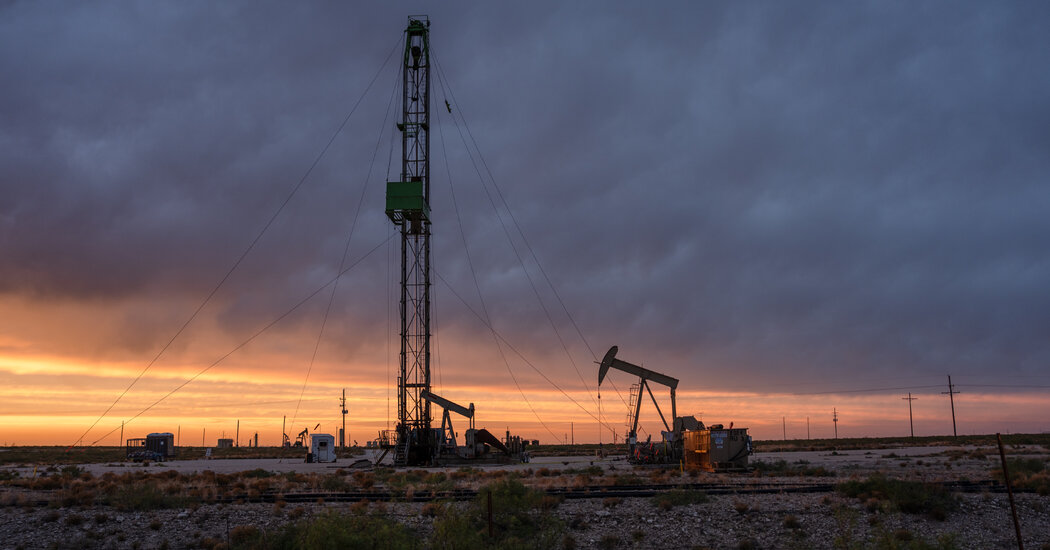
The Trump administration on Monday moved to relax environmental rules governing the extraction of oil, gas and coal from public lands across the country.
The Interior Department issued a pair of proposed rules that would reduce costs and weaken requirements for fossil fuel companies that operate on federal lands. The first rule would drastically lower the fees that companies must pay before drilling, while the second could allow firms to release more methane, a powerful greenhouse gas that contributes to climate change.
Together, the proposals were the latest effort by the Trump administration to boost drilling and mining on millions of acres of lands and waters that the federal government owns. President Trump has summarized his energy policies as “drill, baby, drill,” and his administration has taken sweeping actions to dismantle environmental regulations, sideline conservation and fast-track the leasing of public lands for fossil fuel production.
Interior Secretary Doug Burgum said in a statement on Monday that the moves would ease burdensome restrictions on domestic energy production.
“Energy dominance requires regulatory clarity,” Mr. Burgum said. “These targeted updates cut through the red tape that has historically deterred investment, ensuring our public lands remain a reliable engine for economic growth and innovation.”
The first proposal would significantly lower the cost of the bonds that fossil fuel companies must pay the Interior Department upon purchasing a drilling lease on multiple public lands in a state, from $500,000 to $25,000.
The agency uses this money to remediate the environmental damage left by abandoned oil and gas wells. The Biden administration increased the costs of these bonds more than tenfold in an effort to ensure that companies, not taxpayers, covered any cleanup costs.
Thousands of abandoned wells, also known as “orphaned” wells, dot federal lands across the country. In many cases, the companies that owned the wells went bankrupt and deserted the sites. Left uncapped, the wells can emit methane as well as benzene, a chemical linked to leukemia and other cancers.
Environmentalists sharply criticized the lower bonding rates, saying they would leave taxpayers on the hook for remediating abandoned wells across the country.
“We are putting all U.S. federal taxpayers at risk of needing to pick up the cleanup costs,” said Adam Peltz, a senior attorney at the Environmental Defense Fund, an advocacy group. “It’s somewhat unconscionable.”
But industry representatives applauded the move. Melissa Simpson, the president of the Western Energy Alliance, an oil industry trade group, said it would ease burdens on smaller energy firms.
“Under the Biden administration, the leasing rule was a primary vehicle to restrict oil and natural gas development on lands explicitly open to multiple uses that include energy development,” Ms. Simpson said in a statement. “It did so through excessive increases to bonding rates that targeted small and mid-sized operators.”
The second proposed rule would eliminate a requirement that fossil fuel companies detail their plans to limit methane emissions in their applications for drilling permits. The Biden administration established this requirement in a 2024 rule that formed a centerpiece of its ambitious climate agenda.
Methane is considered a “super pollutant” because, while it breaks down more quickly than carbon dioxide, it traps about 80 times as much heat in the atmosphere in the short term. It is responsible for nearly a third of the rise in global temperatures since the start of the Industrial Revolution.
Representatives for the oil and gas industry and environmental groups did not immediately respond to requests for comment on the second proposed rule.
After publishing both proposed rules in the Federal Register, the Interior Department will solicit public comments on them for 60 days. Then the agency will seek to finalize the proposals, likely within the next year.
