

[ad_1]
One of the starkest divides in the Democratic Party is playing out in a state not often known for liberal politics: Utah.
A reliably Republican bastion that hasn’t voted for a Democrat for president since Lyndon B. Johnson, Utah is poised to send a Democrat to the House this fall for the first time since 2018, after court-ordered redistricting created a left-leaning congressional seat in Salt Lake City.
Tuesday’s primary battle for this rare blue island in a sea of red has turned into a referendum over the brand of politics Democrats should embrace — progressive activism or moderate pragmatism.
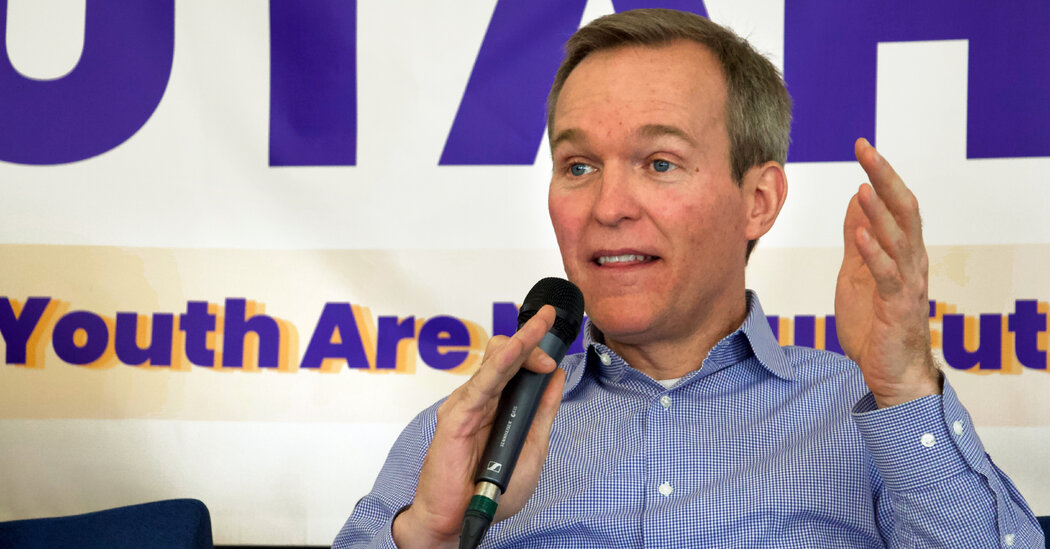
On one side is former Representative Ben McAdams, the most recent Utah Democrat in Congress, who was considered by some metrics the most conservative Democrat in the House during his single term in office. Opposing him are three progressives headlined by Nate Blouin, a state senator backed by Senator Bernie Sanders, independent of Vermont.
Mr. McAdams has an edge, thanks to millions of dollars spent on his behalf by a super PAC tied to the artificial intelligence industry and by New Democrat Majority, which supports centrists. But the redrawn district leans so far left — former Vice President Kamala Harris would have won it by 24 percentage points in 2024 — that Mr. McAdams has been forced to distance himself from his own past positions to fit the new electorate.
Democrats see the contest as crucial to efforts to steer Utah away from MAGA and toward a more moderate future. Though Utah voters have supported President Trump, they also remain fond of the kind of Main Street Republicanism epitomized by the state’s most recently retired senator, Mitt Romney.
Members of the Church of Jesus Christ of Latter-day Saints — who account for around half of Utah’s population, depending on estimates — have grown weary of Mr. Trump. Nationally, 31 percent of church members backed Ms. Harris in 2024. Thousands of Republicans and unaffiliated voters have requested ballots in Tuesday’s open Democratic primary.
Brian King, the chairman of the state Democratic Party, said the contest has given his party a chance to offer a new vision to disillusioned voters.
The question, Mr. King said, is which approach the party should take to woo them.
“Are you going to pitch your message to the people on the progressive side of the spectrum and get out young voters and those who feel disinterested?” Mr. King asked. “Or are you going to make a pitch for disaffected Republicans and unaffiliated voters and pragmatists?”
Progressives have hammered Mr. McAdams, a member of the Latter-day Saints and former Salt Lake County mayor, for the positions he took while in the House, when he represented a more conservative district.
Mr. McAdams opposed federal funding for abortions, and he signed on to a Republican bid to force a vote on an anti-abortion bill.
“I support the teachings of my L.D.S. faith that oppose abortion except in cases of rape, incest, danger to the mother’s life and in certain other rare circumstances,” Mr. McAdams said during his unsuccessful 2020 re-election fight.
He also opposed environmental and labor goals that progressives say are disqualifying, though Mr. McAdams now has support from labor and environmental leaders.
Mr. Blouin said the outside money boosting Mr. McAdams was allowing him to “rewrite his record.”
“I don’t think we need the same folks who have been responsible for the compromises that have gotten us to the brink of authoritarianism,” Mr. Blouin said.
Mr. McAdams has zigzagged on abortion. In his past congressional campaigns, he distanced himself from his own prior comments supporting abortion rights. In 2018, he said he had opposed anti-abortion bills while serving in the Utah Legislature because those bills were poorly written, and not because he supported the procedure.
Trying now to appeal to a drastically different set of voters, he’s doing the opposite. Recently, his campaign said he supported abortion rights in the Legislature, and even noted past opposition research from Republicans. And he committed last year to voting in favor of restoring national abortion access.
Mr. McAdams said he has always supported a woman’s right to choose. As far back as 2018, he said that while he harbored religious qualms about the procedure, he believed that abortion decisions should be made by women themselves.
Mr. McAdams voted to impeach Mr. Trump in 2019, which he has framed as a principled choice, knowing that it would most likely lead to his ouster.
The math is stark for the progressives, who seem likely to split the non-McAdams vote.
Mr. Blouin’s attempts to consolidate liberal support have been hampered by decade-old social media posts in which he made offensive jokes about Latter-day Saints and mocked sexual assault. (He apologized and said the posts didn’t represent his current views.)
Recently, Mr. Blouin urged his two progressive opponents to drop out after touting an internal poll showing him behind Mr. McAdams but leading them. Liban Mohamed, one of the other candidates, rejected the exhortation, saying his campaign was more viable.
“I do not believe that poll is a reflection of reality,” Mr. Mohamed said. “It’s an act of desperation.”
[ad_2]
Source link
