

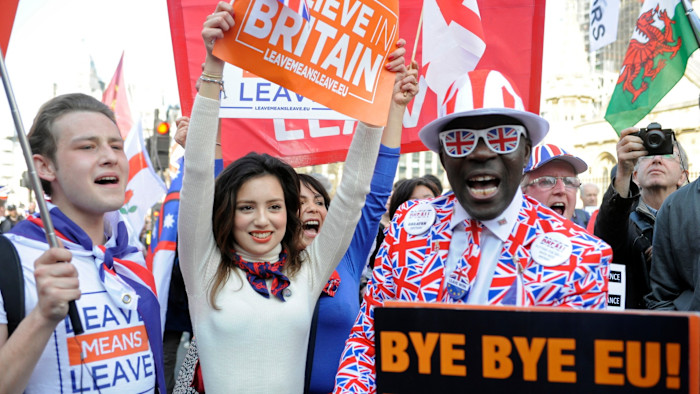
This week’s tenth anniversary of the Brexit referendum offers a moment for reflection on the economic arguments made and the lessons that should be learnt.
Mainstream economists are still asked whether their consensus that leaving the EU would be bad for the UK was accurate. A strange question for the referendum’s losers? Yes. But there is a clear two-part answer. The short-term predictions of immediate harm and likely recession, as summarised by the Treasury’s analysis, were wrong. But the longer-term forecast that Brexit would undermine UK economic performance was right.
There have been some surprises since 2016, such as the remarkable strength of UK services exports. But the swift drop in the value of sterling cut real incomes, then the uncertainty of the withdrawal process amid political turmoil undermined business investment. Higher barriers to trade have reduced the dynamism of the UK economy.
History cannot be rerun, so no one can be certain of the exact Brexit effect. But the most careful analyses now estimate that the UK economy is 6 to 8 per cent smaller than it would have been had the country voted to stay in the EU. This was also the Treasury’s own 2016 estimate of the damage Brexit would cause by 2030 if there were a negotiated bilateral agreement between the UK and EU. Brexiters used to complain that the UK was “shackled to a corpse” when Britain’s economy regularly outperformed Europe; those days are past.
What is outlandish is that while these consensus predictions have been chewed over for a decade, those of the Leave side are forgotten. Economists for Brexit was a loose group of like-minded souls with a profound inability to understand the likely consequences of the rupture. In forecasts that are now very hard to find, they saw a Leave vote creating a rapid improvement in economic performance with growth rates just shy of 3 per cent a year up to 2020. They expected the UK to offer other countries unilateral free trade and thought this would boost GDP by 4 per cent over time.
Instead of the “Nike swoosh” in which a little bit of post-referendum volatility would be replaced by permanently better economic performance, we have had the reverse. The UK economy started its post-referendum years with some resilience which has faltered since.
Why did mainstream economics broadly get it right? The simple answer is that although the fashionable view is to say that economics has far too narrow a view of human behaviour, it is wrong. Empirical economics tries hard to understand human and corporate actions and uses sophisticated techniques to produce nuanced estimates of the relationships between policies and outcomes. This work found that proximity, trade and integration mattered for economic dynamism. Forecasts will never be wholly right, but economics understood that erecting barriers to doing business was likely to be costly.
Of course, it should never have been controversial to say so. Doctors would be nervous about predicting that if you smoke one packet of cigarettes, it will give you a heart attack, but they would be pretty confident that if you continued, it would shorten your life.
Ten years on, although Europe accepts that the UK made a big mistake and no other country seeks to emulate Brexit, that has not stopped the spread of bad economics and wishful thinking. The resilience of the global economy after President Donald Trump’s tariffs and attack on Iran is a triumph of modern capitalism, not trade barriers. The system of trade and co-operation can withstand a lot, but efforts to undermine the rules-based international order also undermine this strength, adding extra layers of fragility.
Brexit is a warning not to ignore mainstream economics. It is one that, sadly, is still not being heeded.
[email protected]
