

[ad_1]
Unlock the Editor’s Digest for free
Roula Khalaf, Editor of the FT, selects her favourite stories in this weekly newsletter.
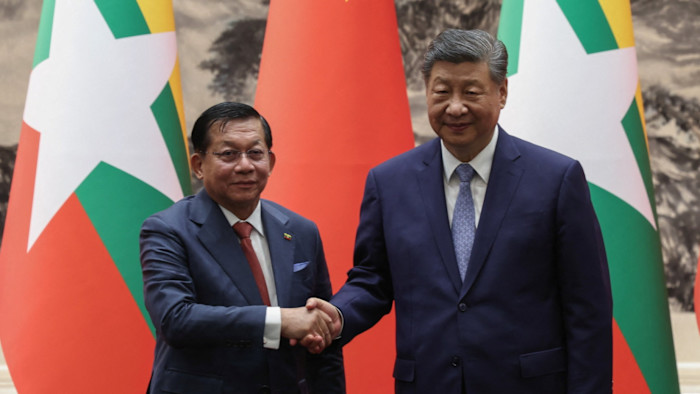
Chinese President Xi Jinping is hosting his Myanmar counterpart Min Aung Hlaing in Beijing this week, as China embraces the former general and junta leader who has refashioned himself as civilian president following a sham election.
The two leaders were set to discuss issues such as cross-border scams run by criminal groups in Myanmar and infrastructure projects of strategic interest to China such as the Kyaukphyu port on the Bay of Bengal, according to Chinese state media.
The visit, which will last until Friday, “highlights China’s enduring support for Myanmar’s peaceful and democratic process”, the Chinese Communist Party’s mouthpiece Global Times said ahead of the trip.
Few details were immediately available of the meeting between Xi and Min Aung Hlaing on Tuesday, which was confirmed by China’s state-owned news agency Xinhua.
Myanmar has been racked by civil war since Min Aung Hlaing, then commander-in-chief of the military, toppled the democratically elected government of Nobel Peace Prize laureate Aung San Suu Kyi in February 2021.
The ensuing conflict between the army and a patchwork of ethnic and anti-regime insurgencies has killed thousands of people and displaced nearly 4mn others.
The junta held an election in stages in late 2025 and early 2026 in a bid for political legitimacy and to draw back investment from foreign companies and countries that exited the country in the wake of the coup.
But the polls were dominated by military-backed factions — with Aung San Suu Kyi and other pro-democracy leaders imprisoned and opposition parties dissolved — and were widely dismissed as fraudulent.
China is the junta’s biggest international backer, though it has also provided arms and support for ethnic minority rebel groups in border areas. Analysts say Beijing believes that military rule is likely to bring the most stability to Myanmar, with which it shares a 2,100km border.
But Beijing has grown increasingly concerned by the relentless conflict, as well as the spread of multibillion-dollar online scam compounds in border areas and delays to major infrastructure projects undertaken by Chinese companies.
China’s foreign ministry on Friday also confirmed that authorities in the country had arrested Min Zin, a Burmese-American academic and founder of the ISP-Myanmar think-tank, earlier this month.
Min Zin, who is also a PhD candidate at the University of California, Berkeley, was detained on suspicion of espionage, the ministry said.
Chinese state media said one of the main points of discussion this week would be the China-Myanmar Economic Corridor, which analysts say is a vital part of Xi’s flagship Belt and Road international infrastructure initiative.
Xi said at the meeting that both sides should “steadily advance the construction of key projects with safety ensured to help Myanmar develop its economy and improve people’s livelihoods”, according to Xinhua.
The corridor includes the deep-water port and special economic zone in Kyaukphyu in Myanmar’s western Rakhine state — where the military has faced accusations of genocide against the Muslim Rohingya minority — as well as oil and natural gas pipelines running through Mandalay to China’s Yunnan province.
The port will give China direct access to waters bordering the east coast of India.
Min Aung Hlaing’s trip to Beijing is his second state visit since taking the role of civilian president in April. Last month, he travelled to India, Myanmar’s other great power neighbour, for five days as part of his administration’s efforts to end its isolation and ease the impact of international sanctions.
This week’s meeting comes as the conflict in the Middle East has inflicted a further blow on Myanmar’s struggling economy.
The World Bank on Tuesday said the economy was “under significant strain”, with inflation climbing to 25 per cent in April, as it cut its growth forecast for the 2026-27 fiscal year from 3 per cent to 2 per cent. The country’s private sector was focused on survival rather than growth, the bank added.
[ad_2]
Source link
