

[ad_1]
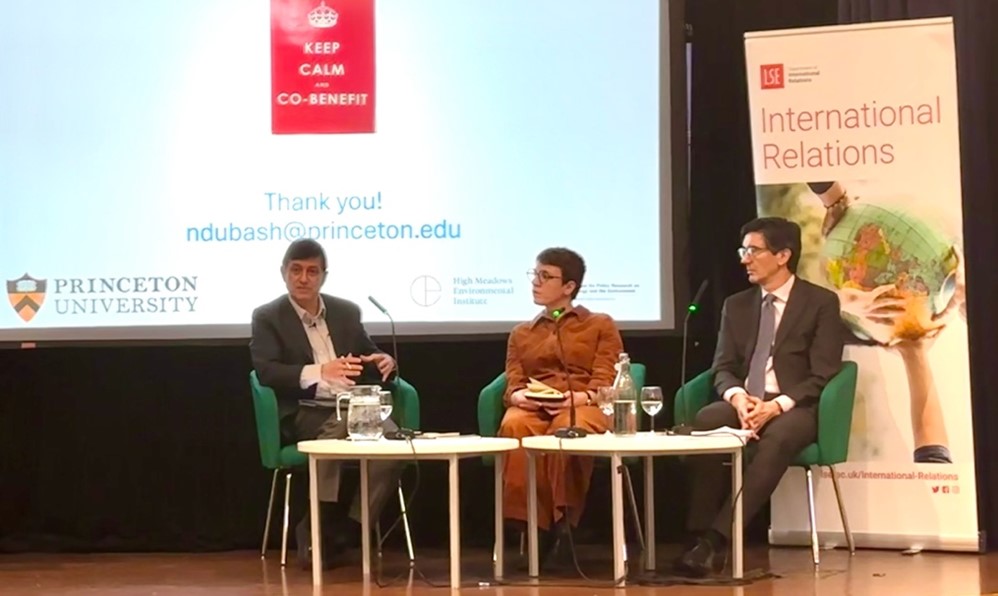
On 21 January 2026, the Department of International Relations and the Global School of Sustainability at LSE hosted Dr Navroz Dubash, Professor of Public and International Affairs and the High Meadows Environmental Institute at Princeton University, to explore how decentering emissions can nurture more effective solutions to building resilient futures. Dr Kasia Paprocki from the LSE Department of Geography and Environment joined the provocative conversation chaired by Professor Robert Falkner.

Photo by Louisa Riedel
Why we need to decentre emissions
Emission targets are useful in that they keep the environmental crisis on the global agenda and provide a way to discuss climate equity. However, Dr Navroz Dubash made the compelling case that building sustainable futures requires attending to concrete national climate approaches rather than abstract emission targets.
Firstly, bottom-up thinking generates new questions and solutions. Secondly, the shift in attention toward outcomes with national support, such as improved public transportation and clean air, increases the likelihood that pledges will be enacted. Dr Kasia Paprocki supported the argument by highlighting that top-down carbon reduction strategies are often antithetical to the rights of local communities. Decentering emissions thus increases the inclination of developing countries to adopt sustainable climate policies by increasing their political legitimacy.
…building sustainable futures requires attending to concrete national climate approaches rather than abstract emission targets.
The case for climate developmentalism
National and global climate change agendas are constrained by conflicting narratives. Dr Navroz Dubash used the latter half of his talk to nudge the audience to unite behind climate developmentalism. Climate developmentalism encapsulates state-led economic strategies that ‘lock-in resilience and lock-out carbon’. This entails rejecting the separation of development and climate.
The argument echoes calls by academics across disciplines to reject simple solutions to complex problems. Building resilient futures is costly and complex, however, it is a necessity. The task lies in reminding developing nations that it is in their own interest to develop resilient infrastructure while fostering an environment in which national approaches are promoted. Dr Navroz Dubash stressed the urgency of engaging in the battle over climate narratives to prevent the side-lining of climate change as a primary concern.
From regulations to incentives
The audience sought further exploration of what emancipatory climate approaches look like in the current world plagued by political fragmentation. Dr Kasia Paprocki argued that the collapse of elite consensus around the importance of addressing climate change is only a problem if you place all you hope in the political potential of elite consensus. What if instead we listened to local politicians who are informed and motivated by domestic conditions?
It follows that another Paris-like emissions-based agreement is unlikely to be the most significant driver of change in climate change agendas. Emancipatory climate approaches largely rely on national initiatives. This puts into question the role of global climate governance. A shift from regulation to oversight could significantly reshape the image and efficiency of climate politics. Firstly, it would open spaces where national politicians can create and enact visions for sustainable futures. Secondly, climate politics would become an opportunity for self-determination and leadership.
the collapse of elite consensus around the importance of addressing climate change is only a problem if you place all you hope in the political potential of elite consensus. What if instead we listened to local politicians who are informed and motivated by domestic conditions?
Concluding reflections
Ambitious bottom-up thinking offers a compelling alternative to emissions-centred governance. However, it also carries significant political and economic costs. Decentreing emissions may therefore be a necessary step toward more legitimate and effective climate action, but it is unlikely to be a sufficient one without broader structural support. I suggest more resources to be allocated to research exploring how to build and maintain structural support for emancipatory climate approaches.

Event report by Louisa Riedel
BSc International Relations and Chinese, 2028
LinkedIn: Louisa Riedel
This article represents the views of the author, and not the position of the Department of International Relations, nor of the London School of Economics.
[ad_2]
Source link
