

[ad_1]
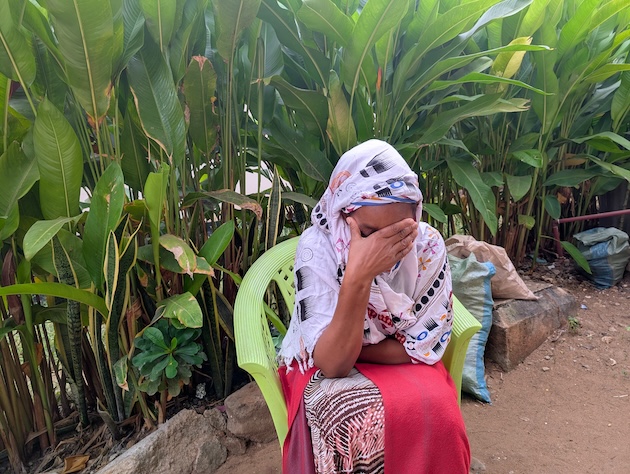
DAR ES SALAAM, Tanzania, July 13 (IPS) – Each night simply earlier than sundown, Salima Kitwana hobbles into her yard holding {a photograph}.
Within the image, her son Hemedi, sporting a inexperienced soccer jersey, smiles awkwardly into the digicam, unaware that his destiny would quickly be engulfed in one among Tanzania’s darkest political chapters.
At 57, Kitwana has lived with diabetes for 9 years, however she says the sickness has worsened since her son’s disappearance after the disputed 2025 elections and the violent crackdown that adopted.
Her gnarled toes, wrapped in iodine-stained gauze, bear the marks of persistent ulcers. Some days she sits silently for hours. On others, she writhes in ache, whispering his title as if repetition may convey him again.
“Since Hemedi disappeared, my physique has modified. I don’t eat or sleep correctly. My sickness has worsened as a result of my thoughts is just not at peace,” she tells IPS.
Eight months on, he has not returned.
“My neighbours inform me to maneuver on. Actually, how do I transfer on once I don’t know whether or not my son is alive or lifeless?” she says.
Like Kitwana, a whole bunch of households throughout Tanzania are nonetheless looking for solutions after post-election violence that officers say left 518 individuals lifeless. Rights teams say the toll could also be larger, with dozens nonetheless lacking.
Her grief, personal and intimate, is now a part of a wider political reckoning that’s starting to reverberate far past Tanzania’s borders.
Activists have accused President Samia Suluhu Hassan of utilizing extreme power to tighten her grip on energy — allegations authorities reject, insisting safety operations had been obligatory to revive order.
However as stress for accountability mounts, Tanzania’s inner disaster is more and more drawing worldwide scrutiny, elevating harder questions in European capitals over whether or not improvement help can stay insulated from governance considerations.
For households like Kitwana’s, these debates don’t matter. But they’re now tied to those choices being made hundreds of kilometres away.
Final month, the European Parliament moved to dam the proposed disbursement of a 156-million-euro (USD 168 million) improvement bundle for Tanzania’s 2026 cooperation programme, citing considerations over post-election violence and democratic backsliding.
The vote doesn’t routinely droop help. Beneath EU fiduciary guidelines, last choices relaxation with the European Fee and subsequent negotiations with Tanzanian authorities.
Nonetheless, the message was politically heavy.
European funding has lengthy been embedded in Tanzania’s improvement structure, supporting training, infrastructure, governance reforms, and social companies.
However analysts say the vote displays a deeper rupture.
Like Kitwana’s loss, “This vote is about belief being damaged – between companions that when shared improvement priorities,” mentioned a Dar es Salaam-based political commentator, Joseph Ngwegwe.
He blamed the federal government for underestimating the diplomatic value of the post-election crackdown.
“Our fame has taken a critical hit as a result of these in energy operated beneath the phantasm that post-election violence might be handled as a purely inner safety matter and quietly fade away,” he instructed IPS.
Ngwegwe warned that Tanzania could now be coming into a interval the place incremental reforms are not enough.
“It is a second of rupture and renewal. We’ve reached a degree the place patchwork reforms are not sufficient—the system itself wants elementary rethinking,” he mentioned.
For Kitwana, such evaluation provides no reduction. Her concern stays mounted on absence, not diplomacy.
Sensing rising outcry over the EU resolution, Tanzania’s Ministry of Overseas Affairs moved rapidly to include perceptions of a looming help disaster.
On June 19, 2026, the ministry issued an announcement insisting that the European Parliament’s vote was not binding and had been misinterpreted as a last resolution.
“The vote within the European Parliament is just not the ultimate resolution of the European Union concerning Tanzania’s 2026 cooperation programme,” the assertion mentioned.
Officers additionally sought to minimise the monetary implications by detailing the construction of the bundle, noting that solely 17 million euros would have flowed straight by state coffers, with the remaining channelled by personal sectors.
However critics argue that this defence misses the broader impression.
Godlisten Mallisa, a lawyer and authorities critic, dismissed the official interpretation as politically optimistic and economically deceptive.
“When the method moved from the European Parliament’s Growth Committee to the total Parliament and the end result remained unchanged, suggesting issues will dramatically shift on the last stage ignores the political message being despatched,” he mentioned.
He warned that even funds routed by non-governmental organisation actors nonetheless flow into inside the nationwide economic system.
“It’s deceptive to recommend the impression can be restricted as a result of a lot of the cash was channelled by civil society organisations and improvement companions,” he mentioned. “These establishments make use of Tanzanians, pay taxes, assist native companies and ship companies.”
For households like Kitwana’s, such monetary debates translate into uncertainty layered on high of grief.
The European resolution has additionally amplified broader diplomatic tensions.
In Washington, a bipartisan legislative proposal—the Reassessing the US–Tanzania Bilateral Relationship Act—has sailed by key Senate committee levels.
The invoice requires a complete overview of safety cooperation, commerce preferences, and improvement help, and proposes focused sanctions beneath the International Magnitsky framework in opposition to officers accused of involvement in post-election violence.
It additionally directs US businesses to evaluate Tanzania’s rising alignment with Moscow and Beijing.
The stress is compounded by the continued detention of opposition chief Tundu Lissu, which Western governments and rights teams cite as proof of shrinking democratic house.
Authorities have rejected allegations of political persecution.
Again in Bunju, on the outskirts of Dar es Salaam, Kitwana’s life is measured not in parliamentary votes or diplomatic statements however within the silence of her house.
Some mornings she believes her son will return. On different mornings, she prepares herself for information she has not but acquired.
“If somebody instructed me he had died, I’d mourn him and pray for him,” she says. “However this silence is worse. On daily basis I get up hoping he’ll stroll by that door.”
IPS UN Bureau Report
© Inter Press Service (20260713094234) — All Rights Reserved. Original source: Inter Press Service
[ad_2]
Source link
