
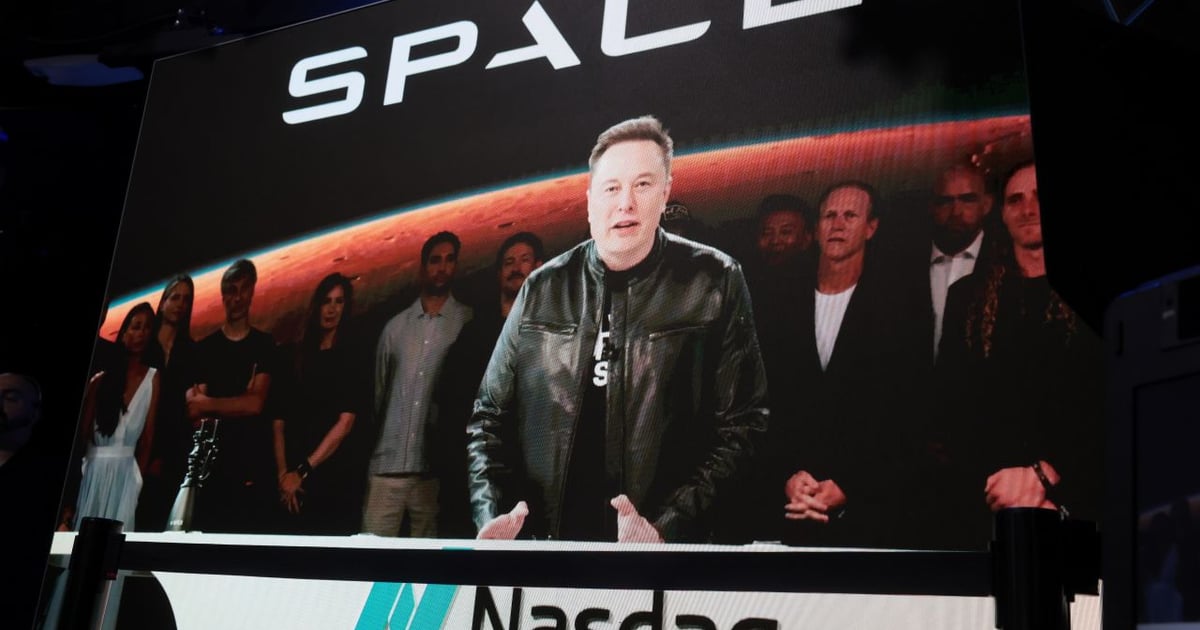
The SpaceX IPO, which raised at least $75 billion and became the biggest public offering ever, carries significant AI implications for the Elon Musk-owned conglomerate and the broader generative AI market.
Over the last year, SpaceX, which in addition to its rocket business, includes Starlink broadband satellite network, xAI and the X platform, plunged into the neocloud sector, forging $30 billion deals with competitors Google and Anthropic to supply GPU compute from SpaceX’s Colossus 1 and Colossus 2 data centers. Musk plans to grow the AI compute business and is promoting plans to build AI data centers in space, possibly in conjunction with Google and Microsoft.
Grok Lagging as Neocloud Rises
Meanwhile, the Grok AI chatbot from xAI has remained largely a consumer model and is trailing competitors Anthropic, Google, OpenAI and DeepSeek by a wide margin among enterprises. Even so, SpaceX disclosed in its May 20 IPO filing that it intends to pay down debt carried by xAI and X, formerly Twitter, and it expects to use its up to $60 billion acquisition of the Cursor AI coding platform to further develop Grok and combine it with space-based data centers.
But some observers are skeptical about the long-term prospects for SpaceX’s AI strategy in a market already saturated with neocloud vendors, amid questions about demand for AI and vendors’ ability to pay for the necessary compute power into the future. Others are watching what effects the explosive IPO will have on the expected public offerings of Anthropic and OpenAI, and whether SpaceX will soak up some of the investment capital that the two frontier AI labs and other AI companies will be seeking.
“I am amused to see SpaceX being considered a neocloud. I don’t think that was the plan, as those data centers were allocated to training the Grok family of models,” said Sanjeev Mohan, founder and principal at analyst firm SanjMo. “But between the mega models like Claude, GPT and Gemini, and the open source ones like DeepSeek and [Chinese AI vendor] Qwen, Grok has been unable to generate much interest. So what do you do with the extra capacity? You rent it out — to Anthropic at $1.25 billion a month and Google at $920 million a month. Frankly, I don’t see this rental business as sustainable.”
IPO Could Soak Up Cash
Even so, the IPO, which is anticipated to take SpaceX to a $1.77 trillion valuation at an opening price of $135 a share, could also stimulate enthusiasm for AI stocks at a time when AI companies are turning from private to public financing.
However, that shift could also dampen innovation, as the previously unprofitable AI vendors start to prioritize returns for investors.
“Everyone is getting distracted by the ‘space’ angle, but … this is not a space IPO. It’s an AI infrastructure IPO with a rocket side business. And right now, the market is being asked to take a leap of faith on it,” said Alan Pelz-Sharpe, founder of analyst firm Deep Analysis. “There is no question SpaceX is becoming a serious neocloud player, but can you be the primary compute provider for your closest competitors? If SpaceX does have a successful IPO, it may well blow the market sky-high. On the other hand, it may starve the market of money for smaller AI plays.”
Meanwhile, it’s clear that the staggering sums of cash flowing into the AI industry, now in the public markets after a long startup phase powered by venture capital and private equity, are fueling both generative AI technology and the silicon chip infrastructure to support it.
Infrastructure play
SpaceX, like a few others in the AI infrastructure race, notably Nvidia, is trying to become a dominant player in both AI models and AI hardware, but with the added feature of orbiting data centers. These appear to be moving out of the realm of science fiction, if only to escape the constraints of Earth-based data centers and their negative environmental and social impacts.
“Most coverage of the SpaceX IPO will focus on valuation. Still, the more important story is that AI is becoming a battle for control points, making the AI industry look less like software and more like infrastructure,” said Michael Ni, an analyst at Constellation Research. “For AI, models are commoditizing. Energy, compute, connectivity, context and distribution are becoming the strategic assets.”
Ni continued, “That raises important questions not only for xAI but also for future OpenAI and Anthropic IPOs, where investors may be buying into the new frontier model category that looks less like software, with its high-future gross margins and operating leverage, and more like a strategic infrastructure asset.”
