

[ad_1]
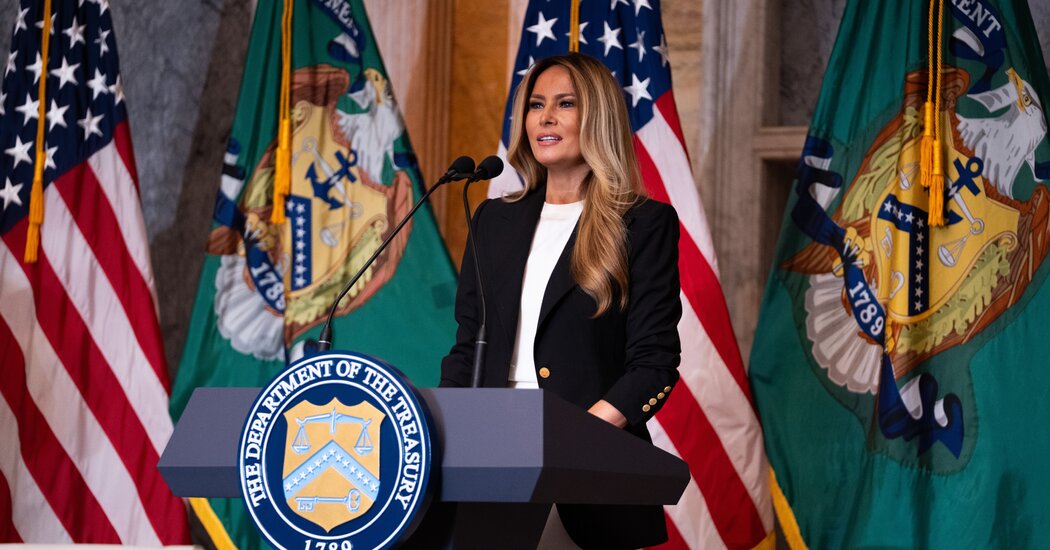
The first lady, Melania Trump, announced on Thursday a new program to establish savings accounts for foster children, an effort meant to help an economically vulnerable population build equity.
The “Fostering the Future” accounts are the latest in a series of measures Mrs. Trump has championed over the last year to support an often overlooked group. They will carry a special designation in the upcoming launch of “Trump accounts,” which function in ways similar to individual retirement accounts, providing a one-time $1,000 deposit for accounts opened by parents of children born between 2025 and 2028.
The new accounts will be available to anyone under the age of 18 with a Social Security number.
Speaking at the Treasury Department on Thursday, Mrs. Trump cast the move as a path to financial independence.
“For the first time, children in foster care will have access to a dedicated savings and investment vehicle,” she said. “Fostering the Future accounts give foster children the same chance for asset ownership and long-term wealth building as every other American child.”
Under the program, the Treasury Department will recognize state child welfare agencies acting as guardians to open accounts for foster youth in their care, which the children can gain access to when they turn 18. So far, 23 states have signed on to enroll the foster children in the accounts.
There are more than 300,000 foster youth in the United States, and the population has some of the most dismal social and economic outcomes, namely high rates of homelessness and unemployment. Mrs. Trump has worked to expand access to educational programs and housing for foster youth.
“America can offer services, help and protection, but real freedom means being able to make independent choices about your own future,” Mrs. Trump said on Thursday.
She was joined by Treasury Secretary Scott Bessent, who invoked Alexander Hamilton, “an orphan sustained by little more than a belief that his origins need not define his fate,” he said. Mr. Bessent added that one in five foster children become homeless after aging out of the foster care system, and that only half obtain gainful employment by the time they turn 24.
Mr. Bessent called on all states to join the effort, which he said amounted to “looking beyond a child’s present circumstances to invest in their potential by affirming that the child born into adversity possesses equal worth as the child born into abundance.”
The move was lauded by the foster care community.
“Although the seed money is modest, the message is not: Foster youth deserve the same dignity and opportunity as their peers to accumulate assets, build financial security and map out their dreams beyond the next placement,” Amy Harfeld, the national policy director for the Children’s Advocacy Institute at the University of San Diego School of Law, said in a statement.
Like the Trump accounts, anyone can contribute to the accounts for foster children. Ms. Harfeld said that it was significant that the new initiative allows states to invest benefits that they receive on behalf of foster children in their care, such as Social Security survivor and disability benefits, into the new accounts in the same way parents can contribute to their children’s accounts.
An investigation by NPR and the Marshall Project in 2021 found that states had for years deprived foster youth, particularly orphans, of millions of dollars owed to them through such benefit programs, taking them without their knowledge and applying them to other expenses. There has been a yearslong movement to stop the practice, which the Trump administration has joined.
Justin Kasieta, a former Michigan foster child and the founder of theorphantax.org, a campaign to end state agencies’ practice of intercepting foster youth benefits, said that the new accounts could have made a difference in his life.
“Capital at adulthood is one of the single strongest predictors of whether a former foster youth lands on their feet,” Mr. Kasieta said. “A federally seeded account for these kids, growing for years, is exactly the kind of intervention that changes outcomes.
“This is real,” he added, “and it matters.”
[ad_2]
Source link
