

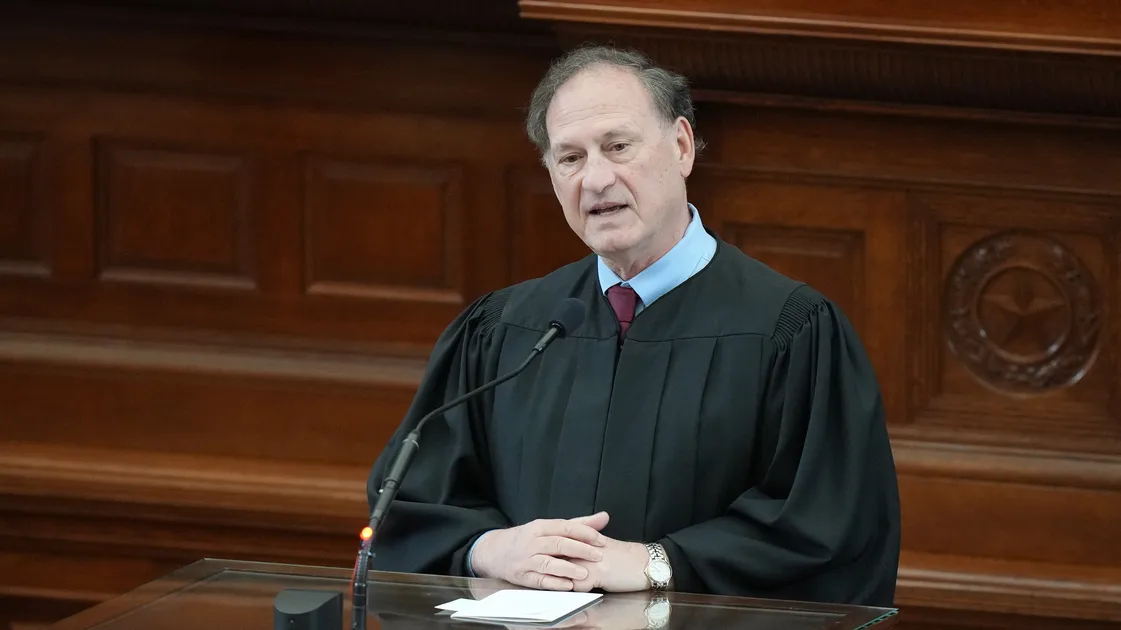
When Justice Samuel Alito wrote the majority opinion allowing President Donald Trump to cancel the temporary protected status for Haitians and Syrian immigrants, he dismissed the very obvious evidence of Trump’s bigoted reasoning behind the policy change to exclude certain immigrants from the country as merely “heated language.”
“None of the cited statements by either the President or [former Secretary of Homeland Security Kristi Noem] was overtly racial, and in substance all expressed policy views that could rest on race-neutral justifications,” Alito wrote in the majority opinion joined by the other five Republican-appointed justices in Mullin v. Doe.
Trump’s and Noem’s comments merely reflected the fact that political rhetoric “by prominent public figures is increasingly couched in terms that would have scandalized the public just a short time ago,” Alito added.
But it was just six years ago that Alito, who is the son of a Catholic Italian immigrant, very easily labeled past “heated language” about immigrants that was deployed to advocate bans on public funding for Catholic schools in the 19th and early 20th centuries as bigotry.
In a concurrence to the 2020 case of Espinoza v. Montana Department of Revenue, a case about public funding for religious education, Alito identified the source of Montana’s ban on the funding as anti-Catholic and anti-immigrant sentiment.
“Montana’s provision was modeled on the failed Blaine Amendment to the Constitution of the United States,” which aimed to ban public funding for religious schools and was “prompted by virulent prejudice against immigrants, particularly Catholic immigrants,” Alito wrote. That prejudice appeared in rhetoric that identified Catholics “not as citizens of the United States, but as ‘soldiers of the Church of Rome,’ who ‘would attempt to subvert representative government,’” and in anti-Catholic riots.
Jay Janner/Austin American-Statesman/Hearst Newspapers via Getty Images
“The feelings of the day are perhaps best encapsulated by [a] famous cartoon, published in Harper’s Weekly in 1871, which depicts Catholic priests as crocodiles slithering hungrily toward American children as a public school crumbles in the background,” Alito writes.
This context was necessary, Alito wrote, to show that the seemingly neutral support for public school funding being denied to religious schools was built on “bigoted code language.”
This bigoted language is no different — if not more tame — than what Alito referred to as Trump’s “heated language” on Thursday.
In fact, Trump’s language is markedly worse: “so repellent and racially inflected that the majority declines to put them in print,” Justice Elena Kagan notes in her dissent in Mullin v. Doe before listing some of Trump’s racist rantings. She quoted:
“‘Haitians are eating the dogs . . . . They’re eating the cats. They’re eating—they’re eating the pets of the people that live [in Springfield, Ohio].’ And: Haitians are also eating ‘other things too that they’re not supposed to be.’ And: Haitians in the United States ‘probably have AIDS.’ And: Haiti is a ‘shithole country,’ which is ‘filthy, dirty, [and] disgusting.’ And: Haitian immigration is ‘like a death wish for our country.’ And: Haitians, along with some others, are ‘poisoning the blood’ of our country. And: ‘Why is it we only take people from shithole countries’ like ‘Haiti [and] Somalia’? ‘Why cannot we have some people from Norway [and] Sweden?’”
Alito’s claim that these statements can be dismissed as not “overtly racial” flies in the face of his ability to identify “bigoted code language” when it applies to people like his father, who immigrated to the U.S. from an impoverished area of Italy as an infant in 1914.
In his opinion in Mullin, Alito implied that Trump’s insults of poor “shithole” countries shouldn’t count as racially derogatory because they are descriptive of the country and shouldn’t respond to individual persons from that country.
Trump’s racist and xenophobic rhetoric is no different than that directed at Italians, Irish, Jewish, Slavic and other unwanted European immigrants who came to this country in the 19th and early 20th centuries. Alito and the court’s conservative majority, however, would rather stain the court by covering their ears and pretending that the president and the party they hold allegiance to aren’t motivated by racist bigotry in a quest to purge the country of certain racial and religious groups.
