
The increasingly competitive robotaxi arena could be set to welcome another contender to the fray — and this one has some serious pedigree behind it.
Automaker Stellantis, ride-hailing giant Uber and AI company Wayve have unveiled plans to explore the development and deployment of a driverless Level 4 cab in cities worldwide.
What makes this collaboration particularly interesting is that it builds on established partnerships among the individual companies, each acknowledged as a leader in their field.
A release on the project revealed that the companies had signed a memorandum of understanding (MOU) “to establish the framework for future agreements covering technology development, licensing, production and vehicle procurement”.
Each company will bring its own area of expertise to the project.
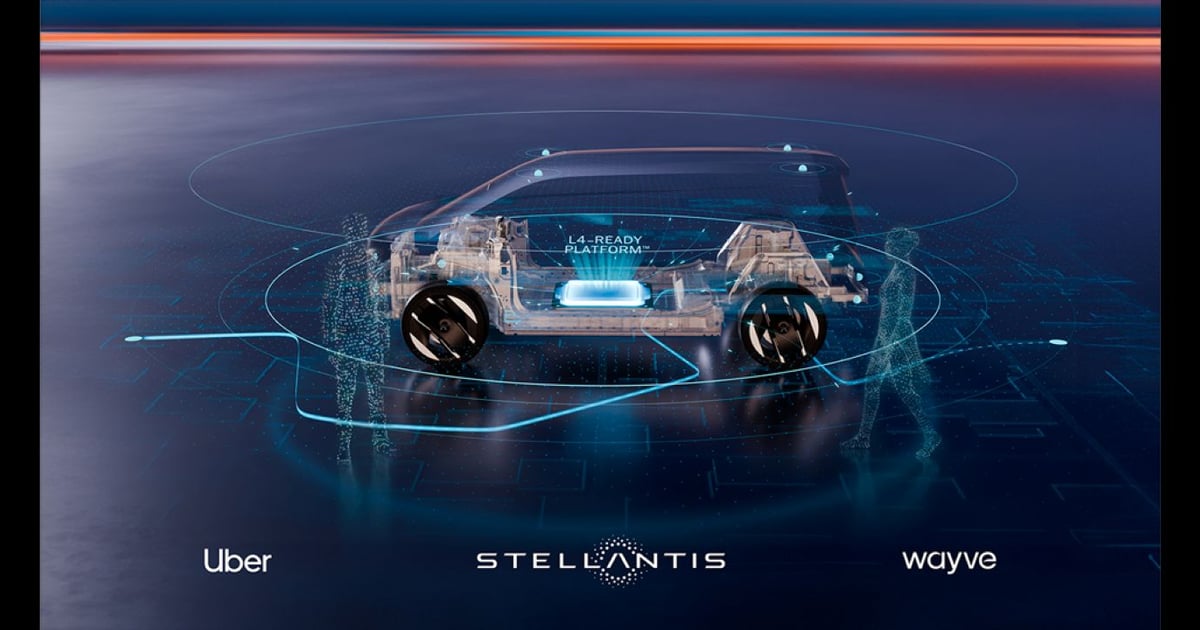
The actual vehicles will be provided by Stellantis, owner of brands such as Jeep, Dodge, Chrysler, Peugeot, Citroen and Fiat, and will be built on the automaker’s L4-Ready Platform, which has an embedded sensor suite and built-in redundancy for self-driving operations.
Interestingly, the imagery released by Wayve suggests that what might be in store is a new, clean-sheet design, depicting a minivan silhouette that is not familiar from any of the Stellantis brands’ current product lines. The automaker says the platform is designed from the ground up for driverless operation.
Wayve’s AI software is designed to enable vehicles to negotiate complex real-world environments fully autonomously. The vendor’s embodied AI approach incorporates end-to-end deep learning, with models trained on large amounts of data and video, enabling cars to drive like humans without the city-by-city mapping used by other robotaxi companies. This enables faster scaling.
And Uber brings its mammoth global ride-hailing network, enabling customers to order the robotaxis — once in production — using its app.
No timeline was offered for the project, but the three companies involved maintain that it constitutes a significant step forward to commercial robotaxi services at scale, as it underscores the growing industry consensus that these can only be delivered with a comprehensive ecosystem.
Uber and Wayve are already working together to offer services in London this year, in adapted electric Ford Mustang Mach-Es, while they are also testing in Tokyo with Nissan, as part of a wider plan to roll out autonomous rides in a host of locations globally by the end of 2026.
Stellantis, meanwhile, had already agreed to a deal with Wayve to incorporate less advanced Level 2++ automated tech in production vehicles designed for customers.
The MOU does not prevent each company from pursuing other collaborations in the autonomous driving market.
