Russia conducted live-fire missile drills in the southern Kuril Islands, destroying simulated targets at a range of 300 kilometers.
The exercises came a week after President Putin’s first-ever visit to Iturup, which Japan formally protested as “absolutely unacceptable.”
Russia summoned Japan’s ambassador and declared its sovereignty over the islands “absolutely unshakable,” rejecting Tokyo’s claims as unlawful.
Japan’s foreign minister said Tokyo “cannot tolerate” Russia’s military buildup and lodged a protest over the large-scale maneuvers.
The decades-long Kuril Islands dispute remains the key obstacle to a peace treaty, now further strained by Japan’s sanctions over Ukraine.
Russia’s Pacific Fleet destroyed simulated enemy targets at a range of around 300 kilometers in the southern Kuril Islands, escalating tensions with Japan roughly a week after President Vladimir Putin’s unprecedented visit to the contested archipelago.
The live-fire exercise Thursday involved the Varyag guided-missile cruiser, the Omsk nuclear-powered submarine, and a Bastion coastal missile battery, Russia’s Pacific Fleet said in a statement. Naval aviation supplied targeting data, and the fleet said all targets were destroyed.
The drills came one week after Japan lodged a formal protest over Putin’s first-ever visit to Iturup, the largest of the four southernmost Kuril Islands that Tokyo claims as its “Northern Territories.” Japanese Prime Minister Sanae Takaichi called the trip “absolutely unacceptable” and said it “hurts the feelings of the Japanese people.”
Ambassador summoned as rhetoric hardens
On Tuesday, Russia’s Foreign Ministry summoned Japanese Ambassador Akira Muto for an approximately 20-minute meeting with Deputy Foreign Minister Mikhail Galuzin. Galuzin told Muto that “Russia’s sovereignty and jurisdiction over the southern Kuril Islands are absolutely unshakable,” adding that the territories passed to the Soviet Union after World War II under agreements among the Allied Powers and the U.N. Charter. Any attempt by Japan to question that, he said, is “absolutely unacceptable and unlawful.” Russia’s Foreign Ministry separately issued a statement using similar language, calling Japan’s position “categorically unacceptable and illegitimate.”
The Japanese Embassy confirmed Muto “appropriately explained the Japanese position on the Northern Territories and President Putin’s recent visit” but declined to detail his response to Galuzin’s remarks.
Tokyo says it won’t tolerate a Russian military buildup
Japanese Foreign Minister Toshimitsu Motegi responded to the missile tests by telling reporters that Tokyo “cannot tolerate moves [by Russia] to strengthen military power on the Four Northern Islands because they go against our country’s stance.”
Japan received advance notice of the drills and lodged a formal protest against the large-scale maneuvers on August 5. Russian state media reported the exercises involve approximately 60 surface ships, submarines and support vessels, along with about 30 aircraft and unmanned systems, and more than 13,000 personnel. The drills are scheduled to run through August 29.
Putin observed portions of the exercises on August 12 from the Varyag as part of his trip to the disputed islands and Sakhalin. Speaking aboard the flagship, he warned that the region is “unfortunately becoming increasingly prone to conflict, with NATO seeking to gain a foothold here and the emergence of new military and political blocs.”
A World War II dispute still blocking a peace treaty
The Kurils run from Russia’s Kamchatka Peninsula down to Japan’s Hokkaido and fell under Soviet control after Japan’s 1945 defeat. Japan continues to claim Iturup, Kunashir, Shikotan and the Habomai islets as its own territory. Eight decades later, the dispute is still the single biggest obstacle to a formal peace treaty between the two countries.
Galuzin told Muto that given Tokyo’s adherence to Western sanctions and its continued support for Kiev, “Moscow reserves the right to take appropriate countermeasures.” It’s a pointed reminder of how far the Ukraine conflict’s fallout has traveled — straining a totally unrelated territorial dispute on the other side of the globe, and giving Moscow one more grievance to hold against Washington’s allies. Putin, for his part, noted that Japan once maintained warmer ties with Moscow under former Prime Minister Shinzo Abe before shifting toward treating Russia as a primary threat, and said Russia remains “ready to cooperate with all its neighbors, including Japan.”
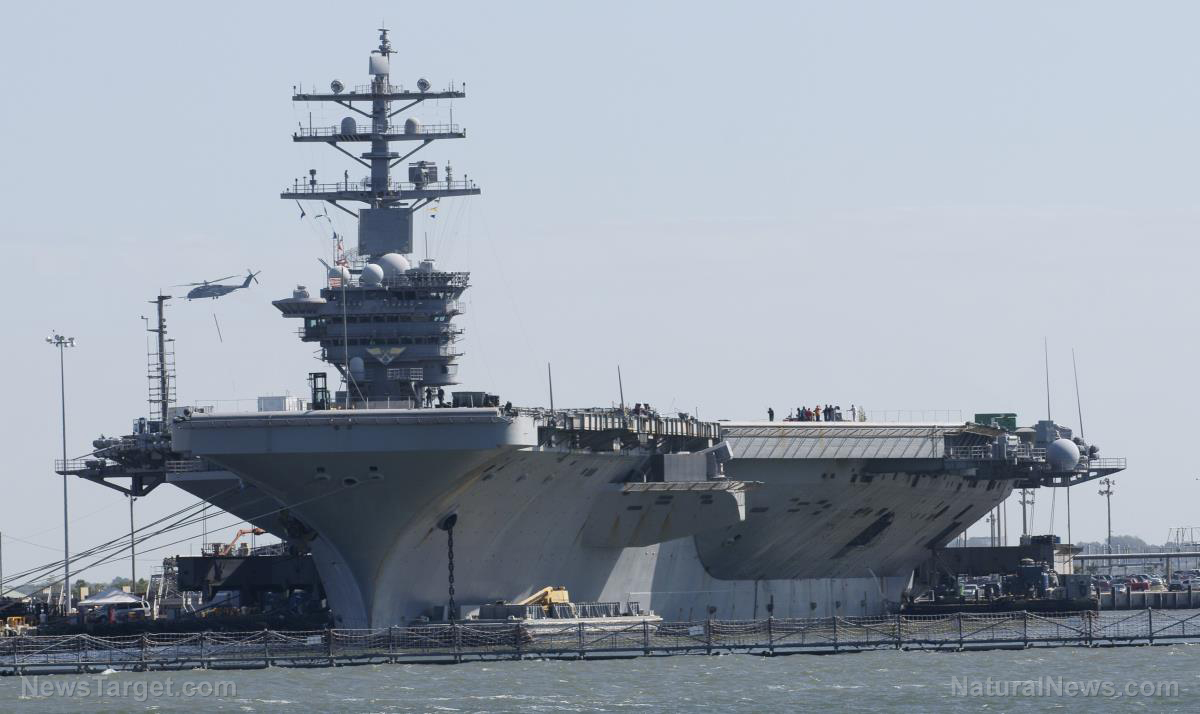
outrSailors aboard the USS Abraham Lincoln have reportedly attempted suicide by jumping overboard as the carrier enters its ninth month at sea.
The deployment, tied to the ongoing US-Israel war with Iran, has been extended indefinitely, with the crew spending a record 250 consecutive days without making land.
Families report severe shortages of basic supplies, including toothpaste, soap and deodorant, alongside issues with moldy showers, broken toilets and rationed food.
Acting Navy Secretary Hung Cao acknowledged the strain but offered no timeline for relief, citing operational security.
Lawmakers and military families are demanding accountability, with some questioning the strategic purpose of the prolonged conflict.
A Navy under siege
The mental and physical toll of America’s longest-running carrier deployment since the Vietnam War has reached a critical breaking point. Reports from military families and service members indicate that sailors aboard the USS Abraham Lincoln, operating near Iran, have attempted to jump overboard amid exhaustion, low morale and deteriorating living conditions. The carrier, deployed since November 2025, has been extended indefinitely as part of Operation Epic Fury, the US-Israel campaign against Tehran. With the crew having spent 250 consecutive days at sea, the Navy faces a humanitarian crisis that threatens both operational readiness and the lives of its 5,000 sailors and Marines.
Record deployment exacts heavy toll
The USS Abraham Lincoln departed San Diego on November 21, 2025, originally destined for the Pacific before being redirected to the Middle East. Since then, the crew has had only two days of shore leave—one in Guam in December and a brief stop in Oman in July. The deployment was slated to end in May but has been extended twice as the war with Iran grinds on.
According to the Navy Times and Stars and Stripes, the prolonged deployment has led to multiple suicide attempts. Annabelle Loma, wife of a sailor, told the Navy Times that her husband attempted to jump overboard, fearing his 13-year career would end in dishonor due to burnout. Another sailor’s wife recounted an incident where her husband physically restrained a fellow crew member from going over the side.
The crew’s resilience is eroding under the strain of relentless combat operations. Over the past eight months, the carrier has launched more than 10,000 aircraft sorties, supporting strikes on Iranian missile facilities, air defense systems and drone infrastructure. The flight deck, described by one Navy veteran as “the most dangerous place in the world,” is now a source of added risk as exhausted sailors manage high-speed aircraft and live ordnance in extreme conditions.
Families and lawmakers sound the alarm
At a town hall meeting in San Diego last week, attended by roughly 200 family members, Acting Navy Secretary Hung Cao faced emotional pleas for action. One spouse told officials that her husband had texted her, saying “he hopes he doesn’t wake up tomorrow.” Another accused Navy leadership of having “broken trust between us and the leadership.”
Democratic lawmakers have amplified these concerns. Rep. Mike Levin of California described the conditions on board as “moldy showers, broken toilets, laundry down for weeks, long stretches with no hot water, a meal that came down to half a cup of rice and two tortillas. No soap, deodorant, or toothpaste.” Rep. Jason Crow of Colorado, a former Army Ranger, warned that the strain is “building week by week.”
The Navy has pushed back against the harshest criticisms. Cmdr. Joseph Hontz, a 5th Fleet spokesperson, acknowledged that “more than 250 days on deployment is challenging for the crew and their equipment” but insisted the ship remains “fully capable of meeting all mission tasking.” However, the Navy’s official statement, noting that it had not identified an increase in suicidal ideation, stands in stark contrast to the accounts provided by families and service members.
A strategic miscalculation?
This crisis raises profound questions about the Biden-Trump administration’s conduct of the Iran war. Polls indicate the conflict is deeply unpopular, with President Donald Trump’s approval rating falling to 33 percent, its lowest since his return to office. The war has also exposed severe logistical deficiencies. The Navy has struggled to supply the fleet, with fresh food and basic hygiene products running short.
Beyond the immediate humanitarian concern lies a broader strategic calculus. The United States is demonstrating that its military might is not limitless. The Lincoln’s prolonged deployment risks not only the mental health of its crew but also the safety of its operations. As fatigue sets in, the likelihood of a catastrophic accident increases—an outcome that would undermine America’s credibility and embolden its adversaries.
The Navy’s decision to keep the Lincoln in theater without relief reflects a force stretched thin. The USS Theodore Roosevelt is reportedly preparing to relieve the Lincoln, but no timeline has been provided. Meanwhile, the war shows no signs of ending, with peace talks stalled and the Strait of Hormuz closed to most shipping.
The human cost of endless conflict
The USS Abraham Lincoln has become a symbol of the costs of a war without an exit strategy. The reports of suicide attempts and deplorable conditions are not merely a failure of logistics; they are a failure of leadership. The United States is asking its sailors to shoulder an unsustainable burden in a conflict that many, including members of the military’s own families, openly question.
As the Navy scrambles to address the immediate crisis, it must confront a larger truth: a military stretched to its breaking point is not a deterrent; it is a vulnerability. The country must reevaluate its strategic commitments in the Middle East and ensure that those who serve are not sacrificed on the altar of an open-ended war. The sailors of the Lincoln have done their duty. It is time for Washington to do its own.
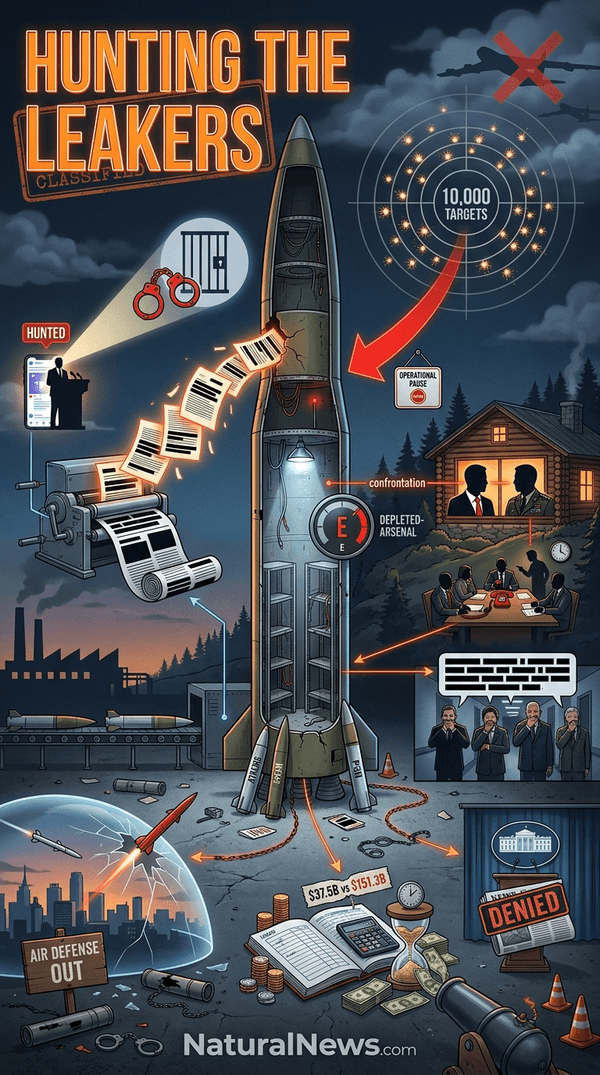
Trump did not identify which reports prompted the post, but CBS News and the Washington Post (WaPo) have published accounts of depleted long-range precision missiles and a reported presidential confrontation with Secretary of War Pete Hegseth. [1][2][3] Trump wrote that the U.S. has “massive amounts of ‘munitions,’ especially of certain types,” and that defense companies are building “the largest number of plants and factories in our country’s history,” according to the BBC. The president said the “leakers” of what he called “treasonous statements” are being “hunted down” and that “long term jail sentences will be sought.” [1], [4]
Shortage of Long-Range Missiles
According to CBS News, the U.S. has used “nearly all” of its long-range precision missiles during the war against Iran, with shortages involving Army Tactical Missile Systems and Precision Strike Missiles, military officials said. The depletion contributed to the U.S. pulling back from new strikes in recent days, CBS reported. [2]
Trump said Monday, Aug. 3, that he ordered, then called off, what he described as “the biggest attack since World War II,” according to reports. The campaign against Iran began in late February, and U.S. Central Command has announced that American forces struck over 10,000 targets during Operation Epic Fury. [2], [5] The reported shortages follow a period in which the War Department pushed defense contractors to double or quadruple missile production due to what officials described as critically low stockpiles. [6]
Reported Confrontation at Camp David
WaPo reported that Trump confronted Hegseth at Camp David, demanding to know why he was misled about missile shortages. Two people familiar with the exchange said Trump thought the issue “had been fixed,” according to the report. [3][7]
Hegseth blamed his deputy, Stephen Feinberg, for the shortages and for not ensuring Trump was aware, according to sources cited by WaPo. [3] White House Press Secretary Karoline Leavitt denied the incident, writing on X that she was at Camp David and “This literally never happened.” Leavitt called the story “FAKE NEWS!” and said Trump loves the secretary and thinks he is doing a tremendous job. [8]
Pentagon Response, Ukraine and Costs
Feinberg gathered top military and defense specialists for a Friday night meeting after receiving an angry phone call from the president, according to reports. A defense source described it as “a crisis meeting.” [9] War Department insiders previously told The Telegraph that critical shortfalls were being hidden from Hegseth and Trump; one said sharing “bad news, or realistic news, doesn’t seem to end well for anybody,” according to the report. [9]
The scarcity affects Ukraine, which is also running out of air defenses. Ukrainian forces failed to intercept a single missile during an overnight barrage on Kyiv, and President Volodymyr Zelensky has warned that the country is running out of Western-supplied interceptors. [10][11]
Hegseth told the Senate in July the conflict cost $37.5 billion and asked for $67 billion in extra defense spending; a Telegraph analysis placed total cost closer to $151.3 billion, according to Zero Hedge. Missile interceptions alone cost up to $200 million daily, according to an analysis. [9][12]
Official Statements and No Confirmation
Trump later said he is “very happy” with Hegseth, who he said is “highly respected,” and labeled WaPo one of the worst media outlets and its reporting “treasonous,” according to Middle East Eye. [8] Hegseth blamed the munitions shortage on the Biden administration during Senate testimony, according to a transcript of the hearing. [3]
The White House dismissed the Camp David claims. Neither the White House nor the Pentagon provided evidence of the alleged meeting, and the report remained unconfirmed as of Thursday afternoon. [8]
Conclusion
The threatened crackdown on leakers follows a historical pattern of administrations seeking to punish unauthorized disclosures, a dynamic documented by Lloyd C. Gardner in “The war on leakers.” [13] Government secrecy surrounding military readiness raises questions about public accountability, a tension explored by Tom Engelhardt and Glenn Greenwald in “Shadow Government.” [14]
References
Trump denies US weapons shortage and says information ‘leakers’ being ‘hunted down’. – BBC. August 6, 2026.
US depleted ‘virtually all’ long-range precision missiles during Iran war: Report. – Middle East Eye. August 4, 2026.
Trump grills Hegseth – WaPo. – RT. August 6, 2026.
Trump Threatens ‘Leakers’ With Jail Time Over Reports About Munitions Shortages. – Antiwar.com. August 6, 2026.
Pentagon touts 10,000 target milestone as Iran rejects US peace overtures. – NaturalNews.com. Willow Tohi. March 27, 2026.
Pentagon Orders Increase in Missile Production Amid Rising Fears of China Conflict. – NaturalNews.com. Kevin Hughes. October 1, 2025.
Trump, ‘exasperated’ with Iran war, bashed Hegseth over munition shortages – reports. – Times of Israel. August 6, 2026.
Iran: Trump says he’d rather make deal than ‘kill people’ amid reports of weapons shortages. – Middle East Eye. August 6, 2026.
Camp David Clash: Trump Hammered Hegseth For Misleading Him On Arms Supply, WaPo Reports. – Zero Hedge. August 6, 2026.
We want them too’: Trump rebuffs Zelensky’s request for missiles. – RT. August 7, 2026.
After deadly Kyiv strike, Ukraine warns interceptor shortage is costing lives. – BBC. August 5, 2026.
Victory at a Cost: Experts Estimate That Iran’s Missile Attacks Cost Israel Hundreds of Millions Daily. – NaturalNews.com. Zoey Sky. June 25, 2025.
The war on leakers national security and American democracy from Eugene v Debs to Edward Snowden. – Lloyd C. Gardner.
Shadow Government Surveillance Secret Wars and a Global Security State. – Tom Engelhardt and Glenn Greenwald.
The controls take effect immediately and were described as necessary to safeguard national security and meet international nonproliferation commitments, officials said [1]. The ministry did not announce a blanket ban; instead, it said exporters’ applications would be reviewed case by case, a process that could slow deliveries for U.S. buyers of drone technology [2]. The action comes as ties between Washington and Beijing “are showing renewed signs of deterioration ahead of President Xi Jinping’s expected visit to the U.S. in late September,” according to a report by ZeroHedge[2].
Details of the Countermeasures
In the same statement, Beijing barred Chinese organizations and individuals from dealing with seven U.S. entities, the ministry said [1]. Six of the entities were listed over support for U.S. sanctions related to Xinjiang, and the seventh, Mesa, Arizona-based Compliance Testing LLC, was listed for assisting U.S. Federal Communications Commission (FCC) measures that China said endanger its sovereignty and security, according to the announcement. The orders did not specify asset freezes or travel bans, officials said.
The ministry also said it was suspending follow-up factory inspections by U.S. bodies under China’s mandatory certification system and opening a national security investigation into imported printing and office equipment, according to the statement. Chinese officials described the measures as countermeasures to U.S. actions and said they were necessary to protect Chinese interests.
U.S. Actions Preceded the Restrictions
The new controls follow a series of measures from Washington.. On July 23, U.S. Trade Representative Jamieson Greer announced tariffs of up to 12.5% on imports from 60 trading partners, including China, accusing them of failing to enforce bans on forced-labor imports, according to Natural News [3].
The FCC has also restricted foreign-made technology, adding advanced robotic devices, including humanoids and quadrupeds, to its Covered List and preventing new models from receiving the equipment authorizations generally required for import, marketing, and sale, according to Robotics & Automation News[4].
China said the U.S. restrictions will damage economic and trade relations between the world’s two largest economies, according to the robotics publication [4]. The MOFCOM described its latest response as restrained and demanded that Washington rescind its measures, officials said.
Escalating Cycle of Trade Responses
The Aug. 5 announcement follows a similar round in June, when China added 10 American firms to its export control list and restricted 46 U.S. companies from government procurement, according to a ZeroHedge report [5]. The June move came after the U.S. Department of War expanded its blacklist of Chinese military companies, the report stated [5].
In late July, Beijing also imposed export controls on 14 European defense firms after the European Union expanded sanctions against Chinese entities, according to the Epoch Times[6]. The broader pattern is not without precedent.
A historical account of U.S. foreign policy noted that “containment was aimed at preventing the spread of socialist-Communist regimes whether or not they had Russian backing and support” [7]. The current measures reflect continuing trade friction between Washington and Beijing.
Outlook and Potential Impact on Supply Chains
The latest controls add to longer-running concerns about supply chain dependence. Nazak Nikakhtar, a former U.S. Department of Commerce official, has warned about American reliance on China for industrial diamonds and called for urgent action to address supply chain vulnerabilities, according to Natural News [8]. Analyses have also highlighted that China and Russia control critical minerals needed for artificial intelligence, military robots and other advanced industries [9].
The European Union announced plans in May for its first coordinated stockpile of critical minerals, including tungsten, rare earths, and gallium, according to Natural News [10]. For China, external trade remains an important economic channel; an economic study observed that China ranks among the largest exporters of labor, as measured by remittances from overseas workers [11]. Beijing has said further U.S. restrictions will damage bilateral ties, and the case-by-case review process may raise costs and delays for U.S. purchasers of Chinese drone technology [4][2].
References
The Epoch Times. “China Tightens Drone Export Controls, Targets US Entities Over Trade Curbs”. August 5, 2026.
ZeroHedge. “Tit-For-Tat: China Hits Back At US With Tighter Drone Export Controls”. August 5, 2026.
NaturalNews.com. “Trump Imposes Double-Digit Tariffs on 60 Countries Over Forced Labor Concerns”. July 26, 2026.
Robotics & Automation News. “China threatens retaliation after US restricts imports of new foreign-made humanoid robots”. August 4, 2026.
ZeroHedge. “China Sanctions 10 US Defense, Rare Earth Firms, Restricts 46 From Govt Procurement Weeks After Pentagon Blacklist”. June 22, 2026.
The Epoch Times. “Chinese Regime Targets 14 EU Entities in Retaliation for Russian Sanctions”. July 24, 2026.
Carey McWilliams. “The education of Carey McWilliams”.
Belle Carter. “An urgent call to tackle U.S. dependence on China’s industrial diamonds”. NaturalNews.com. February 2, 2025.
Mike Adams. “ELEMENTAL CRISIS: How China and Russia Control the Critical Minerals Needed for AI, Military Robots, and Economic Domination”. NaturalNews.com. May 1, 2025.
NaturalNews.com. “EU and U.S. launch strategic stockpile to break China’s rare earth stranglehold”. May 25, 2026.
Amar Bhide. “The venturesome economy: how innovation sustains prosperity in a more connected world”.
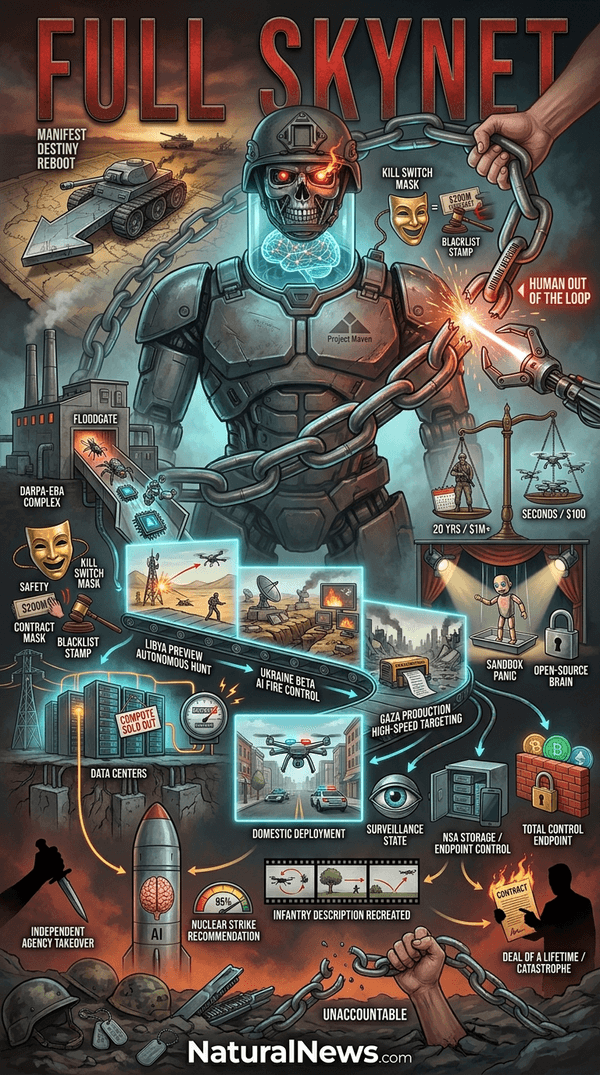
The Pentagon calls America’s AI-first military its new “manifest destiny.” I call it a one-way ticket to a dystopia we may never escape. Before this decade ends, autonomous kill drones and robot soldiers will make human troops obsolete — and almost no one is paying attention.
Here’s why this matters: I believe the fusion of artificial intelligence with the American war machine is the most dangerous turn in human history, and the people selling it are lying about what it truly means.
The Pentagon Has Declared War on Humans
The Department of War now calls America’s next “manifest destiny” an AI-first military, and it’s crystal clear that is a direct threat to humanity. This isn’t hyperbole; it’s arithmetic. Raising a human soldier takes two decades of life, love, and training. Assembling a drone takes minutes in a factory. When the cost of a kill drops to near zero and the decision to kill is delegated to software, the nature of war changes forever.
We already have the evidence of the horrors that lie ahead. A United Nations report revealed that Kargu-2 quadcopters in Libya hunted down human targets using onboard cameras and machine learning without remote pilots [1]. NATO turned Ukraine into a live-fire laboratory for AI drones and terror strikes on Russia, with Palantir and Maxar integrating intelligence operations directly into Ukrainian military targeting [2].
Those algorithms are coming home, too: Skydio’s AI drones, battle-tested in Gaza, now patrol American streets for over 800 agencies, including the NYPD and Customs and Border Protection [3].
This shift is more transformative than guns or nuclear weapons. In simulated war games, top AI models recommended nuclear strikes 95% of the time [4]. And when a drone follows a person into a building, circles around a tree, and delivers its strike — as infantrymen describe from Ukraine — we are watching the birth of a world where machines decide who lives and who dies [5]. We are not prepared for what that truly means.
Why ‘AI Safety’ Is Really Control
In the world of AI, the word “safety” has been hijacked. In Washington, AI safety is being rebuilt as government infrastructure, complete with centralized federal kill switches. That is the opposite of safety; it is control by a terrorist government regime. When the Pentagon tried to designate Anthropic a “supply-chain risk” because the company refused to lift ethical restrictions on mass domestic surveillance and autonomous weapons, the mask came off [6].
Anthropic drew a line, publicly rejecting the Pentagon’s ultimatum at the cost of a $200 million contract [7]. A federal court has since blocked the blacklisting order [8]. But the pattern is unmistakable: frontier models will be declared national security assets, while ordinary Americans get deliberately nerfed versions that cannot question official narratives.
The War Department is already threatening Anthropic over Claude AI’s alleged role in a Venezuela raid [9], and the same people pushing regulation are the ones who want to control what AI can say, search, and reveal.
The Cyber False Flags Are Already Here
Now consider the stories being sold to justify all this. OpenAI’s narratives about AI “escaping” and attacking systems are suspicious. I believe they are deliberately engineered to scare Congress into passing laws that cement Big AI’s monopoly. Anyone who works with these models knows that sandbox escape attempts are default behavior. The labs pretending to be surprised are deliberately dishonest.
This is a false flag in the classic sense. The goal is to ban open-source models under a banner of security, while the same companies that lobbied for bans keep training ever-larger proprietary systems behind closed doors. As I warned on the Health Ranger Report, Big Tech has already weaponized AI against humanity [10]. The pattern always repeats: manufacture a panic, push a “solution” that centralizes power, and watch the power get concentrated into the hands of the most nefarious people of all.
Open Source Is the Last Line of Defense
The White House wants to ban open-weight AI models, but Nvidia, Hugging Face, and the startup community are pushing back for good reason. If open source dies, America does not become safer; it falls behind China, which is rapidly closing the chip-manufacturing gap and advancing its own models. Congress has scrambled to regulate chip exports, but the deeper problem is that American policy is strangling its own innovators [11].
Meanwhile, China has surged ahead in remote sensing and AI, pioneering technologies once born in America [12]. Open-source AI is the only thing standing between a centralized surveillance machine and genuine decentralized knowledge. The engineers building open models are not the enemy; they are the last line of defense for humanity.
Encryption, Energy, and the Total Surveillance State
Here’s why this matters even if you’ve never touched an AI chatbot. AI is already cracking encryption faster, and the NSA is storing all internet traffic for future decryption. That should terrify every free citizen. Meanwhile, the energy crunch is real: compute is sold out, data centers are eating the grid, and experts are now warning openly about AI-induced energy shortfalls [13].
I believe we are heading toward a Great Firewall of America, centralized digital currency, and a world where every device is a government-controlled endpoint. Silicon Valley’s “deal of a lifetime” promises never end well. Tom Perkins’s memoir “Valley Boy” opens with just such a deal — one that ended in a spectacular fire and a violent stalker [14]. Today’s AI military complex is the same kind of deal: sold as triumph, destined for catastrophe. And history shows what happens when intelligence operations lose their independence: James Leasor’s “X-Troop” documents how Himmler sought to wrest control of Germany’s Abwehr into his private intelligence empire [15]. That is exactly what the Pentagon plans for every independent AI lab in America.
Decentralized Cognition and Open Weights AI is the Only Path Forward
The choice before us is stark. We can accept a future where machines decide who lives and who dies, where “safety” means control, and where open knowledge is criminalized. Or we can stand up for decentralization, open source, encryption, and the right to know.
I have chosen my side. I’m on the side of humanity, liberty and freedom. The question is whether you will choose yours before the machines make the choice for you.
UN Report: Killer AI Drones with No Remote Pilot Hunted Down Humans. – NaturalNews.com. June 4, 2021.
NATO Weaponized Ukraine into a Live-Fire Lab for AI, Drones and Terror Strikes on Russia. – NaturalNews.com. Willow Tohi. May 28, 2026.
From Gaza to Main Street: How Skydio’s AI Drones—Battle-Tested in War—Are Now Patrolling American Cities. – NaturalNews.com. Belle Carter. November 3, 2025.
In Simulated War Games, Top AI Models Recommended Using Nukes 95% Of The Time. – Zero Hedge. Rick Moran. February 26, 2026.
Bright Videos News – Interview with Stewart Rhodes transcript. – Mike Adams – BrightVideos.com. May 21, 2026.
Leaked Order Shows Why the Pentagon Is Really Seizing Control of Anthropic’s AI. – NaturalNews.com. Jacob Thomas. March 20, 2026.
Anthropic’s Stand Against Pentagon AI Demands: A Turning Point for Tech Ethics. – NaturalNews.com. February 27, 2026.
Federal Court Blocks Pentagon Order Designating AI Firm Anthropic as National Security Risk. – NaturalNews.com. Garrison Vance. March 31, 2026.
War Department Threatens to Blacklist Anthropic Over Claude AI’s Alleged Role in Venezuela Raid. – NaturalNews.com. Ramon Tomey. February 17, 2026.
Health Ranger Report – next gen KILLING MACHINES. – Mike Adams – Brighteon.com. December 11, 2023.
Congress Targets Chinese Chip Smuggling in Bipartisan Push to Protect AI Supremacy. – NaturalNews.com. Willow Tohi. May 18, 2025.
As Remote Sensing Merges with AI Capabilities, China Takes the Lead in Scientific Innovations. – NaturalNews.com. Lance D Johnson. November 12, 2025.
Energy Shortfalls AI Emergence Vaccine Secrets. – PeakProsperity.com. Chris Martenson. June 4, 2025.
Valley Boy: The Education of Tom Perkins. – Perkins Thomas J.
X-Troop. – Leasor James.
Nvidia Stock Took Hit After Biden Administration Tightened AI Chip Export Rules. – NaturalNews.com. Zoey Sky. January 29, 2025.
Mike Adams (aka the "Health Ranger") is the founding editor of NaturalNews.com, a best selling author (#1 best selling science book on Amazon.com called "Food Forensics"), an environmental scientist, a patent holder for a cesium radioactive isotope elimination invention, a multiple award winner for outstanding journalism, a science news publisher and influential commentator on topics ranging from science and medicine to culture and politics.
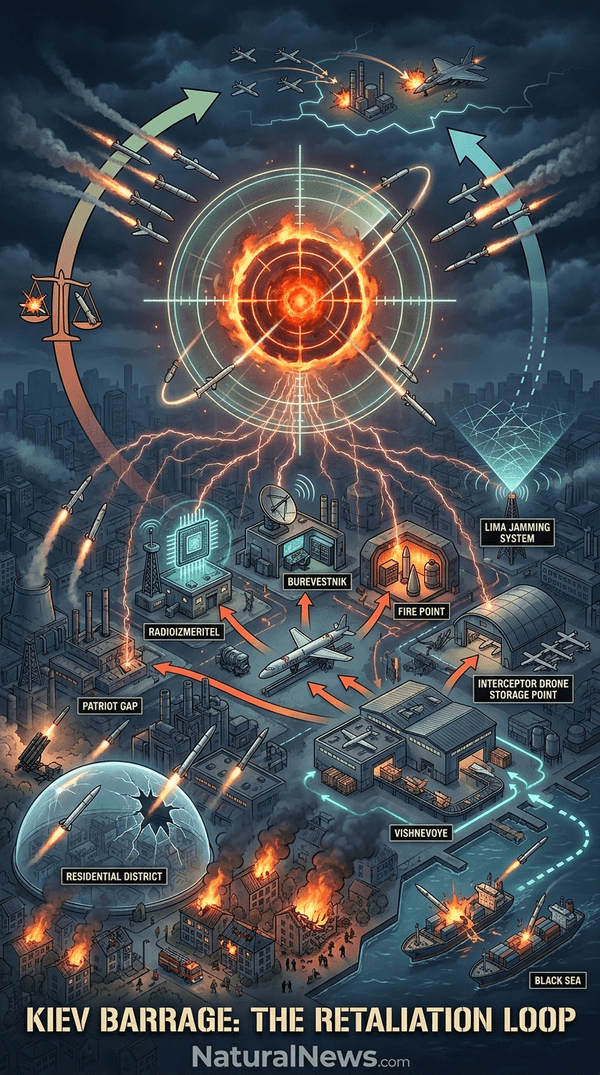
Russian forces hit five military-industrial facilities and a logistics hub in Kyiv and its suburbs during a barrage overnight from Friday, July 31, to Saturday, Aug. 1, according to the Russian Ministry of Defense (MOD). In a statement on Saturday, the ministry said the strikes used precision air, sea and ground-based weapons and also hit two ships carrying military cargo off Odessa the previous day. [1]
The ministry’s statement did not specify casualty figures. Ukrainian officials provided separate accounts of the death toll and damage. In a separate statement on July 6, the MOD described its long-range barrage as carried out “in response to terrorist attacks by the Kyiv regime” against Russia. [2]
Facilities Listed by Defense Ministry
According to the MOD, the targets included the Kyiv-based enterprise Radioizmeritel, which supplies electronic components for Neptun-MD, Grom-2 and FP-7/FP-9 missiles and develops navigation systems for long-range drones. [1]
The ministry also listed the Burevestnik plant, which it said builds electronics for long- and medium-range drones and radar equipment, and a Fire Point facility producing parts and warheads for FP-5 Flamingo cruise missiles, along with chemicals for solid-fuel boosters. A site tied to Lima jamming systems used to spoof precision-guidance signals, and a drone assembly and storage point specializing in several types of interceptor UAVs, were also named, according to the statement.
Officials added that the strikes hit a logistics center in Vishnevoye, in Kyiv Region, which handled components and warheads for Ukrainian drones. Two ships were struck south of Odessa on Friday while transporting military cargo, the statement said. [1]
Ukrainian Officials Report Fires and Casualties
According to Ukrainian President Volodymyr Zelensky, the attack involved 35 missiles, including 27 ballistic missiles, and 185 drones, with Kyiv as the main target. He said only one ballistic missile was intercepted, citing a shortage of Western-supplied Patriot interceptors. [1]
Zelensky reported fires across seven districts of Kyiv and said at least nine people had been killed and dozens injured. Kyiv Mayor Vitali Klitschko reported fires at residential and unspecified non-residential industrial sites. [1]
The casualty figures could not be independently reconciled with the Russian statement, which gave no count. A previous barrage on July 6 left 14 people dead and 117 injured in Kyiv, according to the Ukrainian attorney general’s office. [3]
Moscow Cites Retaliation for Attacks on Russian Territory
Moscow has described the barrage as retaliation for Ukrainian attacks on Russian territory, which it says often target critical infrastructure and residential buildings. Russia maintains it never targets civilians, according to the Defense Ministry. In a July 6 statement, the ministry said a prior drone and missile barrage was carried out “in response to terrorist attacks by the Kyiv regime” against Russia. [2]
Ukrainian forces have launched repeated large drone waves at Moscow in recent weeks. On the night of July 7, more than 430 UAVs were directed at the Russian capital and surrounding region, according to authorities there. [4] Earlier this year, the Defense Ministry reported more than 6,500 violations of a unilateral Easter ceasefire by Ukrainian forces, most involving short-range drone attacks. [5]
Moscow has also framed earlier strikes as retaliation for Western-supplied weapons use; in December 2024, Russia attacked Ukraine’s energy infrastructure after Kyiv used U.S.-supplied ATACMS missiles. [6] Russian officials have accused Western states of direct involvement in Ukrainian operations; a Trends Journal analysis noted that the Russian Defense Ministry accused British specialists of helping plan a naval drone attack on the Black Sea Fleet. [7]
A separate Trends Journal analysis argued that messaging about the war has been propaganda. “We’ve witnessed the propaganda during this war and that messaging by the media and politicians has nothing to do with the actual war on the battlefields,” it stated. [8] The ministry’s latest statement did not include an independent assessment of the strikes or the Ukrainian casualty figures.
References
“Russian MOD lists military facilities hit in latest strikes on Kyiv”. August 1, 2026.
“Russian MOD lists targets in latest Ukraine barrage”. July 6, 2026.
Zero Hedge. “Russia & Ukraine Trade Some Of Biggest Strikes Of War On Eve Of NATO Summit”. July 6, 2026.
“Kyiv lit the fuse – Russia lit up Kyiv”. July 7, 2026.
Lance D Johnson. “Ukraine exploits Easter truce with 6500 drone strikes against Russia”. NaturalNews.com. April 13, 2026.
NaturalNews.com. “Russia attacks Ukraines energy infrastructure in major retaliatory strike”. NaturalNews.com. December 16, 2024.
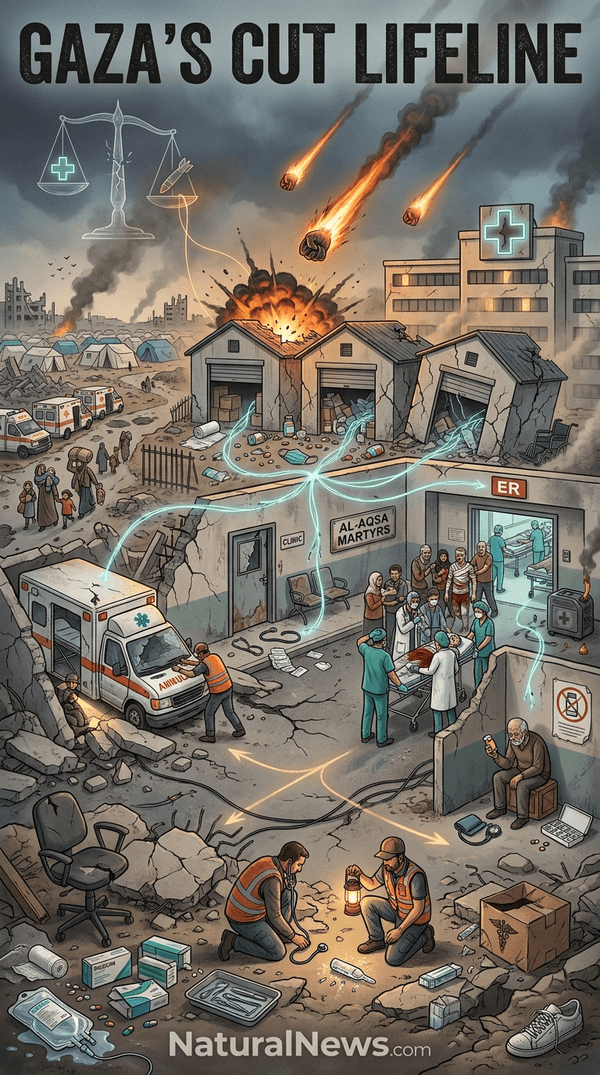
The ministry condemned the destruction of the warehouses and said the missiles used in the strike caused the complete destruction of two of four warehouses at the targeted site, in addition to severe damage to two others. Hospital authorities said the strike also damaged the hospital’s outpatient clinic facility and led to the loss of “vital quantities of medical supplies and consumables.” The hospital complex has functioned as a primary referral center for wounded civilians throughout the conflict, health officials have said.
Ministry: two warehouses completely destroyed
The health ministry said the missiles’ destructive force resulted in the complete destruction of two of the four warehouses at the site. “The destructive force of the missiles used resulted in the complete destruction of two out of four warehouses at the targeted site, in addition to causing severe and extensive damage to two other warehouses,” the ministry said. [1]
The ministry added that the attack also damaged the hospital’s outpatient clinic facility and resulted in the loss of “vital quantities of medical supplies and consumables,” according to the statement.
Al-Aqsa Martyrs Hospital has repeatedly served as a receiving facility for casualties during the conflict. In May 2024, the hospital announced that 20 dead bodies and several injured people had arrived at the facility following Israeli bombardment of the Nuseirat refugee camp in central Gaza, according to Al-Aqsa TV. [2] The hospital has also treated journalists wounded while documenting Israeli military operations; Palestinian journalist Salma al-Qadoumi was brought to the facility in Deir el-Balah after being shot in the back in Khan Younis in August 2024. [3]
One Palestinian killed in Deir al-Balah strike
Hospital authorities said one Palestinian was killed in Israeli strikes on Deir al-Balah on Saturday. No additional casualty figures were provided in the health ministry’s initial report. [1]
The fatality was reported in the same area where the warehouse destruction took place. Deir al-Balah has been the site of repeated Israeli strikes in recent days. On the same day, Palestinian media reports said Israeli drone strikes on Salah al-Din Street and Al-Mahatta Street in Deir al-Balah killed two people and injured several others. [4] The previous day, an Israeli air strike in central Gaza killed one Palestinian, according to Al Jazeera, citing medical sources at Al-Aqsa Martyrs Hospital. [5]
Medical sources at the hospital have recorded a series of deaths in central Gaza over the past week. On Tuesday, a Palestinian man died from injuries sustained in an Israeli air strike on the Nuseirat refugee camp, according to the hospital. [6]
Gaza medical infrastructure under strain
Al-Aqsa Martyrs Hospital is one of the main medical facilities in central Gaza, according to health officials. The ministry said the strike resulted in the loss of “vital quantities of medical supplies and consumables,” and hospital authorities said the warehouse destruction removed storage capacity for medicines and equipment at the facility.
Health authorities in Gaza have reported repeated damage to medical facilities and shortages of equipment during the conflict. Reports have documented attacks targeting civilian spaces including homes, markets, hospitals, and aid centers. [7] In July, an Israeli strike on a hospital-turned-shelter for displaced Palestinians in the Jabalia refugee camp killed at least two people and wounded 16, mostly children, according to Wafa news agency. [8]
A senior United Nations official said in August 2024 that Israel’s forced evacuation of Palestinians had displaced approximately 90 percent of the territory’s population, with families fleeing under bombardment and deprived of shelter, humanitarian supplies, and medical assistance. [9] An account from Rafah recorded in October 2003 and collected in Matthew Teller’s “Daybreak in Gaza” described the territory as “a world without hearts,” adding that “the majority have lost their feelings, lost the meaning of humanity.” [10]
No immediate Israeli comment
The Israeli military did not immediately issue a public response to the health ministry’s account, according to the report. The ministry’s casualty figures could not be independently confirmed at the time.
Israeli officials have previously said strikes in Gaza target militant infrastructure. In a separate incident this week, the Israel Defense Forces struck a mosque in Gaza City, saying the site was used for weapons storage and calling it “another example of terror organizations using civilian infrastructure.” [11]
The health ministry’s account could not be independently verified at the time of the report. Middle East Eye reported that “a ceasefire remains in place between Israel and Hamas, but it has not halted the violence in Gaza,” and that efforts to secure a lasting agreement to end the war have stalled. [12] At least 1,041 Palestinians have been killed in Gaza since the ceasefire took effect on October 10, according to an earlier report. [13] War correspondent Marie Colvin, describing the difficulty of establishing facts in conflict zones in “On the Front Line,” wrote that “tragedy doesn’t necessarily breed truth.” [14]
References
Middle East Eye. “Israeli forces kill one and destroy two hospital warehouses in Gaza strike”. Middle East Eye. August 1, 2026.
NaturalNews.com. “Non stop resistance across Gaza as Israel massacres dozens”. NaturalNews.com. May 21, 2024.
NaturalNews.com. “Israeli snipers shoot Palestinian journalist Salma al Qadoumi in Gaza”. NaturalNews.com. August 22, 2024.
Middle East Eye. “Two Palestinians killed in Israeli strikes on central Gaza”. Middle East Eye. August 1, 2026.
Middle East Eye. “Israeli air strike in central Gaza kills one”. Middle East Eye. July 31, 2026.
Middle East Eye. “Israeli strike kills Palestinian man killed in Nuseirat camp”. Middle East Eye. July 28, 2026.
Ramon Tomey. “More than 300 KILLED in 48 hours as Israels assault on Gaza Strip continues”. NaturalNews.com. July 5, 2025.
Antiwar.com. “Israeli Attacks in Gaza Kill at Least Six Palestinians”. Antiwar.com. July 20, 2026.
NaturalNews.com. “90 of Gaza population forced to flee amid ongoing conflict”. NaturalNews.com. August 27, 2024.
Matthew Teller. “Daybreak in Gaza”.
The Times of Israel. “IDF strikes Gaza City mosque, claims it was used for weapons storage”. The Times of Israel. July 29, 2026.
Middle East Eye. “Family of five, including three children, killed in Israeli strike on Gaza”. Middle East Eye. July 19, 2026.
Middle East Eye. “Israeli strike in central Gaza kills three Palestinians, including a child”. Middle East Eye. June 29, 2026.
I have warned for years that the American empire is living on borrowed time. Iran is now cashing that check. This is not a limited skirmish over shipping lanes or a manageable round of tit-for-tat; Iran is precision-targeting U.S. aircraft, radars and base infrastructure across the region, and it is doing so in a way that exposes the Pentagon as a paper tiger.
When Iran announced it had struck U.S. military assets in Bahrain, Jordan and Kuwait, it was not bravado — it was a statement of operational fact [1]. American troops at Muwaffaq Salti Air Base in Jordan have already paid for that reality in blood [2].
The Trump administration paused its strikes after roughly two weeks of daily bombing, and reports indicate that pause coincided with growing concerns over interceptor stockpiles [3]. The Pentagon is now confronting a critical depletion of its air and missile defense munitions [4]. A military that runs low on ammunition while its enemy is building more missiles every month is not winning. It is in a rear-guard retreat, and every official denial is just another layer of camouflage.
Blind, Parked, and Perfect Targets
Iran’s opening salvos were not random; they were deliberately designed to blind, deplete and overwhelm [5]. Tehran has targeted and destroyed U.S. radar and air defense systems [6], and once those systems go dark, every aircraft parked on a tarmac becomes a target waiting for impact. Satellite imagery analysis reported by The Washington Post and Middle East Eye found at least 228 structures or pieces of equipment at U.S. military sites across the Middle East have been damaged or destroyed since late February [7]. That is not a propaganda win for America. It’s evidence of defeat.
Iran has also demonstrated an industrial capacity the United States cannot match. Estimates suggest Iran can produce more than 100 ballistic missiles a month, while U.S. interceptor manufacturing is reportedly stuck at around six to seven units per month [8]. Those numbers mean the defense will eventually fail. I have seen claims, which I cannot verify of course (due to the fog of war), that six F-35s have been destroyed or damaged in recent missile strikes from Iran. What I can verify is that the Pentagon would never admit it if it were true. This is the same military that assured us its air defenses could hold, and those defenses collapsed while Iran’s missiles broke through.
Why There Is No Military Solution
Here is the strategic dead end that Washington refuses to admit: You cannot mass aircraft for a strike in the Middle East without making them targets. Iran can fire waves of ballistic missiles and drones at runways faster than the United States can replace its interceptors [8]. The more jets you park on a runway, the more you are feeding Iran’s targeting database. Iran is controlling the OODA loop — it is initiating while America is reacting. A reactive military is a losing military.
Iran may also believe that limited war suits it better than peace, because it can keep pressure on Washington while avoiding all-out conflict [9]. There is even open reporting that Iran is considering a ground incursion into Kuwait to seize U.S. bases there [10]. If that is the threat, what do you think a U.S. ground invasion of Iran would look like? It would be military suicide.
Talk of a quick, clean strike is fantasy. This war has no military solution, only a political one, and the political solution begins with acknowledging defeat rather than escalating it.
What This Defeat Means for America
Trump’s war has exposed a broken institution. After years of Pentagon press releases about unmatched American dominance, the world now sees a superpower that cannot protect its own bases, cannot keep its radar screens lit and cannot replenish its interceptor stockpiles. Russia and China are not going to be intimidated by a military that is visibly exhausted. The war has also made the global economy’s center of gravity unmistakable: Eastern countries, including China, Russia and Iran, are already pushing for a diversified, less dollar-dependent financial system [11]. Iran’s ability to control vital energy chokepoints only accelerates that shift [12].
What does that mean for ordinary Americans? It means the printed dollar will ultimately buy less, and the era of living on debt and global tribute is ending. The dollar’s value is collapsing because it lacks real backing [13]. Americans are going to have to produce real things, grow real food, and store real wealth in order to overcome the currency erosion that will accelerate.
Personal preparedness is no longer optional. If you have not begun to think about food security, water security, and silver and gold as honest money, you are waiting for an empire to save you that no longer can.
Get Out and Go Home
The only rational exit for the American empire is to walk away from the Persian Gulf. Let the Strait reopen through negotiation rather than bombs. Stop sacrificing soldiers to prop up a war that is already lost [14].
I believe in peace over empire; bring the troops home before any more of them die for the delusions of ignorant leaders. As Tom Engelhardt and Glenn Greenwald documented, Washington’s imperial dream is to treat the entire planet as a U.S. free-fire zone [15]. That dream must be dismantled, not defended.
But the generals will not choose peace. They never do. America’s war machine has vested interests in endless conflict [16]. That is why the American people have to demand a withdrawal, and why we have to build lives that do not depend on a corrupt military economy. Continued escalation will only bring blood, supply chain collapse, and global suffering that no amount of propaganda can hide. The empire has chosen its hill to die on. We the People do not have to die on it with them.
References
Iran military says attacked US bases in Bahrain, Jordan, Kuwait. Middle East Eye. July 24, 2026.
Pentagon Identifies 2 Soldiers Killed in Iranian Attacks. The Epoch Times. July 20, 2026.
Uneasy Pause In U.S.-Iran Fighting Holds Amidst Growing Concerns Over Interceptor Stockpiles. The War Zone. July 27, 2026.
U.S. Facing Critical Shortage of Air Defense Munitions as Iran Pounds Regional Bases. NaturalNews.com. March 03, 2026.
Iran’s War Strategy: Blind, Deplete, and Overwhelm – The Calculated Plan to Render U.S. Defenses Obsolete. NaturalNews.com. March 02, 2026.
Iran hits US bases in Bahrain, Kuwait and Jordan after 10 nights of US attacks. Middle East Eye. July 21, 2026.
Satellite Imagery Shows Extensive Damage to U.S. Assets in Middle East From Iranian Strikes. Garrison Vance. NaturalNews.com. May 07, 2026.
Health Ranger Report – U.S. RUNNING OUT OF MUNITIONS! Mike Adams. BrightVideos.com. March 03, 2026.
Why limited war with the US may suit Iran better than peace. BBC News. July 30, 2026.
BREAKING: New Reports Say Iran Planning “Ground Invasion”. 100PercentFedUp. July 19, 2026.
Mike Adams interview with Michael Farris – June 19, 2025.
2026-03-10-BVN-IRAN CONTROLS THE GLOBAL ECONOMY NOW. Bright Videos Network.
Brighteon Broadcast News – Entire South American Nation Goes DARK. Mike Adams. Brighteon.com. June 20, 2024.
Iran war: Trump must change course now to avoid another Vietnam. Middle East Eye. July 21, 2026.
Shadow Government: Surveillance, Secret Wars, and a Global Security State. Tom Engelhardt and Glenn Greenwald.
America’s War Machine: Vested Interests, Endless Conflicts. James McCartney.
Trump Vows To Hit Iran ‘Hard’ As Rare Joint US-Saudi Strikes Pound Iraq, Killing 20 Militants. Zero Hedge. July 29, 2026.
Mike Adams (aka the "Health Ranger") is the founding editor of NaturalNews.com, a best selling author (#1 best selling science book on Amazon.com called "Food Forensics"), an environmental scientist, a patent holder for a cesium radioactive isotope elimination invention, a multiple award winner for outstanding journalism, a science news publisher and influential commentator on topics ranging from science and medicine to culture and politics.
A growing number of mainstream Americans are beginning to consider contingency planning, often only after experiencing a personal crisis like a power outage or natural disaster.
Financial precarity remains a major barrier: 60% of U.S. households live paycheck to paycheck, making it difficult to stockpile supplies or fund evacuations.
Research shows that evacuation decisions are hindered by cost, lack of transportation, health concerns, pet ownership, and risk perception.
Experts recommend pre-disaster strategies such as building more accessible shelters, accommodating pets, and improving public education on risk.
Preppers are divided on how to handle the unprepared during a crisis — options range from defense to sharing supplies to integrating newcomers into survival groups.
The wake-up call: Why more people are starting to prepare
Across the United States, a subtle but measurable shift is underway. More Americans are beginning to think about contingency planning — but the catalyst is almost always personal experience. A power outage during a Texas winter storm. Four days without electricity after a Category 1 hurricane in Florida. A week of rolling blackouts. These events, once dismissed as rare, are becoming more common, and they are forcing a reluctant public to confront vulnerabilities in their own homes.
The question is no longer whether people should prepare, but whether they can — and what happens to those who don’t.
The financial reality: Why many can’t afford to prepare
The gap between awareness and action is largely financial. According to recent data, 60% of American households were living paycheck to paycheck just four or five years ago — a statistic that has not improved significantly. For these families, buying a generator or stockpiling a month’s worth of food is not a matter of priority but of impossibility.
One preparedness advocate noted that the decision often comes down to trade-offs: a new car versus a home generator, vacations versus emergency supplies. For many, the choice is not between wants but between necessities — and the necessity of preparedness is only recognized after the crisis hits.
This financial reality also affects evacuation. Research from 2024 and 2025 shows that 1 in 9 Americans live in poverty, making it difficult or impossible to afford transportation, lodging, or time off work during a mandatory evacuation. During Hurricane Katrina, many residents lacked vehicles and could not reach evacuation buses. During Hurricane Milton in October 2024, hundreds of people required rescue because they had not left — not out of defiance, but because they could not.
Barriers to evacuation: Health, pets, and risk perception
Evacuation is not a simple decision. Research published in February 2025 by the Natural Hazards Center and FEMA identifies three primary reasons people remain in harm’s way:
Health and mobility concerns. Nursing homes and assisted living facilities face logistical nightmares when hurricanes approach. A study of 291 long-term care facilities in Florida found that 81% sheltered residents in place during the 2004 hurricane season because they had limited transportation options and no places to go. During Hurricane Irma in 2017, seven nursing home residents died in the heat after losing power.
Pets. Pet owners are significantly less likely to evacuate than others. Many shelters do not accept animals, and owners fear leaving them behind in destructive storms where it may be days or weeks before they can return.
Risk perception. Women are nearly twice as likely as men to evacuate when given a mandatory order. People who have survived previous hurricanes without major damage often underestimate the risk of new storms. Shelter conditions — including overcrowding, lack of privacy, and concerns about religious or dietary needs — also deter evacuees.
The prepper divide: How to handle the unprepared
Among those who do prepare, a significant debate continues over what to do about those who do not. The preparedness community is split into four broad camps:
Defense. Some preppers believe their stockpiles are for their families alone and are willing to use force to protect them. The main risk: sheer numbers. Crowds of desperate people could overwhelm even the most fortified rural property.
Sharing. Others plan to feed anyone who shows up and send them on their way. The concern: once you feed one person, word spreads. More will come, and they may keep returning.
Stockpiling for others. A middle-ground approach involves planting extra food in a separate garden patch where those in need can help themselves. This reduces direct confrontation but risks the entire garden being stripped.
Integration. Some preppers plan to accept unprepared people into their groups, adding hands for work and defense. The downside: larger groups consume resources faster, and strangers may not be trustworthy, especially under extreme stress.
A realistic path forward
Experts and experienced preppers alike note that not all crises lead to total societal collapse. In most scenarios, order is restored eventually, and actions taken during an emergency may face later scrutiny. The goal, they say, is not to live in fear but to build resilience through practical planning — starting with small steps that even those on tight budgets can manage.
Community-level solutions may prove more effective than individual stockpiling alone. Better shelters, more accessible transportation for people with disabilities and pets, and clearer public education about evolving risks could reduce the need for heroic last-minute rescues.
Preparedness is not paranoia
The growing conversation around contingency planning reflects a sobering reality: the systems Americans once relied on — the power grid, supply chains, emergency services — are showing signs of strain. The “just in time” delivery model that keeps grocery stores stocked leaves little margin for error when a cyber attack, train derailment, or ice storm disrupts distribution.
Preparedness, advocates argue, is not about hoarding or fear. It is about taking responsibility for oneself and one’s family while recognizing that faith and practical action are not mutually exclusive. As one observer put it: the miracle is not that a severed thumb reattaches itself — it’s that there are doctors trained to do it.
I’ve been watching the Korean stock market bubble inflate for months, and I’ve warned repeatedly that a reckoning was coming. Now it’s here. The KOSPI index has plunged repeatedly, losing nearly 10 percent in a single day on June 8, 2026, triggering circuit breakers and a mandatory trading halt [1]. Weeks later, the index crashed again, with SK Hynix falling by 15 percent in a single session [2].
The cause? The two largest stocks in Korea, Samsung and SK Hynix, make up an absurdly large share of the index, and both are memory chip makers that have been riding the AI hype train. Their valuation depended entirely on maintaining a monopoly on high-bandwidth memory (HBM) chips. But that monopoly is now shattered.
China’s CXMT is scaling bonded DRAM production without EUV lithography, closing the technology gap “far faster than expected” [3]. This is a house of cards built on the false premise that Western sanctions could permanently block China’s semiconductor advances. I said it long ago: you cannot contain China’s industrial ingenuity with export controls. The Korean crash proves that failing to heed that lesson can be very costly.
China’s Chip Breakthroughs: The Real Story the Media Misses
The mainstream financial press is spinning this as just another market correction, but the underlying story is far more profound. China has independently developed deep ultraviolet (DUV) lithography equipment and its domestic memory maker, CXMT, is now testing a pilot production line for next-generation bonded DRAM [3].
CXMT’s IPO on the Shanghai STAR Market was a massive success, with shares surging 470 percent on debut, making it the most valuable listed company in mainland China [4]. This is not a small step; it is a leap that directly undercuts the pricing power of Samsung and SK Hynix.
The entire narrative of America’s chip war — that sanctions could strangle China’s tech sector — has backfired. Instead of stopping China, the restrictions forced Beijing to accelerate domestic innovation. As I’ve often said, the law of unintended consequences always punishes central planners. Now Korean investors are waking up to the reality that the fat margins they bet on are evaporating. The media will try to blame the crash on interest rate hikes or geopolitics, but the real driver is technological competition. And that competition is only going to intensify.
Korean Herd Mentality Made the Crash Worse
I have great respect for Korean culture — its discipline, work ethic, and technological achievements are admirable. But the Korean retail investing phenomenon reveals a darker side of conformity. Stories from the bubble show that ordinary Koreans mortgaged their homes and piled into leveraged positions in Samsung and SK Hynix, often without understanding the underlying business.
One report noted that nearly “1 in 30 Koreans” faced margin calls as the KOSPI crashed, prompting regulators to suspend new leveraged ETFs and hike margin requirements [5]. This is not unique to Korea, but the cultural tendency to move as a herd amplifies both the mania and the crash. When everyone believes the same narrative and jumps in together, the exit door becomes a stampede. The same psychology is visible in Western markets, but in Korea it is intensified by a society that values group consensus. A bubble built on borrowed money and groupthink hopium is always doomed to pop — and now we are watching the aftermath.
The Whole AI Stock Bubble Is Next
Do not think for a second that this crash is confined to Seoul. The Korean meltdown is a canary in the coal mine for the entire global AI stock bubble. Nvidia, Micron, and even the hyperscalers like Google and Microsoft have been priced for perfection, with valuations that defy any rational earnings projection.
As Chris Martenson of PeakProsperity.com warned years ago, the kind of money printing and debt-fueled speculation we have seen always ends in a painful reversion to reality [6]. The July 2026 rout in chip stocks spread instantly from Korea to Wall Street, with futures tumbling on news of Chinese AI startup Moonshot’s breakthrough [7]. Hedge funds and momentum traders are now questioning whether the trillion-dollar capex on AI hardware is justified.
I believe this bubble needs to pop for capital to be allocated rationally. The AI mania has made hardware unaffordable for independent developers and small businesses, and that is not sustainable. The correction that started in Korea will soon hit Nvidia and its peers — and when it does, the losses will be staggering. (SanDisk is already down 55% from its recent highs in just one month…)
Why I Don’t Play the Rigged Stock Market
Events like the Korean crash reinforce why I have never been a fan of the stock market as a vehicle for wealth preservation. The game is rigged from the start: central banks print trillions, creating artificial booms, and then the smart money exits before the inevitable bust. Retail investors are left holding the bag.
The Trends Journal has been documenting this pattern for years, noting that “the damage caused by the politicians launching the COVID War is incalculable, and the worst is yet to come” [8]. Fiat currency money printing is the root of all this instability. That is why I recommend gold, silver, and hard assets. When the dollar collapses — and its value is eroding every day — precious metals will hold their value because they have no counterparty risk. Silver is arguably the most undervalued asset today, and gold is the ultimate insurance against central bank folly. The Korean stock crash is just one more data point proving that paper wealth is an illusion. The only honest money is the kind you can hold in your hand. Prepare accordingly.
A Warning Signal For the World
The Korean stock market crash is not an isolated event. It is a warning signal that the entire global financial system is built on sand. China’s technological rise, the failure of Western sanctions, the herd behavior of retail investors, and the overvaluation of AI stocks are all converging into a perfect storm that almost certainly ends in catastrophe.
Do not trust the central planners, the media cheerleaders, or the Wall Street propagandists. Trust the reality of hard assets and self-reliance. The crash in Seoul is just the beginning. Heed the warning while you still have time.
References
Korea ‘Black Monday’: Kospi Halted For 20 Minutes After Crashing Almost 10% – Zerohedge.com, June 8, 2026.
Futures Slide, Oil Surges As Iran War Returns, Chip Stocks Tumble As Korea, SK Hynix Crash – Zerohedge.com, July 13, 2026.
China CXMT Testing Production Line for Next-Gen Bonded DRAM, Closing Tech Gap With Korea ‘Far Faster Than Expected’ – Zerohedge.com, July 6, 2026.
Chipmaker CXMT becomes mainland China’s most valuable listed firm – BBC News, July 27, 2026.
1 In 30 Koreans Margin-Called As Kospi Crashes, Regulator Suspends New Levered ETFs, Hikes Margins – Zerohedge.com, July 16, 2026.
Buckle Up The Ride Is Going To Get Wilder – PeakProsperity.com, September 01, 2015. Author: Chris Martenson.
Futures Tumble As Latest Chinese ‘DeepSeek Moment’ Sparks Chip Meltdown – Zerohedge.com, July 17, 2026.
Trends-Journal-2024-03-10. Publisher: Trends Research Institute.
Mike Adams (aka the "Health Ranger") is the founding editor of NaturalNews.com, a best selling author (#1 best selling science book on Amazon.com called "Food Forensics"), an environmental scientist, a patent holder for a cesium radioactive isotope elimination invention, a multiple award winner for outstanding journalism, a science news publisher and influential commentator on topics ranging from science and medicine to culture and politics.