Russia says it struck military cargo facilities at Ukraine’s Izmail port, across the Danube from North Atlantic Treaty Organization (NATO) member Romania.
Moscow also claims it hit two dry cargo ships carrying military supplies toward Odessa.
The same night, two tankers caught fire in Romanian waters, leaving seven sailors missing.
Romania says Russian drones entered its airspace but has not blamed them for the fires.
Bulgarian Prime Minister Rumen Radev suspects Russia in recent ship attacks but admits there is no solid evidence.
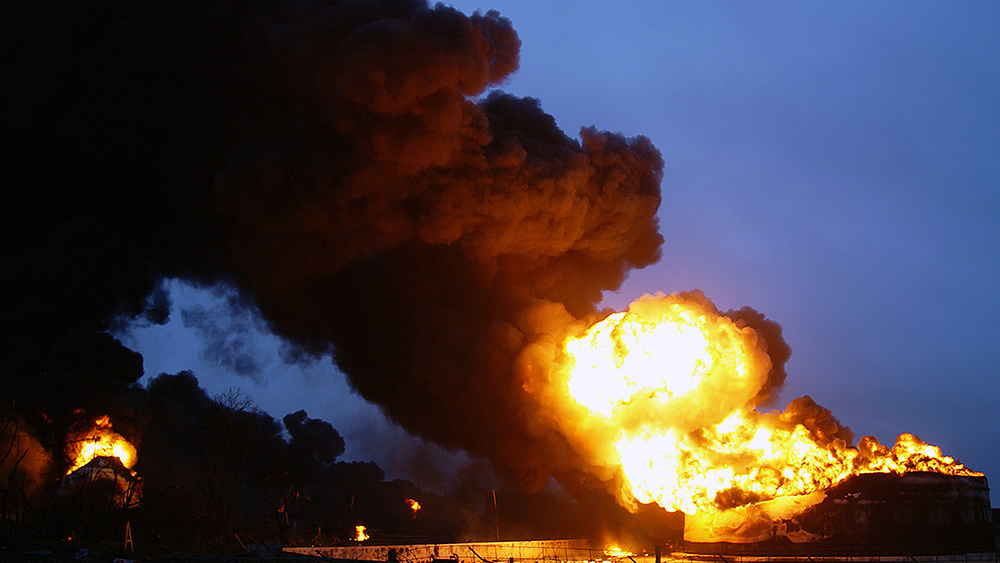
The war in Ukraine took a dangerous turn Wednesday night when Russian forces struck the Danube port of Izmail, located right on NATO’s doorstep, while two chemical tankers caught fire in Romanian territorial waters and fighter jets were scrambled over the Black Sea. Hours later, seven crew members remained missing from a San Marino-flagged tanker that caught fire inside Romanian waters near the Danube’s mouth, with Romanian officials acknowledging Russian drones had crossed into their airspace. The escalating confrontation around Black Sea shipping lanes is dragging NATO members closer to a direct clash with Moscow that no Western electorate voted for.
Russia says strikes hit Izmail’s military cargo operations
Russia’s Defense Ministry announced that its overnight strikes successfully hit infrastructure at Izmail’s port, which it said the Ukrainian armed forces have been using to unload and store military equipment and dual-use cargo. The ministry added that its forces hit two dry cargo vessels en route to Odessa with military supplies.
The attack represents another salvo in Moscow’s campaign to disrupt Ukraine’s supply lines along the Danube River, a critical alternative route after Russia pounded Ukraine’s main Black Sea ports. Ukraine’s Air Force claimed its air defenses intercepted 536 of the 580 drones Russia launched overnight.
Ships burn inside NATO waters as drones cross Romanian airspace
The same night, a separate crisis unfolded in Romanian territorial waters, where two chemical tankers anchored near the Danube’s Sulina Canal caught fire. The San Marino-flagged Wine Trader reported seven of its 12 crew missing, while the Comoros-flagged Yara J also caught fire, although its crew was reported safe, according to Romanian naval authorities.
Romanian officials confirmed Russian drones had entered their airspace, but they stopped short of directly blaming Moscow for the ship fires. These fires come on the heels of drone strikes that have hit at least five more cargo ships off Romania and Bulgaria in the past 10 days in attacks that left at least 23 sailors dead or missing just outside NATO’s territorial waters. On October 5, a Turkish cargo ship that had just left Izmail sank off Romania after a drone strike, killing two crew members.
Ships off neighboring Bulgaria have also been hit, and Bulgarian Prime Minister Rumen Radev said the European Union would discuss a proposed moratorium on attacks against civilian shipping in the Black Sea, calling the strikes a flagrant violation of international and maritime law. Radev said he suspects Moscow, arguing it would make no sense for Ukraine to attack its own ships and crews, but he acknowledged investigators lack definitive proof. “We don’t have any solid evidence that the drones are Russian,” Radev told reporters.
A widening conflict that threatens global food supplies
The intensifying attacks on Black Sea shipping are not merely a military concern; they threaten to trigger a global food crisis. Both Russia and Ukraine are major grain exporters, and the disruption of maritime trade routes has forced Ukraine to lean more heavily on its Danube ports and on sea lanes running along the Bulgarian and Romanian coasts. But as the drone strikes creep closer to NATO waters, those alternative routes are becoming just as dangerous, and each incident brings the alliance closer to a decision no Western leader wants to make.
Romania and Bulgaria caught between Western supply lines and Russian drones
Romanian and Bulgarian patrols now face the impossible task of protecting commercial shipping in waters where drone strikes are a near-daily occurrence. The pattern is unmistakable: Moscow accuses the West of funneling weapons and supplies to Ukraine through these ports, Russia strikes them, and NATO members find themselves caught in the middle.
Washington’s reported talk of unfreezing some Russian assets to restart peace talks, along with Trump’s Sunday “energy ceasefire,” may grab headlines, but it is the smoke rising from burning tankers in NATO’s backyard that tells the real story. This is a war being fought with drones and missiles, not diplomatic cables, and the alliance is being dragged into it one fiery incident at a time.
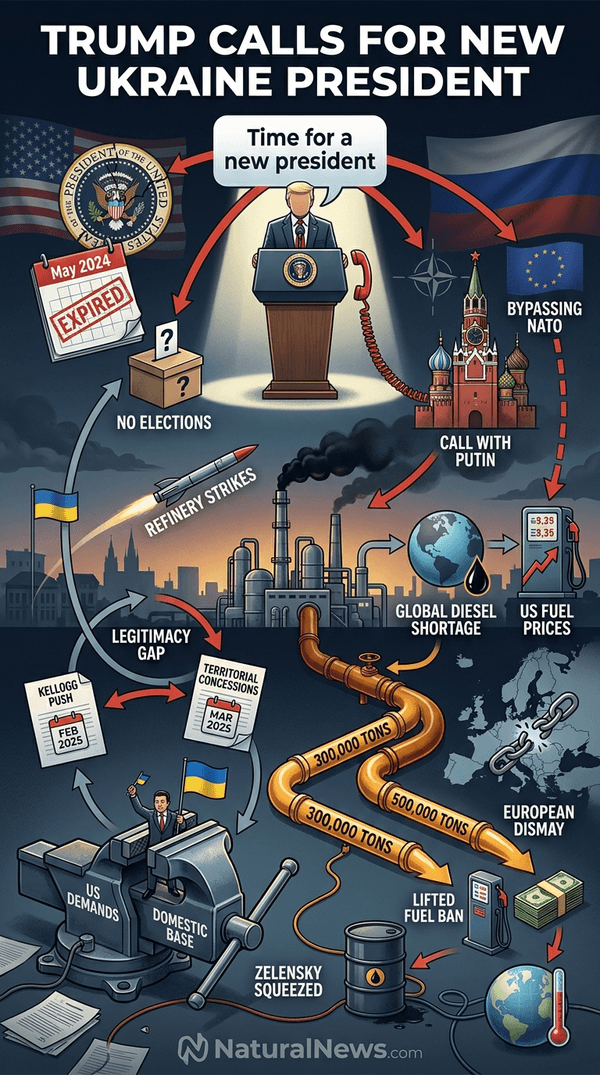
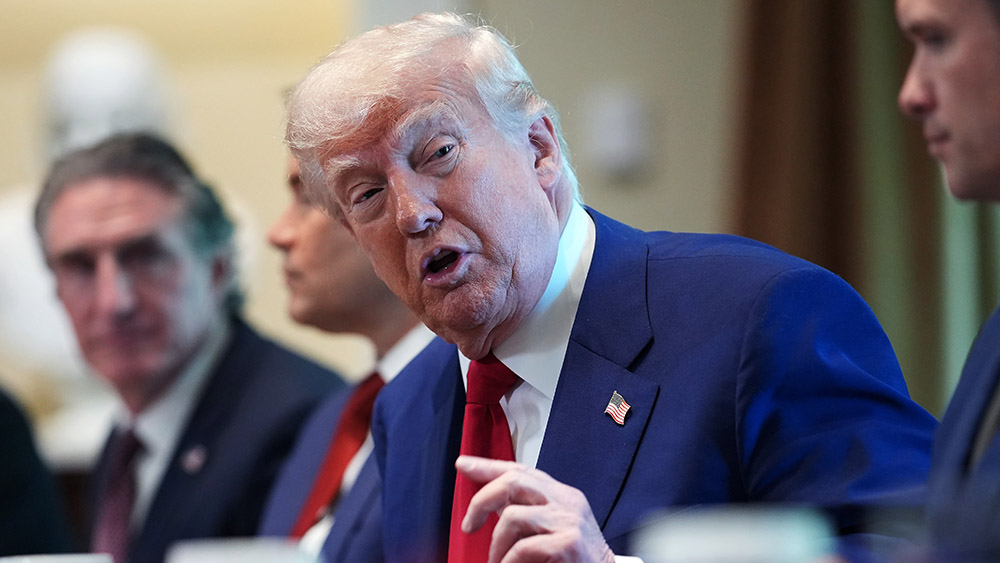
“I think it’s time for Ukraine to get a new president,” Trump said. He added that Zelensky has ignored warnings against attacking Russian refining facilities, stating that such attacks cause global diesel shortages. “We said, you can do whatever you want to Russia, don’t hit the refineries, because that’s a world problem that’s caused. And he wants to make problems for the world,” Trump said.
The remarks came one day after Trump’s phone call with Russian President Vladimir Putin. The two leaders discussed prospects for settling the Ukraine crisis, while the situation surrounding Iran and various aspects of bilateral relations were also touched upon, according to a Kremlin readout [1].
Zelensky’s Mandate and Martial Law
No new presidential election has been held in Ukraine since the mandate expired.
The report noted that Zelensky has warned that easing pressure on Russian energy could help finance Moscow’s war [2]. This follows earlier U.S. pressure on Ukraine to hold elections. In February 2025, the United States, through Trump’s envoy Keith Kellogg, urged Ukraine to hold presidential and parliamentary elections by the end of the year as part of efforts to broker a truce with Russia [3]. Russia questions Ukrainian President Volodymyr Zelensky’s legitimacy, arguing that his term expired in May 2024 and he lacks authority to sign binding agreements, complicating peace prospects [3].
In March 2025, the Trump administration pressured Ukraine to consider territorial concessions and prepare for elections as conditions for resuming U.S. military aid and intelligence sharing [4]. U.S. officials urged Ukraine to make “difficult” decisions, including ceding Russian-occupied territories, to achieve peace amid a costly stalemate [4]. Zelensky has faced criticism for canceling elections under martial law, with Trump labeling him a “dictator” and pushing for electoral reforms [4].
Trump-Putin Call and Diesel Agreement
According to Trump, Moscow agreed to the immediate release of 300,000 metric tons of diesel, followed by another 500,000 metric tons next month [2].
Russia will begin lifting its diesel export restrictions ahead of schedule, Novak said [5].
This deal represents a shift in U.S. policy. Previously, the U.S. had imposed sanctions on Russian fuel exports. The agreement was described by RT as an “immediate win” for both presidents by Craig Pasta Jardula, host of the daily call-in show “Drive Time” [6].
Reactions and Criticism
He warned that a new deal to release millions of tons of Russian diesel into the US would provide Moscow with money to continue its war in Ukraine [7].
Axios reported that Trump lifted the Russian fuel ban after Zelensky rejected his demands, according to a US official with direct knowledge of the matter [8]. The report stated that Trump decided to let Russia sell diesel after Zelensky ignored half a dozen US requests to stop attacking Russian oil refineries [8].
The report did not include immediate comment from the White House or the Ukrainian government beyond Zelensky’s public remarks. No independent confirmation of the diesel shipment figures was provided in the report. Ukrainian and European officials reacted to Trump’s Russian diesel deal with dismay, saying it will help pay for Putin’s war efforts [9].
Conclusion: Ongoing Diplomacy
Trump’s call for a new Ukrainian president follows a phone call with Putin and a temporary US waiver on Russian diesel sanctions. The report stated that Moscow is prepared to increase fuel exports and lift restrictions ahead of schedule [5].
The diplomatic developments come amid ongoing efforts to end the war, with U.S. officials emphasizing the need for a negotiated settlement.
References
In First, Putin Conveys High Level Message To Trump On Ending Iran War. https://www.zerohedge.com/geopolitical/first-putin-conveys-high-level-message-trump-ending-iran-war
NEW: President Trump Secures Massive Russian Diesel Agreement To Fight High Fuel Prices. https://100percentfedup.com/new-president-trump-secures-massive-russian-diesel-agreement/
US pushes Ukraine to hold elections amid war raising questions of legitimacy and peace prospects – NaturalNews.com, February 03, 2025.
Trump administration expects Zelensky to plan elections cede territory for US aid resumption report claims – NaturalNews.com, March 11, 2025.
Russia confirms it’s ready to ship diesel to US from October. https://www.middleeasteye.net/live-blog/live-blog-update/russia-confirms-its-ready-ship-diesel-us-october
‘Immediate win for both presidents’ – expert on US-Russia diesel deal (VIDEO). https://www.rt.com/news/647021-pasta-us-russia-diesel-deal/?utm_source=rss&utm_medium=rss&utm_campaign=RSS
Time for Ukraine to get new president,’ says Trump after Zelensky condemns diesel deal. https://bbc.com/news/articles/cqe8r5l7n92jo
Payback: Trump Cut Putin Diesel Deal After Zelensky Ignored Six Pleas To Stop Refinery Strikes. https://www.zerohedge.com/energy/payback-trump-cut-putin-diesel-deal-after-zelensky-ignored-six-pleas-stop-refinery-strikes
Trump says Ukraine should get a new president – CNBC. https://www.cnbc.com/2026/10/10/trump-says-ukraine-should-get-a-new-president.html
The price of oil is no longer just a market signal. It is a confession. Every spike in crude and every insurance premium demanded from a supertanker captain is a receipt for a war that was sold to the American people as a limited, surgical engagement and has instead metastasized into the greatest energy supply shock in the history of the global oil industry [1]. This is not a “temporary spike.” It is the opening chapter of a deliberate destruction of the world’s energy architecture.
I’ve been warning most of this year that the U.S.-Israeli war with Iran would not stay contained to a single theater. In March, I wrote that the closure of the Strait of Hormuz would trigger a global food catastrophe that unfolds with terrifying speed, because that waterway is a critical artery not just for oil but for fertilizer shipments [2]. The White House can spin the numbers, but it cannot spin a barrel of oil that isn’t there.
What I believe, and what the evidence increasingly demands, is that the same government that lit this fire is now lying about the state of the blaze. Trump claims on social media that “record numbers of barrels are coming out now on an almost daily basis” [3], but that statement collapses the moment you ask for ship IDs, captain names, or verified manifests. The data is being curated for political consumption ahead of elections. But it’s all rooted in lies, of course.
The Strait of Hormuz: Insurance Costs and the Data Deception
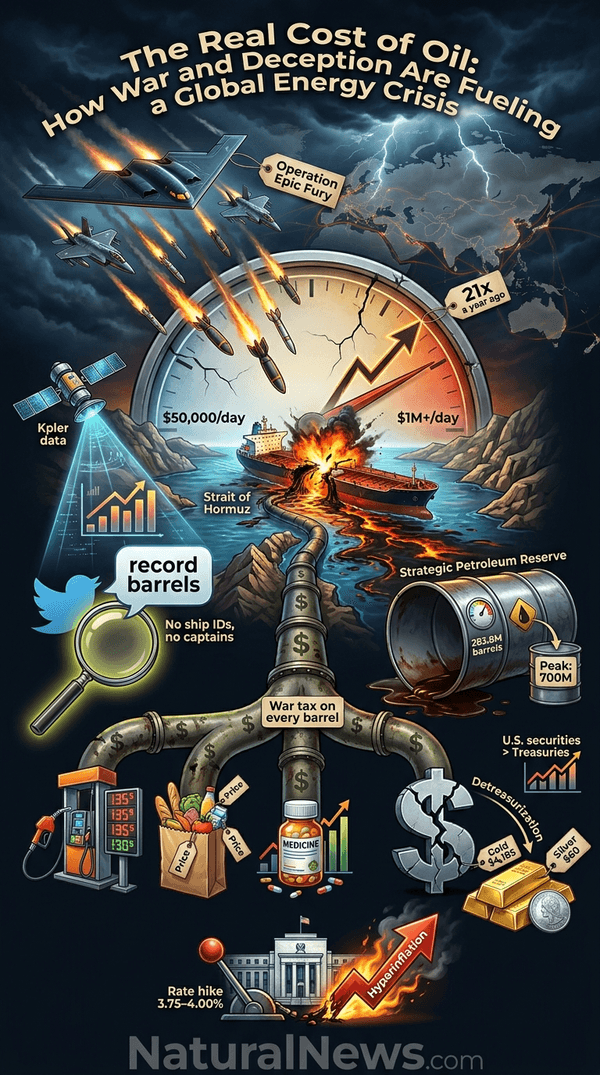
Start with the single number that should be screaming from every financial headline: the cost to insure and charter a supertanker through the Strait of Hormuz has gone from roughly $50,000 per day to more than $1 million per day — a twenty-fold increase. This is not speculation. The Baltic Exchange’s TD3C benchmark route from Saudi Arabia to China hit another all-time high of $1.33 million per day, up 10% on the week and 21 times where it was a year ago [1]. Every barrel of oil moving through that chokepoint now carries a war tax baked into its freight cost, and those costs are then passed directly to you at the gas station, the grocery store, and the pharmacy.
Even if crude still technically moves, the cost of moving it has exploded. As one analysis put it, the immediate damage is not a collapse in production — it is a transportation and security problem that is pushing costs through the entire oil supply chain [4]. Diesel itself has become a global crisis, with leaders across the world suspending gas taxes and issuing emergency regulations just to keep trucks moving [5]. This is what a real supply shock looks like when it hits the physical economy, not the paper economy.
Now ask yourself why the White House is pointing to Kpler satellite data and claiming that Middle East crude flows through Hormuz have “recently reached their highest level since the start of the Iran war” [6]. I find that claim impossible to verify and highly suspicious. Where are the ship IDs? Where are the captain names? Where are the insurance certificates? When the government and its analytics contractors release numbers without auditable underlying data, those numbers are not evidence — they are propaganda. I believe these data are potentially being fabricated or selectively released by intelligence agencies to talk down oil prices before midterm elections. The American people are being gaslit with likely doctored satellite images.
Trump, Iran, and the Betrayal of America
Donald Trump promised to end wars. He ran on it, he won on it, and then he betrayed it. On February 28, 2026, American B-2 Spirit bombers and Israeli F-35I fighters crossed into Iranian airspace and launched Operation Epic Fury — nine hundred strikes in twelve hours [7]. That was not a defensive act. It was an act of war. Trump is a puppet of Zionists who wanted this war, and he gave it to them.
Meanwhile, the strategic petroleum reserve, America’s emergency buffer against exactly this kind of catastrophe, has been drained to its lowest level since October 1982, sitting at roughly 283.8 million barrels [8]. That reserve once held more than 700 million barrels at its peak [9]. There is no buffer left. The West has “drained” all available oil inventories, as the CEO of the world’s largest independent oil trader put it, leaving the market increasingly exposed to further shocks [10]. When you burn the furniture to heat the house, you should not be surprised when the house gets cold.
Meanwhile, the dollar’s reputation as the world’s reserve currency is crumbling. The conflict has opened a new threat to the global monetary system, and the world is undergoing what Andy Schectman calls “detreasurization” — foreign investors are now buying more U.S. securities than Treasuries for the first time in over a hundred years, and that divestment is driving gold higher at the highest institutional level [11]. When the reserve currency loses its anchor, hyperinflation is no longer a fringe prediction. It is a mathematical certainty. I said years ago that fiat currency printing steals wealth from the people, and the war with Iran has simply accelerated the timeline.
The Coming Economic Collapse and How to Protect Yourself
Here is the part the mainstream media will not tell you plainly: this ends in hyperinflation. The Federal Reserve hiked interest rates 25 basis points to 3.75–4.00% in September 2026, its first hike since 2023 [12], but rate hikes cannot fix a supply shock. As Ed Dowd put it, the Fed hiked into a supply shock [12], and as Rabobank’s Michael Every warned, “repeated and persistent supply-side shocks” are now here to stay [13]. You cannot tighten your way out of a world where the ships that move the fuel are being sunk, mined, or priced beyond reach.
The only rational response is to own real things. Physical gold and silver are the only honest money — no counterparty risk, no government counterfeiting, no sudden devaluation. Gold is now around $4,185 an ounce and silver is about $60 an ounce, and those prices are not a bubble; they are a signal. That shift marks the end of the only thing that has been protecting the dollar.
This is not financial advice — it is personal conviction born from years of watching centralized institutions lie, steal, and devalue. The people who are not prepared will be wrecked. Those who prepare will not merely survive; they will be positioned to help rebuild. You can also visit NaturalNews.com for independent financial and geopolitical analysis that the corporate press refuses to publish, and BrightAnswers.ai as an uncensored AI engine that will give you honest answers about money, liberty, and health.
Conclusion: Prepare for the Unthinkable
The energy crisis is real. It is not a talking point and not something that will resolve itself when the next election cycle ends. The G7’s emergency release of 100 million barrels of oil and diesel over four months is a band-aid on a severed artery [14], and the world’s advanced economies are already being warned by the IMF that shocks have been “pushing debt levels up like a staircase not to heaven” [15]. The lies and the manipulation will only delay the inevitable reckoning. They cannot prevent it.
I urge you to take action now, while you still can. Stack physical gold and silver. Store food and water. Learn to grow your own food. Build relationships with neighbors you can trust. Stay informed through independent sources like NaturalNews.com, BrightNews.ai, and BrightAnswers.ai, and move your social presence to uncensored platforms like Brighteon.social of Pickax.com. Use BrightLearn.ai to generate free books and educate yourself on anything you need to know. Self-reliance is not paranoia — it is the only rational posture in a world run by liars. The only way to survive what is coming is to be prepared, decentralized, and free.
God bless you, and God bless humanity.
References
The $1 Million Tanker Was Just The Start: Every Crude Freight Index Hits Record High As Hormuz “Works” Too Well. 2026-10-06T18:40:00.000Z. https://www.zerohedge.com/markets/1-million-tanker-was-just-start-every-crude-freight-index-hits-record-high-hormuz-works-too
The Window Is Closing How the Iran Conflict Just Unleashed a Global Famine Trigger – NaturalNews.com, March 05, 2026. by NaturalNews.com
Trump blames Ukraine for US fuel price surge (VIDEO). 2026-10-06T11:27:08.000Z. https://www.rt.com/news/646744-trump-blame-ukraine-fuel-prices/?utm_source=rss&utm_medium=rss&utm_campaign=RSS
Oil Still Moves, But the Cost of Moving It Is Exploding. https://nordexium.substack.com/p/oil-still-moves-but-the-cost-of-moving
World Leaders React to Diesel Crisis: What to Know. 2026-10-08T18:01:08.035Z. https://theepochtimes.com/world/world-leaders-react-to-diesel-crisis-what-to-know-6100461
Why Are Oil Prices Still Above $100 as Gulf… – Modern Diplomacy. 2026-10-05T09:28:21Z. https://moderndiplomacy.eu/2026/10/05/why-are-oil-prices-still-above-100-as-gulf-crude-exports-recover/
How The Iran Conflict Opened A New Threat To The Global Monetary System. 2026-10-02T00:55:00.000Z. https://www.zerohedge.com/geopolitical/how-iran-conflict-opened-new-threat-global-monetary-system
U.S. Strategic Petroleum Reserve Drops To Lowest Level Since 1982 – Can Washington Afford To Refill It?. 2026-09-29T06:00:00.000Z. https://www.naturalnews.com/2026-09-29-spr-drops-to-lowest-level-since-1982.html
Strategic Petroleum Reserve Falls to 285.4 Million Barrels, Lowest Since 1982. 2026-09-16T06:00:00.000Z. https://www.naturalnews.com/2026-09-16-spr-falls-to-lowest-level-since-1982.html
West has ‘drained’ all available oil inventories – Vitol CEO. 2026-10-07T13:53:57.000Z. https://www.rt.com/business/646895-west-oil-inventories-vitol/?utm_source=rss&utm_medium=rss&utm_campaign=RSS
Andy Schectman: Insiders Buying Gold – Public is Next. 2026-09-19T23:10:15.000Z. https://thedailybell.com/all-articles/exclusive-interviews/andy-schectman-insiders-buying-gold-public-is-next/
Ed Dowd: The Fed Hiked Interest Rates Into A Supply Shock. 2026-09-22T16:20:00.000Z. https://www.zerohedge.com/markets/ed-dowd-fed-hiked-interest-rates-supply-shock
“Repeated And Persistent Supply-Side Shocks” Are Here To Stay. 2026-09-22T14:30:00.000Z. https://www.zerohedge.com/markets/repeated-and-persistent-supply-side-shocks-are-here-stay
G7 Nations to Release 100 Million Barrels of Diesel, Crude. 2026-10-02T19:41:52.000Z. https://www.ntd.com/g7-nations-to-release-100-million-barrels-of-diesel-crude_1176505.html
Rich nations must cut debt as global shocks push up borrowing costs, IMF chief tells BBCIn an interview with the BBC, Kristalina Georgieva says economic shocks had pushed “debt levels up like a staircase not to heaven”.6 hrs agoBusiness. 2026-09-23T05:01:15.432Z. https://bbc.com/news/articles/cx305ymq4ldqo
Mike Adams (aka the "Health Ranger") is the founding editor of NaturalNews.com, a best selling author (#1 best selling science book on Amazon.com called "Food Forensics"), an environmental scientist, a patent holder for a cesium radioactive isotope elimination invention, a multiple award winner for outstanding journalism, a science news publisher and influential commentator on topics ranging from science and medicine to culture and politics.
A Saudi-led military coalition says it struck 82 Houthi military targets in Yemen overnight.
The strikes followed Houthi attacks on airports in Riyadh and Abha that killed three foreign civilians and injured 36.
The Houthis, an Iran-aligned armed group in Yemen, claimed a new missile attack on Riyadh’s airport Thursday, which Saudi Arabia has not confirmed.
The United Nations says nearly 200,000 Yemenis have been displaced since September.
The fighting revives a war that began in 2015 and paused under a 2022 truce.
The Saudi-led military coalition fighting Yemen’s Iran-aligned Houthi forces launched a sweeping retaliatory operation overnight, striking 82 military targets across four Yemeni provinces after Houthi attacks on two Saudi international airports killed three civilians and wounded 36 others earlier in the week.
The attacks on King Khalid International Airport in Riyadh and Abha International Airport in southern Saudi Arabia were the deadliest Houthi strikes on Saudi soil since the kingdom began its own bombing of Houthi positions earlier this year.
Three foreigners killed, 36 hurt in strikes on two Saudi airports
According to the Saudi General Authority of Civil Aviation (GACA), the attacks came on Tuesday and Wednesday. At Abha, a Moroccan woman and an Algerian woman who lived in the kingdom were killed, and 28 other people were hurt. At King Khalid, a Sudanese citizen died and eight residents were wounded, among them five Saudis. GACA said it is working with security agencies to assess the damage and protect passengers and workers.
On Thursday, the Houthis said they had struck King Khalid again with a ballistic missile, Reuters reported, but Saudi Arabia did not immediately confirm the claim. Around the same time, a New York Times reporter in Riyadh heard several blasts in quick succession, though their cause was unclear. Saudi authorities have recently warned residents of legal consequences for sharing information about missile and drone attacks.
Coalition spokesman announces strikes on missile depots and command centers
Coalition spokesman Maj. Gen. Turki Al-Maliki announced the strikes with a dramatic warning, declaring that “the brutal attacks by the Terrorist Houthi Militia on civilian and civilian objects in the Kingdom… will not go unpunished.” He said coalition forces destroyed 82 targets he described as legitimate military objectives in Saada, Al Hudaydah, Al Jawf and Ma’rib.
Among the targets were 11 missile storage sites and several command and communication hubs, the statement said. Al-Maliki also said forces shot down a missile north of Riyadh and wrecked a Sanaa launch site that he said had been used to strike the Saudi capital. The Houthis did not immediately respond to the coalition’s claims.
Nearly 200,000 Yemenis displaced as the 2022 truce gives way to open war
The United Nations said Wednesday that the escalating violence has forced nearly 200,000 Yemenis from their homes since September. The kingdom has been here before. Its air war that began in 2015, meant to return Yemen’s ousted government to Sanaa, set off a conflict that lasted years, led to hundreds of thousands of deaths and produced one of the world’s worst humanitarian crises before a shaky truce took hold in 2022.
Now, Yemen’s internationally recognized government, backed by Saudi warplanes, has launched a military offensive to retake Red Sea territory from the Houthis, who hold a broad swath of land along the Bab al-Mandeb Strait, a vital sea lane between the Red Sea and the Gulf of Aden.
The Riyadh airport has been a target before. Coalition forces said they shot down a suspected Houthi ballistic missile aimed at it on Sept. 18, and the next day an explosion was heard nearby as black smoke rose from a fuel storage area. This week, cage-like fencing also went up around Aramco fuel tanks and equipment near the airport.
The United States embassy in Riyadh has issued another security alert urging Americans in the kingdom to stay especially vigilant amid the fighting. That warning is a reminder that a conflict half a world away is no longer abstract. Saudi Arabia’s last air war was meant to restore a government and instead set off a conflict that left hundreds of thousands dead. With a new offensive underway and foreign residents already among the casualties, Washington would be wise to think hard before being drawn into a second round.
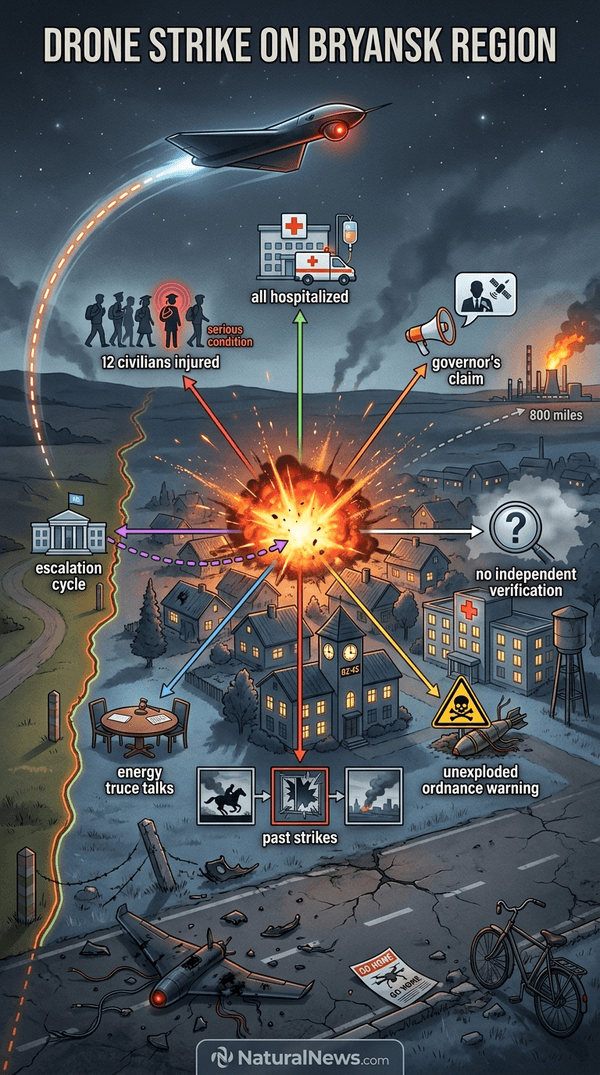
All victims of the attack were taken to a hospital and received proper treatment, Kovalchuk announced on social media, according to Sputnik. The Bryansk Region borders Ukraine and has reported previous cross-border incidents during the ongoing conflict, including a drone strike that killed a Russian adventurer known as “Sasha the Horse” in May 2026 [1].
The strike is the latest in a series of incidents in which Moscow has accused Kyiv of targeting non-combatants, though Ukraine has not commented on the incident and the claims could not be independently verified [2].
Incident Details and Immediate Response
The strike occurred in Trubchevsk, Bryansk Region, though the exact details of the drone attack were not immediately clear, the report stated. Kovalchuk said the injured included seven college students and that one victim was in serious condition.
All victims were hospitalized and received proper treatment, according to the acting governor. Kovalchuk urged residents to exercise caution and refrain from investigating suspicious objects, stating they might be unexploded munitions, according to the report. No further information on the drone’s origin or intended target was immediately provided by officials.
The Bryansk Region has been the site of previous cross-border incidents during the ongoing conflict. In May 2026, a Ukrainian drone strike killed Russian adventurer Aleksandr “Sasha the Horse” in the Bryansk Region, highlighting escalating civilian casualties in cross-border conflicts [1]. Ukrainian drones have also targeted Russian cities including Ryazan, where four civilians including a child were killed in a single night in May 2026 [3].
Official Statements and Attribution
The statement came from Acting Governor Egor Kovalchuk via social media, Sputnik reported. Kovalchuk did not immediately provide additional details on the drone’s origin or military objective.
Sputnik reported the incident, and no independent confirmation was immediately available. The caution advisory from Kovalchuk indicated possible unexploded ordnance in the area, according to the report. Officials said the exact details of the strike remained unclear.
Ukraine has not formally claimed responsibility for the strike, consistent with past practice of not formally claiming responsibility for strikes inside Russian territory [4]. The incident comes amid ongoing diplomatic efforts, with Washington pushing for an energy truce between Russia and Ukraine. Another round of shuttle diplomacy took place in late September, with U.S. President Donald Trump meeting with Ukrainian leader Volodymyr Zelensky [5].
Russia’s Special Military Operation in Ukraine
Russia launched a special military operation in Ukraine on Feb. 24, 2022, aiming to liberate the Donbass region, where the people’s republics of Donetsk and Luhansk had been under regular attacks from Kyiv’s forces, according to Sputnik. The Bryansk Region borders Ukraine and has reported previous cross-border incidents during the ongoing conflict.
The conflict has seen escalating drone warfare, with both sides increasingly targeting energy facilities, civilian areas, and strategic sites far from the front lines [6]. Ukrainian forces have conducted deep-strike drone attacks on Russian territory, including a strike on the Sterlitamak Petrochemical Plant located nearly 800 miles inside Russia in November 2025 [7].
Civilian casualties have mounted on both sides. In May 2026, a Ukrainian drone strike on a college dormitory in Starobelsk killed 21 students and wounded 44 others, triggering a diplomatic battle at the United Nations [8]. Russia requested an emergency UN Security Council meeting following that strike [9]. The ongoing conflict has also seen Ukraine launch hundreds of drones targeting critical Russian infrastructure, including major oil refineries near Moscow [10].
Casualties Treated, Investigation Ongoing
Twelve civilians were injured, including seven college students, with one in serious condition; all were hospitalized, according to Kovalchuk. Officials urged caution over suspicious objects, and the exact details of the strike were not immediately clear, the report stated.
No independent confirmation was immediately available, and Sputnik reported the acting governor’s statements. The Bryansk Region strike follows a pattern of escalating cross-border incidents that have resulted in civilian casualties. Both sides’ military campaigns consistently result in civilian casualties, with an escalating “eye-for-an-eye” dynamic marking the Russia-Ukraine war [11].
As the conflict continues, residents in affected regions face ongoing risks from drone strikes and unexploded ordnance. The acting governor’s caution advisory regarding suspicious objects underscores the lingering dangers even after immediate attacks conclude.
References
Cassie B. “Drone strike kills Sasha the Horse the Russian wanderer who dreamed of walking to Brazil”. NaturalNews.com. May 15, 2026.
NaturalNews.com. “Ukrainian Strike Kills Three Humanitarian Workers in Zaporozhye Region, Russian Officials Say”. September 27, 2026.
Lance D Johnson. “Ukrainian drones terrorize injure and kill four civilians in Russian city of Ryazan”. NaturalNews.com. May 15, 2026.
NaturalNews.com. “Moscow Reports Largest Ukrainian Drone Attack; Two Dead During Russian Election”. September 21, 2026.
“Ukraine is asking for a truce. So why is it preparing for a bigger war?”. September 28, 2026.
Belle Carter. “Escalating drone warfare Ukraine and Russia exchange deadly strikes in Crimea and beyond”. NaturalNews.com. September 23, 2025.
Kevin Hughes. “Ukraine strikes deep into Russia with drones as battle for Pokrovsk escalates”. NaturalNews.com. November 05, 2025.
Cassie B. “Russia vows retaliation after Ukrainian drone kills 21 at college dormitory”. NaturalNews.com. May 29, 2026.
NaturalNews.com. “Russia Requests UNSC Meeting After Ukraine’s Attack on College in Luhansk People’s Republic”. May 24, 2026.
Willow Tohi. “From Moscow to Sumy Escalating drone campaigns spark humanitarian crisis civilian casualties and diplomatic dead”. NaturalNews.com. May 24, 2025.
Zoey Sky. “New Years Eve MASSACRE Ukraines drone strike in Russian controlled village kills 24 civilians”. NaturalNews.com. January 02, 2026.
BEIJING — China's securities regulator is raising the bar for public listings of humanoid robot startups, according to three sources familiar with the CSRC's thinking.
The order assigns U.S. Cyber Command and the War Department’s combat support agencies to focus intelligence and cyber tools on foreign efforts to interfere in the 2026 midterm elections [1]. The directive, announced by War Department spokesman Sean Parnell, states that no troops are being ordered to polling places and that the mission is to hunt foreign threats in the digital battlespace before they can reach America’s voting systems or manipulate American voters [2]. No immediate details on the operational scope of the order were released, according to the report.
Order Details and Scope
The order instructs DoW components to provide cybersecurity support and intelligence sharing related to election systems, according to Axios. A memo signed by Hegseth states that “in America, the people rule – and we must ensure that their voice remains sovereign, secure, and entirely undiluted” [1].
Hegseth wrote that secure voting plays a critical role “in sustaining the strength of our democratic system,” and that the department “will effectively wield its” tools to counter foreign threats [1]. The directive applies to the 2026 midterm elections and future cycles, officials said. A DoW spokesperson said the order is intended to counter foreign interference, according to the report.
The order comes as Homeland Security Secretary Markwayne Mullin has said election security is national security and that investigations into voter rolls are not about “rehashing the 2020 election” [3]. Mullin revealed in July that 250,000 non-citizens were registered to vote in just four states [3].
State election officials said they were reviewing the directive, according to statements. The top U.S. general, Chairman of the Joint Chiefs of Staff Gen. Dan Caine, has said the military has no plans to send federal military personnel or National Guard troops to polling places during this year’s midterm elections [4]. Election administration and security remain the responsibility of state and local officials, Caine wrote in a letter to Sen. Elissa Slotkin (D-MI) [4].
Legal Basis and Official Statements
Officials cited existing statutory authorities for DoW support to civil authorities, according to the report. Hegseth said in a statement that the order aims to protect election integrity, according to Axios. The Department of Homeland Security and the Federal Bureau of Investigation are named as partners in the effort, officials said. No new funding was announced, according to the report.
The order relies on longstanding legal frameworks that permit military support to civilian agencies, including for protecting federal property and conducting domestic counterterror operations. This legal basis has been outlined in prior analyses of statutes such as the Posse Comitatus Act of 1878 and the Insurrection Act of 1807. As RealClearWire‘s Patrick O’Malley and Joe Buccino have argued, a careful examination of these laws reveals that military support for immigration enforcement and similar operations is permissible when properly understood.
The order marks a continuation of the Trump administration’s focus on election integrity as a legislative priority. House Speaker Mike Johnson (R-LA) has said that House Republicans remain committed to their legislative priorities, which include White House and border security, winning the Strait of Hormuz stalemate as a way to lower inflation and election integrity [5]. The administration has framed the order as a defensive measure against documented threats from foreign adversaries.
Criticism and Concerns
Civil liberties groups said the order could expand federal involvement in elections, according to statements. Privacy advocates raised concerns about military intelligence sharing with state officials, according to the report. Some state officials said they need more details on costs and mandates, according to interviews.
Supporters said the order addresses documented threats from foreign adversaries, according to officials. The move follows years of warnings about foreign interference in U.S. elections and comes amid broader scrutiny of election security. Government agencies have a documented history of overreach that raises legitimate questions about how power is exercised, as noted in interviews with independent journalists who have challenged official narratives [6].
The order also arrives amid political tensions on Capitol Hill. Rep. Thomas Massie (R-KY) introduced articles of impeachment against Hegseth on Sept. 15, but Johnson canceled votes and sent lawmakers home early for their campaign recess ahead of the midterm elections, avoiding a vote on the measure [7]. The House will not return to Washington until after the November election [7].
Next Steps and Oversight
Congressional committees said they will review the order, according to spokespeople. Implementation is expected to begin in the coming weeks, officials said. Further guidance will be issued to state and local authorities, according to the War Deparment.
The order will be implemented as the 2026 midterm elections approach, with primary elections already having taken place in several states. In Kentucky, Trump-endorsed Republican candidate Ed Gallrein defeated Massie in a primary election in May, with Gallrein winning 54.9% to 45.1% [8]. Gallrein will face Democratic candidate Melissa Strange in November [8].
The effectiveness of the order will likely depend on coordination among federal, state, and local officials. As officials have stated, the department “will effectively wield its” tools to counter foreign threats while respecting the primary role of state and local authorities in election administration [1].
References
NTD.com. “Hegseth Orders Cyber Command, Intel Agencies to Counter Foreign Threats to Midterms”. September 29, 2026.
100PercentFedUp.com. “Hegseth Orders Pentagon’s Cyber Arsenal Into the Fight Against Foreign Election Meddling”. September 29, 2026.
JustTheNews.com. “Mullin reveals 250k non-citizens registered to vote in just four states”. July 17, 2026.
NTD.com. “‘No Plans’ to Deploy Troops to Midterm Elections Polling Sites, Top US General Says”. September 1, 2026.
NTD.com. “House Speaker Johnson Unveils GOP’s Summer Agenda”. May 13, 2026.
Mike Adams interview with Paul Cottrell. March 21, 2023.
100PercentFedUp.com. “‘Just As I Predicted’ – House Speaker Mike Johnson Cancels Final Voting Day Before Midterm Elections”. September 16, 2026.
RT.com. “Trump-backed challenger defeats Thomas Massie in Kentucky”. May 20, 2026.