
[ad_1]
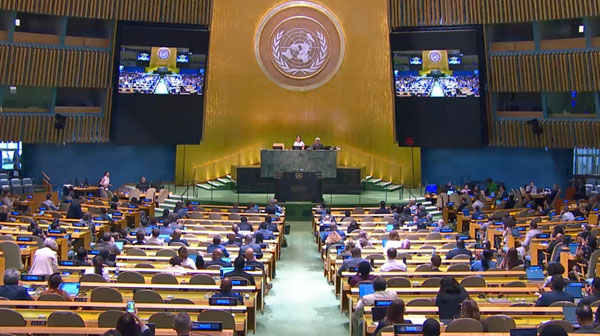
LONDON, June 5 (IPS) – Ahead of World Environment Day, the UN General Assembly made a vital commitment to protect people from climate impacts, adopting a resolution on the climate change obligations of states. The resolution follows up on the International Court of Justice (ICJ) advisory opinion issued last year, which found that states have a legal duty to prevent activities that cause environmental harm. Most states voted for the resolution despite a concerted campaign by the Trump administration to block it.
From ruling to resolution
The ICJ ruling was a landmark moment. It made clear that climate change is a human rights issue, because the right to a clean, healthy and sustainable environment is essential for human rights as a whole. Its ruling means that if states breach their climate obligations, it’s an intentionally wrongful act, opening them up to legal challenges.
The ICJ case was brought by the government of Vanuatu, but it was a victory for civil society, because the campaign to seek a ruling was started by law students who formed an organisation, Pacific Islands Students Fighting Climate Change, to pressure their governments to go to the court.
ICJ advisory opinions aren’t legally binding, but their reasoning often plays a part in litigation efforts, strengthening the climate lawsuits civil society is increasingly bringing against states and corporations. It’s already being referenced in court hearings. Last year, a Brazilian judge cited it when he ordered a coalmine and thermoelectric plant to cease operations, although his ruling is currently on hold pending an appeal.
However, at the latest global climate summit, COP30, the Saudi Arabian government vetoed any reference to the ICJ ruling. Vanuatu therefore pushed for the General Assembly resolution to recognise the international legal standing of the judgment and encourage greater implementation.
Approval was far from unanimous. The Trump administration urged its allies to pressure Vanuatu to withdraw the resolution, part of its extensive campaign to defend the interests of fossil fuel corporations. It has also renounced the Paris Agreement and UN Framework Convention on Climate Change, withdrawn from an array of international climate and environmental bodies and blocked an agreement on global shipping emissions. It was one of eight states that voted against, alongside Belarus, Iran, Israel, Liberia, Russia, Saudi Arabia and Yemen, a roll call of petrostates, countries that routinely ignore international rules and their close allies. The Trump administration continues to dispute the resolution, having issued a statement questioning its legality.
Momentum and resistance
States that backed the resolution have made clear that action on the climate crisis isn’t a question of political convenience, but a matter of respecting international law.
The resolution further contributes to the growing momentum behind climate action, despite attempts by a handful of powerful states to drag the world backwards. Renewables now provide around 30 per cent of global electricity, and renewable energy investments in 2025 were more than double those in fossil fuels. The First Conference on Transitioning Away from Fossil Fuels, held in April, brought together 57 states to commit to developing national roadmaps to phase out fossil fuel production and consumption. The blockade of the Strait of Hormuz, through which a fifth of the world’s oil supplies flow, has brought further recognition of the reality that fossil fuel dependence benefits only a handful of petrostates and leaves everyone else vulnerable.
These shifts are having an impact. In May, the UN’s Intergovernmental Panel on Climate Change dropped its worst-case scenario for the possible effects of climate change, under which global temperatures could have risen to 4.5 degrees above preindustrial levels, because emissions cuts are making a difference.
Activists in the crosshairs
The ICJ case offers just one example of how civil society is making a crucial difference in pushing for climate action. Activists are urging ambition and resisting new fossil fuel projects. But they’re paying a heavy price. The Business and Human Rights Centre found that in 2025, three quarters of almost 800 attacks it documented against people who spoke out against businesses targeted those who mobilised on climate, environmental and land rights issues.
Ten activists from the Mother Nature Cambodia environmental group remain in jail, having been handed heavy sentences in 2024 in retaliation for their work to raise public awareness about the impacts of extractive and infrastructure projects. In Mexico, Kenia Hernandez, leader of the Zapata Vive peasant movement that protects land rights, is serving a ten-and-a-half year sentence on fabricated charges.
In Uganda, last year authorities arrested 11 activists for protesting against the construction of the East African Crude Oil Pipeline. In January, police raided the home of Harjeet Singh, one of India’s most prominent environmental activists and a vocal campaigner for a fossil fuel non-proliferation treaty. In Chile, where the government has weakened environmental laws, Indigenous women activists are experiencing intimidation, judicial harassment and violent attacks for opposing large-scale projects.

Last year the German government launched an inquiry into public funding of environmental groups, the Dutch parliament adopted a motion declaring Extinction Rebellion an ‘unlawful, society-disrupting and vandalistic organisation’ and the Portuguese government listed environmental groups in a section on terrorism of its annual security report. Authorities in Australia and New Zealand have arrested numerous people at climate and environmental protests, including in opposition to coal mining.
The UN resolution makes clear that criminalisation and violence are incompatible with states’ obligations, and everyone has a part to play in climate action. It calls on states to ‘ensure the full, meaningful and equal participation of Indigenous Peoples, local communities, people of African descent, women and girls, children and youth, persons with disabilities and people in vulnerable situations in decision-making on climate action’.
States that backed the resolution are attacking the people it demands they work with. They can’t meet their climate obligations unless they stop repressing civil society. The resolution should give fresh impetus to civil society’s calls to replace repression with partnership.
Andrew Firmin is CIVICUS Editor-in-Chief, co-director and writer for CIVICUS Lens and co-author of the State of Civil Society Report.
For interviews or more information, please contact [email protected]
© Inter Press Service (20260605051815) — All Rights Reserved. Original source: Inter Press Service
[ad_2]
Source link
