

[ad_1]
BENGALURU, India, July 13 (IPS) – For most people, the method of peace begins with the signing of a ceasefire or an settlement amongst politicians. Nevertheless, those that reside in areas experiencing violence perceive that peace is made lengthy earlier than politicians meet on the negotiating desk. Peace is created amongst communities by individuals who work on a regular basis to make sure that no violence takes place, and that disputes are sorted out.
Ladies have been enjoying central roles within the course of of constructing peace, however their function is basically ignored in official peacebuilding processes.
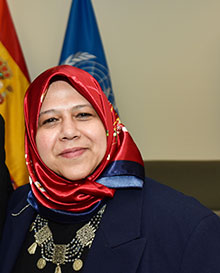
Chatting with IPS Inter Press Service, Yemeni peacebuilding advisor and humanitarian chief Muna Luqman challenged typical desirous about who builds peace and the place peacebuilding actually begins, “Communities by no means wait till peace occurs,” Luqman stated. “They’re working to guard peace each day.”
Based mostly on her in depth expertise working in Yemen for greater than 15 years, Luqman defined how native communities, particularly girls, resolve disputes, present essential providers, negotiate humanitarian help and create dialogical areas approach forward of any intervention of worldwide organizations.
Luqman is the founder and chairperson of Meals for Humanity, has seen first-hand the adjustments battle brings about in society. Whereas residing by the Yemeni civil struggle, she confronted airstrikes and negotiated the evacuation of civilians caught up within the struggle zone. These experiences led her to understand that humanitarian response alone is insufficient.
“If we solely reply to the results of battle with out addressing its causes, we’ll all the time be a step behind,” she mirrored. Her expertise additionally uncovered one of many best challenges going through native peacebuilders and that’s of recognition.
“We thought we’d be the primary to be supported,” she stated, referring to native organisations that led humanitarian responses earlier than worldwide actors arrived. “However we discovered that it was an extended course of.”
In line with a report by UN Women, round 676 million lived inside 50 kilometers of lethal battle in 2024 – the very best determine for the reason that Nineties. Sima Bahous, Govt Director of UN Women, stated, “Ladies and women are being killed in document numbers, shut out of peace tables, and left unprotected as wars multiply. Ladies don’t want extra guarantees, they want energy, safety, and equal participation.”
Data collected by the United Nations from 2020-2024 discovered that, “Ladies’s illustration as negotiators, mediators and signatories in peace processes is way under the goal set by the UN. In 2024, girls made up solely seven p.c of negotiators on common worldwide, and almost 9 out of ten negotiation tracks included no girls negotiators”. The report said, girls had been barely extra represented in mediation roles, averaging 14 p.c however nonetheless, two-thirds of mediation efforts didn’t embody girls.
The discrepancy for Luqman pointed to an underlying drawback in worldwide peacebuilding. Whereas native teams responded instantly to communities in want, different establishments had been sure by mandates, funding, and procedures. It turns into evident, she says, why true inclusion in peacebuilding needs to be greater than merely symbolic in nature.
True inclusion requires recognizing girls not as mere recipients of assist or observers of processes, however as lively members in negotiating, mediating, and taking essential selections. It’s proven that peace treaties are rather more sustainable in these instances the place girls are actively concerned within the negotiation course of. Ladies broaden the agenda from purely political points like political power-sharing to such essential areas as justice, schooling, well being care, livelihoods, displacement, and neighborhood reconciliation.
Luqman believes that native girls possess a singular understanding of those realities as a result of they continue to be deeply embedded inside their communities. “Ladies mediators are keen to stop disagreements earlier than they grow to be violence,” she defined. She has witnessed girls in Yemen securing the discharge of prisoners, organizing their communities to rebuild faculties and water provides, and stopping kids from becoming a member of armed teams. That is usually performed discreetly, exterior the limelight of the worldwide neighborhood.
“The power of girls peacebuilders is their potential to mobilize their communities,” she stated. Nevertheless, it’s exactly these girls who discover themselves in extraordinary circumstances. They’re threatened, intimidated, compelled to flee, and infrequently lack funds regardless of serving to others. Defending girls peacebuilders have to be a precedence on the worldwide agenda, Luqman asserts.
“They do that work whereas they’re going through both lack of funding or no funding in any respect. They continue to be resilient, they continue to be weak on the identical time, and so they stay beneath threats.”
She believes that the worldwide neighborhood must transcend recognizing the contribution of girls and work to supply monetary assist to women-led organizations which can be trusted and credible throughout the native communities.
Whereas serving because the United Nations Nationwide Coordinator on Inclusion within the Peace Strategy of Yemen, Luqman developed an method that will enable native folks to talk up. The initiative didn’t take into account participation simply as a proper side however really aimed to usher in the neighborhood perspective. “It wasn’t symbolic participation,” she instructed me. “We actually took that evaluation and used it in our system.” It’s because peace processes can’t be made by the political elite solely; they have to be inclusive of communities which were experiencing battle.
In Luqman’s opinion, native governance, local weather challenges, livelihoods, transitional justice, and constructing belief usually are not marginal questions however reasonably central elements in avoiding additional outbreaks of violence.
Luqman insists on the necessity for peacebuilding to contain listening: “Typically listening to the folks themselves and giving them an area is in itself a peace course of.”
Within the context of rising complexity of conflicts, the significance of inclusion into peace processes has by no means been so pressing. Ladies’s involvement within the processes can’t be thought of as some type of equality subject or just as an obligation beneath worldwide mechanisms.
Quite the opposite, it’s strategically vital primarily based on expertise and neighborhood belief. The message from Luqman to policymakers is clear: native girls peacebuilders usually are not marginal figures in peacebuilding however its cornerstone. “The native girls peacebuilders are the construction and the spine of those societies,” Luqman stated. “They’re beneficial. They need to be handled as beneficial belongings. They need to be supported and guarded.” Setting up sustainable peace just isn’t potential solely by negotiations of the events concerned in armed battle but additionally by investing in individuals who have performed so a few years of maintaining communities collectively regardless of the state of affairs being unrecognizable.
Sania Farooqui is an impartial journalist and host of The Peace Temporary, a platform devoted to amplifying the voices of girls in peacebuilding and human rights.
IPS UN Bureau Report
© Inter Press Service (20260713125001) — All Rights Reserved. Original source: Inter Press Service
[ad_2]
Source link
