

[ad_1]
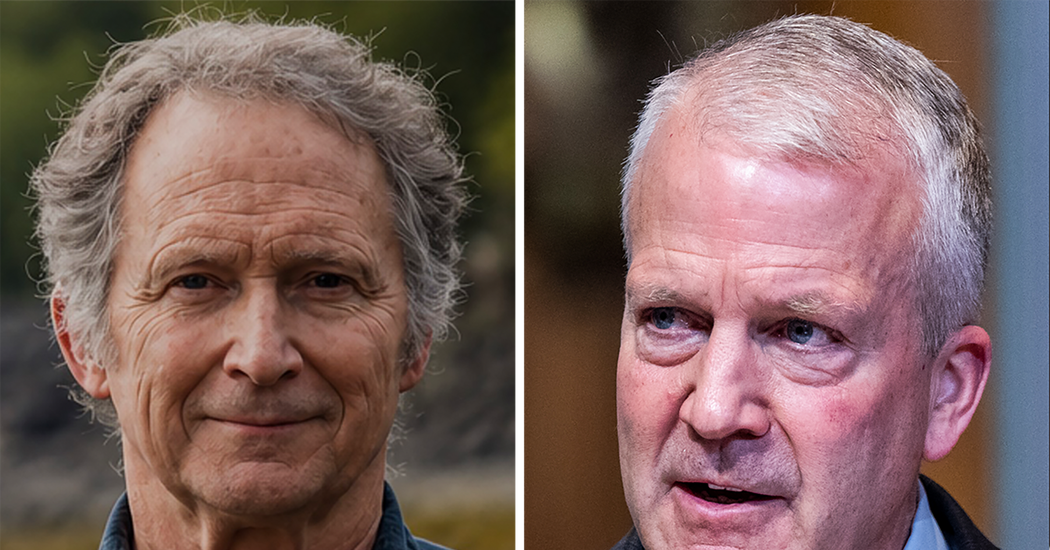
Alaska voters may have two Dan Sullivans to choose from on the state’s primary ballot for the U.S. Senate after all.
A state judge ordered late Friday local time that Dan J. Sullivan be allowed to join the Republican Senator Dan S. Sullivan on the ballot, reversing a state elections official’s finding that Dan J. Sullivan was ineligible.
The ruling, by Judge Thomas A. Matthews of the Alaska Superior Court in Anchorage, is expected to be appealed to the Alaska Supreme Court. But the decision, at least for now, figures to please Democrats and frustrate Republicans, who believe Dan J. Sullivan’s candidacy could hamper Senator Sullivan’s efforts to win re-election.
Judge Matthews wrote that the removal of Dan J. Sullivan did not have a basis in the U.S. Constitution, Alaska state law or any regulations laid out by the Alaska Division of Elections.
“Here, the Division has utilized a previously unidentified criteria, ‘good-faith,’ to exclude Mr. Sullivan from the primary ballot,” Judge Matthews wrote. “This exclusion is contrary to the Alaska Supreme Court’s well-established presumption in favor of candidate eligibility.”
Dan J. Sullivan, who says he recently registered as a Republican, is not expected to wage a competitive campaign.
But almost as soon as he entered the race in late May, Republicans across the country began to worry that some voters would mistakenly vote for him instead of Senator Sullivan, potentially lifting a Democratic candidate, former Representative Mary Peltola, in a race that could decide control of the Senate. Republicans said Dan. J. Sullivan’s candidacy was a plot by Democrats to help Ms. Peltola; the top four vote-getters in the nonpartisan Aug. 18 primary will advance to the November general election.
Republicans swiftly filed complaints with the state’s Division of Elections, arguing that Dan J. Sullivan had not filed to run for office in “good faith” and that he should be removed from the ballot.
The Division of Elections, which is overseen by the state’s Republican lieutenant governor, agreed with those arguments.
In response, Dan J. Sullivan turned to the courts.
“Nothing in Alaska law regulates in any way the private motivations that draw individuals to declare or campaign for office,” Dan J. Sullivan’s lawyers wrote in court papers, arguing that the “good-faith” requirement that election officials had used to remove him from the ballot had no grounding in state regulations.
They argued that Alaska voters were “savvy” enough to “understand the dynamics of an open primary and to choose a qualified candidate.”
Election officials, Dan J. Sullivan’s lawyers wrote, could not “patronizingly assume that voters are too simple to appreciate the nuances of a dynamic campaign.” And they argued that any confusion could be dispelled by including the candidates’ middle initials on the ballot.
The lawsuit didn’t dispute that Dan J. Sullivan might be a Democratic plant.
His campaign website described him as a former elementary-school teacher and bartender from Petersburg, Alaska, a small town about 120 miles southeast of Juneau.
When he announced his entry in the race, he said that he had one goal: to unseat the incumbent. “It’s time for Alaska to elect a Sullivan that’s on their side,” he said in a statement.
Federal campaign filings show that a Dan Sullivan from Petersburg, Alaska, donated small sums of money to Democratic congressional candidates over the years, including to Ms. Peltola’s campaigns and to the campaign of Kat Abughazaleh, a progressive influencer in Illinois who lost a closely watched House primary in March.
Republicans have also pointed to metadata in the news release announcing Dan J. Sullivan’s campaign announcement that suggests it originated with a Democratic consultant who had supported Ms. Peltola in the past.
In court papers filed Wednesday, the Division of Elections argued that “tellingly,” Dan J. Sullivan had not disputed “the substance” of its decision. It said it had no choice but to draw a “necessary and principled line” to “preserve the integrity of the electoral process.”
Judge Matthews, however, found that the agency had exceeded its authority.
“Despite the Division’s assertion that Mr. Sullivan may be excluded from the ballot because he lacks ‘good-faith’, there is no statute which provides such a criterion,” the judge wrote. “The concept of ‘good-faith’, or pure motive, or bona fide intent is simply absent.”
Any appeals in the case are expected to be resolved within days. The deadline for elections officials to print primary ballots is Tuesday.
Kellen Browning contributed reporting.
[ad_2]
Source link
