

More Tariff Pass‑Through Is in the Pipeline

The previous 12 months introduced dramatic modifications to U.S. commerce coverage, together with sweeping new tariffs, in addition to a Supreme Court decision that additional reshaped the tariff panorama. Many companies noticed their prices enhance considerably and confronted advanced selections about whether or not to soak up the tariffs by means of decrease revenue margins, elevate their costs to recuperate the upper prices, or some mixture of the 2. Final 12 months, we discovered that almost all companies had handed on at the very least a few of these increased prices to their prospects by means of increased costs. Now, over a 12 months later, have companies completed adjusting costs, or do additional tariff-induced value will increase lie forward? Our newest regional enterprise surveys reveal that just about half of corporations which have paid tariffs nonetheless plan further value will increase to offset these prices, with some anticipating to boost costs six months or extra sooner or later.
Many Companies Are Not Completed Elevating Costs to Offset Tariffs
Tariffs are taxes on imports that may elevate the price of inputs used to provide home items and companies. Certainly, latest analysis has proven that just about 90 p.c of the financial burden of tariffs has fallen on U.S. corporations and shoppers. Two-thirds of service corporations and nearly all producers responding to our surveys import at the very least a few of their inputs. Amongst these importing corporations, 40 p.c of service corporations and 70 p.c of producers mentioned they immediately paid tariffs over the previous twelve months, although many others confronted increased prices on imported inputs from their suppliers who paid the tariffs and charged increased costs to their prospects.
The chart under tracks tariff pass-through habits by these companies that paid tariffs immediately. A small share of those companies reported that tariffs had an insignificant affect on their prices—3 p.c of service corporations and eight p.c of producers—proven by the underside darkish blue bars. Roughly 30 p.c of service suppliers and 20 p.c of producers reported that that they had absolutely handed by means of tariffs to prospects by elevating costs, that means they don’t have any want for additional changes to cowl tariffs. One other 20 p.c of service corporations and 30 p.c of producers don’t plan further value hikes sooner or later, no matter tariffs they’ve already paid. Collectively, companies in these three classes—proven in shades of blue within the chart and representing simply over half of tariff-paying corporations—indicated they don’t have any plans for additional value will increase to recoup tariff bills.
Extra Value Will increase Are Coming from Companies That Paid Tariffs
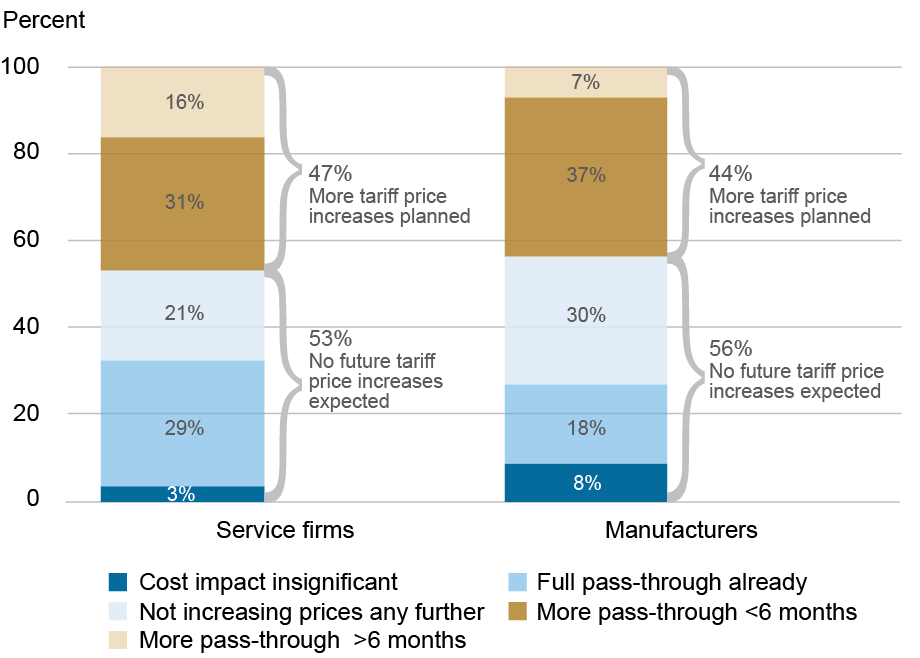
Notice: Figures symbolize the shares of companies that immediately paid tariffs during the last twelve months.
That leaves 47 p.c of service corporations and 44 p.c of producers that paid tariffs immediately saying they’ve extra tariff-induced value will increase to come back—proven by the 2 shades of gold bars within the chart. Amongst tariff-paying service corporations, roughly 30 p.c plan further value will increase throughout the subsequent six months, as do almost 40 p.c of tariff-paying producers. Notably, 16 p.c of service corporations and seven p.c of producers plan tariff-induced value will increase greater than six months from now.
These outcomes counsel that many companies are nonetheless adjusting their costs, greater than a 12 months after tariffs had been first launched. It isn’t clear whether or not corporations are responding to a single spherical of tariffs or to the sequence of will increase that has unfolded over the previous 12 months or extra. What is evident is that the adjustment has been gradual, consistent with a rising body of research exhibiting that tariffs go by means of to shopper costs incrementally, constructing over the higher a part of a 12 months relatively than unexpectedly.
Why Companies Are Planning Future Value Will increase
In our surveys, companies cited two essential causes for planning value will increase to date into the long run.
First, some companies function beneath contracts with fastened promoting costs and are unable to boost costs till such contracts expire, forcing them to soak up value will increase within the meantime. Certainly, research has discovered that long-term contracts can impede companies from passing by means of value will increase.
Second, some companies reported taking a “trickle up” strategy to cost will increase, the place they steadily elevate costs over time relatively than instantly elevating costs to totally cowl tariffs. This pricing technique permits corporations to keep away from surprising their prospects with sharp value will increase whereas retaining the power to speed up value will increase if enter prices proceed to rise. Furthermore, uncertainty surrounding future tariff insurance policies—together with potential fee modifications, exemptions, or tariff responses from different nations—could also be inflicting some corporations to undertake cautious, incremental pricing methods relatively than making massive, discrete changes. This habits extends the interval over which tariff-related value pressures work their approach by means of the economic system.
Pricing Pressures Could Be Persistent
Whereas economists and policymakers typically anticipate that value will increase on account of tariffs will represent a one-time price-level adjustment, what “one-time” means in apply could also be a drawn-out affair, particularly when the tariffs change incessantly. Our enterprise surveys counsel that, in an ever-changing tariff surroundings, many corporations are spreading value will increase throughout prolonged durations—that means that inflationary pressures on account of tariffs might properly final for a while to come back.

Jaison R. Abel is head of Microeconomics within the Federal Reserve Financial institution of New York’s Analysis and Statistics Group.

Mary Amiti is head of Labor and Product Markets within the Federal Reserve Financial institution of New York’s Analysis and Statistics Group.

Richard Deitz is an financial coverage advisor within the Federal Reserve Financial institution of New York’s Analysis and Statistics Group.

Sebastian Heise is a analysis economist within the Federal Reserve Financial institution of New York’s Analysis and Statistics Group.

Nick Montalbano is a knowledge analytics specialist within the Federal Reserve Financial institution of New York’s Analysis and Statistics Group.
Methods to cite this submit:
Jaison R. Abel, Mary Amiti, Richard Deitz, Sebastian Heise, and Nick Montalbano, “Extra Tariff Go‑By way of Is within the Pipeline,” Federal Reserve Financial institution of New York Liberty Avenue Economics, July 8, 2026, https://doi.org/10.59576/lse.20260708
BibTeX: View |
operate _toggle_bibtex5(){
let el = doc.getElementById(‘bibtex5’);
el.fashion.show = el.fashion.show === ‘none’ ? ” : ‘none’;
}
@article{AbelAmitiDeitzHeiseMontalbano2026,
    creator={Abel, Jaison R. and Amiti, Mary and Deitz, Richard and Heise, Sebastian and Montalbano, Nick},
    title={Extra Tariff Go‑By way of Is within the Pipeline},
    journal={Liberty Avenue Economics},
    word={Liberty Avenue Economics Weblog},
    quantity={July 8},
    12 months={2026},
    url={https://doi.org/10.59576/lse.20260708}
}
Are Companies Absorbing the Tariffs or Passing Them On to Their Clients?
Who Is Paying for the 2025 U.S. Tariffs?
Disclaimer
The views expressed on this submit are these of the creator(s) and don’t essentially mirror the place of the Federal Reserve Financial institution of New York or the Federal Reserve System. Any errors or omissions are the duty of the creator(s).
