

What Do Over 3,000 Bank Runs Teach Us About Banking Crises?
Runs on monetary establishments are one of many salient markers of monetary crises. However the position of runs in crises is a subject of longstanding debate. Runs may be seen as the important thing turning level, whereby even small shocks can generate extreme crises with widespread financial institution failures. One other view is that runs are primarily a symptom of deeper rot within the monetary system, exacerbating crises slightly than being their main trigger. Understanding this debate has first order implications for the way to consider monetary crises and the suitable coverage responses. On this put up, we use a brand new database of greater than 3,000 financial institution runs (launched in our companion put up) to indicate that poor fundamentals are central to explaining each when runs happen and after they have extreme financial results. We argue that this proof tempers the view that small shocks can have outsized actual results by means of self-fulfilling run dynamics.
The Historic Financial institution Run Database
A key problem for understanding the causes and penalties of financial institution runs is the absence of systematic microdata on the prevalence of financial institution runs. As we detailed in our earlier put up, we overcome this hole by learning the near-universe of runs within the U.S. banking system from 1863 to 1934 as recorded in up to date newspapers. We mix this new information on financial institution runs with information on financial institution stability sheets, macroeconomic circumstances, and native enterprise failures and manufacturing exercise.
The historic U.S. banking system supplies an interesting atmosphere to review runs. Our pattern covers the quite a few panics of the Nationwide Banking Period and the Nice Melancholy. This contrasts with the up to date banking system, the place runs are a lot much less frequent as a result of a wide range of authorities interventions that have an effect on depositor habits, similar to deposit insurance coverage and lending of final resort.
Discovering #1: Runs Are Significantly Extra Possible in Weak Banks however Can Additionally Happen in Sturdy Banks.
We first doc that runs are considerably extra seemingly in banks with weak observable fundamentals. To ascertain this discovering, we assemble a easy abstract measure of financial institution well being (“fundamentals”) based mostly on variables measuring a financial institution’s capitalization, profitability, and talent to finance itself with low-cost deposits relative to costly noncore funding. Present analysis exhibits that these metrics seize financial institution well being and failure danger (Correia, Luck and Verner, 2025).
The chart under supplies a visualization of the connection between financial institution fundamentals and the chance of a run, a run with failure, and a run with out failure throughout deciles of our proxy for fundamentals. The gold line exhibits that runs are extra seemingly in banks with weak fundamentals. A financial institution within the lowest decile of fundamentals has a virtually 100 foundation level likelihood of being uncovered to a run in a given yr, whereas the likelihood is barely about 25 foundation factors for banks with robust observable fundamentals. Thus, runs on robust banks are much less frequent, however they’ll happen. Furthermore, absolutely the likelihood of a run for weak banks is comparatively low.
Chance of Financial institution Runs by Financial institution Fundamentals
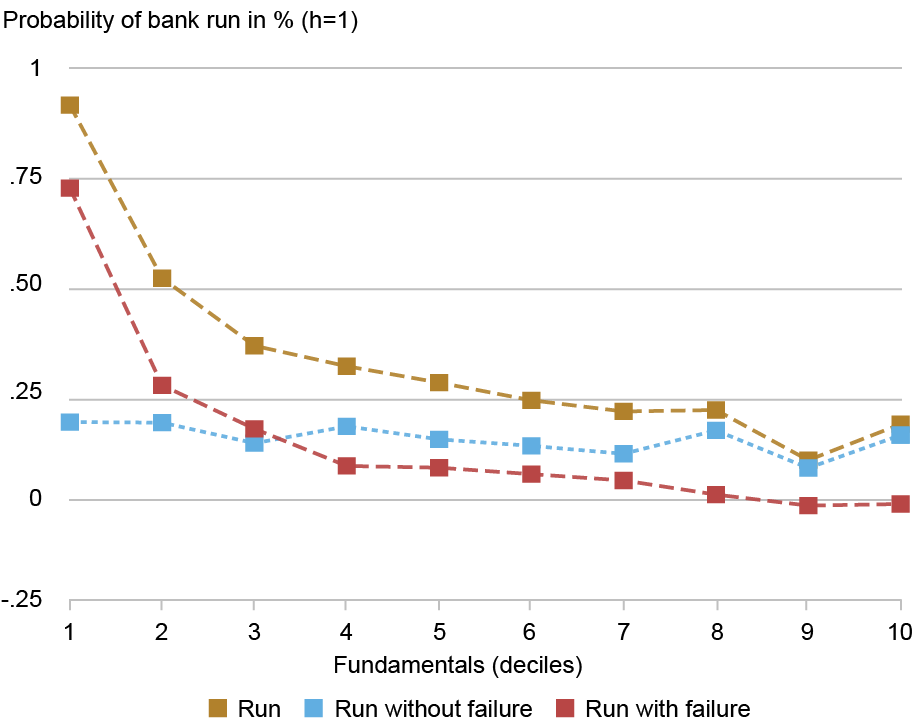
Notes: This chart plots the likelihood of a financial institution run, a financial institution run that doesn’t lead to failure, and a financial institution run that doesn’t lead to failure throughout deciles of a proxy of bank-specific fundamentals (see textual content for definition).
Discovering #2: Runs Sometimes Solely End in Failure for Banks with Weak Fundamentals.
How frequent is it for runs to lead to financial institution failure? We discover {that a} financial institution has a 38 % likelihood of failing whether it is topic to a run. This can be a excessive conditional likelihood of failure, provided that the annual unconditional likelihood of financial institution failure is 0.85 %. On the identical time, it additionally implies {that a} run shouldn’t be a demise sentence. There are extra runs with out financial institution failure than runs with failure, highlighting a key novel perception from our method.
We additional set up that whether or not a run leads to failure relies upon crucially on a financial institution’s monetary well being. The chart above decomposes runs into these the place the financial institution fails and people the place it survives. It exhibits that runs are considerably extra more likely to lead to failure for banks with weak fundamentals. In our paper, we estimate that conditional on a run, a financial institution with very weak fundamentals—outlined as being within the lowest decile of our most well-liked metric that summarizes a financial institution’s monetary well being—has a 63 % likelihood of failing. In distinction, the strongest banks, measured as being within the high decile of the identical metric, primarily by no means fail when topic to a run. Thus, weak financial institution fundamentals are needed for a run to be related to financial institution failure.
How Do Sturdy Banks Survive Runs?
Banks with robust fundamentals sometimes don’t fail when topic to a run. This raises the query: How do robust banks survive runs? What measures do banks take to fend off runs? To raised perceive how banks with sound fundamentals are capable of survive runs, we analyze how newspapers describe banks’ responses to runs. We establish seven frequent responses mentioned in newspapers. The chart under exhibits the share of run episodes mentioning every of those responses, distinguishing between runs that lead to failure and runs the place the financial institution survives.
Step one banks absorb response to runs is to accommodate withdrawals and try to sign energy to depositors, similar to delivering a “truckload of money” to the financial institution. To acquire more money, financial institution homeowners would typically inject extra fairness into the financial institution or borrow from different banks. To preserve liquidity and funky the run, banks would usually partially droop convertibility, invoking 30-/60-day discover guidelines for financial savings deposits. In excessive runs, banks totally droop convertibility. Suspension was usually coupled with examinations by state supervisors, federal examiners, or the native clearinghouse to judge if the financial institution was solvent. When these banks are deemed to be bancrupt, they’re closed. Lastly, in about 10 % of runs, newspapers explicitly point out the involvement of clearinghouses, both by means of the supply of a mortgage, examination, or different measure. These measures enabled solvent banks to outlive runs, severing the hyperlink between illiquidity and insolvency.
Financial institution Responses to Runs Mentioned in Newspapers
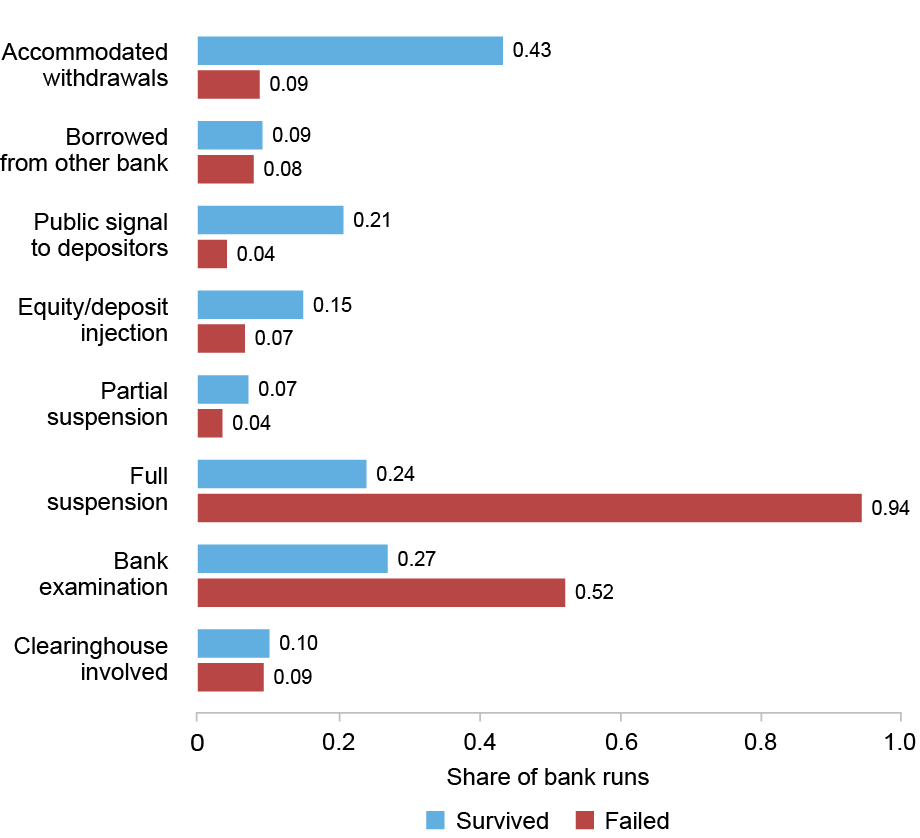
Notes: This chart plots the share of episodes involving a financial institution run during which the newspapers point out one of many listed actions. The shares are reported individually for runs with out and with failures.
Discovering #3: Runs on Weak Banks Result in Considerably Bigger Native Declines in Deposits, Lending, and Manufacturing Exercise than Runs on Sturdy Banks.
To review the actual financial results of runs on the native metropolis degree, we use information on historic native financial exercise constructed from problems with Bradstreet’s from 1917 to 1935. Bradstreet’s was a enterprise journal that offered, amongst different issues, summaries of financial circumstances at a weekly frequency in main cities for numerous sectors, together with manufacturing, retail commerce, and wholesale commerce.
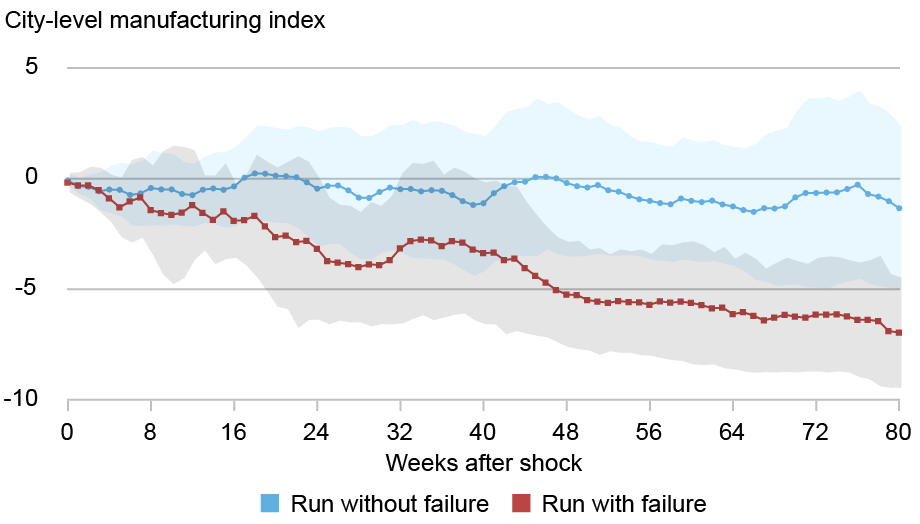
The chart under reveals that runs during which the financial institution fails predict considerably worse declines in native financial exercise than runs with out failure. Runs with out failure don’t lead to considerably decrease manufacturing exercise inside the subsequent eighteen months. In distinction, runs with failure predict a decline in manufacturing exercise of over 5 %. This proof argues towards the view that runs that originate as pure liquidity occasions can generate extreme disruptions in native credit score markets and actual exercise. Runs on robust banks carry restricted adversarial results past the affected banks. As an alternative, the proof signifies that poor fundamentals are needed for runs to generate extreme native monetary disruptions.
The Impact of Financial institution Runs on Native Manufacturing Exercise
Wrapping Up
Our findings lend little help to the view that small shocks by themselves can lead to widespread banking panics that trigger main financial downturns. In distinction, our findings counsel that poor financial institution fundamentals are needed for financial institution runs to translate into failure and for financial institution misery to generate extreme financial misery. Though runs can happen in each weak and powerful banks, poor fundamentals are needed for runs to lead to financial institution failures. Runs ought to thus be seen as a set off for financial institution failures and crises, however bancrupt banks are needed for this set off to devastate the banking system and the financial system.

Sergio Correia is a senior economist on the Federal Reserve Financial institution of Richmond.

Stephan Luck is a monetary analysis advisor within the Federal Reserve Financial institution of New York’s Analysis and Statistics Group.
Emil Verner is the Lemelson Professor of Administration and Monetary Economics and a professor of finance at MIT Sloan College of Administration.
The best way to cite this put up:
Sergio Correia, Stephan Luck, and Emil Verner, “What Do Over 3,000 Financial institution Runs Educate Us About Banking Crises?,” Federal Reserve Financial institution of New York Liberty Road Economics, July 7, 2026, https://doi.org/10.59576/lse.20260707b
BibTeX: View |
perform _toggle_bibtex6(){
let el = doc.getElementById(‘bibtex6’);
el.model.show = el.model.show === ‘none’ ? ” : ‘none’;
}
@article{CorreiaLuckVerner2026,
    writer={Correia, Sergio and Luck, Stephan and Verner, Emil},
    title={What Do Over 3,000 Financial institution Runs Educate Us About Banking Crises?},
    journal={Liberty Road Economics},
    be aware={Liberty Road Economics Weblog},
    quantity={July 7},
    yr={2026},
    url={https://doi.org/10.59576/lse.20260707b}
}
Utilizing AI to Let Historical past Communicate About Financial institution Runs
Financial institution Failures: The Roles of Solvency and Liquidity

Why Do Banks Fail? Financial institution Runs Versus Solvency
Disclaimer
The views expressed on this put up are these of the writer(s) and don’t essentially mirror the place of the Federal Reserve Financial institution of New York or the Federal Reserve System. Any errors or omissions are the accountability of the writer(s).
