
[ad_1]
In igniting a war against Iran on Feb. 28, President Trump billed the U.S. campaign as an unprecedented step toward transforming the Middle East and terminating the threat from what he called a “wicked, radical dictatorship.”
Roughly 100 days later, as the United States and Iran have reached a somewhat vague memorandum of understanding to end the war, skeptics are expressing bafflement over what exactly has transformed.
Neither the war nor the agreement ended what U.S. and Israeli officials regard as the main threats emanating from Iran. The country’s nuclear program, while heavily damaged, was not eliminated — its fate punted to future negotiation.
The same goes for its ballistic missiles, which the deal does not address. Iran’s authoritarian regime endured, albeit with new leaders. Its proxies remain a threat to the region. Israel and Hezbollah, the Iran-backed militia in Lebanon, persisted in attacking each other.
By Saturday, even the most significant immediate result of the deal — Iran’s reopening of the Strait of Hormuz, which Mr. Trump had identified as essential — seemed at risk. Iran’s military said it was closing the waterway again, because the United States had failed to stop the fighting in Lebanon. The U.S. military contested that, saying the strait remained open as the agreement stipulated.
“This is not a document the United States agreed to because the war demonstrated a new U.S. military superiority,” said Caitlin Talmadge, a professor at M.I.T. who specializes in Persian Gulf security issues. “I think it’s a document that has resulted from the fact that the United States bit off more than it could chew and doesn’t want to escalate.”
That’s a worthy goal, she said. “But it really raises the question of what was achieved here, especially in comparison to the original Iran nuclear deal.”
For its part, the Islamic Republic is set to receive potentially substantial financial rewards. That is one substantive change, although not necessarily one in the United States’ favor.
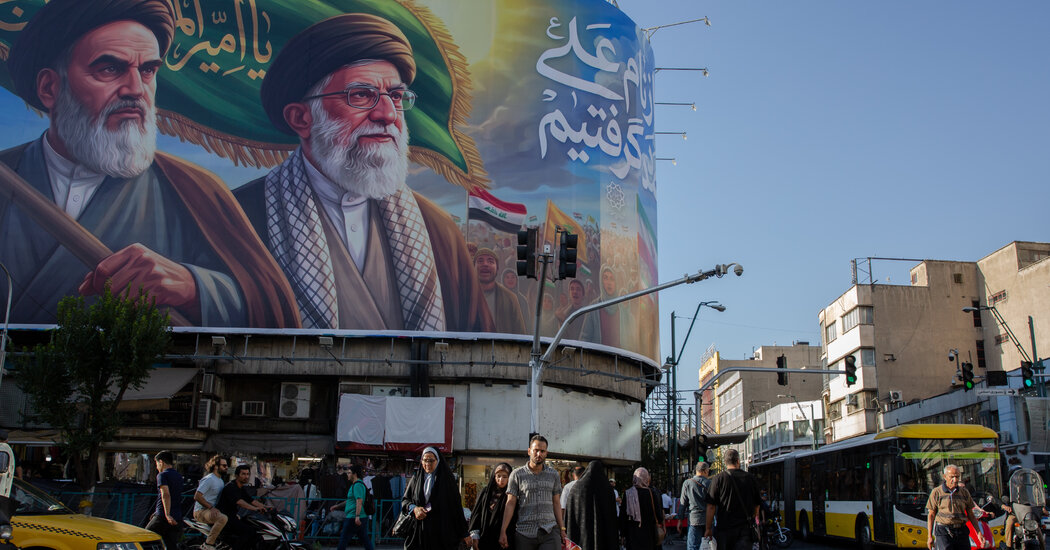
For Tehran, weathering the blistering assaults from the United States and Israel, and demonstrating the ability to retaliate and inflict damage, constituted a victory. Indeed, aside from the Trump administration, the people crowing most about what transpired were core members of Iran’s regime.
Mohammad Bagher Ghalibaf, the speaker of Iran’s parliament and a lead negotiator, hailed a revelation that Iran had taken from the war: that it could exert leverage by controlling the Strait of Hormuz, the crucial transit point for one-fifth of the world’s oil supply.
“This was a potential capacity that had never been activated,” Mr. Ghalibaf said in an interview Wednesday with IRIB, the state broadcaster. “But our enemies — God created them fools — turned that potential into reality.”
Although the memorandum allows for free passage of ships for two months, Tehran has threatened to implement transit fees for services, a system that did not exist before the war.
The heart of the memorandum is that Iran will abandon hostility toward the United States and its regional allies, a pillar of the revolution, in exchange for sweeping, if sometimes gradual, economic benefits. They include the lifting of the American naval blockade, a $300 billion reconstruction fund to be created by the Gulf Arab states, the release of billions of dollars in frozen assets and an end to all American sanctions.
The deal’s ambition, as Vice President JD Vance portrayed it to reporters on Thursday, went so far as the transformation of Iran’s hostile relations with the United States and much of the region since its 1979 revolution.
“People say the Iranians will never change their behavior. Well, maybe that’s true and if so, they don’t get any of the benefits of the bargain,” said Mr. Vance. “But isn’t it worth trying?”
Experts on the region are skeptical. Middle Eastern wars tend to breed more radicalization, not less, said Karim Haggag, director of the Stockholm International Peace Research Institute. “The reality is that the region in the aftermath of this conflict will be much more insecure,” he said.
Here is a look at how the memorandum left various countries:
The United States
Mr. Vance said the agreement maintained U.S. leverage over Iran and that it could turn financial rewards on and off like a spigot. Many experts were doubtful.
It’s true that Mr. Trump broke the American taboo against invading Iran, but in doing so analysts said that he squandered the most powerful tool that Washington had maintained since the Islamic Revolution: the threat of force. The United States used it, and didn’t achieve its goals — a lesson Iran is sure to internalize, analysts said.
In the initial, 12-day war last June, for example, the U.S. military managed to cast a shadow over the long-term viability of Iran’s nuclear program by dispatching long-range bombers to bury nuclear facilities under a mountain of rubble, said Ms. Talmadge of M.I.T.
The more recent war had the opposite effect, she added, since Mr. Trump backed off further escalation. “I think the U.S. in some ways undermined the leverage that it had,” Ms. Talmadge said.
At the same time, Iranian attacks on U.S. military bases in the region caused extensive damage, undermining another facet of American leverage, she said, by puncturing the sense that they were inviolable.
And the memorandum has a further stipulation: that unspecified American forces should withdraw from the “proximity” of Iran within 30 days.
“When did we ever negotiate with the Iranians about our force deployments going forward?” asked Robert S. Ford, a former American ambassador in the region.
Iran
The war wrought widespread devastation, with a reported death toll of 1,700 civilians. Iran’s supreme leader, Ayatollah Ali Khamenei, was killed along with dozens of senior military commanders, and its air defenses proved porous. Reconstructing military and industrial infrastructure will cost hundreds of billions of dollars. Inflation is skyrocketing, and high unemployment could fuel public unrest.
But the government’s tenacity served to “reinvigorate Iran’s perception of its own security,” said Afshon Ostovar, author of “Wars of Ambition: The United States, Iran, and the Struggle for the Middle East.”
The idea that it will trade its hostility toward the United States and its allies for improved prosperity is a gamble, since it had almost always chosen confrontation previously, analysts said.
Israel
Israel entered the war convinced that it would defang Iran for at least a generation.
Instead it found itself sidelined by its ally, the United States, in an agreement that ignored its goals, and worse, limited its freedom to attack in Lebanon. Mr. Trump has also repeatedly disparaged Prime Minister Benjamin Netanyahu, revealing rare disunity in American-Israeli relations at a fraught moment, with Israeli elections approaching.
From an Israeli standpoint, the memorandum is a catastrophe. “It is a collapse of all the strategy that we had regarding Iran,” said Danny Citrinowicz, a retired Israeli intelligence officer who specializes in Iran.
Lebanon
Lebanon is considered by analysts to be the soft underbelly of the memorandum.
Hezbollah had alienated many of its mostly Shiite Muslim supporters by dragging the country into two devastating wars — one in support of Hamas in Gaza and the other when Israel attacked Iran. The violence has left thousands of people dead, including almost 4,000 civilians this year, according to the health ministry.
Lack of financial support from Iran for reconstruction augmented public anger. But Iran’s Islamic Revolutionary Guards Corps is working assiduously to restore Hezbollah’s military capacity, analysts said, and some of the money promised to Tehran for reconstruction could flow to the militia. That gives Hezbollah incentive to respect the agreement.
Both Mr. Trump and Mr. Vance have acknowledged that some violence in Lebanon is likely to continue, but it is not clear how much it would take to trigger a strong American intervention.
The Gulf
The six Arab Gulf states hoped in vain to remain bystanders in the longstanding duel between Israel and Iran. Instead, Iran’s closure of the strait and attacks on their oil infrastructure brought economic turmoil.
Although American interceptors prevented the worst damage, the war has forced Gulf states to rethink their dependence on the United States for security.
Now, there is talk of a “golden bridge” to Iran: mutual investments that were impossible under sanctions. “We can benefit from one another, intertwine interests, to make the cost of returning to war higher,” said Bader Al-Saif, a historian at Kuwait University. “If I have an Iranian plant in Kuwait City, they’re going to think twice before hitting us, right?”
Overall, though, the memorandum itself was widely seen as encompassing minimal concrete change.
“I’m skeptical that much progress will be made on the nuclear issue now that the U.S. has removed the main leverage that it has,” said Paul Salem, a Middle East analyst, speaking at the Center for Strategic and International Studies in Washington. “So in a way, this deal is a bit of a nothing burger at the end of this very long and devastating war.”
Shirin Hakim contributed reporting.
[ad_2]
Source link
